Category: AI & Machine Learning

Explore the latest in AI and machine learning—real-world applications, top tools, frameworks, and innovations driving the future of intelligent systems.

  • Agentic AI ROI: Measuring Autonomous Workflow Value

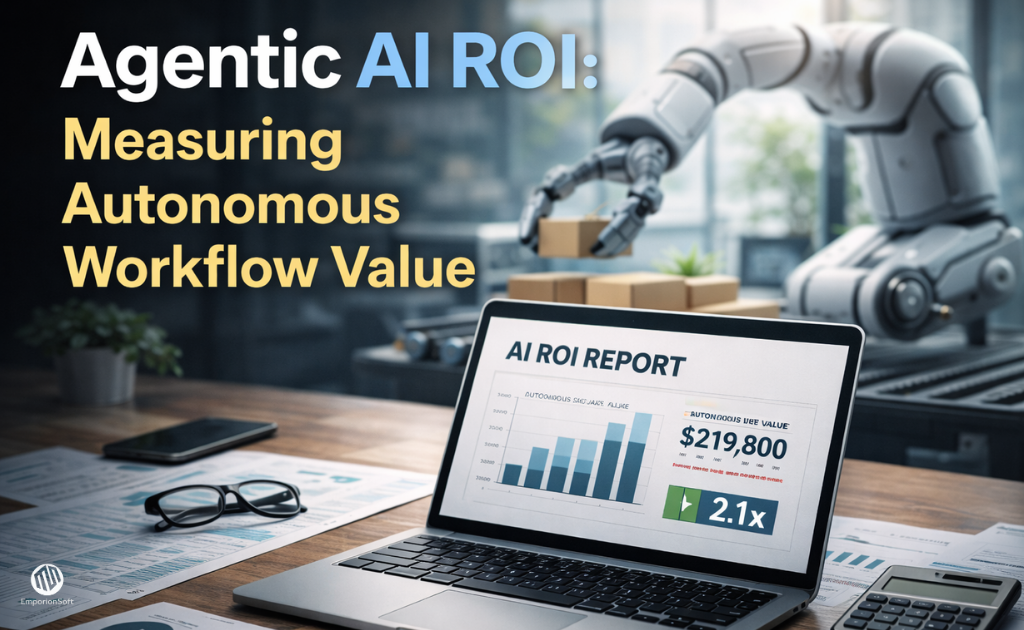
    Agentic AI ROI: Measuring Autonomous Workflow Value

    From Systems of Record to Systems of Action: Why Agentic AI Changes the ROI Conversation

    For decades, enterprise technology investment centred on systems of record. These platforms store transactions, customer data, inventory movements, and financial history. They improved accuracy, compliance, and reporting. Their return on investment was typically calculated through efficiency gains, headcount reduction, or reduced error rates.

    Agentic AI introduces a structural shift. Instead of merely storing and presenting information, autonomous agents interpret context, make decisions within defined boundaries, and execute workflows across systems. This transition from systems of record to systems of action reshapes how leaders must evaluate Agentic AI ROI.

    Traditional ROI models assume technology supports human decision-making. Agentic systems compress or eliminate the decision layer for repeatable workflows. An AI agent does not simply highlight anomalies in supply chain data. It can reorder stock, renegotiate pricing thresholds, or reroute logistics based on predefined objectives. The economic effect is not limited to labour savings. It alters the speed, scale, and consistency of execution.

    This distinction is critical. In a conventional architecture, data flows into dashboards. Human operators interpret those dashboards and act. In a system of action, data triggers autonomous execution—the measurable value shifts from insight generation to outcome delivery.

    Many organisations still evaluate AI initiatives using conventional technology ROI metrics. These frameworks often focus on cost savings or automation percentages. As discussed in technology ROI metrics frameworks, financial evaluation must align with the nature of the capability being deployed. When the capability executes decisions rather than supports them, the evaluation criteria must evolve.

    Agentic AI ROI should account for decision velocity. Faster execution reduces cycle times in sales, operations, procurement, and customer service. Time compression has economic value. Revenue can be recognised earlier. Customer churn can be prevented before escalation. Operational bottlenecks can be resolved before cascading failures occur.

    There is also the compounding effect of autonomous workflow value. Once agents are orchestrated across multiple systems, improvements accumulate across the organisation. A single optimisation may be incremental. A network of coordinated agents creates systemic leverage. This compounding effect is rarely captured in static ROI models.

    From an architectural perspective, this shift requires rethinking enterprise design. Systems of action demand event-driven coordination, API connectivity, and governance structures that support autonomous execution. These considerations are explored in enterprise architecture patterns, which highlight how structural design decisions influence long-term scalability.

    The business impact of AI agents is therefore multi-dimensional. It includes operational cost reduction, but also resilience, adaptability, and strategic responsiveness. When market conditions shift, autonomous workflows can recalibrate faster than human-dependent processes.

    For startup founders and SME owners, this matters because competitive advantage increasingly depends on execution speed rather than information access. For CTOs and engineering leaders, it raises architectural and governance questions. For product leaders, it reframes how digital capabilities are positioned within the organisation.

    Agentic AI ROI is not simply about replacing tasks. It is about shifting from passive information systems to active execution infrastructure. That transition changes how value is generated, measured, and sustained over time.


    Defining Agentic AI ROI: What Should Actually Be Measured

    If autonomous systems execute workflows rather than merely inform decisions, the definition of return on investment must expand accordingly. Agentic AI ROI cannot be reduced to headcount savings or automation percentages. It must reflect how autonomous agents alter economic throughput across the organisation.

    Most businesses still evaluate technology through a cost reduction lens. This approach is incomplete. As outlined in technology ROI metrics frameworks, meaningful evaluation requires alignment between capability and strategic objective. Agentic AI introduces capabilities that change speed, consistency, and opportunity capture. These effects require different measurement dimensions.

    The first distinction is between direct and indirect ROI.

    Direct ROI includes measurable cost reductions. Examples include lower operational labour, fewer manual interventions, reduced processing time, and decreased error rates. These metrics are straightforward and often form the basis of initial investment justification.

    Indirect ROI is more subtle, but often more significant. Autonomous agents compress decision cycles. When procurement approval time reduces from days to minutes, working capital efficiency improves. When customer support triage becomes autonomous, response time shortens and retention increases. These effects compound over time, even if they are harder to isolate in quarterly reports.

    Time compression should be treated as an economic variable. Faster execution translates into earlier revenue recognition, improved customer experience, and lower exposure to volatility. In high-growth startups, reducing operational latency may influence valuation multiples more than incremental cost savings.

    Another critical variable is error reduction and risk mitigation. Human workflows are prone to inconsistency. Autonomous agents operate within defined constraints and maintain execution discipline. Fewer compliance breaches, reduced billing discrepancies, and lower operational leakage contribute directly to margin stability. These gains may not appear dramatic individually, but their cumulative effect can materially influence profitability.

    Opportunity cost reduction is equally important. When skilled employees spend less time on repetitive coordination tasks, they can focus on strategy, product innovation, or customer development. This redeployment of cognitive capacity is difficult to quantify, yet it often generates outsized long-term value.

    Revenue acceleration should also be measured explicitly. AI agents can trigger upsell workflows, optimise pricing dynamically, or personalise engagement sequences at scale. These activities expand top-line growth rather than merely reducing expenses. In many cases, this is where the real business impact of AI agents becomes visible.

    Traditional cost-benefit spreadsheets struggle to capture these dynamics. They assume linear cause and effect relationships. Autonomous workflow value, however, is networked and compounding. A single workflow improvement may appear incremental. When orchestrated across finance, operations, sales, and customer support, the aggregate impact becomes structural.

    There is also a strategic dimension. Organisations that embed systems of action develop institutional learning loops. Agents improve based on feedback signals. Over time, performance gains widen relative to competitors who rely solely on human coordination.

    For founders and SME leaders, the practical implication is clear. Agentic AI ROI must be framed across multiple axes: cost efficiency, time compression, risk mitigation, revenue expansion, and strategic agility. CTOs and product leaders must design measurement systems that reflect these dimensions.

    Only by expanding the definition of ROI can organisations accurately evaluate the business case for autonomous workflow orchestration. Anything narrower risks underestimating the true economic value of agentic systems.


    Cost Structures and Operational Constraints in Autonomous Workflow Orchestration

    Understanding Agentic AI ROI requires a clear view of cost architecture. Autonomous workflow orchestration is not a single line item. It is a layered capability built across models, infrastructure, integration, and governance.

    At the most visible level are model usage costs. These include API consumption fees, inference compute, and fine-tuning overhead where applicable. For high-frequency workflows, usage can scale rapidly. A customer service agent handling thousands of interactions per day carries a different cost profile than a strategic planning assistant used weekly. Without usage modelling, projected ROI can be distorted.

    Infrastructure costs form the next layer. Autonomous systems require orchestration engines, event routing, secure API gateways, logging pipelines, and observability stacks. Decisions do not execute in isolation. They traverse microservices, databases, and external platforms. Architectural decisions around cloud deployment, multi-region redundancy, and hybrid environments significantly influence operating expenditure. These trade-offs are explored in hybrid cloud strategies, where cost, resilience, and flexibility intersect.

    Integration complexity often represents the most underestimated constraint. Agentic systems must interact with legacy platforms, ERP systems, CRMs, finance tools, and custom internal applications. Poor API design or fragmented data schemas increase integration overhead. This is where scalable API architecture becomes central, as discussed in scalable APIs for SaaS platforms. Without clean integration layers, autonomous workflow value is limited by technical friction.

    There is also the orchestration layer itself. Agent coordination requires task routing logic, memory persistence, and guardrails. These systems introduce additional engineering and maintenance effort. Over time, poorly designed orchestration logic can accumulate complexity similar to traditional technical debt. The long-term impact of unmanaged complexity is addressed in the technical debt explained, which highlights how hidden structural issues erode returns.

    Observability and monitoring costs must also be considered. Autonomous agents require continuous logging, anomaly detection, performance evaluation, and audit trails. These are not optional. Without monitoring, error propagation can scale faster than human review cycles. Investment in monitoring tools increases short-term cost but protects long-term ROI by reducing systemic risk.

    Human oversight remains a structural component. Even advanced agentic systems operate within defined autonomy thresholds. Subject matter experts must define constraints, validate outputs, and adjust policies. In practice, this creates a blended cost model rather than full labour elimination. Organisations that assume zero oversight frequently underestimate operating expenses.

    Capital expenditure versus operational expenditure dynamics vary by implementation model. Some businesses invest heavily upfront in custom orchestration layers and internal tooling. Others rely on managed services with recurring subscription models. For SMEs and startups, subscription-heavy models may reduce initial risk but increase long-term variable costs. Enterprise-scale organisations may prefer greater capital investment for predictable cost control at scale.

    Finally, scaling introduces nonlinear cost behaviour. What functions efficiently at pilot scale may generate unexpected latency, model consumption spikes, or integration bottlenecks under production load. Infrastructure elasticity and architectural modularity become critical variables.

    Agentic AI ROI, therefore, depends on disciplined cost modelling across these layers. Autonomous workflow value cannot be assessed purely through feature comparison. It must be evaluated through infrastructure resilience, integration maturity, and operational sustainability. For founders and technology leaders, this means treating agentic systems not as isolated tools but as structural components of enterprise architecture.


    Risk, Governance, and the Hidden Costs of Autonomous AI Agents

    Agentic AI ROI is directly influenced by how risk is managed. Autonomous agents execute decisions. When those decisions operate across financial systems, customer data, or operational infrastructure, governance becomes an economic variable rather than a compliance formality.

    Unmanaged risk reduces return. In extreme cases, it eliminates it.

    The first dimension is decision accountability. When an AI agent approves a transaction, modifies pricing, or triggers a workflow escalation, responsibility must remain clearly defined. Without structured oversight and audit trails, organisations expose themselves to regulatory and reputational consequences. Governance frameworks are not abstract theory. They directly protect ROI by preventing costly failure events. Practical guidance on structuring responsible AI deployment is outlined in AI governance for SMEs.

    Data privacy exposure is equally critical. Autonomous systems often require access to customer records, financial transactions, behavioural signals, and operational data streams. Poor access control or insufficient data segmentation increases vulnerability. Regulatory penalties, customer trust erosion, and legal remediation costs quickly offset operational gains. Foundational safeguards are discussed in data privacy frameworks for modern systems, where privacy architecture is treated as a strategic design requirement.

    Model drift presents another hidden cost. Autonomous agents rely on patterns and context. As business environments evolve, decision quality may degrade. Pricing logic may become outdated. Fraud detection thresholds may become misaligned. Without continuous evaluation loops, performance declines gradually and invisibly. This erosion reduces autonomous workflow value over time.

    Security vulnerabilities expand with autonomy. Each integration endpoint, API connection, and orchestration layer increases the attack surface. When agents can execute actions automatically, compromised credentials or exploited logic can cause rapid systemic damage. Secure development and operational discipline become core to protecting long-term ROI. For smaller teams, structured practices are covered in DevSecOps for small teams, where security is embedded into development rather than added retrospectively.

    There is also a governance cost associated with explainability. Decision transparency matters for regulators, partners, and internal stakeholders. If a credit approval agent declines an application or a logistics agent reroutes inventory, leaders must understand why. Systems that lack explainability increase friction and reduce executive confidence, limiting adoption.

    Importantly, governance is not a constraint on innovation. It is a multiplier of sustainable value. When risk controls are embedded into architecture from the outset, organisations gain the confidence to scale autonomy further. This confidence directly influences capital allocation decisions and expansion strategy.

    For founders and SME leaders, the practical implication is clear. Agentic AI ROI calculations must include risk-adjusted projections. The question is not simply how much cost can be removed, but how resilient the system remains under stress.

    For CTOs and engineering leaders, governance requires deliberate structural decisions. Clear permission models, audit logging, anomaly detection, and layered approval thresholds should be designed into orchestration logic. Reactive controls are rarely sufficient once autonomous workflows are in production.

    Autonomous agents amplify both efficiency and exposure. Without governance discipline, hidden risks accumulate. With structured oversight, risk becomes controlled and predictable, enabling compounding returns.

    Agentic AI ROI, therefore, depends as much on responsible execution as on technological capability. Sustainable value emerges when autonomy and accountability scale together.


    Building a Strategic Framework to Evaluate Autonomous Workflow Value

    Agentic AI ROI cannot be assessed through isolated pilot metrics. It requires a structured evaluation framework that connects workflow suitability, economic impact, architectural readiness, and long-term strategic alignment.

    The first step is workflow suitability assessment. Not every process benefits equally from autonomous execution. High-volume, rule-constrained, repeatable workflows with measurable outcomes are strong candidates. Strategic, ambiguous, or low-frequency decisions often require human oversight. Mapping workflows across complexity, variability, and risk exposure creates clarity around where autonomous workflow value is most realistic.

    Next is autonomy gradient scoring. Autonomy is not binary. It exists along a spectrum from decision support to full execution authority. A structured scoring model should assess the degree of autonomy appropriate for each workflow. Early-stage implementations may focus on assisted execution, where agents recommend actions but require confirmation. As confidence and governance maturity increase, autonomy thresholds can expand.

    Economic impact modelling follows. This requires quantifying cost reduction, time compression, risk mitigation, and revenue acceleration in combination. Rather than treating these variables independently, they should be layered into a composite projection. For example, reducing procurement cycle time improves working capital efficiency while also lowering supplier risk exposure. The economic impact is multidimensional.

    Risk-adjusted ROI projection is equally important. Governance, security controls, and oversight mechanisms introduce cost. These investments must be incorporated into financial modelling rather than treated as afterthoughts. Practical approaches to structuring AI investment within a broader transformation roadmap are outlined in the AI roadmap for small businesses, where sequencing and capability maturity are central considerations.

    Time-to-value mapping completes the framework. Autonomous systems rarely deliver full ROI immediately. Initial pilots produce learning signals. Controlled expansion phases deliver measurable efficiency gains. Scaled orchestration across departments generates structural impact. Clear milestones aligned with measurable outcomes reduce investment uncertainty.

    Enterprise architecture alignment underpins all of this. Autonomous workflow orchestration requires event-driven integration, API maturity, and modular service design. If foundational architecture is fragmented, ROI projections may be unrealistic. Structural considerations are discussed in enterprise architecture patterns, where long-term scalability is treated as a strategic asset.

    There is also a build versus partner decision embedded within the evaluation. Some organisations may develop orchestration infrastructure internally. Others may collaborate with specialist partners to accelerate maturity. A structured decision model, such as the build vs buy framework, provides clarity when determining where to allocate internal resources.

    For startup founders and SME owners, this framework prevents reactive experimentation. For CTOs and product leaders, it ensures alignment between business strategy and technical capability. Autonomous workflow value becomes measurable when evaluated through a disciplined lens rather than enthusiasm.

    Agentic AI ROI is ultimately a strategic calculation. It depends not only on technological potential but on structural readiness, governance maturity, and economic modelling discipline. A clear framework transforms autonomous AI from an experimental initiative into a deliberate enterprise capability.


    Architectural Patterns That Enable Measurable Business Impact from AI Agents

    Agentic AI ROI is strongly determined by architecture. Autonomous agents may demonstrate impressive capability in isolation, yet fail to generate sustained business impact if the surrounding systems are fragmented or brittle. Structural design decisions influence scalability, observability, and long-term cost control.

    Event-driven architecture is foundational. Autonomous workflows respond to triggers rather than static requests. Inventory changes, customer actions, payment confirmations, or operational anomalies generate events that initiate decision flows. When systems publish and subscribe to events in a structured manner, agents can operate across departments without tightly coupled integrations. This flexibility reduces integration overhead and accelerates expansion.

    API-first design is equally critical. AI agents require reliable, secure, and well-documented interfaces to execute actions. Poorly designed APIs create latency, increase failure rates, and restrict orchestration scope. Clean interface contracts enable agents to interact with finance systems, CRMs, logistics platforms, and internal services consistently. Long-term scalability considerations around API architecture are explored in scalable APIs for SaaS platforms, where extensibility and resilience are treated as strategic priorities.

    Modular service design supports adaptability. Autonomous systems evolve. New workflows emerge. Regulatory requirements shift. A modular architecture allows individual services to be updated without destabilising the entire ecosystem. When services are decoupled, agents can be reconfigured or replaced without large-scale system rewrites. Architectural trade-offs between distributed models are examined in microservices vs serverless, highlighting how scalability and operational complexity interact.

    Observability is another structural requirement. Autonomous execution must be transparent. Logging, tracing, and performance monitoring enable organisations to measure agent effectiveness, detect drift, and identify anomalies. Without structured observability, ROI cannot be validated with confidence. Leaders need measurable indicators of throughput improvement, latency reduction, and error containment.

    Data consistency also shapes business impact. Agents rely on accurate, timely information. Fragmented data schemas or duplicated records reduce decision reliability. Unified data pipelines and controlled data governance ensure that autonomous actions reflect the current operational reality.

    Technical debt can quietly erode Agentic AI ROI. Rapid prototyping without architectural discipline introduces hidden complexity. Over time, maintenance effort increases and agility declines. The long-term consequences of unmanaged structural complexity are detailed in technical debt explained, where incremental shortcuts accumulate into systemic constraints.

    Security architecture intersects directly with business impact. Agents that operate across payment systems, user accounts, or operational controls must function within robust permission models. Fine-grained access control, encryption standards, and anomaly detection mechanisms protect against unintended execution. Security is not a peripheral concern. It is central to preserving sustainable value.

    For CTOs and engineering leaders, the implication is clear. Agentic AI ROI is inseparable from architectural maturity—autonomous workflow value scales only when systems are interoperable, observable, and resilient.

    For founders and product leaders, this translates into strategic sequencing. Before scaling autonomy, foundational architecture must support expansion without exponential complexity growth.

    Autonomous agents can amplify efficiency and revenue, but architecture determines whether that amplification is stable or fragile. Sustainable business impact emerges when technical structure aligns with long-term strategic objectives.


    Execution Model: Phased Implementation, Metrics, and Continuous Optimisation

    Agentic AI ROI is not realised through a single deployment milestone. It emerges through disciplined execution, measured expansion, and structured feedback loops. Autonomous workflow orchestration should be treated as a staged capability rather than a one-time implementation.

    The first stage is the pilot phase. This stage focuses on a clearly bounded workflow with measurable outputs. The objective is not scale. It is validation. Leaders should select a process where success metrics are transparent, such as response time reduction, processing accuracy improvement, or approval cycle compression. Controlled experimentation reduces exposure while generating empirical data.

    During this phase, baseline metrics must be captured before agent deployment. Without a reference point, ROI cannot be assessed objectively. Structured experimentation approaches, similar to those described in the beta testing guide for digital systems, provide a disciplined foundation for performance comparison.

    The second stage is controlled autonomy. In this phase, agents operate with limited execution authority under defined guardrails. Human oversight remains active, but intervention becomes exception-based rather than routine. Metrics should expand beyond cost savings to include latency reduction, error variance, and workload redistribution.

    Cross-functional alignment is essential here. Product, engineering, compliance, and operations teams must share visibility into performance indicators. Transparent dashboards and audit logs increase confidence and accelerate learning cycles.

    The third stage is scaling. At this point, orchestration expands across multiple workflows or departments. Integration complexity increases, and coordination between agents may become necessary. Clear KPI alignment prevents fragmentation. Each additional workflow should map back to defined economic variables such as margin improvement, revenue acceleration, or risk containment.

    Case-based evidence can strengthen decision-making at this stage. Reviewing structured transformation examples through documented case studies provides insight into sequencing and organisational readiness.

    Continuous optimisation becomes the dominant activity once scale is achieved. Autonomous systems must be monitored for drift, performance variance, and behavioural anomalies. Feedback loops should be institutionalised. This includes periodic policy refinement, retraining cycles where applicable, and structured performance reviews.

    Financial metrics must also evolve. Early ROI calculations may emphasise operational savings. At scale, metrics should incorporate capital efficiency, opportunity capture, and resilience indicators. Adjusting measurement models ensures alignment with strategic outcomes.

    Governance must scale alongside capability. Oversight mechanisms should be refined as autonomy thresholds increase. Controlled escalation pathways prevent systemic failure while preserving efficiency gains.

    Finally, leadership alignment determines sustainability. Agentic AI ROI depends on cultural readiness as much as technical execution. Teams must trust structured automation while retaining accountability for outcomes. Transparent communication reduces resistance and accelerates adoption.

    For founders and SME leaders, phased execution reduces risk while preserving ambition. For CTOs and product leaders, structured rollout prevents architectural overload and misaligned incentives.

    Agentic AI is not a feature. It is an operational layer. Measurable return emerges when implementation is sequenced, monitored, and continuously refined rather than rushed toward scale.


    Strategic Outlook: Turning Agentic AI ROI into Long-Term Enterprise Advantage

    Agentic AI ROI should not be treated as a short-term efficiency project. Autonomous workflow orchestration represents a structural shift in how organisations operate. When implemented with architectural discipline and governance maturity, it becomes a long-term competitive capability rather than a tactical optimisation.

    The first strategic dimension is execution advantage. Organisations that embed systems of action into core workflows reduce operational latency across departments. Decisions move faster. Coordination overhead declines. This creates a measurable gap between firms that rely on manual orchestration and those that operate through autonomous execution layers. Over time, that gap compounds.

    The second dimension is organisational capability building. Agentic systems generate structured data about decisions, outcomes, and performance variance. This creates institutional learning loops. Patterns become visible. Inefficiencies are surfaced earlier. Continuous optimisation becomes embedded in daily operations rather than dependent on periodic transformation initiatives. Insight transitions from reactive reporting to proactive adjustment.

    Capital efficiency is another long-term effect. Autonomous agents enable growth without proportional headcount expansion. This does not eliminate the need for skilled employees. Instead, it shifts human focus toward strategic activities. Product innovation, partnership development, and market expansion become higher leverage uses of talent. When growth does not require linear cost expansion, margin resilience improves.

    Strategic flexibility also increases. In volatile markets, speed of adaptation determines survival. Agentic systems can recalibrate pricing logic, inventory thresholds, customer segmentation rules, and operational routing faster than manual processes allow. This responsiveness reduces exposure to external shocks.

    Importantly, sustainable advantage depends on structured governance and architecture. Organisations that treat autonomy as infrastructure, rather than experimentation, build stronger foundations. The broader transformation context is explored through EmporionSoft insights, where long-term technology strategy is positioned as an executive decision rather than a technical initiative.

    Leadership mindset becomes central. Agentic AI ROI is not simply calculated through spreadsheets. It reflects a deliberate shift in how value is created and delivered. Founders and SME owners must decide whether autonomy aligns with their growth trajectory. CTOs and product leaders must evaluate architectural readiness and governance capacity.

    When these elements align, autonomous workflow value compounds. Execution becomes faster, more consistent, and less dependent on individual bandwidth. Competitive differentiation moves from isolated product features to operational excellence embedded across systems.

    For organisations evaluating next steps, the priority is not immediate scale but structured progression. A clear roadmap, aligned metrics, and disciplined governance create the conditions for sustainable return.

    EmporionSoft works with SMEs, startups, and enterprise teams to translate complex technologies into measurable business outcomes. Strategic consultation can clarify where autonomous orchestration delivers real advantage and where restraint is appropriate. Leaders seeking long-term, resilient growth can explore tailored guidance through EmporionSoft services or initiate a structured discussion by contacting us.

    Agentic AI ROI ultimately reflects a leadership choice. When autonomy is integrated thoughtfully into enterprise design, it becomes a durable source of operational and strategic strength rather than a passing technology trend.
  • AI Governance: Rules Every SME Must Follow in 2026

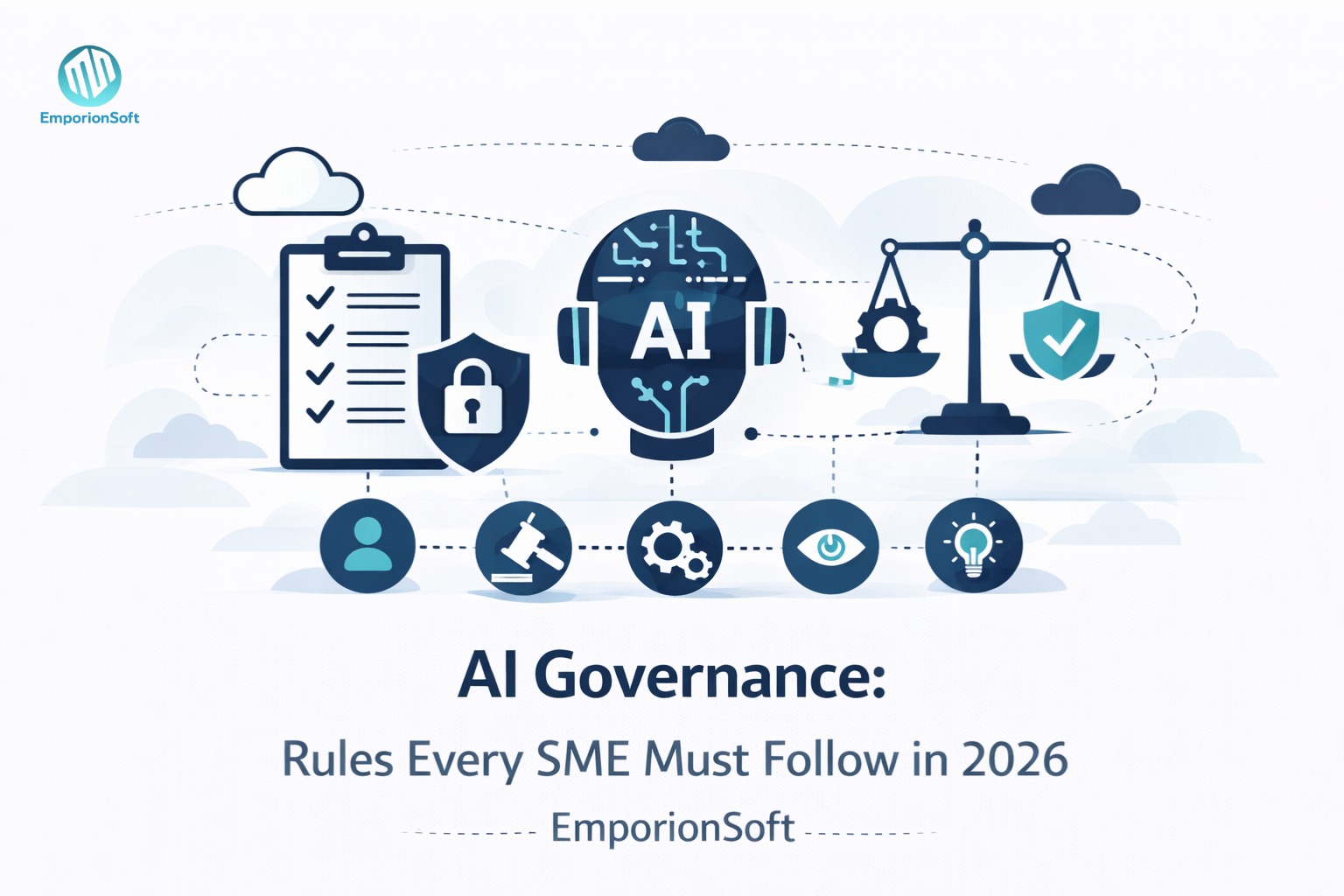
    AI Governance: Rules Every SME Must Follow in 2026

    AI Is Moving Faster Than SME Governance Can Keep Up

    Small and medium-sized enterprises are adopting artificial intelligence at a pace that would have seemed unrealistic just three years ago. AI tools now write marketing copy, screen CVs, forecast demand, personalise pricing, and automate customer support. For many SMEs, this adoption has happened organically, driven by efficiency gains rather than long-term planning.

    The problem is that governance has not kept pace. In many organisations, AI systems are already influencing decisions before anyone has defined who is accountable for their outcomes. This growing gap explains why AI governance for SMEs has shifted from a future discussion to an immediate business concern.

    AI no longer sits at the edge of operations. It is becoming embedded in workflows that affect customers, employees, and financial outcomes. When AI decisions go wrong, SMEs feel the impact faster and more directly than large enterprises.


    Why AI Governance for SMEs Is Now a Board-Level Issue

    AI governance was once framed as a concern for global corporations with legal departments and compliance teams. That assumption no longer holds. Regulators, customers, and partners increasingly expect all businesses using AI to demonstrate responsible oversight.

    For SMEs, the challenge is amplified by limited resources. Lean teams rarely have dedicated risk or compliance roles. Legal advice is often reactive rather than proactive. Yet the expectations around AI accountability do not scale down simply because a business is smaller.

    AI governance for SMEs is no longer about theoretical risk. It is about operational credibility. Businesses must be able to explain how AI systems make decisions, what data they rely on, and who is responsible when outcomes are challenged.


    Regulatory Pressure Is Reaching Smaller Businesses

    AI regulation is evolving rapidly across major markets. While enforcement initially focused on large technology providers, attention is now shifting towards users of AI systems, including SMEs. The direction is clear: accountability follows usage, not company size.

    This creates a new reality for small enterprises. Even when AI tools are purchased off the shelf, responsibility for their application remains with the business. Regulators are increasingly concerned with how AI outputs affect individuals, whether through automated decisions, profiling, or data processing.

    For SMEs operating internationally or working with enterprise clients, regulatory expectations are even higher. Many procurement processes already require evidence of AI oversight policies. Businesses without clear governance risk exclusion from contracts before any formal penalty is applied.


    Customer Trust Depends on Responsible AI Use

    Trust has always been a fragile asset for SMEs. Unlike global brands, smaller businesses cannot absorb reputational damage at scale. AI introduces new trust dynamics that many SMEs underestimate.

    Customers want to know when AI is involved in decisions that affect them. They expect fairness, transparency, and recourse if outcomes feel wrong. Silent automation without accountability undermines confidence quickly, especially in regulated or customer-facing industries.

    Responsible AI is no longer a branding choice. It is a trust requirement. SMEs that fail to demonstrate basic AI oversight risk appearing careless, even when intentions are good. This erosion of trust can be far more damaging than short-term efficiency gains.


    Data Responsibility and AI Accountability Are Converging

    AI systems are only as reliable as the data they consume. For SMEs, data is often fragmented across tools, spreadsheets, and third-party platforms. When AI models draw from inconsistent or poorly governed data, accountability becomes blurred.

    Questions arise quickly. Who approved the data source? Who validates model outputs? Who is responsible if an automated recommendation causes harm or loss? Without governance, these questions have no clear answers.

    AI accountability is becoming inseparable from data responsibility. SMEs must recognise that delegating decisions to machines does not remove human responsibility. It simply changes where oversight must sit.


    The SME Reality: Speed First, Structure Later

    Most SMEs did not plan to become AI-driven organisations. Adoption often began with a single tool solving a narrow problem. Over time, these tools multiplied, creating invisible dependencies across the business.

    This pattern is understandable. SMEs prioritise speed, experimentation, and survival. However, as AI becomes embedded in core processes, the lack of governance creates hidden risk. What started as productivity support quietly turns into decision authority.

    In markets where AI adoption is accelerating rapidly, including regions discussed in EmporionSoft’s analysis of https://blogs.emporionsoft.com/ai-adoption-in-pakistan/, this tension between speed and structure is becoming more pronounced. SMEs must now confront the consequences of ungoverned AI use, whether they are ready or not.

    Enterprise AI Governance vs What SMEs Actually Need

    Enterprise AI governance is often described in dense policy documents, steering committees, and layered approval processes. That model assumes large teams, specialist roles, and time to manage complexity. Most SMEs operate in a very different reality.

    For small and medium-sized businesses, governance must be practical, lightweight, and directly connected to daily operations. The goal is not to replicate enterprise bureaucracy. It is to ensure AI is used responsibly, predictably, and in a way the business can defend if challenged.

    This distinction matters. When SMEs hear “governance,” they often imagine red tape. In practice, effective AI governance for smaller organisations is about clarity, not control.


    What AI Governance Really Means for Small Businesses

    At its core, AI governance is about how decisions involving AI are made, monitored, and owned. It defines who is responsible, what rules apply, and how issues are handled when something goes wrong.

    For SMEs, governance does not mean slowing innovation. It means putting basic guardrails around systems that already influence outcomes. These guardrails help leaders stay in control rather than reacting after damage is done.

    An AI governance framework for small businesses focuses on four essentials: clear policies, defined ownership, ongoing oversight, and accountability. None of these require complex documentation. They require agreement and consistency.


    Policies: Setting Boundaries Without Blocking Progress

    Policies are simply written expectations. They describe where AI can be used, where it cannot, and what standards apply to its outputs. In an SME context, policies should be short, clear, and easy to follow.

    Good policies answer practical questions. Can AI generate customer-facing content without review? Can it influence pricing or eligibility decisions? What data is acceptable for training or prompting models?

    These rules help teams move faster with confidence. Instead of debating each use case, employees understand the boundaries. This reduces risk while preserving agility.


    Ownership: Someone Must Be Accountable

    One of the biggest gaps in SME AI adoption is unclear ownership. AI systems are often introduced by one team but affect many others. When responsibility is shared informally, accountability disappears.

    Effective governance assigns ownership clearly. This does not require a new role. It requires naming who is responsible for AI behaviour in each business area. That person becomes the point of escalation when issues arise.

    Ownership ensures decisions are intentional. It also protects the business by making accountability visible, both internally and externally.


    Oversight: Monitoring Without Micromanagement

    Oversight is not about watching every AI output. It is about regular review and awareness. SMEs need simple ways to check whether AI systems behave as expected over time.

    This includes monitoring accuracy, consistency, and unintended consequences. Oversight should be periodic and focused, not continuous and burdensome. The aim is early detection of problems, not perfect control.

    Clear SME AI oversight policies define how often reviews happen and what triggers deeper investigation. This keeps AI aligned with business goals as conditions change.


    Accountability: Humans Remain Responsible

    AI can recommend, generate, and predict. It cannot accept responsibility. Accountability always sits with people.

    For SMEs, this principle is critical. Governance ensures that AI supports decisions rather than replaces judgement. When outcomes are questioned, the business can explain how and why AI was involved.

    This approach strengthens trust with customers and partners. It also reinforces internal confidence in AI adoption, reducing fear of hidden risks.


    Governance as an Operational Asset

    When implemented pragmatically, AI governance becomes an enabler rather than a constraint. It gives leaders visibility into how AI shapes outcomes and confidence to scale its use responsibly.

    As discussed in EmporionSoft’s exploration of how AI is reshaping development practices (https://blogs.emporionsoft.com/how-ai-is-revolutionizing-software-development/), clarity around responsibility is what allows innovation to grow sustainably. For SMEs, governance is not about control. It is about staying in charge as AI becomes part of everyday work.

    Governance Before Optimisation: Why Structure Comes First

    Many SMEs approach AI the same way they approach most technology decisions: optimise first, govern later. The logic is understandable. Early wins create momentum, and AI promises immediate gains. However, without structure, optimisation amplifies risk rather than value.

    AI governance is not something to bolt on once systems scale. It must be embedded early, before AI decisions become deeply woven into operations. This mindset shift is essential when thinking about how to build AI governance for SMEs in a sustainable way.

    Governance provides the foundation that allows AI to evolve safely. Without it, even well-intentioned use cases can create long-term fragility.


    Ownership and Accountability: Defining Who Is Responsible

    The first pillar of any effective AI governance framework is ownership. AI systems rarely belong to a single function. They influence marketing, operations, finance, and customer experience simultaneously.

    SMEs must decide who owns AI outcomes, not just implementation. Ownership does not mean technical control. It means accountability for how AI affects decisions and people.

    Clear accountability answers practical questions. Who approves changes to AI behaviour? Who responds if outputs are challenged? Who decides when AI should be paused or adjusted? Without clear ownership, these decisions default to silence or confusion.


    Data Quality and Access Control: Governing the Inputs

    AI decisions reflect the quality of the data behind them. For SMEs, data is often decentralised, inconsistently maintained, and shared across teams without formal controls.

    Governance at this level focuses on two things: data quality and access. Businesses must understand what data feeds AI systems and whether it is reliable, current, and appropriate for the task.

    Access control is equally important. Not every employee or system should be able to modify inputs that influence AI outputs. Simple rules around who can update data, and under what conditions, reduce accidental bias and misuse.

    This pillar protects the integrity of AI decisions before they are even made.


    Human Oversight and Escalation: Keeping People in the Loop

    AI governance does not aim to remove automation. It ensures that humans remain accountable at critical points. Oversight defines when and how people review AI-influenced decisions.

    For SMEs, this often means identifying high-impact scenarios. Decisions affecting customers, finances, or employee outcomes typically require human review or approval. Lower-risk tasks may not.

    Equally important is escalation. Teams must know what to do when AI behaves unexpectedly. Clear escalation paths prevent delays and reduce the risk of small issues becoming serious problems.

    Human oversight ensures AI supports judgement rather than replacing it.


    Documentation and Traceability: Creating Institutional Memory

    Documentation is often misunderstood as bureaucracy. In reality, it is about traceability. SMEs need to understand what AI systems do, why they were introduced, and how they have changed over time.

    This does not require lengthy manuals. Effective documentation answers simple questions: What is this AI system used for? What data does it rely on? Who owns it? When was it last reviewed?

    Traceability becomes critical when decisions are questioned internally or externally. Without records, SMEs struggle to explain outcomes or demonstrate responsible use.

    As AI systems evolve rapidly, especially in real-time environments explored by EmporionSoft (https://blogs.emporionsoft.com/real-time-ai-in-production/), documentation provides continuity amid change.


    How the Pillars Work Together

    These pillars are not independent. Ownership enables accountability. Data quality supports reliable outcomes. Human oversight ensures judgement. Documentation ties everything together.

    For SMEs, an AI governance framework for small businesses succeeds when these elements reinforce each other. None require advanced tooling or legal expertise at this stage. They require clarity, discipline, and intent.

    By establishing these foundations early, SMEs create the conditions needed for safe growth. Governance becomes an enabler of confidence, not a brake on innovation.

    Regulation Is Catching Up With AI Adoption

    For several years, AI adoption has outpaced regulation, especially among small and medium-sized enterprises. SMEs embraced AI for speed, efficiency, and competitiveness, often without clear guardrails. That gap is now closing.

    By 2026, AI regulation will no longer feel distant or abstract. Policymakers are shifting focus from technology providers to how businesses use AI in real-world decisions. This is why SME AI governance regulations explained has become a pressing topic for business leaders, not just legal teams.

    The intent behind these changes is not to slow innovation. It is to ensure AI-driven decisions are understandable, accountable, and fair, regardless of company size.


    What Regulators Are Really Asking From SMEs

    At a high level, upcoming AI regulations focus on responsibility rather than complexity. SMEs are not expected to implement enterprise-grade compliance programmes. They are expected to demonstrate awareness and control.

    Three themes appear consistently across regulatory discussions:

    Risk classification
    Not all AI use carries the same weight. Regulators increasingly distinguish between low-risk and high-impact AI applications. Systems that influence financial decisions, access to services, or individual outcomes receive greater scrutiny.

    For SMEs, this means understanding where AI matters most. Businesses must be able to identify which AI uses require stronger oversight and which do not.

    Transparency
    Regulation is moving towards explainability. Customers, employees, and partners should be able to understand when AI is involved in decisions that affect them.

    This does not require technical explanations. It requires clarity. SMEs must be able to say what AI does, why it is used, and how outcomes are reviewed.

    Data handling
    AI governance and data responsibility are becoming inseparable. Regulators expect businesses to know what data feeds their AI systems and whether it is appropriate for that use.

    For SMEs, preparation means mapping data sources and ensuring AI does not quietly repurpose data beyond its original intent.


    Why SMEs Cannot Ignore These Expectations

    A common misconception is that enforcement will target only large corporations. In reality, regulatory pressure often reaches SMEs through indirect channels first.

    Enterprise clients increasingly require suppliers to demonstrate responsible AI use. Financial institutions and partners are embedding AI oversight expectations into contracts. This creates a form of “soft enforcement” long before formal penalties appear.

    SMEs that cannot explain their AI practices risk being excluded from opportunities. This is not about fines. It is about credibility in a market where AI trust is becoming a baseline requirement.


    Preparing Without Becoming Legal Experts

    The most important preparation step is mindset, not documentation. SMEs do not need to memorise regulatory language. They need to understand intent.

    Regulators are asking simple questions. Do you know where AI is used? Do you understand its impact? Can you explain decisions influenced by AI? Can you intervene when needed?

    Answering these questions requires governance, not legal mastery. This is why AI ethics and oversight discussions, such as those explored by EmporionSoft (https://blogs.emporionsoft.com/ethics-in-ai/), are increasingly central to regulatory readiness.


    Regulation as a Signal, Not a Threat

    It is important to avoid fear-based interpretations. Regulation signals maturity, not punishment. It reflects AI’s transition from experimental technology to mainstream infrastructure.

    Industry analysis from firms such as McKinsey consistently highlights that organisations prepared for governance adapt faster to regulatory change than those reacting late. For SMEs, early awareness reduces disruption rather than increasing burden.

    By 2026, AI governance expectations will be embedded into normal business operations. SMEs that prepare now will experience regulation as a continuation of good practice, not an external shock.

    Understanding what is coming allows businesses to stay focused on growth while remaining in control of how AI shapes their decisions.

    When AI Fails Quietly, SMEs Feel It First

    Most AI failures in small enterprises do not arrive as dramatic system crashes. They surface quietly. A model that once performed well slowly drifts off course. Outputs become subtly biased. Data is reused in ways no one intended. By the time the issue is noticed, damage has already been done.

    This is why AI risk management for small enterprises cannot be treated as a theoretical exercise. Without governance, AI-related risk accumulates invisibly. SMEs often discover problems only after customers complain or results deteriorate.

    Unlike large organisations, small businesses have little margin for error. A single AI-driven mistake can ripple across operations and reputation.


    Operational Risk: When AI Undermines Day-to-Day Decisions

    Operational risk is usually the first to appear. AI systems influence forecasts, prioritisation, and customer interactions. When these systems degrade, decisions follow suit.

    Model drift is a common example. As data patterns change, AI outputs become less accurate. Without oversight, SMEs continue relying on recommendations that no longer reflect reality. Productivity falls, but the cause remains hidden.

    Another operational risk comes from over-automation. When AI outputs are accepted without review, errors propagate quickly. Teams lose situational awareness, assuming the system is “working as designed” when it is not.


    Reputational Risk: Trust Is Easier to Lose Than Regain

    For SMEs, reputation is tightly linked to personal trust. Customers often interact directly with decision-makers. AI failures break that trust faster than traditional errors.

    Biased outputs are particularly damaging. An AI system that unintentionally favours or disadvantages certain customers creates perceptions of unfairness. Even if the issue is unintentional, the impact is real.

    Lack of transparency compounds the problem. When SMEs cannot explain why an AI-driven decision occurred, trust erodes further. Silence or vague explanations rarely satisfy affected stakeholders.


    Legal and Ethical Risk: Accountability Without Awareness

    Legal risk does not always arrive through regulation. It often begins with disputes, complaints, or contractual challenges. AI-generated decisions that affect pricing, eligibility, or service delivery can trigger scrutiny.

    Ethical risk overlaps closely. AI systems may behave in ways that conflict with a business’s values, even when outcomes are technically correct. Data misuse, inappropriate inference, or lack of consent create ethical tension that SMEs may not immediately recognise.

    Without governance, these risks go unmanaged. Responsibility remains with the business, regardless of whether the AI system was internally built or externally sourced.


    The Hidden Cost of Ungoverned AI

    One overlooked risk is compounding complexity. As AI systems evolve without oversight, understanding how decisions are made becomes harder. Knowledge concentrates in individuals or disappears entirely.

    This creates a form of technical debt, where future changes become riskier and more expensive. EmporionSoft’s analysis of technical debt (https://blogs.emporionsoft.com/technical-debt-explained-identify-manage-eliminate/) highlights how unmanaged systems gradually limit flexibility. AI behaves no differently.

    Over time, SMEs lose the ability to challenge or adjust AI behaviour confidently. Risk becomes embedded rather than visible.


    Why Risk Management Starts Before Checklists

    Many SMEs assume risk management begins with compliance documentation. In reality, it begins with awareness. Understanding where AI could fail is more valuable than reacting after harm occurs.

    This is where the idea of an AI compliance checklist for SMEs emerges. Not as a document, but as a mindset. It represents the shift from reactive problem-solving to proactive risk awareness.

    Before compliance or tooling, SMEs must recognise how AI interacts with people, data, and decisions. Only then can risks be addressed systematically rather than incident by incident.

    Without governance, AI risk remains fragmented and invisible. With awareness, SMEs regain control over systems that increasingly shape their business outcomes.

    Trust Is the SME Advantage AI Cannot Replace

    For small and medium-sized businesses, trust is often the strongest competitive asset. Customers choose SMEs not because they are the cheapest or fastest, but because they feel understood, treated fairly, and respected. As AI becomes more involved in decisions, that trust increasingly depends on how responsibly AI is used.

    This is why responsible AI adoption in small business is not a moral luxury or a regulatory chore. It is a strategic choice. SMEs that embed ethical thinking into AI use strengthen credibility at a time when customers are more sceptical of automation than ever.

    Ethics, in this context, is not abstract philosophy. It is about how AI behaviour aligns with human expectations.


    Ethical AI Guidelines for SMEs: What They Really Mean

    When people hear “ethics,” they often expect complex debates or academic frameworks. For SMEs, ethical AI guidelines are far more practical.

    Ethical AI guidelines for SMEs focus on three principles that customers instinctively care about: transparency, fairness, and explainability. These principles guide behaviour rather than restrict it.

    Transparency means people are not misled about AI involvement. Fairness ensures AI does not systematically disadvantage certain groups. Explainability allows decisions to be questioned and understood.

    Together, these principles help SMEs maintain human-centred decision-making, even as automation increases.


    Transparency: Making AI Visible Without Overexposure

    Transparency does not mean revealing algorithms or technical details. It means being honest about when and how AI is used.

    For example, customers generally accept AI-assisted recommendations if they understand their purpose. Problems arise when AI decisions feel hidden or deceptive. SMEs that communicate AI involvement clearly reduce suspicion before it forms.

    Internally, transparency also matters. Employees should know when AI influences their work, whether through prioritisation, evaluation, or automation. This openness builds confidence rather than resistance.

    Transparency creates alignment between intention and perception.


    Fairness: Protecting Relationships at Scale

    Fairness is where ethical AI becomes most tangible. Even well-designed AI systems can reflect hidden bias if left unchecked. For SMEs, this risk affects relationships directly.

    Consider scenarios where AI influences eligibility, pricing, or service prioritisation. If outcomes consistently favour or disadvantage certain customers, trust erodes quickly. SMEs often hear about this first through informal feedback rather than formal complaints.

    Ethical governance encourages regular reflection. Are outcomes consistent with the business’s values? Would a human decision-maker reach similar conclusions? Asking these questions protects long-term relationships, not just compliance standing.


    Explainability: Keeping Humans in Control

    Explainability is often misunderstood as a technical requirement. In reality, it is a communication principle. SMEs should be able to explain AI-driven outcomes in plain language.

    This does not mean predicting every output. It means understanding the logic behind decisions well enough to justify them. When customers or employees ask “why,” the business should have an answer.

    Explainability reinforces accountability. It ensures AI supports judgement rather than replacing it. This human-in-the-loop mindset is central to ethical adoption.


    Ethics as a Growth Enabler, Not a Brake

    Ethical AI is sometimes framed as a constraint on innovation. For SMEs, the opposite is often true. Clear ethical boundaries reduce uncertainty and hesitation.

    Teams move faster when they know what is acceptable. Customers engage more willingly when trust is established. Partners feel safer collaborating with businesses that demonstrate responsibility.

    As discussed in EmporionSoft’s broader perspective on ethical AI (https://blogs.emporionsoft.com/ethics-in-ai/), ethics creates stability in environments where technology evolves quickly.

    Industry guidance from organisations such as OpenAI also emphasises that responsible use builds resilience rather than slowing progress (https://openai.com/policies). For SMEs, ethics is not about perfection. It is about intention, clarity, and respect.

    By treating ethical AI as part of their identity, small businesses turn responsibility into a differentiator that scales alongside growth.

    Governance That Fits SME Budgets, Not Enterprise Overhead

    For many SMEs, the idea of operationalising AI governance raises an immediate concern: cost. There is a persistent assumption that governance requires dedicated teams, expensive platforms, or complex processes. In practice, effective governance can be implemented with minimal overhead when it is designed around how SMEs actually work.

    The key is proportionality. Governance should scale with impact, not ambition. When applied pragmatically, it becomes part of normal operations rather than an added layer of bureaucracy. This is where AI governance best practices for SMEs differ sharply from enterprise models.


    Policy Templates: Keeping Rules Simple and Actionable

    Policies do not need to be lengthy documents written in legal language. For SMEs, the most effective policies are short, focused, and practical.

    Well-designed policy templates typically cover a small number of core questions. Where can AI be used? Where is human review required? What data is off-limits? Who is accountable for outcomes? These templates provide consistency without slowing teams down.

    Using shared templates also reduces dependency on individual judgement. New employees adopt the same standards quickly, and decisions remain aligned even as teams grow.


    Review Cycles: Light Touch, Regular, and Predictable

    Governance fails when reviews are either constant or nonexistent. SMEs benefit most from simple, predictable review cycles.

    Rather than monitoring every output, businesses should schedule periodic reviews of high-impact AI use. These reviews focus on performance, alignment with business goals, and unintended consequences.

    Short review cycles help surface issues early, without requiring continuous oversight. Over time, this rhythm becomes routine, blending into existing operational reviews rather than standing apart.


    Role Ownership: Governance Without New Job Titles

    One of the most common mistakes SMEs make is assuming governance requires new roles. In reality, governance works best when ownership is embedded into existing responsibilities.

    Each AI-enabled process should have a named owner. This person does not need to be technical. They need authority to question outcomes, approve changes, and escalate concerns.

    Clear ownership prevents diffusion of responsibility. When something goes wrong, the business knows where to respond. This clarity is often more valuable than any formal structure.


    Affordable AI Governance Tools for SMEs: Focus on Function, Not Features

    While governance begins with process, tools can support consistency as AI usage expands. The challenge for SMEs is avoiding over-investment.

    Affordable AI governance tools for SMEs typically focus on documentation, access control, and auditability. They help track decisions, changes, and responsibilities without introducing complexity.

    The emphasis should be on fit rather than sophistication. Tools should integrate into existing workflows and reduce manual effort. If a tool requires significant training or maintenance, it likely adds friction rather than value.

    Importantly, tools should support governance practices, not define them. Process always comes first.


    Making Governance Operational, Not Theoretical

    Operational governance succeeds when it feels familiar. Policy templates resemble existing guidelines. Review cycles mirror standard performance check-ins. Ownership aligns with current management structures.

    This approach avoids repeating abstract framework theory. Instead, governance becomes an extension of how the business already manages risk and quality.

    Industry analysis from firms such as McKinsey consistently highlights that organisations with lightweight, embedded governance adapt faster than those relying on heavy controls. SMEs are well positioned to apply this lesson, precisely because they are agile.

    As governance matures, many SMEs choose to formalise support through partners offering structured guidance, such as those outlined in EmporionSoft’s service offerings (https://blogs.emporionsoft.com/services/). However, the foundation remains the same: clarity, consistency, and proportionality.

    When governance fits the organisation, it stops feeling like overhead. It becomes part of how SMEs operate confidently as AI takes on a greater role in everyday decisions.

    Scaling With Confidence in an AI-First Business Environment

    By 2026, SMEs that scale successfully will share one defining trait: confidence in how their AI systems behave. AI will no longer be a novelty layered onto operations. It will sit quietly inside pricing decisions, customer interactions, forecasting, and internal workflows. Businesses that grow without understanding this influence will find scale amplifying uncertainty rather than opportunity.

    This is where AI governance for SMEs proves its long-term value. Governance is not about slowing adoption or second-guessing innovation. It is about ensuring that as AI becomes more powerful, the business remains in control of outcomes, responsibility, and trust.


    What the Journey Has Shown

    Across this article, one theme has remained consistent. AI governance is not a single document or a one-time exercise. It is a set of practical disciplines that mature alongside the business.

    For SMEs, governance begins with clarity. Knowing where AI is used, who owns its outcomes, and how decisions can be explained creates stability. From there, accountability, oversight, and ethical intent turn AI from a risk factor into a strategic asset.

    Crucially, governance does not require enterprise-level complexity. It requires proportional thinking. Policies that are readable. Review cycles that are realistic. Ownership that fits existing roles. These choices allow SMEs to adopt AI at speed without losing sight of responsibility.


    Governance as a Growth Multiplier

    When governance is absent, AI growth feels fragile. Teams hesitate to expand use cases. Leaders worry about unintended consequences. Customers sense uncertainty, even if they cannot name it.

    When governance is present, the opposite happens. Decision-making becomes more confident. AI initiatives scale more smoothly because boundaries are clear. Trust strengthens, both internally and externally.

    This is why AI governance should be viewed as a multiplier rather than a constraint. It supports resilience as markets shift, data evolves, and AI capabilities accelerate. SMEs that invest early in governance find themselves better prepared not just for regulation, but for sustained growth.


    Why Partnership Matters as AI Matures

    As AI usage deepens, many SMEs reach a point where informal practices are no longer enough. Governance needs to be formalised without becoming heavy or disruptive. This transition is where experience matters.

    Working with partners who understand both AI systems and SME realities reduces friction. It helps businesses avoid over-engineering while still meeting rising expectations around accountability and ethics.

    In complex technology ecosystems, collaboration between specialists often delivers the best outcomes. Organisations such as https://thecodev.co.uk/ demonstrate how focused technical expertise can complement governance-led thinking, particularly when AI moves from experimentation into production-grade systems.


    A Practical Path Forward

    The most successful SMEs treat AI governance as an evolving capability. They review it periodically, adjust it as AI use changes, and keep it aligned with business values. Governance becomes part of strategic planning, not an afterthought triggered by risk.

    This approach ensures that AI continues to serve the business, rather than the business adapting itself to unmanaged systems. It also creates confidence when engaging with customers, partners, and stakeholders who increasingly expect transparency around AI use.


    Working With EmporionSoft

    EmporionSoft works with SMEs navigating exactly this transition. The focus is not on imposing rigid frameworks, but on helping businesses build governance that fits their scale, sector, and ambitions.

    For organisations looking to move from reactive AI use to confident, responsible growth, a structured conversation can clarify next steps without commitment or pressure. You can explore this further through EmporionSoft’s consultation process at
    https://blogs.emporionsoft.com/consultation/.

    As AI becomes inseparable from everyday business decisions, governance is what allows SMEs to scale with assurance rather than uncertainty.

  • How Small Businesses Can Build an AI Roadmap Without Breaking the Bank

    How Small Businesses Can Build an AI Roadmap Without Breaking the Bank

    The Pressure Facing Small Businesses Has Shifted

    Small businesses today are operating in a tighter, faster, and more demanding environment than ever before. Customers expect instant responses, personalised experiences, and consistent quality. At the same time, teams are lean, margins are narrow, and budgets rarely stretch to experimentation for its own sake.

    What has changed most is the competitive baseline. Larger organisations are already using automation and data-driven systems to move quicker and operate cheaper. This widens the gap for smaller firms that still rely on manual processes and fragmented software. The pressure is no longer theoretical. It shows up in slower delivery, rising costs, and missed opportunities.

    This is where an AI roadmap for small business moves from “nice to have” to necessary. Without a plan, even affordable AI tools can add noise instead of value.


    Why AI Adoption Without Direction Fails

    Artificial intelligence is more accessible than it has ever been. Cloud platforms, subscription pricing, and plug-and-play services have removed many technical barriers. Yet accessibility alone does not guarantee results.

    Many small businesses adopt AI reactively. A chatbot here. An automation there. A new analytics tool because a competitor mentioned it. These decisions are often made in isolation, without clear ownership or measurable outcomes.

    The result is predictable. Tools overlap. Staff feel overwhelmed. Costs creep up without delivering real efficiency. In some cases, AI becomes another layer of complexity rather than a solution.

    Ad-hoc adoption fails because it treats AI as a feature instead of a capability. Without a guiding structure, businesses struggle to align technology with real operational needs. Momentum is lost before value is created.


    Reactive Tools vs Strategic Planning

    There is a clear difference between reacting to trends and building a strategy.

    Reactive adoption focuses on individual tools. Strategic planning focuses on outcomes. One asks, “What AI product should we try?” The other asks, “Where are we losing time, money, or insight?”

    A strategic approach recognises that AI touches processes, people, and data. It considers readiness before deployment. It sets priorities based on impact, not novelty. Most importantly, it connects every decision back to business goals.

    An AI roadmap does not lock a business into a rigid path. Instead, it provides clarity. It helps leaders decide what to adopt now, what to postpone, and what to ignore entirely.

    This distinction becomes critical as options increase. The AI landscape is moving fast, and small teams cannot afford constant switching or wasted learning cycles.


    The New Economics of AI for Small Businesses

    AI no longer belongs exclusively to enterprises with large research budgets. Cloud-based infrastructure has changed the cost equation entirely.

    Today, small businesses can access advanced capabilities through monthly subscriptions or usage-based pricing. There is no need for heavy upfront investment in hardware or specialist teams. Updates, maintenance, and scaling are handled by providers.

    This affordability is a double-edged sword. While entry is easier, choice overload is real. Without structure, businesses risk paying for tools they do not fully use or understand.

    Insights from global adoption patterns show that businesses succeed when AI investments are tied to clear operational problems rather than abstract innovation goals. EmporionSoft’s analysis of regional adoption trends highlights how structured planning enables even resource-constrained organisations to extract real value from AI initiatives without overspending (https://blogs.emporionsoft.com/ai-adoption-in-pakistan/).


    Why a Cost-Aware AI Roadmap Is Now Essential

    An AI roadmap for small business provides a practical way to navigate this complexity. It balances ambition with realism. It acknowledges constraints while identifying opportunities.

    Rather than asking businesses to “go all in,” a roadmap encourages phased thinking. It focuses on quick wins first, learning loops second, and scalable foundations third. Costs are controlled because decisions are intentional, not impulsive.

    Just as importantly, a roadmap creates internal alignment. Teams understand why certain tools are chosen and others are not. Leadership gains visibility into progress and return. AI becomes part of the operating model, not an experiment running on the side.

    What an AI Roadmap Really Is (and What It Is Not)

    An AI roadmap is often misunderstood before it is even defined. For many small businesses, it is mistaken for a shopping list of tools or a technical plan owned entirely by developers. That misunderstanding is one of the main reasons early AI initiatives fail to deliver value.

    An AI roadmap is not a catalogue of software. It is not a side project for the IT team. It is a business-facing framework that connects goals, capabilities, and constraints into a coherent direction for using artificial intelligence responsibly and affordably.

    At its core, an AI roadmap exists to answer one question: how should this business use AI to improve outcomes over time, without creating unnecessary risk or cost?


    The Core Components of a Good AI Roadmap

    A well-structured AI roadmap for small businesses is built from several interdependent parts. Each plays a role in keeping adoption realistic and aligned with strategy.

    Clear Business Goals

    Every roadmap starts with intent. This is not about vague innovation targets. It is about specific problems worth solving. Reducing response times, improving forecasting accuracy, or freeing staff from repetitive work are examples of outcomes that justify AI investment.

    Without defined goals, AI initiatives drift. Decisions become reactive, and success becomes difficult to measure.

    Data Readiness and Quality

    AI systems depend on data, but many small businesses overestimate their readiness. A roadmap acknowledges current data limitations instead of ignoring them.

    This does not require perfect datasets. It requires honesty about where data lives, how reliable it is, and what gaps exist. Addressing these realities early prevents disappointment later.

    Skills and Organisational Readiness

    AI adoption is not only technical. It is organisational. A roadmap considers who will own decisions, who will interpret results, and who will be accountable for outcomes.

    This is why AI roadmaps are not developer-only documents. They must involve leadership, operations, and domain experts. Skills can be developed over time, but responsibility cannot be vague.

    Timelines and Phasing

    A common mistake is expecting immediate transformation. Effective roadmaps work in phases. They prioritise learning and validation before scale.

    This phased thinking has appeared repeatedly in earlier frameworks, from early enterprise planning models to public sector guidance such as the ai roadmap 2019 discussions. The lesson remains consistent: progress compounds when it is paced.

    Governance and Oversight

    Even small businesses need governance. This does not mean heavy bureaucracy. It means setting boundaries.

    A roadmap outlines how decisions are reviewed, how risks are managed, and how ethical considerations are addressed. This becomes increasingly important as AI systems influence customer interactions and internal decisions.

    Insights into how AI moves from experimentation into live environments show why governance matters, even at modest scale (https://blogs.emporionsoft.com/real-time-ai-in-production/).


    Debunking Common AI Roadmap Myths

    Several myths continue to slow adoption or push businesses in the wrong direction.

    One of the most persistent is that AI requires large budgets. In reality, cost is driven more by poor planning than by technology itself. A roadmap exists precisely to prevent waste by aligning spend with value.

    Another misconception is that AI equals automation. Automation is one outcome, but not the only one. AI can support decision-making, pattern recognition, and prioritisation without replacing human judgement.

    There is also a belief that roadmaps lock businesses into rigid paths. In practice, a good roadmap does the opposite. It creates flexibility by defining priorities while allowing adjustments as understanding improves.


    Setting Expectations for What Comes Next

    Defining an AI roadmap is about setting expectations before action. It clarifies what AI can realistically achieve and what it cannot, at least in the short term.

    This clarity is essential for small businesses operating under budget and resource constraints. It ensures that ambition is matched with discipline, and curiosity is guided by purpose.

    Why Hiring AI Specialists Is Not the First Step

    The demand for AI talent has surged faster than supply. Experienced AI engineers command salaries that sit well beyond the reach of most small businesses. Even when budgets allow, competition from large enterprises and global tech firms makes hiring slow and uncertain.

    This reality often leads to a false conclusion: that meaningful AI adoption is impossible without expensive specialists. In practice, the opposite is often true. Most early AI value does not come from advanced research roles. It comes from applying existing capabilities thoughtfully, using people who already understand the business.

    Building internal AI capability is less about hiring unicorns and more about reshaping roles, expectations, and learning paths.


    Rethinking Roles Instead of Chasing Job Titles

    Small businesses do not need full-scale AI departments to move forward. What they need are clearly defined responsibilities that align AI initiatives with business outcomes.

    Product and Business Owners

    Product owners or operational leads play a critical role. They translate business problems into questions AI can help answer. Their value lies in prioritisation, not coding.

    Without this role, AI efforts drift toward technically interesting but commercially irrelevant work.

    Analysts and Domain Experts

    Data analysts and subject-matter experts are often overlooked. They already understand patterns, workflows, and pain points. With modest upskilling, they can guide AI systems, validate outputs, and ensure results make sense in context.

    This group often delivers faster returns than newly hired specialists because they require less onboarding.

    Junior Developers and Technically Curious Staff

    Junior developers or technically inclined team members can support AI initiatives without becoming researchers. Their focus is integration, experimentation, and iteration under guidance.

    For many, following a structured learn ai roadmap is enough to contribute meaningfully without years of experience. The goal is competence, not mastery.


    Learning Paths as Business Assets, Not Side Projects

    Learning is often treated as an individual pursuit. In AI adoption, it works best when aligned with organisational goals.

    A roadmap to becoming an AI engineer, at a small-business level, does not resemble a university curriculum. It is selective and applied. Teams learn what they need, when they need it, in service of specific outcomes.

    This is where phased learning becomes powerful. Early phases focus on understanding concepts and limitations. Later phases deepen skills only where value is proven. Learning stops being abstract and starts becoming operational.

    Open ecosystems play a supporting role here. Community-driven resources, shared frameworks, and example projects—often discussed conceptually around ideas like ai roadmap github—lower the barrier to entry. They allow teams to learn from real-world patterns rather than starting from scratch.

    What matters is not the source of knowledge, but its relevance to the business problem at hand.


    Avoiding the “Expert Bottleneck”

    One of the biggest risks in early AI adoption is dependency on a single expert. When knowledge is concentrated, progress slows the moment that person becomes unavailable.

    An effective skills strategy spreads understanding across roles. Not everyone needs depth, but everyone needs context. This shared literacy allows better decisions, faster feedback, and healthier collaboration.

    Tools that support learning and productivity can accelerate this process by reducing friction for developers and non-developers alike. Platforms that assist experimentation and code comprehension help teams move faster without raising complexity, especially when learning curves are steep (https://blogs.emporionsoft.com/boost-developer-productivity-with-cursor-ai/).


    Aligning Capability Building With Business Priorities

    Internal capability should grow in step with business priorities. There is little value in developing advanced skills before knowing where AI will deliver impact.

    This alignment keeps learning focused and costs controlled. It also prevents teams from chasing trends that do not serve immediate needs.

    Why “AI for AI’s Sake” Is a Costly Mistake

    One of the fastest ways for small businesses to lose money with AI is to adopt it without a clear purpose. The temptation is understandable. New capabilities promise speed, insight, and automation. Yet when AI is introduced simply because it is available or fashionable, results are often disappointing.

    AI only delivers value when it solves a real business problem. Without that anchor, initiatives drift. Teams spend time experimenting, subscriptions accumulate, and leadership struggles to explain the return. Strategic prioritisation exists to prevent exactly this outcome.

    The goal is not to do more with AI. The goal is to do the right things with it.


    Where Small Businesses Typically See the Highest ROI

    While every organisation is different, patterns emerge across sectors. Certain areas consistently offer stronger and faster returns when AI is applied thoughtfully.

    Operations and Process Optimisation

    Operational inefficiencies are often hidden in plain sight. Manual handovers, duplicated work, and slow approvals drain time and money. AI can support better scheduling, smarter routing of tasks, and improved visibility into workflows.

    These use cases matter because they touch daily activity. Even small improvements compound quickly when applied across routine operations.

    Customer Support and Service Quality

    Customer support is another high-impact area. Response times, consistency, and resolution quality directly affect retention and reputation.

    AI can assist by prioritising queries, suggesting responses, or identifying recurring issues. Importantly, this does not require full automation. Many businesses see strong ROI simply by augmenting human teams rather than replacing them.

    Forecasting and Decision Support

    Forecasting is often underestimated in small businesses. Decisions about staffing, inventory, or marketing spend are frequently based on intuition rather than evidence.

    AI-supported forecasting improves accuracy and confidence. Even modest gains can reduce waste and prevent missed opportunities. This makes forecasting a strategic, not just analytical, use case.

    Internal Efficiency and Knowledge Access

    Internal efficiency often delivers quieter but reliable returns. Helping staff find information faster, summarising internal data, or reducing repetitive administrative work frees capacity without affecting headcount.

    These gains may not feel dramatic, but they directly improve productivity and morale.


    A Simple Framework for Prioritising AI Use Cases

    Strategic prioritisation does not require complex scoring models. For small businesses, simplicity is an advantage.

    A practical starting point is to assess each potential use case against four criteria.

    Cost considers both direct and indirect expense. This includes licensing, time investment, and change management.

    Effort reflects organisational disruption. Some initiatives require minimal adjustment, while others affect multiple teams.

    Data availability asks whether the information needed already exists in usable form. If data is fragmented or unreliable, value will be delayed.

    Payoff focuses on measurable impact. This might be cost reduction, time saved, revenue growth, or risk reduction.

    Use cases that score well across these dimensions deserve priority. Those that do not can wait.


    Learning From Mature Strategy Thinking

    Public and regional frameworks offer useful signals, even for small businesses. Initiatives often referenced under ideas like ai roadmap australia or csiro ai roadmap consistently emphasise phased value creation and economic impact over experimentation.

    The lesson is not to copy these strategies, but to adopt their mindset. Mature AI planning starts with outcomes, not technology. It values governance, sequencing, and evidence.

    Case-driven insights from real projects further reinforce this approach. Patterns seen across different organisations show that focused use cases outperform broad, unfocused adoption (https://blogs.emporionsoft.com/case-studies/).

    SaaS Overload Is Quietly Draining Small Business Budgets

    Most small businesses did not plan to overspend on software. It happened gradually. One subscription solved a problem. Another promised efficiency. Over time, stacks grew cluttered, overlapping, and expensive.

    AI has accelerated this problem. New tools appear weekly, each marketed as essential. Without a clear framework, businesses risk paying for capabilities they rarely use or do not fully understand. Subscription waste becomes invisible until budgets are reviewed too late.

    Choosing AI tools strategically is less about finding the “best” product and more about making disciplined decisions that align with the roadmap.


    The Core Criteria That Matter More Than Features

    Shiny features fade quickly. Structural qualities last longer. A strong evaluation framework focuses on characteristics that protect flexibility and cost control over time.

    Interoperability and Fit

    AI tools rarely operate in isolation. They must work with existing systems, data sources, and workflows. Interoperability reduces friction and prevents duplication.

    A tool that fits naturally into current operations often delivers more value than a more advanced option that requires constant workarounds.

    Pricing Models and Cost Visibility

    Pricing is not just about monthly fees. Usage-based models, tiered access, and add-on costs can change the real price significantly.

    Strategic selection favours transparency. Businesses should understand how costs scale before adoption, not after growth. Predictable pricing supports planning and prevents surprise overruns.

    Scalability Without Forced Commitment

    Scalability is often misunderstood. It does not mean choosing the most powerful option upfront. It means ensuring that growth is possible without replacement.

    Tools should allow gradual expansion. Paying for advanced capacity before it is needed rarely makes sense for small teams.

    Exit Cost and Flexibility

    Exit cost is one of the most overlooked factors. Lock-in can occur through proprietary data formats, rigid contracts, or deep dependencies.

    A roadmap-aware approach values reversibility. If a tool stops delivering value, leaving should not be painful. This principle keeps vendors accountable and decisions reversible.


    Build vs Buy: A Strategic, Not Technical, Question

    The build-versus-buy debate often becomes overly technical. In reality, it is a strategic choice shaped by timing and intent.

    Buying makes sense when speed matters and differentiation is low. Many AI capabilities fall into this category early on. The focus is learning and validation, not ownership.

    Building becomes relevant later, when a capability proves core to the business and justifies investment. Even then, building does not mean starting from scratch. It often means extending existing platforms or customising components.

    The roadmap determines when each approach is appropriate. Without that context, businesses risk building too early or buying too much.


    Tool Choice Should Reflect Roadmap Stages

    AI tools should be selected in response to roadmap phases, not anticipation of future ambition.

    Early stages prioritise learning and experimentation. Flexibility and low commitment matter most. Mid stages focus on integration and consistency. Reliability and governance become more important. Later stages may justify deeper investment, but only after value is proven.

    This staged thinking prevents overspending and reduces churn. It also ensures that tools support progress instead of dictating it.

    Governance concepts often highlighted in frameworks like the nist ai roadmap reinforce this approach. Oversight, accountability, and clarity grow in importance as AI moves closer to core operations. Tool selection should reflect that maturity.


    Aligning Tool Decisions With Business Support

    Tool selection rarely happens in isolation. It benefits from external perspective, especially when internal experience is limited.

    Advisory and delivery partners can help map tools to roadmap stages, ensuring choices remain aligned with goals rather than trends. This support focuses on fit, not promotion, and helps businesses avoid common traps associated with early AI adoption (https://blogs.emporionsoft.com/services/).

    For authoritative guidance on responsible and scalable AI capabilities, many organisations also look to providers shaping the ecosystem itself, such as OpenAI, whose platform thinking highlights modularity and staged adoption rather than one-size-fits-all solutions (https://openai.com).

    Why Execution, Not Technology, Is Where Most AI Initiatives Fail

    The biggest risk in AI adoption is rarely the technology itself. It is disruption. Change introduces uncertainty, and uncertainty creates resistance. Staff worry about job security, leaders worry about operational stability, and teams fear adding complexity to already stretched processes.

    For small businesses, this risk is amplified. There is little room for prolonged disruption or failed experiments. That is why phased implementation matters. It reduces exposure, builds confidence, and allows learning to happen without jeopardising day-to-day operations.

    AI succeeds when it is introduced deliberately, not abruptly.


    Pilots First, Scale Later

    A phased approach begins with pilot programmes. Pilots are not proofs of concept built in isolation. They are controlled deployments inside real workflows, with clear boundaries and expectations.

    The purpose of a pilot is learning. It tests assumptions about data quality, user behaviour, and operational fit. It also reveals unintended consequences early, when they are cheaper to fix.

    Feedback loops are critical at this stage. Users should be encouraged to share friction points, not just successes. Regular reviews allow teams to adjust scope, refine inputs, and recalibrate goals before any wider rollout.

    Iteration is not a sign of weakness. It is a sign of responsible execution.


    Building Governance Without Slowing Progress

    Governance is often misunderstood as bureaucracy. In reality, it is about clarity. Small businesses do not need heavy frameworks, but they do need defined ownership and accountability.

    Clear decision rights help prevent confusion. Someone must be responsible for approving changes, monitoring outcomes, and escalating issues. Without this structure, pilots drift and adoption stalls.

    Data governance is equally important. Poor data quality undermines trust quickly. If outputs feel unreliable, staff disengage. Early attention to data accuracy, relevance, and access protects credibility.

    As AI becomes more embedded, governance ensures consistency. This aligns with broader industry thinking, where effective AI execution balances speed with oversight rather than sacrificing one for the other, as highlighted in strategic research from McKinsey on responsible AI deployment (https://www.mckinsey.com/).


    Securing Stakeholder Buy-In at Every Level

    Technology adoption fails when people feel excluded. Buy-in cannot be assumed, even when benefits seem obvious.

    Leaders should communicate intent clearly. AI is being introduced to support better decisions, reduce friction, and free time. It is not a hidden restructuring tool.

    Involving end users early makes a measurable difference. When teams help shape how AI fits into their work, resistance drops. Ownership increases. Feedback becomes constructive instead of defensive.

    Training should focus on understanding, not mastery. Most users do not need deep technical knowledge. They need confidence in how AI supports their role and where its limits are.


    Managing Technical Debt Along the Way

    AI adoption often exposes existing technical debt. Legacy systems, inconsistent data structures, and undocumented processes become friction points during integration.

    Ignoring these issues increases long-term cost. Addressing everything at once, however, is unrealistic. The goal is prioritisation.

    A phased approach allows businesses to tackle technical debt incrementally, aligned with AI value creation. This keeps remediation purposeful rather than overwhelming. Understanding where debt exists, and how it affects scalability, helps teams make informed trade-offs (https://blogs.emporionsoft.com/technical-debt-explained-identify-manage-eliminate/).

    Responsible execution accepts imperfection while planning improvement.


    AI as Augmentation, Not Replacement

    One of the most effective ways to reduce resistance is to position AI correctly. AI should augment human capability, not replace it.

    In practice, this means supporting judgement rather than removing it. AI can surface insights, prioritise tasks, and highlight patterns. Humans still decide what action to take.

    This framing protects trust. It also improves outcomes. Human oversight catches edge cases, ethical concerns, and contextual nuances that automated systems miss.

    When AI is treated as a partner instead of a substitute, adoption becomes collaborative rather than confrontational.

    The Risks Are Real, Even When Intentions Are Good

    AI adoption often begins with optimism. The promise of efficiency and insight is compelling. Yet the risks tend to surface quietly, not dramatically. They appear as small inaccuracies, unintended decisions, or subtle erosion of trust.

    For small businesses, these issues can be harder to absorb. A single data incident or reputational mistake can have outsized impact. This is why risk management is not a later concern. It is a core part of building a sustainable AI roadmap.

    Responsible use does not slow progress. It protects it.


    Data Privacy and Trust Cannot Be an Afterthought

    Most AI systems rely on data that is personal, sensitive, or commercially valuable. Customer interactions, internal communications, and operational records often sit at the centre of AI-driven workflows.

    Poor handling of this data creates immediate risk. Regulatory exposure is one concern. Loss of customer confidence is another. Once trust is damaged, it is difficult to rebuild.

    Small businesses must be clear about what data is used, where it is stored, and how it is protected. Transparency matters. Users should understand how their data contributes to outcomes, even if the underlying technology is complex.

    Clear boundaries reduce fear and uncertainty. They also demonstrate maturity to customers, partners, and regulators alike.


    Bias and the Illusion of Objectivity

    AI systems often appear neutral, but they reflect the data and assumptions behind them. Bias enters quietly through historical patterns, incomplete datasets, or narrow perspectives.

    For small businesses, the risk is not only ethical. Biased outputs can lead to poor decisions, unfair treatment, or missed opportunities. Over time, these effects compound.

    Responsible AI means acknowledging limitations. It requires regular review of outputs and openness to challenge results that feel wrong. Human oversight is not a safeguard of last resort. It is a continuous requirement.

    Frameworks focused on ethical AI stress the importance of fairness, accountability, and explainability. These principles apply at every scale, not just in large enterprises (https://blogs.emporionsoft.com/ethics-in-ai/).


    The Danger of Over-Automation

    Automation is one of AI’s most visible benefits. It also carries risk when applied without restraint.

    Over-automation can remove context from decision-making. It can weaken human judgement and reduce adaptability. In customer-facing processes, it may create experiences that feel efficient but impersonal.

    Sustainable AI adoption recognises where automation helps and where it harms. Not every process benefits from full automation. Some benefit more from support, recommendation, or prioritisation.

    Keeping humans in the loop preserves flexibility. It also ensures accountability remains clear when decisions matter.


    Compliance Is a Moving Target

    Regulatory expectations around AI are evolving quickly. What feels acceptable today may require adjustment tomorrow.

    Small businesses cannot track every change in detail, but they can adopt a posture of readiness. This includes documenting decisions, understanding system behaviour, and knowing when to pause or reassess.

    Industry guidance increasingly highlights the need for proportional governance. According to Gartner’s research on AI governance, organisations that embed oversight early reduce long-term risk and cost, even when operating at smaller scale (https://www.gartner.com/).

    Compliance should be seen as alignment, not obstruction. It reinforces discipline and long-term viability.


    Transparency as a Strategic Advantage

    Transparency is often framed as a compliance requirement. In reality, it is a competitive advantage.

    When businesses explain how AI supports decisions, users feel respected. When limitations are acknowledged, expectations remain realistic. This openness builds credibility over time.

    Responsible AI is not about perfection. It is about intent, visibility, and accountability. Small businesses that adopt this mindset position themselves as trustworthy operators, even as technology evolves.

    Turning an AI Roadmap Into a Lasting Business Advantage

    Small businesses no longer need to choose between caution and progress. With the right approach, artificial intelligence can be adopted steadily, affordably, and with full control. The difference lies not in the technology itself, but in how clearly it is guided.

    An AI roadmap brings that clarity. It transforms scattered ideas into a coherent direction. It replaces reactive decisions with intentional progress. Most importantly, it ensures that every step taken with AI serves a real business purpose rather than adding noise or cost.

    Looking ahead, the businesses that succeed will not be those that adopt the most tools. They will be those that adopt with discipline.


    What a Strong AI Roadmap Ultimately Delivers

    Across this guide, several principles emerge that define a sustainable AI roadmap for small businesses.

    First, direction matters more than speed. Starting small, learning early, and scaling deliberately protects operations while building confidence. Progress becomes measurable rather than speculative.

    Second, people remain central. AI works best when it augments human judgement, not when it attempts to replace it. Clear ownership, shared understanding, and realistic skill development keep adoption grounded and effective.

    Third, structure controls cost. By aligning use cases, tools, and learning to business priorities, a roadmap prevents waste. Spending becomes intentional. Exit paths remain open. Flexibility is preserved.

    Finally, governance builds trust. Transparency, ethical awareness, and responsible oversight are not enterprise-only concerns. They are foundations for long-term credibility at any scale.

    Together, these principles allow AI to evolve alongside the business, rather than outpacing it.


    Scalability Without Losing Control

    One of the greatest advantages of a roadmap-led approach is scalability without lock-in. As needs grow, capabilities can expand. As priorities shift, direction can adjust.

    This balance is difficult to achieve without a plan. Unstructured adoption often leads to dependency, rising complexity, and fragile systems. A roadmap keeps growth intentional.

    It also enables better conversations with partners, stakeholders, and teams. Decisions are easier to explain. Trade-offs are clearer. Confidence increases because progress is visible and grounded in strategy.

    In this way, an AI roadmap becomes more than a planning document. It becomes a management tool that supports smarter leadership.


    Why Strategic Guidance Matters

    Designing and executing an AI roadmap requires both technical understanding and business perspective. Small businesses rarely need cutting-edge research. They need practical judgement.

    This is where strategic partners add value. Experience across different industries and maturity levels helps avoid common mistakes and accelerate learning without unnecessary risk.

    EmporionSoft works with organisations that want to move forward thoughtfully. The focus is not on pushing technology, but on aligning AI initiatives with real operational goals, constraints, and timelines.

    This advisory approach mirrors how other technology-focused teams, including those at https://thecodev.co.uk/, support businesses by prioritising clarity and long-term value over short-term experimentation.


    A Measured Next Step

    For leaders considering their next move, the most productive step is often a conversation, not a commitment. Discussing goals, constraints, and readiness helps shape a roadmap that fits the business as it is today, while preparing it for what comes next.

    A structured discussion can reveal where AI will add value now, where it should wait, and how to move forward without overstretching resources.

    If you are exploring how an AI roadmap could support your organisation’s growth, a focused consultation can provide direction and confidence without pressure. You can start that conversation here: https://blogs.emporionsoft.com/consultation/.

  • AI Adoption in Pakistan 2026: How Businesses Are Using AI Stats, Sectors & Barriers

    AI Adoption in Pakistan 2026: How Businesses Are Using AI Stats, Sectors & Barriers

    AI Adoption in Pakistan: A Digital Shift Gaining Serious Momentum

    AI adoption in Pakistan is no longer a future concept—it is unfolding right now. Across cities like Karachi, Lahore, and Islamabad, businesses are quietly embedding artificial intelligence into daily operations. From automating customer support to analysing market behaviour, AI is becoming a practical growth tool rather than a buzzword.

    Pakistan’s digital economy is expanding fast. Internet penetration, cloud access, and mobile usage have reached a tipping point. This shift has created fertile ground for AI-powered solutions. What makes this moment unique is that adoption is not limited to large enterprises. SMEs and startups are leading much of the experimentation.

    Artificial intelligence is now seen as a way to scale efficiently, compete globally, and reduce operational friction. This mindset marks a clear turning point in how technology is perceived across the country.


    What AI Adoption Means for Local Businesses, SMEs, and Startups

    Moving Beyond Automation to Intelligence

    Artificial intelligence implementation in Pakistan goes beyond basic automation. Local businesses are using AI to make smarter decisions. Predictive analytics, recommendation engines, and intelligent chatbots are becoming common tools.

    For SMEs, AI adoption often starts small. Customer service bots, demand forecasting, and marketing automation are typical entry points. These tools help businesses do more with limited teams and budgets.

    Startups are even more aggressive. Many Pakistani startups are building AI directly into their products. This allows them to target international markets while operating locally. The cost advantage plays a major role here.

    As highlighted in EmporionSoft’s technology insights, AI is increasingly treated as a core capability rather than an optional upgrade
    👉 https://blogs.emporionsoft.com/our-insights/


    Current AI Adoption Trends in Pakistan

    Where Adoption Is Happening Fastest

    AI adoption trends in Pakistan show clear sectoral patterns. Technology, fintech, e-commerce, and logistics are early leaders. These sectors already rely on data, making AI integration more natural.

    Common use cases include:

    • Customer behaviour analysis

    • Fraud detection and risk scoring

    • Personalised digital marketing

    • Process optimisation through machine learning

    Cloud-based AI services have lowered entry barriers. Businesses no longer need heavy infrastructure investments. This shift has accelerated AI growth in Pakistan, especially among small and mid-sized firms.

    According to the McKinsey Global Institute, companies that adopt AI early tend to outperform peers on productivity and profitability, particularly in emerging markets


    AI Readiness in Pakistan vs Global Markets

    A Growing Gap, But a Closing One

    AI readiness Pakistan still trails developed economies like the US and EU. Data maturity, advanced research output, and large-scale enterprise adoption remain limited. However, the gap is narrowing.

    Key strengths include a young workforce, strong software development talent, and competitive costs. Pakistan produces thousands of IT graduates each year. Many are already working with AI frameworks and cloud platforms.

    Challenges remain around data quality, governance, and advanced research funding. Yet, compared to other emerging markets, Pakistan shows strong upward momentum.

    Global benchmarks such as the Stanford AI Index consistently highlight talent availability as a critical enabler for AI growth in developing economies


    Inside the Pakistan AI Ecosystem

    Startups, Universities, IT Firms, and Government Push

    The Pakistan AI ecosystem is built on multiple pillars working in parallel. Startups are driving applied innovation. Universities are expanding AI-focused curricula and research labs. IT firms are delivering AI-enabled solutions for local and international clients.

    Government initiatives are also shaping the landscape. Digital Pakistan policies, incubation centres, and technology parks support innovation and skills development. While still evolving, these efforts signal long-term intent.

    Private software companies play a critical bridging role. Firms like EmporionSoft help businesses translate AI concepts into deployable systems, aligning technology with real operational needs
    👉 https://blogs.emporionsoft.com/

    How SMEs and Startups Are Using AI to Compete Beyond Borders

    Small businesses in Pakistan are no longer limited by geography. With the right AI tools, a five-person team in Lahore can now compete with global players. This shift explains why AI adoption in SMEs Pakistan is accelerating faster than many expect.

    For many founders, AI is not about experimentation. It is about survival, speed, and scale. The focus is practical: reduce costs, reach customers faster, and make smarter decisions with limited resources.

    This mindset is reshaping how SMEs and startups approach growth.


    AI for Small Business Pakistan: Practical, Focused, and ROI-Driven

    Using AI Where It Matters Most

    AI for small business Pakistan typically begins with customer-facing functions. Marketing, sales, and operations offer quick returns with minimal disruption.

    Common applications include AI-powered CRM systems that prioritise leads automatically. Marketing teams use AI to optimise ad spend and personalise campaigns. Chatbots now handle routine queries without human intervention.

    Automation tools also play a major role. Invoicing, inventory alerts, and workflow management are increasingly handled by intelligent systems. This reduces manual work and error rates.

    Many of these solutions are cloud-based, making adoption easier for non-technical teams. As highlighted in EmporionSoft’s service portfolio, AI integration is often layered onto existing systems rather than replacing them
    👉 https://blogs.emporionsoft.com/services/


    AI in Pakistani Startups: Speed, Scale, and Cost Efficiency

    Building AI Into the Product Itself

    AI in Pakistani startups goes beyond operational efficiency. Many startups embed AI directly into their core products. This allows them to deliver smarter features without increasing headcount.

    Startups use AI to analyse user behaviour in real time. Recommendation engines, predictive analytics, and dynamic pricing models are common. These capabilities help startups iterate faster and scale without heavy infrastructure costs.

    Cost reduction is a major driver. AI enables lean teams to manage tasks that once required entire departments. This creates a strong competitive edge, especially in international markets.

    Case studies from Pakistani tech firms show that early AI adoption often shortens time-to-market significantly
    👉 https://blogs.emporionsoft.com/case-studies/


    Common AI Tools Used by Pakistani SMEs

    Tools That Lower the Barrier to Entry

    Pakistani SMEs rarely build AI systems from scratch. Instead, they rely on proven tools and platforms that offer quick deployment.

    Popular categories include:

    • AI-driven CRM and sales automation tools

    • Marketing analytics and ad optimisation platforms

    • Customer support chatbots with natural language processing

    • Business intelligence dashboards with predictive insights

    These tools support a clear AI strategy Pakistan businesses can adopt incrementally. Start small, validate impact, then scale usage across departments.

    According to the McKinsey Global Institute AI adoption survey, SMEs that adopt AI in targeted functions often see faster productivity gains than those attempting full-scale transformation at once

    Industry-Wise AI Adoption in Pakistan: One Technology, Very Different Impacts

    AI adoption in Pakistan is not uniform. Each industry applies artificial intelligence in ways shaped by its data, risks, and operational realities. What works in agriculture looks very different from what succeeds in banking or healthcare. This sector-specific transformation is where AI delivers its real value.

    From farms and hospitals to financial institutions, AI is solving deeply local problems with measurable outcomes.


    AI in Agriculture Pakistan: Data-Driven Farming at Scale

    AI in agriculture Pakistan is gaining traction as food security and climate pressure intensify. Farmers and agribusinesses are increasingly turning to data to improve yields and reduce waste.

    One of the most impactful use cases is precision farming. AI models analyse satellite imagery, soil data, and weather patterns to guide irrigation and fertiliser use. This helps farmers optimise inputs while protecting crops.

    AI is also used to detect crop diseases early through image recognition. Mobile-based solutions allow farmers to identify issues before damage spreads. These systems are especially valuable in rural areas with limited access to agronomists.

    According to the Food and Agriculture Organization (FAO), AI-enabled agriculture can significantly improve productivity in developing economies by reducing resource inefficiencies and climate risk exposure.


    AI in Healthcare Pakistan: Faster, Smarter Clinical Decisions

    AI in healthcare Pakistan focuses on improving access, accuracy, and efficiency. With growing patient loads and limited specialist availability, AI offers practical support to healthcare providers.

    One key application is medical diagnostics. AI systems assist doctors by analysing radiology images, pathology slides, and patient records. These tools help flag anomalies early, reducing diagnostic delays.

    AI is also improving hospital operations. Predictive models help manage patient flow, optimise staffing, and forecast demand. This operational intelligence is becoming essential in urban hospitals.

    As AI moves from pilots to production, real-time data processing becomes critical. Many healthcare platforms rely on production-grade AI pipelines similar to those described in modern software environments
    👉 https://blogs.emporionsoft.com/real-time-ai-in-production/

    The World Health Organization (WHO) has highlighted AI’s potential to strengthen health systems, particularly in countries facing workforce and infrastructure constraints.


    AI in Finance Pakistan and AI Adoption in Banking

    AI in finance Pakistan is one of the most mature adoption areas. Banks, fintechs, and payment platforms rely heavily on data, making AI integration both natural and necessary.

    The most common use cases include fraud detection and credit scoring. Machine learning models analyse transaction patterns in real time to flag suspicious activity. This improves security while reducing false positives.

    Credit scoring models powered by AI assess risk using alternative data. This enables financial inclusion for customers with limited credit history. AI adoption in banking also supports personalised financial products and automated customer service.

    Behind these capabilities lies strong software architecture. Scalable AI systems require robust engineering foundations, as explored in modern AI-driven development practices
    👉 https://blogs.emporionsoft.com/how-ai-is-revolutionizing-software-development/

    The State Bank of Pakistan has repeatedly emphasised the role of advanced analytics and AI in strengthening financial stability and digital banking innovation.

    AI Adoption Challenges in Pakistan: The Barriers Slowing Real Progress

    AI adoption in Pakistan is advancing, but not without friction. While interest is high, real-world implementation often stalls due to structural and operational barriers. These AI adoption challenges Pakistan faces are practical, not theoretical, and they affect businesses of all sizes.

    Understanding these constraints is essential to evaluating where AI can realistically deliver value today.


    Core AI Adoption Barriers Pakistan Faces

    Several challenges to adopting AI consistently appear across industries. These barriers slow experimentation and limit long-term scalability.

    Key obstacles include:

    • Limited access to clean, structured, and reliable data

    • Fragmented digital systems across departments

    • High dependency on imported AI tools and platforms

    • Unclear data governance and compliance frameworks

    Many organisations still struggle with legacy systems. Technical debt makes it harder to integrate AI into existing workflows without disruption
    👉 https://blogs.emporionsoft.com/technical-debt-explained-identify-manage-eliminate/

    These foundational issues often delay AI projects before they reach meaningful deployment.


    Skills Gap and AI Readiness in Pakistan

    The skills gap remains one of the most cited AI adoption barriers Pakistan-wide. While Pakistan produces strong software engineers, advanced AI expertise is still limited.

    AI readiness Pakistan varies sharply between organisations. Large firms may access specialised talent, but SMEs often rely on generalist developers. This limits the sophistication of AI use cases they can support.

    There is also a gap between business leaders and technical teams. Decision-makers may not fully understand AI capabilities or limitations. This misalignment leads to unrealistic expectations or underutilised systems.

    According to the World Bank, emerging economies often face AI readiness challenges due to talent concentration and uneven access to advanced digital skills


    Data Quality and Infrastructure Constraints

    AI systems are only as effective as the data they consume. In Pakistan, data quality remains a persistent challenge.

    Common data-related issues include:

    • Inconsistent data collection practices

    • Siloed databases across teams

    • Limited historical data for model training

    • Weak cybersecurity and data protection controls

    Infrastructure also plays a role. While cloud adoption is rising, connectivity and latency issues still affect real-time AI workloads in some regions.

    Ethical concerns further complicate adoption. Without strong governance, businesses risk misuse of data or biased AI outcomes
    👉 https://blogs.emporionsoft.com/ethics-in-ai/


    Difficulty to Adopt AI in Education

    The difficulty to adopt AI in education directly impacts long-term AI maturity. Universities and training institutes are still catching up with industry needs.

    Many curricula focus on theory rather than applied AI. Access to real datasets, production environments, and modern tooling is limited. This slows the development of job-ready AI professionals.

    As a result, businesses often need to invest heavily in on-the-job training. This increases costs and delays project timelines.

    AI Policy and Enterprise Readiness in Pakistan: When Regulation Shapes Innovation

    Regulation does not slow innovation when done right. It defines the rules that allow innovation to scale safely. In Pakistan, the evolving AI policy framework Pakistan is beginning to influence how enterprises plan, invest, and deploy artificial intelligence.

    Policy direction and enterprise readiness are now tightly linked. Businesses that understand this connection are moving faster and with fewer risks.


    Pakistan’s AI Policy Direction: Still Emerging, Clearly Intentional

    Pakistan’s AI policy direction is still in its formative stage. Unlike the EU or the US, the country does not yet have a single, comprehensive AI act. However, multiple digital and technology policies signal growing intent.

    Government initiatives focus on digital transformation, data governance, and skills development. These efforts aim to prepare institutions for AI-enabled systems rather than regulate them retroactively.

    This flexible approach offers short-term freedom for innovation. At the same time, it creates uncertainty for enterprises planning long-term AI investments. Compared to mature markets, policy clarity remains limited.

    Global benchmarks such as the OECD AI Policy Observatory show that countries with clear AI frameworks tend to see faster enterprise adoption and lower compliance friction


    AI Strategy Pakistan: How Enterprises Are Preparing

    For enterprises, policy gaps place greater responsibility on internal planning. A clear AI strategy Pakistan businesses can follow is becoming essential.

    Many organisations now start with governance-first thinking. They define how data is collected, stored, and used before deploying AI models. This reduces risk and improves trust.

    Enterprise AI readiness Pakistan depends heavily on architecture maturity. Scalable systems, secure identity layers, and controlled access are foundational. Technologies such as decentralised identity are increasingly relevant in this context
    👉 https://blogs.emporionsoft.com/decentralized-identity-and-authentication/

    Without these foundations, AI initiatives struggle to move beyond pilots.


    Public-Private Collaboration in the Pakistan AI Ecosystem

    The Pakistan AI ecosystem relies on collaboration more than regulation alone. Universities, private software firms, startups, and government bodies are beginning to work in parallel rather than isolation.

    Incubation centres and innovation hubs support early-stage experimentation. Private firms translate research into deployable solutions. This collaboration helps bridge the gap between policy ambition and operational reality.

    Enterprise-grade AI also requires mature operational practices. Model monitoring, performance tracking, and lifecycle management are becoming critical as adoption grows. This is where structured approaches like LLMOps play a role in readiness
    👉 https://blogs.emporionsoft.com/llmops-scaling-monitoring-and-optimising-large-language-models-in-real-world-apps/

    In more mature markets, such as the EU, regulation like the AI Act is shaping these practices early. Pakistan’s approach is looser for now, but enterprise responsibility is increasing.

    The Next Wave of AI Opportunities in Pakistan: From Local Impact to Global Reach

    The next phase of AI adoption in Pakistan will not be defined by experimentation, but by scale. As digital foundations mature, the conversation is shifting from whether to adopt AI to how far it can transform entire business models. These AI opportunities in Pakistan are both ambitious and achievable.

    What lies ahead is less about technology novelty and more about strategic execution.


    AI for Digital Transformation Pakistan: Moving Beyond Isolated Use Cases

    AI for digital transformation Pakistan is becoming an enterprise-wide priority. Businesses are beginning to integrate AI across workflows rather than confining it to single departments.

    End-to-end automation, intelligent decision support, and real-time analytics are shaping this shift. AI is increasingly connected to cloud platforms, enabling scalable deployment and rapid iteration.

    Cloud-native infrastructure will be a key enabler. As computing moves closer to data sources, AI systems can operate faster and more reliably. This evolution aligns closely with broader trends in cloud architecture
    👉 https://blogs.emporionsoft.com/future-of-cloud-computing/

    The result is smarter organisations that can adapt quickly to market changes.


    Export-Driven AI Services: Pakistan’s Global Advantage

    One of the strongest AI opportunities in Pakistan lies beyond domestic markets. Pakistani tech firms are well-positioned to deliver AI-powered services internationally.

    Cost competitiveness, time-zone alignment with Europe and the Middle East, and a growing talent pool make Pakistan an attractive outsourcing destination. AI-enhanced development, analytics, and automation services are in rising demand.

    Many firms are already offering AI-driven solutions as part of broader digital transformation packages. Industry players like https://thecodev.co.uk/ illustrate how regional companies can compete globally with the right technical focus.

    This export-oriented model accelerates AI maturity while bringing foreign revenue into the ecosystem.


    AI in Logistics, Education, and SaaS: High-Growth Frontiers

    Several sectors are emerging as high-growth areas for AI adoption.

    In logistics, AI is improving route optimisation, demand forecasting, and warehouse management. These capabilities reduce costs and improve delivery reliability in complex supply chains.

    In education, adaptive learning platforms and automated assessment tools are gaining traction. AI can personalise content delivery while supporting educators with performance insights.

    SaaS platforms are embedding AI to differentiate products. Features like predictive analytics, intelligent recommendations, and automated workflows are becoming standard expectations.

    All of these use cases depend on strong data foundations. Scalable data lakes enable continuous learning and system improvement
    👉 https://blogs.emporionsoft.com/harnessing-the-power-of-data-lakes-for-scalable-data-driven-software-development/

    AI Adoption in Pakistan: From Early Momentum to Sustainable Growth

    AI adoption in Pakistan has moved beyond experimentation. SMEs are using AI to compete globally. Startups are building intelligence into their products from day one. Enterprises are embedding AI into core operations to improve efficiency and resilience.

    What stands out today is maturity. Businesses are no longer chasing trends. They are making deliberate investments in data, architecture, and governance. This shift signals long-term intent rather than short-term hype.

    Across industries, AI is becoming a strategic capability. It supports smarter decisions, faster execution, and scalable growth. As skills improve and infrastructure strengthens, the impact will compound.

    The trajectory is clear. Pakistan’s AI journey is entering a phase defined by trust, accountability, and measurable outcomes.


    Partnering for AI That Delivers Real Business Value

    Turning AI ambition into results requires more than tools. It demands strategy, execution discipline, and experience across markets. This is where the right technology partner makes the difference.

    EmporionSoft Pvt Ltd is a UK-based software partner with global delivery experience. The team works with businesses to design AI strategies aligned with real operational goals. From implementation to optimisation, the focus remains on outcomes that scale.

    Whether you are an SME exploring automation, a startup building AI-first products, or an enterprise planning digital transformation, EmporionSoft helps you move with clarity and confidence.

    Explore how to get started:

  • The Future of AI in Software Testing: From Manual QA to AI-Powered Automation

    The Future of AI in Software Testing: From Manual QA to AI-Powered Automation

    The Future of Software Testing: From Manual QA to AI-Powered Automation

    AI in software testing is no longer a futuristic concept—it is redefining how organisations deliver reliable, high-quality software in today’s digital-first economy. For years, businesses have relied on traditional manual quality assurance (QA) to ensure applications met user expectations. But as systems grew in complexity and speed-to-market became critical, manual methods struggled to keep up. This is where artificial intelligence (AI) enters the conversation, transforming not only how testing is performed but also how we think about quality itself.

    So, what is AI in software testing? At its core, it refers to the integration of intelligent algorithms, machine learning, and data-driven models into the testing process. Unlike traditional automation scripts that rely on rigid pre-programmed instructions, AI-driven testing adapts, learns, and predicts outcomes based on real-world data. This makes testing smarter, faster, and more aligned with the dynamic nature of modern applications.

    The role of AI in software testing is already proving to be pivotal. AI is enabling predictive defect analysis, automatic test case generation, and even self-healing automation frameworks that adapt to code changes without human intervention. This shift is vital because, according to Gartner, organisations that integrate AI and machine learning into their DevOps pipelines are seeing up to a 20% reduction in testing time and costs (Gartner, 2024). Such outcomes illustrate that artificial intelligence in software testing is not just about efficiency—it is about unlocking new levels of innovation and reliability.

    In the past, QA teams relied heavily on manual testing. Testers would spend hours writing cases, executing scenarios, and manually logging results. While effective in smaller projects, this approach became unsustainable as digital ecosystems expanded across mobile, web, and cloud. The introduction of automation tools like Selenium and JUnit helped bridge the gap, but these frameworks still required constant maintenance and lacked adaptability. AI has arrived as the natural next step in this evolution, creating systems capable of autonomous decision-making, predictive analytics, and intelligent error detection.

    At EmporionSoft, we recognise that businesses can no longer rely solely on legacy testing methods if they want to remain competitive. Our QA and development services are designed to integrate emerging technologies with proven testing practices, helping organisations transition smoothly from traditional automation to AI-powered solutions. This blend of expertise allows enterprises to embrace change without disrupting their delivery cycles. You can explore our comprehensive offerings through our services page.

    Artificial intelligence in software testing is not merely a tool—it is a strategic enabler. By embedding AI into QA processes, organisations gain the ability to identify risks earlier, test at scale, and ensure flawless customer experiences. More importantly, AI shifts the focus from reactive defect detection to proactive quality assurance, ensuring that applications are built with resilience and user satisfaction in mind from the very start.

    Yet, this transformation does not happen overnight. It requires cultural shifts, investment in training, and a clear understanding of how AI integrates into existing testing pipelines. Companies that fail to adapt risk being left behind in an era where software quality directly impacts reputation, revenue, and user trust.

    As we look ahead, the future of testing is clear: intelligent automation will dominate, and human testers will evolve into strategic quality leaders, focusing on creativity, edge-case design, and oversight of AI-driven systems. In the following sections, we will explore how manual QA compares to AI-powered testing, the practical benefits AI brings, real-world use cases, and how organisations can prepare for the next wave of innovation in software quality assurance.

    Manual QA vs Automation: Setting the Stage for AI

    Software testing has always been a critical part of delivering dependable applications. For decades, quality assurance teams relied on manual testing, where human testers followed step-by-step instructions to verify functionality. While effective in smaller environments, manual QA faced significant barriers as digital ecosystems became more complex. The emergence of automation tools promised relief, but even they had limitations. Today, the industry stands at a crossroads where AI in testing software is reshaping the landscape entirely.

    Manual Testing Limitations

    Manual testing played a vital role in the early stages of software development. Testers meticulously executed cases, reported bugs, and validated requirements. Yet, this approach soon revealed its flaws.

    • Time-consuming: Large projects required thousands of test cases, leading to lengthy cycles that slowed delivery.

    • Human error: Even the most skilled testers could overlook defects or inconsistencies.

    • Limited scalability: Testing across multiple platforms, devices, and browsers was nearly impossible to manage manually.

    As software moved toward continuous integration and delivery, these inefficiencies became glaring. Manual QA could not keep pace with the demands of rapid iteration, making innovation harder to achieve.

    Rise of Automation Tools

    To address these challenges, automation frameworks such as Selenium, JUnit, and QTP gained popularity. Automation reduced the need for repetitive manual effort, improving speed and accuracy. It allowed teams to rerun tests consistently and validate core functionality with less human intervention.

    The benefits were clear:

    • Repeatability for regression testing.

    • Faster execution across environments.

    • Cost savings through reduced reliance on large QA teams.

    However, automation was not without drawbacks. Scripts required frequent maintenance, particularly when applications underwent UI or logic changes. Test coverage still depended on predefined scripts, which meant that automation lacked adaptability. This rigidity created bottlenecks whenever applications evolved quickly.

    Modern businesses adopting Adaptive Software Development frameworks need more flexible testing solutions. Automation helped, but it did not eliminate the unpredictability of today’s fast-paced digital world.

    Bridging to AI

    This is where AI tools in software testing take centre stage. Unlike traditional automation, AI does not rely solely on fixed scripts. Instead, it learns from data, adapts to changes, and predicts where defects are most likely to occur. This shift represents a leap in capability, enabling proactive rather than reactive quality assurance.

    Key advantages of AI tools used in software testing include:

    • Self-healing scripts: Automation frameworks that automatically adjust when an element changes.

    • Predictive analytics: Identifying risk-prone areas before defects surface in production.

    • Visual validation: Using machine learning to detect UI anomalies across devices.

    • Smarter test creation: AI generates new test cases by analysing user journeys and historical bug data.

    According to BrowserStack (2024), organisations implementing AI-driven testing saw up to 40% improvement in defect detection and 30% faster release cycles. These gains highlight why AI is not just an incremental improvement—it is the foundation for future-proof quality strategies.

    This evolution also aligns with broader shifts in project delivery. Businesses leveraging modern project management tools for tech companies understand that agility and intelligence must extend across the entire software lifecycle. AI in testing is an essential component of that ecosystem.

    Moving Forward

    The progression from manual QA to automation and now to AI illustrates the industry’s constant pursuit of efficiency and accuracy. Manual methods built the foundation, automation addressed scalability, but AI introduces adaptability and foresight. For companies that want to remain competitive, adopting AI-driven testing is no longer optional—it is a strategic necessity.

    In the next section, we will explore the tangible benefits of AI in software testing, from reducing costs to accelerating release cycles, and why forward-thinking organisations are making this investment today.

    The Benefits of AI in Software Testing

    In the fast-paced digital economy, businesses are under constant pressure to release high-quality software quickly and cost-effectively. Traditional methods of testing often struggle to keep up, but artificial intelligence offers a smarter solution. The benefits of AI in software testing extend far beyond efficiency, delivering measurable improvements in cost reduction, accuracy, and speed. By shifting towards intelligent automation, organisations are transforming testing into a competitive advantage.

    Cost Efficiency

    One of the most compelling AI use cases in software testing is cost optimisation. Manual QA and even scripted automation can drain budgets due to the high number of test cases, the need for frequent updates, and the extensive involvement of human testers. By contrast, AI introduces intelligent test creation, prioritisation, and maintenance.

    • Reduced labour costs: AI systems can execute thousands of test cases automatically, reducing dependency on large QA teams.

    • Optimised test coverage: Instead of running every test case, AI prioritises the most relevant ones, saving both time and money.

    • Self-healing scripts: When applications evolve, AI frameworks adapt without requiring costly rework.

    According to McKinsey (2023), companies that adopted AI in testing reported up to 20% lower QA expenditure while simultaneously improving coverage. This illustrates that using AI in software testing is not just about innovation—it is about financial sustainability.

    At EmporionSoft, we design solutions that balance innovation with resilience. For example, our approach to building resilient software ensures businesses minimise costs while maintaining robust testing practices.

    Improved Accuracy & Coverage

    Human testers are limited by time, attention, and fatigue. Even automated scripts can miss issues if they are not designed to anticipate unexpected changes. AI addresses these challenges by leveraging data-driven insights and machine learning models to expand coverage and improve defect detection.

    • Predictive defect analysis: AI identifies areas of code most likely to contain errors.

    • Visual validation: Machine learning detects subtle UI inconsistencies across browsers and devices.

    • Data-driven decision-making: Historical bug reports and user data help AI prioritise high-risk areas.

    This results in a testing process that is not only broader in scope but also deeper in accuracy. By capturing issues earlier in the lifecycle, AI reduces the risk of production failures and costly post-release fixes.

    Real-world case studies show how companies adopting AI-driven QA frameworks have significantly reduced defect leakage, ensuring smoother product launches and enhanced customer satisfaction.

    Faster Release Cycles

    In today’s agile and DevOps-driven environments, speed is as important as quality. Businesses must deliver updates quickly to remain competitive, but this often comes at the cost of testing rigour. AI changes this balance by automating repetitive tasks and accelerating test execution without compromising quality.

    • Continuous testing: AI integrates seamlessly with CI/CD pipelines, enabling real-time validation.

    • Parallel execution: Thousands of tests can run simultaneously across platforms.

    • Proactive risk management: AI anticipates defects before they impact the delivery pipeline.

    These capabilities empower organisations to release updates faster while maintaining confidence in software performance. Accenture’s 2024 report noted that enterprises deploying AI in their QA cycles achieved 25–30% quicker release times compared to those relying solely on manual or script-based testing.

    For modern businesses, this means shorter time-to-market, greater agility, and the ability to respond rapidly to customer demands or market shifts.

    The Bigger Picture

    The AI use in software testing is not merely an incremental improvement; it represents a paradigm shift. By lowering costs, enhancing accuracy, and accelerating delivery, AI transforms testing into a strategic enabler of digital transformation. Companies that embrace this shift position themselves to innovate faster, serve customers better, and sustain long-term growth.

    As we continue, the next section will dive into specific AI use cases in software testing, showcasing how real-world businesses are already leveraging these benefits to revolutionise their QA strategies.

    AI and Machine Learning Use Cases in Software Testing

    The adoption of AI and machine learning in software testing is no longer experimental—it is practical, scalable, and increasingly essential. As applications grow in complexity, traditional QA methods fall short in ensuring quality at the speed modern businesses demand. The role of AI in software testing is to bridge this gap by automating routine tasks, predicting potential issues, and learning continuously from past data. Real-world applications from industry leaders like IBM, Microsoft, and ThoughtWorks demonstrate how transformative these technologies have become.

    Defect Prediction and Risk Analysis

    One of the most powerful AI and ML in software testing use cases is predictive defect analysis. Rather than waiting for issues to surface during regression or production, AI models analyse historical test data, code changes, and bug reports to predict where defects are most likely to occur.

    • Proactive detection: AI identifies risk-prone areas early in development.

    • Resource optimisation: Testers can prioritise high-risk modules, saving time.

    • Reduced production failures: By addressing issues earlier, businesses avoid costly downtime.

    For example, IBM’s AI-driven testing platforms use machine learning to predict failure patterns and reduce defect leakage significantly. This proactive approach illustrates how AI can be used in software testing to improve reliability before users ever encounter problems.

    Visual Testing and User Experience Validation

    Applications today must perform consistently across countless browsers, devices, and operating systems. Manual visual validation is resource-intensive, and even traditional automation cannot always detect subtle issues. AI-based visual testing changes that.

    • Image comparison models: AI identifies pixel-level UI inconsistencies.

    • Device diversity: Testing across multiple resolutions and platforms simultaneously.

    • Enhanced UX assurance: Ensures layout and branding remain intact across interfaces.

    Microsoft has incorporated AI into its Azure DevOps testing suite, enabling continuous validation of visual interfaces at scale. This demonstrates the growing role of machine learning in ensuring end-user experience remains seamless and brand-consistent.

    Intelligent Test Case Generation

    Another vital application is automated test case creation. Traditionally, QA teams spend hours writing, updating, and maintaining test cases. AI drastically reduces this workload by analysing application flows, historical bug data, and user journeys to generate relevant test cases dynamically.

    • Coverage expansion: AI creates cases for scenarios testers may overlook.

    • Self-healing capability: When application logic changes, test cases adapt automatically.

    • Efficiency: Significant reduction in manual scripting effort.

    ThoughtWorks has reported success in integrating AI-driven test generation into agile pipelines, allowing teams to scale QA practices without increasing headcount. This is a tangible example of AI and machine learning in software testing driving measurable productivity gains.

    Continuous and Real-Time Testing

    In the era of DevOps and CI/CD pipelines, testing can no longer be an isolated stage. AI enables continuous, real-time validation, ensuring quality is integrated throughout the lifecycle.

    • Continuous monitoring: AI algorithms check software health as code is committed.

    • Real-time defect alerts: Issues are flagged instantly for faster resolution.

    • Adaptive feedback loops: Machine learning improves accuracy with each iteration.

    This aligns with broader business strategies, such as those discussed in EmporionSoft’s Real-Time AI in Production. Integrating real-time AI validation ensures stability while accelerating deployment cycles.

    The Bigger Impact

    These use cases highlight how AI can be used in software testing to go beyond simple automation. By embedding intelligence into the QA process, companies gain the ability to anticipate problems, ensure flawless user experiences, and release software faster with greater confidence.

    For organisations navigating digital transformation, the implications are clear. As EmporionSoft outlines in How AI is Revolutionising Software Development, the integration of intelligent technologies is not a matter of if but when. Businesses that delay risk falling behind competitors who are already leveraging AI to deliver more reliable and customer-centric applications.

    Looking Ahead

    The future of quality assurance lies in smarter, self-learning systems that enhance both accuracy and efficiency. From defect prediction to visual validation and dynamic test creation, the role of AI in software testing is rapidly expanding. In the next section, we will explore how generative AI and agentic AI are pushing these capabilities even further, creating autonomous QA agents capable of reshaping the very foundation of software testing.

    Generative and Agentic AI in Software Testing

    The emergence of generative AI in software testing and autonomous AI agents represents the next major evolution in quality assurance. While traditional AI-driven tools focus on automation, prediction, and defect detection, generative and agentic models introduce creativity, adaptability, and autonomy into testing processes. These technologies are not just optimising existing workflows—they are reimagining what software testing can achieve.

    Generative AI in Testing

    Generative AI (Gen AI) refers to systems capable of creating new artefacts, from text and code to test cases and datasets. In software testing, this means:

    • Dynamic test case generation: AI generates test scenarios based on natural language requirements, reducing reliance on manual scripting.

    • Synthetic data creation: Gen AI builds realistic test datasets where sensitive or limited production data cannot be used.

    • Exploratory testing support: AI simulates diverse user behaviours, uncovering edge cases that human testers may not anticipate.

    For example, developers can provide natural language prompts such as “test login with invalid credentials” and Gen AI will generate scripts tailored to the application under test. According to the Stanford AI Index Report (2024), generative models are already accelerating QA productivity by up to 30% in early adopter organisations.

    Agentic AI and Autonomous Testing

    While Gen AI focuses on creation, agentic AI in software testing introduces autonomous problem-solving. AI agents in software testing act like digital colleagues, capable of analysing codebases, identifying gaps, executing tests, and even fixing scripts without human intervention.

    Key features include:

    • Self-healing automation: When UI elements change, agents adapt scripts automatically.

    • Autonomous exploration: AI agents identify new areas to test, beyond predefined scenarios.

    • Continuous learning: Agents improve their accuracy over time by incorporating results from previous test cycles.

    This approach represents a shift towards autonomous QA pipelines, where human testers become strategic supervisors rather than script maintainers. NIST’s 2023 guidelines on trustworthy AI emphasise that agentic systems must be transparent, reliable, and ethically aligned—a critical factor for enterprises adopting these technologies at scale.

    Diagram-Style Explanation

    To conceptualise the relationship between traditional AI, generative AI, and agentic AI in testing, consider this structured flow:

    [Manual QA] → Limited scalability, time-consuming
    [Traditional Automation] → Scripted, repeatable, but rigid
    [AI-Enhanced Testing] → Predictive, adaptive, faster execution
    [Generative AI] → Creates test cases, datasets, exploratory flows dynamically
    [Agentic AI] → Autonomous agents manage, heal, and evolve testing pipelines

    This continuum shows how the field has advanced from human-led validation to intelligent, autonomous systems capable of redefining QA practices.

    Challenges and Ethical Considerations

    The integration of gen AI in software testing is not without risks. Issues such as data privacy, model bias, and over-reliance on machine decisions must be carefully managed. Ethical frameworks play a crucial role here. At EmporionSoft, we emphasise responsible adoption, aligning with insights outlined in our article on Ethics in AI. Ensuring transparency and accountability in AI agents’ decision-making processes will be essential to building trust in these systems.

    Additionally, managing and scaling large models used for generative and agentic AI testing requires robust operational strategies. EmporionSoft’s work with LLMOps provides a framework for safely deploying and monitoring these complex systems in production environments.

    Looking Ahead

    Generative and agentic AI signify a future where testing is not merely automated but intelligent and autonomous. Generative models will continuously supply fresh, relevant test cases, while AI agents will oversee and adapt entire QA ecosystems. Human testers will evolve into curators and strategists, guiding these systems while focusing on creativity and higher-level problem-solving.

    The combination of these technologies points towards a new era of proactive, self-sustaining quality assurance. As the Stanford AI Index suggests, enterprises adopting generative and agentic AI early will gain a competitive edge in delivering secure, resilient, and user-centric software.

    In the next section, we will explore how testers and organisations can prepare themselves—through training, tools, and courses—to embrace this AI-driven transformation in software quality assurance.


    Learning AI in Software Testing: Courses, Skills, and Tools

    As artificial intelligence becomes a cornerstone of modern QA, professionals must adapt. Manual testers and traditional automation engineers can no longer rely on legacy skills alone. Instead, they must embrace structured learning paths, practical experience, and exposure to advanced tools. The demand for skills in AI in software testing course programmes is growing rapidly, with opportunities available across online platforms, professional workshops, and industry-driven internships.

    Why Upskilling Matters

    Software development is evolving at a relentless pace, and testing must keep up. Testers who understand AI concepts gain the ability to work with predictive analytics, machine learning frameworks, and automated case generation. As highlighted in EmporionSoft’s Software Developer’s Roadmap 2025, continuous learning is no longer optional—it is the backbone of a sustainable technology career.

    Upskilling in AI for testing also makes professionals more attractive in the job market. Organisations increasingly look for testers who can bridge traditional QA methods with AI-enabled pipelines. By pursuing an AI in software testing course online, individuals can gain certifications that demonstrate their readiness for the future.

    Recommended Online Courses

    Fortunately, there is no shortage of accessible and high-quality learning platforms:

    • Coursera: Offers courses on machine learning, AI for everyone, and applied AI testing frameworks. Many are developed in collaboration with universities such as Stanford or companies like Google.

    • Udemy: Provides tailored AI in software testing Udemy courses focusing on automation integration, visual testing, and real-world QA workflows. Popular among beginners for its affordability.

    • EdX: Features academic-grade modules on AI, ML, and their role in testing environments, suitable for those seeking structured pathways.

    Beginners may consider enrolling in an AI in software testing course for beginners to cover foundational concepts such as supervised learning, neural networks, and test automation principles. For professionals seeking structured knowledge, recorded lectures, downloadable notes, and interactive projects often come in the form of an AI in software testing PPT resource.

    Key Skills to Develop

    Enrolling in courses is only the first step. To remain competitive, testers should focus on building practical competencies in:

    • Machine learning fundamentals: Understanding classification, regression, and clustering for defect prediction.

    • Natural language processing: Useful in test case generation and log analysis.

    • Data analysis and visualisation: To interpret and present results effectively.

    • Continuous integration skills: Integrating AI-driven tools within CI/CD pipelines.

    These skills not only increase individual efficiency but also contribute to building more resilient QA frameworks across organisations.

    Essential AI-Driven Testing Tools

    Alongside learning theory, testers must familiarise themselves with the tools shaping the future of QA:

    • Testim: Uses machine learning to create stable, self-healing automated tests.

    • Applitools: Leverages AI for advanced visual testing and cross-platform validation.

    • Selenium + AI extensions: Traditional automation enhanced with AI plugins for smarter, adaptive testing.

    Practical experience with these platforms often complements online learning. Many courses now include free trials or labs to help learners gain hands-on exposure.

    Practical Pathways

    For learners seeking a structured journey, combining online education with industry experience is essential. EmporionSoft offers internship opportunities where students and graduates can apply AI concepts to real-world testing scenarios. This blend of classroom knowledge and hands-on projects is invaluable in preparing testers for AI-powered roles.

    The Way Forward

    By leveraging platforms such as Coursera, Udemy, and EdX, testers at all levels can access knowledge that was once reserved for AI specialists. When combined with practical skills and hands-on projects, these courses empower QA professionals to move confidently into the age of intelligent testing.

    As the industry embraces AI, those who invest in their skills now will be best positioned to lead the future of quality assurance. In the next section, we will examine what lies ahead: the broader outlook for AI in software testing, and how organisations can prepare for the rise of autonomous QA pipelines.

    The Future of AI in Software Testing

    The trajectory of AI in software testing suggests a future defined by autonomy, speed, and intelligence. As technology ecosystems become more complex and businesses push for rapid digital transformation, AI is moving beyond supportive tools into central enablers of quality assurance. The convergence of AI ML in software testing with DevOps and cloud-native development is setting the stage for self-governing QA pipelines that continuously validate software performance without human intervention.

    Autonomous QA Pipelines

    In the future, testing will no longer be a separate stage in the development lifecycle—it will be a seamlessly integrated function. Autonomous pipelines powered by AI will:

    • Detect and fix issues in real time: AI models will monitor systems continuously and apply corrective actions automatically.

    • Generate adaptive test cases: As applications evolve, AI will dynamically produce new scenarios.

    • Optimise resource allocation: Machine learning will determine the right balance of depth and speed for each test run.

    This represents a radical departure from current practices. Human testers will shift towards supervisory roles, ensuring ethical alignment and providing creative oversight, while intelligent systems handle the bulk of execution.

    Continuous Testing at Scale

    Agility is already a cornerstone of modern development, but AI will amplify this by enabling testing at an unprecedented scale. AI tools in software testing will integrate into CI/CD pipelines, validating every code commit instantly.

    Key benefits include:

    • Early defect detection: Reducing costly post-release fixes.

    • Broader coverage: Thousands of scenarios can be executed across environments simultaneously.

    • Real-time reporting: Dashboards fuelled by AI will provide stakeholders with instant visibility.

    Deloitte’s 2024 report on AI adoption notes that enterprises deploying AI-driven continuous testing achieved 35% faster delivery cycles and significant improvements in reliability. This underlines that the future of AI in testing software is not about incremental improvement—it is about reshaping how organisations deliver value.

    Agentic Collaboration and AI-Driven Teams

    The next evolution will be the rise of agentic AI collaboration. AI agents will act as co-workers in QA teams, handling repetitive tasks, suggesting optimisations, and even debating approaches with human testers. These agents will:

    • Learn continuously: Drawing insights from each sprint or release.

    • Collaborate in real time: Offering recommendations within IDEs or project management tools.

    • Expand creativity: Suggesting unconventional test scenarios that humans may overlook.

    This kind of collaboration will not replace human testers but augment their capabilities. Ethical oversight will remain critical, particularly as AI-driven systems make more autonomous decisions. EmporionSoft’s article on the Future of Cloud Computing highlights how interconnected systems and distributed infrastructures will depend on intelligent testing agents to maintain resilience across global deployments.

    Preparing for What’s Next

    The transformation of software testing will also influence broader strategic approaches. Enterprises will need to adopt robust governance models to ensure AI adoption remains transparent, accountable, and fair. This aligns with the insights available in EmporionSoft’s Our Insights hub, which explores the ethical and operational challenges of next-generation technology adoption.

    PwC predicts that AI adoption across software engineering could contribute trillions in global economic value by 2030, with quality assurance being a major driver. For organisations, this makes the integration of AI into testing pipelines not a matter of innovation, but survival.

    Looking Ahead

    From autonomous pipelines and real-time validation to agentic collaboration, the evolution of QA is accelerating. The future belongs to organisations that can adapt, combining human creativity with machine intelligence to ensure speed, accuracy, and reliability.

    In the final section, we will examine how businesses can act now—partnering with the right technology providers and adopting strategic practices—to make the shift towards AI-driven quality assurance with confidence.

    Making the Shift: Why Partner with EmporionSoft for AI-Driven QA

    The journey from manual quality assurance to fully autonomous, AI-powered testing reflects the broader evolution of software development itself. Where once testers manually executed scripts line by line, today’s intelligent systems can predict defects, generate new cases, and adapt instantly to changing codebases. This transition is more than a technological upgrade—it is a business imperative. The role of AI in software testing has moved from experimental to essential, and organisations that act now will reap the rewards of resilience, speed, and innovation.

    From Manual QA to Intelligent Automation

    Manual QA laid the foundations of software reliability, but its limitations in scalability and efficiency quickly became clear. Automation brought consistency and speed, yet remained dependent on human-written scripts that required constant maintenance. AI has changed the equation entirely. Through machine learning and intelligent agents, businesses now benefit from predictive analytics, real-time validation, and adaptive frameworks that continuously improve.

    By embracing this shift, organisations no longer treat testing as a bottleneck but as a driver of competitive advantage. This is why companies that successfully integrate AI into QA pipelines consistently achieve faster release cycles, higher product quality, and lower long-term costs.

    The Benefits and Opportunities Ahead

    The benefits of AI in software testing have been made clear throughout this exploration. Cost efficiency is achieved by reducing manual effort and optimising resources. Accuracy improves through predictive defect detection and visual validation. Release cycles shorten as continuous testing ensures quality is embedded from day one.

    But the opportunities extend even further. Generative AI promises dynamic case generation and synthetic data creation, while agentic AI introduces autonomous agents capable of managing entire pipelines. Together, these advances enable proactive quality assurance, freeing human testers to focus on strategy, creativity, and ethical oversight.

    Looking forward, industries that rely heavily on digital services—from finance to healthcare—will find these capabilities indispensable. Deloitte and PwC forecast that AI adoption in software engineering will be one of the largest contributors to business productivity gains this decade. For any enterprise, failing to adopt AI in QA is equivalent to conceding ground to more agile competitors.

    Why Invest Now

    Timing is critical. The longer businesses delay adopting AI in software testing, the greater the gap becomes between them and forward-thinking competitors. Integrating AI into QA today allows teams to experiment, refine, and scale before AI-driven testing becomes the industry norm. Early adopters will build institutional knowledge and cultural readiness, while late movers will scramble to catch up.

    At EmporionSoft, we understand this urgency. Our services are designed to help organisations embrace AI strategically, ensuring that adoption aligns with both technical and business objectives. From consultancy and pilot projects to full integration, we guide enterprises at every step of their journey.

    Whether you are exploring AI-enabled automation, implementing generative models, or deploying full QA pipelines, EmporionSoft combines technical expertise with a proven track record of innovation. You can discuss your needs directly with our team through our consultation page or connect with us for tailored solutions via contact us.

    A Trusted Partner for the Future

    Choosing the right partner is as important as adopting the right tools. EmporionSoft’s global experience, coupled with a deep focus on AI-driven development and testing, positions us as a trusted collaborator for businesses ready to modernise their QA. We take pride in bridging the gap between innovation and practicality—delivering solutions that not only leverage AI but also remain aligned with long-term business goals.

    For further insights into the transformative power of AI across industries, you can also explore resources from our peers at TheCodeV, who share a vision of shaping the future through intelligent software solutions.

    The Final Word

    The transition from manual QA to AI-powered testing is no longer optional—it is the pathway to survival and success in a digital economy. By investing now, businesses can future-proof their products, deliver with confidence, and secure a competitive edge.

    Partner with EmporionSoft today, and ensure your software testing evolves with the intelligence, speed, and adaptability that tomorrow demands. The future of software quality is here—make sure you are ready to lead it.

  • How to Integrate an AI Chatbot into Your Mobile App 2026: Step-by-Step Tutorial

    How to Integrate an AI Chatbot into Your Mobile App 2026: Step-by-Step Tutorial

    The Rise of AI Chatbots in Mobile Apps

    Imagine a customer landing on your app at midnight with a burning question—and getting an instant, helpful response without any human intervention. That’s the power of AI chatbots in mobile apps. These intelligent, always-on assistants are transforming how businesses interact with users—redefining support, engagement, and efficiency across every industry.

    AI chatbot integration is no longer just a tech trend—it’s a strategic imperative. According to Forbes, 80% of customer interactions can now be handled by chatbots. From answering FAQs to guiding users through transactions, chatbots offer 24/7 support, automated workflows, and a dramatically enhanced user experience—all while reducing operational costs and response times.

    For businesses, this translates into faster customer resolutions, scalable interactions, and data-driven insights—all seamlessly delivered within your mobile app interface. As Gartner predicts, over 70% of organisations will adopt AI to automate business processes by 2025. If your app isn’t AI-ready, you’re already falling behind.

    At EmporionSoft, we specialise in future-forward mobile app development and AI solutions that help businesses worldwide harness the potential of chatbot technology. Whether you’re building a fintech platform, eCommerce app, or on-demand service—our AI chatbot integration services are designed to elevate your user engagement and unlock measurable ROI.

    In this step-by-step tutorial, you’ll discover how to seamlessly integrate AI chatbots into your mobile app—using proven methods, the latest tools, and best practices that we implement daily at EmporionSoft.

    Let’s dive in and start building your intelligent assistant today.

    Step-by-Step Tutorial: Integrating AI Chatbots into Your Mobile App — Rule-Based vs. AI-Powered Chatbots

    Before integrating a chatbot into your mobile app, it’s crucial to understand the fundamental difference between rule-based and AI-powered chatbots. This decision shapes how your chatbot interacts with users, handles queries, and adds value to your business.

    What Are Rule-Based Chatbots?

    Think of rule-based chatbots as interactive flowcharts. They follow a predefined script or decision tree. If a user types a keyword or selects a specific option, the chatbot provides a preset response.

    Example:
    In a retail app, a user might select “Track My Order” from a menu. The rule-based chatbot replies with, “Please enter your order number,” and then checks the system for that order’s status.

    These bots are:

    • Simple and cost-effective

    • Easy to control

    • Ideal for predictable FAQs and processes

    However, rule-based bots struggle with:

    • Understanding natural, unstructured queries

    • Learning or adapting over time

    • Handling complex customer needs

    What Are AI-Powered Chatbots?

    AI-powered chatbots use Natural Language Processing (NLP) and Machine Learning (ML) to understand, learn from, and respond to human-like conversations. They don’t need a fixed script and can handle a wider variety of inputs.

    Example:
    In a healthcare app, a user might type, “I have a sore throat and headache. What should I do?” An AI-powered chatbot analyses the query, identifies symptoms, and offers personalised suggestions—or routes the user to a medical professional.

    These bots are:

    • Smarter and more adaptive

    • Capable of personalised interactions

    • Suitable for complex industries like healthcare, finance, or e-commerce

    Use Cases: Which Chatbot is Right for You?


    Industry Use Case Ideal Chatbot Type
    Customer Service Basic FAQ (opening hours, returns) Rule-Based
    Handling complaints, feedback, and escalation AI-Powered
    E-Commerce Product lookup, order tracking Rule-Based
    Personalised shopping advice AI-Powered
    Healthcare Appointment booking, contact details Rule-Based
    Symptom checking, triage, health advice AI-Powered

    Need Help Choosing the Right Solution?

    At EmporionSoft, we don’t believe in one-size-fits-all. We provide strategic consultation to help you decide whether a rule-based or AI-powered chatbot fits your goals, budget, and app complexity. Through our free consultation service, we evaluate your business model, audience behaviour, and technical requirements to build a chatbot that works for you.

    Comparing the Best NLP Chatbot Frameworks for Mobile Apps: Dialogflow, Microsoft Bot Framework, Rasa & Wit.ai

    Choosing the right NLP chatbot framework is one of the most strategic decisions you’ll make when building a chatbot into your mobile app. Whether you’re developing a virtual assistant for customer support, sales automation, or user engagement, the right platform can dramatically reduce time-to-market and boost functionality.

    In this comparison, we break down four of the best chatbot platformsGoogle Dialogflow, Microsoft Bot Framework, Rasa, and Wit.ai—based on ease of use, scalability, multilingual support, and pricing. This will help you decide which AI bot tool aligns best with your project goals, whether you’re a startup or enterprise.


    1. Google Dialogflow

    Overview: Backed by Google Cloud, Dialogflow offers a powerful NLP engine and deep integration with Google services.

    • Ease of Use: Beginner-friendly UI, with drag-and-drop intent creation. Ideal for those new to AI bots.

    • Scalability: Highly scalable via Google Cloud infrastructure; great for high-traffic apps.

    • Multilingual Support: Over 30 languages supported, making it suitable for global apps.

    • Pricing: Has a free tier. Paid plans are based on usage and can get costly for large-scale deployments.

    Best For:
    Startups and mid-sized businesses looking for an intuitive, cloud-based chatbot framework with fast deployment.


    2. Microsoft Bot Framework

    Overview: Microsoft’s offering is enterprise-grade and highly customisable, integrating seamlessly with Azure and Microsoft 365 services.

    • Ease of Use: More complex than Dialogflow; requires development expertise.

    • Scalability: Excellent. Built to handle enterprise-grade workloads with Azure’s backing.

    • Multilingual Support: Supports a wide range of languages through Microsoft’s Cognitive Services.

    • Pricing: Flexible pay-as-you-go Azure pricing; however, the learning curve can result in higher initial dev costs.

    Best For:
    Enterprises with in-house dev teams and a need for complex workflows, system integration, and security.


    3. Rasa

    Overview: Rasa is an open-source NLP and chatbot development framework designed for custom, on-premise deployments.

    • Ease of Use: Developer-focused. Requires Python and ML knowledge.

    • Scalability: Exceptionally scalable when self-hosted or integrated into Kubernetes/Docker environments.

    • Multilingual Support: Customisable; multilingual support depends on model training.

    • Pricing: Free for open-source use. Rasa Pro includes enterprise features and support, with a custom quote.

    Best For:
    Tech-savvy startups and large enterprises with privacy requirements or the need for custom ML models.


    4. Wit.ai

    Overview: Owned by Meta (Facebook), Wit.ai is designed for conversational AI with integration into Messenger and voice apps.

    • Ease of Use: Very developer-friendly; fast setup for simple bots.

    • Scalability: Moderate. Not as robust as Azure or Google Cloud for heavy enterprise use.

    • Multilingual Support: Supports over 50 languages.

    • Pricing: Free and open-source under the Meta umbrella.

    Best For:
    Early-stage startups or developers building MVPs or bots for Messenger and voice-based interactions.


    Summary: Best Chatbot Frameworks by Business Type

    Business Type Recommended Platform Why
    Startups Google Dialogflow or Wit.ai Easy to launch, multilingual, cost-efficient
    Enterprises Microsoft Bot Framework or Rasa Custom workflows, security, advanced NLP

    Preparing Your Mobile App for Chatbot Integration

    Before you can unlock the full potential of AI-powered virtual assistants, your app needs the right foundation. This section of our Step-by-Step Tutorial: Integrating AI Chatbots into Your Mobile App walks through the technical groundwork required to ensure your mobile app is chatbot-ready—from backend APIs to secure architecture.

    🔧 Architectural Foundations for Chatbot Integration

    To integrate a chatbot into a mobile app, you’ll need a well-structured backend that enables real-time, bidirectional communication. Key components include:

    • Backend APIs: Your chatbot must be able to read/write data—such as user profiles, order history, or appointments—through secure REST or GraphQL APIs.

    • Message Interface Layer: Whether built-in or modular, your app must include a flexible messaging UI that can support rich conversations (e.g., text, quick replies, media).

    • WebSocket or Webhook Support: For real-time updates and bot replies, your app should support socket-based communication or event-driven webhooks.

    • Authentication Layer: Implement secure user identification to ensure personalised chatbot interactions.

    These components serve as the technical spine for a scalable, secure chatbot integration that works seamlessly with your existing mobile infrastructure.


    📱 Compatibility with Major Mobile Frameworks

    One major advantage of modern chatbot platforms is that they’re framework-agnostic. Whether you’re using:

    • React Native (ideal for rapid cross-platform builds),

    • Flutter (for performance-oriented UI),

    • Native iOS (Swift/Objective-C),

    • Native Android (Kotlin/Java),

    You’ll find compatible SDKs, APIs, or embeddable widgets from most major NLP chatbot frameworks like Dialogflow or Rasa.

    At EmporionSoft, our developers are highly proficient across all major mobile stacks and can help you implement chatbot features that feel native, responsive, and secure.


    🛠️ Tools and Best Practices for a Scalable Setup

    Here are some trusted tools and security best practices to follow:

    Dev Tools & Services:

    • Firebase or Supabase – For real-time messaging and data syncing

    • Cloud Functions – For hosting chatbot logic or middleware connectors

    • SSL/TLS – For securing API endpoints and data exchanges

    • JWT/OAuth2 – For securing user sessions and chatbot permissions

    Security & Performance Best Practices:

    • Use rate limiting to protect endpoints from abuse.

    • Enable logging and monitoring (e.g., with Sentry or Firebase Crashlytics).

    • Employ data encryption at rest and in transit.

    • Structure APIs to be modular and versioned for future updates.

    By aligning your mobile environment with these standards, your chatbot integration won’t just work—it will scale with your app’s growth.


    🧠 Real-World Success Stories

    Want proof that it works? Visit our case studies page to explore how EmporionSoft has helped businesses across industries launch successful chatbot-enabled mobile applications—boosting user engagement, reducing support costs, and driving growth.

    Backend Development Essentials for AI Chatbot Communication

    Your mobile app’s chatbot is only as smart and responsive as the backend powering it. In this section of our guide, we explore how to build or adapt a backend for AI bot communication—laying the foundation for real-time, secure, and scalable chatbot experiences.

    Whether you’re starting from scratch or integrating with an existing system, your backend must support dynamic chatbot interactions via robust APIs, event-driven webhooks, or persistent WebSocket connections. Let’s break it down.


    🌐 REST APIs for Chatbot Communication

    REST remains the most common standard for chatbot integration in mobile apps due to its simplicity and wide adoption.

    • Use Case: Great for retrieving static responses, handling FAQs, and managing structured user flows (e.g., booking appointments, fetching account data).

    • Structure: Design endpoints like POST /chatbot/message or GET /chatbot/context/:userId.

    • Security Best Practices:

      • Use JWT (JSON Web Tokens) or OAuth 2.0 for secure user and chatbot authentication.

      • Enforce rate limiting, input validation, and role-based access control (RBAC).

    Example: A POST request with a user query to /chatbot/message can trigger your NLP engine (e.g., Dialogflow, Rasa) and return a contextual reply within milliseconds.


    ⚡ WebSocket Chatbot Integration for Real-Time Conversations

    For interactive, real-time messaging (like live chat simulations), WebSocket chatbot integration is the ideal choice. Unlike REST, which is request-response-based, WebSockets maintain a persistent two-way connection between your mobile app and backend.

    • Use Case: Ideal for apps with continuous chat streams—like healthcare support, financial consultations, or sales chatbots.

    • Scalability: Use clustered WebSocket servers (e.g., with Redis pub/sub) to support thousands of concurrent users.

    • Security: Secure the connection with WSS, validate tokens during the initial handshake, and handle session timeouts gracefully.

    Pro Tip: Use namespaces and rooms in libraries like Socket.IO to separate conversations and scale easily.


    🔁 Webhooks for Event-Driven Chatbot Features

    Webhooks allow external services (e.g., chatbot platforms like Dialogflow) to notify your backend of user interactions and events.

    • Use Case: Useful for automating actions (e.g., sending confirmation emails, updating CRM, triggering alerts).

    • Best Practice: Webhook endpoints should:

      • Use HMAC signatures to verify authenticity.

      • Respond within milliseconds to avoid timeout issues.

      • Include retry logic in case of temporary failures.


    🔒 Securing the Chatbot API

    Security is paramount when handling sensitive conversations and user data. Follow these best practices:

    • Use HTTPS across all endpoints.

    • Store sensitive tokens using encrypted storage.

    • Audit and log every message and event for compliance and analytics.

    • Implement API gateway controls to monitor usage and enforce policies.


    🧱 Designing for Scalability and Error Handling

    Chatbots can generate thousands of interactions daily. Your backend should be ready.

    • Use queues (e.g., RabbitMQ, Kafka) to handle spikes in requests.

    • Apply caching strategies to reduce redundant NLP requests.

    • Return standardised error codes with clear messages (400 Bad Request, 500 Internal Server Error, etc.).

    • Track uptime, latency, and NLP confidence scores using monitoring tools like Datadog or Prometheus.


    Integrating the Chatbot into Frontend (React Native / Flutter)

    In this part of our Step-by-Step Tutorial: Integrating AI Chatbots into Your Mobile App, we shift focus to the frontend—where the chatbot meets your users. A well-designed chatbot UI is not just a chat bubble; it’s a seamless, intelligent interface that enhances user engagement and brand experience.

    Whether you’re developing in React Native or Flutter, this guide will walk you through how to integrate chatbot functionality into your mobile frontend, establish real-time backend communication, and create a responsive, accessible chat interface.


    🧩 Designing the Chatbot Interface: UI/UX Essentials

    A successful chatbot isn’t only about functionality—it’s about experience. Here are essential components to include in your chatbot’s frontend:

    1. Chat Widget

    • This is the main interface for conversation.

    • Should support text, buttons (quick replies), rich media (images/videos), and links.

    • Should allow scrollable history and auto-scroll to new messages.

    2. Message Bubbles

    • Style messages differently for user vs. bot.

    • Include timestamps and typing indicators.

    • Optional: Enable emojis, clickable URLs, and multimedia previews.

    3. Voice-to-Text (Optional but Powerful)

    • Use packages like react-native-voice or Flutter’s speech_to_text plugin.

    • Allows hands-free interaction and accessibility.

    • Convert speech into text, send it to the backend, and display the response.

    4. Bot Avatar & Branding

    • A friendly avatar improves engagement and humanises the bot.

    • Use consistent colours, fonts, and iconography to reflect your brand identity.

    At EmporionSoft, we create bespoke chat UIs designed for mobile-first experiences—blending smart design with practical function to keep users engaged and informed.


    🔗 Connecting Frontend to Backend APIs

    Here’s how to handle communication between the chatbot frontend and your backend:

    🔄 REST API Integration

    If using REST, structure a conversation loop like this:

    1. User enters a message.

    2. App sends POST /chatbot/message with the message and user ID.

    3. Backend (connected to NLP engine) processes and returns a response.

    4. App displays the response in the chat UI.

    React Native (axios example):

    js
    const sendMessage = async (message) => {
    const res = await axios.post('https://yourapi.com/chatbot/message', {
    userId: user.id,
    message,
    });
    setChat([...chat, { sender: 'bot', text: res.data.reply }]);
    };

    Flutter (http example):

    dart
    final response = await http.post(
    Uri.parse('https://yourapi.com/chatbot/message'),
    body: jsonEncode({'userId': userId, 'message': message}),
    );
    final reply = jsonDecode(response.body)['reply'];

    ⚡ WebSocket Integration (for Real-Time)

    Use Socket.IO (React Native) or WebSocket channel plugins (Flutter) to send/receive messages live.

    React Native Socket.IO:

    js
    socket.emit("sendMessage", { message, userId });
    socket.on("receiveMessage", (data) => {
    setChat([...chat, { sender: 'bot', text: data.reply }]);
    });

    Flutter (web_socket_channel):

    dart
    channel.sink.add(jsonEncode({'message': message, 'userId': userId}));
    channel.stream.listen((response) {
    final reply = jsonDecode(response)['reply'];
    setState(() => chatMessages.add(reply));
    });

    🛡️ Frontend Best Practices

    • Use loading indicators for bot thinking time.

    • Debounce inputs to avoid message spamming.

    • Add offline support with local storage.

    • Validate user input and sanitize text before sending to backend.


    🤖 Platform-Specific Enhancements

    • React Native: Use GiftedChat or build a custom UI with FlatList.

    • Flutter: Use packages like flutter_chat_ui or custom-built ListView components.

    Both platforms support emoji pickers, speech input, and animation libraries to make the chat feel lively and modern.

    Training Your Chatbot with AI & Machine Learning

    Training is the engine that powers intelligent conversation. In this section of our Step-by-Step Tutorial: Integrating AI Chatbots into Your Mobile App, we explore how to train your chatbot to understand users, respond accurately, and improve over time using AI and machine learning principles.

    Chatbot training isn’t a one-off task—it’s an ongoing cycle of teaching your bot how to interpret human input and respond meaningfully. Whether you use Google Dialogflow, Rasa, or another AI bot tool, the process revolves around intents, entities, and dialogues, backed by ML models that learn and evolve.


    🎯 Intents, Entities & Training Data

    Intent

    An intent represents a user’s goal or query—what the user wants to achieve.

    Example:

    • User says: “I want to book an appointment.”

    • Intent: BookAppointment

    Entity

    Entities are the key data points within a user’s query—such as dates, names, or service types.

    Example:

    • User says: “Book me a haircut for Monday at 10 AM.”

    • Entities: service: haircut, date: Monday, time: 10 AM

    Sample Dialogues

    These are example phrases that help the bot learn variations of user input.


    Intent Sample User Inputs
    OrderStatus “Where’s my order?”, “Track package #48392”
    CancelOrder “I want to cancel my order”, “Cancel item 4”
    BookMeeting “Schedule a call tomorrow at noon”

    Tools like Google Dialogflow make it easy to train intents and extract entities using their intuitive UI and built-in ML capabilities. Rasa provides even more flexibility by allowing you to define NLU data manually and run training scripts locally.


    🤖 Supervised & Reinforcement Learning

    Supervised Learning

    This is the most common approach. You feed the model labelled examples (intents and sample utterances), and it learns to classify future messages.

    • Works best during initial training.

    • Requires human-generated datasets.

    • Used by both Dialogflow and Rasa during model setup.

    Reinforcement Learning (RL)

    In RL, the chatbot learns through trial and error, receiving rewards for good responses and penalties for incorrect ones.

    • Ideal for fine-tuning bots in dynamic environments.

    • Often used in complex applications like gaming or dynamic recommendation systems.

    Feedback Loops

    Continuous learning happens when you integrate user feedback and chat logs into the training cycle:

    • Tag unresolved questions for retraining.

    • Introduce fallback intents for unknown queries.

    • Regularly update training data based on new patterns.

    Articles like this one from Towards Data Science explain how ML-driven feedback loops help bots adapt over time, reducing reliance on human oversight.


    🛠 Dialogflow vs. Rasa: Training Comparison


    Feature Dialogflow Rasa
    Interface GUI-based, user-friendly Code-first, requires YAML/JSON knowledge
    Model Customisation Limited Fully customisable NLU and core models
    Language Support 30+ languages with prebuilt NLP Multilingual, requires manual training
    Training Time Fast, cloud-optimised Slower, depends on compute
    Feedback Integration Web-based UI for training corrections Log review and script-based retraining

    📈 EmporionSoft’s AI Training Services

    At EmporionSoft, we do more than just integrate chatbots—we help businesses train them to deliver smarter, more human-like conversations. From defining intent structures to implementing machine learning pipelines, our AI engineers ensure your chatbot evolves as your business grows.

    We also offer ongoing chatbot optimisation as part of our consultation services, helping you evaluate accuracy, fine-tune models, and increase automation performance month-over-month.


    Deploying Your AI Chatbot to Production

    You’ve trained your chatbot, built the frontend, and connected it to the backend. Now it’s time to bring it to life—securely and reliably. In this next phase of our Step-by-Step Tutorial: Integrating AI Chatbots into Your Mobile App, we explore how to deploy your AI chatbot to production using best-in-class DevOps practices and hosting platforms.

    A successful deployment strategy ensures your chatbot is highly available, scalable, and resilient against failure. It’s not just about where the chatbot runs, but how well it performs once it’s in the hands of real users.


    ☁️ Choosing the Right Chatbot Hosting Platform

    Several cloud providers offer powerful, scalable options for hosting your AI chatbot. Here are three widely used platforms:

    1. Firebase (by Google)

    • Best for: Startups and mobile-first apps

    • Features: Realtime Database, Firebase Functions for lightweight backend logic, seamless integration with Dialogflow

    • Pros: Quick to deploy, good for MVPs, built-in analytics

    • Cons: Limited for large-scale enterprise use

    2. AWS Lambda + API Gateway

    • Best for: Serverless, event-driven chatbot architectures

    • Features: On-demand execution, auto-scaling, deep integration with Amazon Lex (AWS’s chatbot service)

    • Pros: Scalable, cost-effective, high performance

    • Cons: Requires setup and configuration knowledge

    3. Azure Bot Services

    • Best for: Enterprises using Microsoft ecosystem

    • Features: Built-in Bot Framework support, Azure Functions, integration with Teams, Dynamics 365

    • Pros: Full enterprise feature set, global compliance standards

    • Cons: Can be complex to manage without DevOps experience

    At EmporionSoft, we help businesses assess the right chatbot hosting platform for their goals, ensuring seamless deployment across Firebase, AWS, or Azure using our deep DevOps expertise.


    🚀 Bot Versioning and Controlled Releases

    Just like mobile apps, chatbots evolve. Managing different versions ensures you can update, test, and rollback without disruption.

    • Create deployment branches: Use Git branching for development, staging, and production.

    • Label versions: Tag chatbot releases (v1.2.0, v1.3-beta) to track updates.

    • Feature toggling: Use environment variables or flags to test new responses or flows before full rollout.

    For example, in Dialogflow, you can deploy different agent versions across environments, while Rasa supports version-controlled model storage with CI/CD tools like GitHub Actions or Jenkins.


    🛠️ Monitoring, Error Logging & Performance

    Post-deployment, you must actively monitor your chatbot to catch issues before users do.

    Monitoring Tools

    • Firebase Crashlytics or Google Analytics for frontend errors

    • Datadog, New Relic, or Azure Monitor for backend metrics

    • Custom logging of intents, NLP confidence scores, and user drop-off points

    Error Handling & Recovery

    • Set up automatic alerts for failed requests or unexpected input

    • Enable fallback intents with helpful messages like “Sorry, I didn’t catch that.”

    • Log and audit all interactions for compliance, debugging, and retraining


    Ensuring Chatbot Performance and Security

    As chatbot adoption grows, so do expectations for instantaneous responses and secure user interactions. In this section of our Step-by-Step Tutorial: Integrating AI Chatbots into Your Mobile App, we’ll explore how to test, optimise, and secure your chatbot for real-world use—while remaining compliant with regulations like GDPR.

    A performant and secure chatbot doesn’t just build trust—it also prevents data breaches, legal issues, and costly downtime. Let’s look at how you can ensure both speed and safety in your AI assistant.


    ⚙️ Performance Testing: Speed Matters

    Chatbots are only as effective as their responsiveness. A delay of even one second can cause users to abandon the conversation. To ensure your bot performs reliably, you need to test its latency, throughput, and load capacity.

    Key Metrics:

    • Latency: Time from user message to bot response.

    • Concurrency: Number of users supported simultaneously without lag.

    • Error Rate: % of failed or incomplete responses.

    Tools for Performance Testing:

    • Postman – Great for simulating API calls and measuring response times.

    • Apache JMeter – Ideal for load testing your chatbot backend by sending thousands of concurrent requests.

    • k6 – A modern alternative for scripting and automating performance tests in JavaScript.

    Regularly simulate peak loads (e.g., during sales events) to ensure your chatbot backend scales smoothly and handles stress without failure.


    🔐 Chatbot Security: Data Protection Is Non-Negotiable

    Your AI chatbot often deals with sensitive user data, which makes it a prime target for cyber threats. Implementing strong security practices is essential.

    🔒 Data Encryption

    • Use HTTPS for all frontend-backend and bot platform communication.

    • Encrypt sensitive data in transit and at rest.

    • If using cloud services, enable server-side encryption (e.g., in Firebase or AWS S3).

    👥 User Authentication & Session Management

    • Use JWT tokens to authenticate sessions.

    • Limit permissions with role-based access control (RBAC).

    • Invalidate tokens on logout or inactivity.

    🛡 Recommended Practices (via OWASP):

    • Validate all user input to prevent injection attacks.

    • Log interactions, but redact personally identifiable information (PII).

    • Set up rate limiting to defend against bot spamming or DDoS attempts.


    🇪🇺 GDPR & Privacy Compliance

    AI chatbots deployed in or serving users from the EU must meet the stringent GDPR standards for data handling and user privacy.

    GDPR Essentials for Chatbots:

    • Explicit Consent: Before capturing or processing user data, ask for consent.

    • Right to Erasure: Allow users to request deletion of their chat data.

    • Transparent Policies: Provide clear privacy guidelines in your app.

    For example, EmporionSoft ensures every chatbot deployment complies with GDPR and international privacy laws. Visit our Privacy Policy for more.


    🔄 Continuous Security Auditing

    Security isn’t a one-time task—it’s a continuous process. Schedule audits every quarter and whenever you deploy a new version.

    Best Practices:

    • Enable audit logging on backend APIs.

    • Review chat logs for anomalies or abuse.

    • Perform penetration testing or hire third-party auditors.


    🛡️ How EmporionSoft Secures Your Chatbots

    At EmporionSoft, security and performance are at the heart of every chatbot deployment. We implement end-to-end encryption, load-balanced APIs, and compliance frameworks that help you protect customer trust and maintain platform integrity. Our DevSecOps team ensures each chatbot is ready for high-traffic scenarios while meeting all industry security standards.

    Post-Launch Support & Continuous Improvement

    Launching your chatbot is only the beginning. The real value emerges when you monitor its performance, listen to your users, and continuously optimise how the chatbot interacts with them. This final phase in our Step-by-Step Tutorial: Integrating AI Chatbots into Your Mobile App focuses on what happens after go-live—turning a functional bot into a high-performing digital assistant.

    With the right chatbot analytics, testing frameworks, and feedback tools, you can refine conversations, eliminate friction, and ensure that every user interaction leads to a better experience.


    📊 Chatbot Analytics: What to Track

    To improve chatbot UX, you need visibility into how users are engaging. Key metrics to track include:

    • Session Duration – How long users are interacting with the bot

    • Goal Completion Rate – Percentage of successful actions (e.g., booking, orders)

    • Fallback Rate – Frequency of “Sorry, I didn’t understand” responses

    • User Retention – How often users return to engage again

    • Popular Intents – Which queries are being asked most frequently

    Platforms like Dialogflow CX, Botpress, and Power Virtual Agents offer built-in dashboards. For more in-depth tracking, tools like Google Analytics, Mixpanel, or BotAnalytics can be integrated to generate actionable reports.


    🧪 A/B Testing for Chatbots

    A/B testing isn’t just for UI—it applies to chatbot behaviour too.

    • Test different response styles: Try short vs. detailed replies.

    • Test flow variations: Compare guided interactions vs. open-ended queries.

    • Measure success metrics: Use click-throughs, user satisfaction scores, or resolution time.

    Use feature flags or versioned intents to switch between test groups and track which variant leads to better results.


    😊 User Sentiment Analysis & Feedback Loops

    Understanding how users feel is just as important as what they say.

    Tools & Techniques:

    • Natural Language Sentiment Analysis: Platforms like Dialogflow, IBM Watson, or custom ML models can tag messages as positive, negative, or neutral.

    • Emoji/Rating Reactions: Prompt users to rate their chatbot experience post-conversation.

    • Feedback Collection: Use simple prompts like “Was this helpful?” or integrate a feedback button into your chat UI.

    This feedback is gold—fueling ongoing training, flagging misunderstood intents, and inspiring new features.


    🔄 Closing the Loop: Continuous Optimisation

    Your chatbot must evolve with your users. Here’s how to keep improving:

    1. Weekly Reviews: Analyse conversation logs to find missed opportunities or failure points.

    2. Retrain Models: Update intents and entities based on recent chat data.

    3. Expand Coverage: Add new use cases and flows as user needs grow.

    4. Human Escalation Paths: Improve handoff logic to live agents where needed.

    Real-world examples of these improvements in action can be found in our case studies, where EmporionSoft has helped brands achieve higher engagement and automation accuracy through iterative chatbot optimisation.


    🤝 Ongoing Support from EmporionSoft

    Your chatbot’s success depends on what you do after launch. At EmporionSoft, we provide long-term support, analytics integration, NLP retraining, and UX enhancements to ensure your bot gets smarter over time. From configuring dashboards to implementing sentiment AI, our team becomes your long-term technology partner.


    Real-World Case Study: EmporionSoft’s Chatbot Success Stories

    To demonstrate the real-world impact of chatbot integration, this section of our Step-by-Step Tutorial: Integrating AI Chatbots into Your Mobile App highlights a case study based on EmporionSoft’s extensive experience in deploying intelligent, scalable chat solutions for global clients. This fictionalised scenario reflects the types of challenges and successes we deliver every day for businesses around the world.


    🌍 Client Overview

    Client: GlobeTech Retail Ltd.
    Industry: E-commerce
    Headquarters: London, UK
    Target Markets: UK, Europe, North America
    Challenge: Slow customer response times, rising support costs, and inconsistent after-hours service across time zones

    GlobeTech Retail is a leading cross-border e-commerce platform specialising in consumer electronics. With over 500,000 monthly users across web and mobile, their support team was overwhelmed with repetitive queries, leading to customer frustration, cart abandonment, and increased operational overhead.


    🧩 The Challenge

    GlobeTech approached EmporionSoft with a clear goal: automate 70% of customer support interactions without compromising on service quality or personalisation. Their specific issues included:

    • 3–5 hour average response time via email

    • High volume of repetitive queries (order tracking, return policy, delivery times)

    • No after-hours support, resulting in user drop-offs from international markets

    • Limited analytics on customer pain points


    🛠️ Our Implementation Approach

    EmporionSoft initiated a full-spectrum chatbot development and deployment cycle, including:

    1. Consultation & Discovery

    We analysed existing support tickets, user queries, and mobile UX flows to identify the top intents for automation.

    2. Custom Chatbot Development

    Using Dialogflow CX for its multilingual and contextual flow capabilities, we built an AI-powered chatbot integrated into GlobeTech’s React Native app and website.

    • Connected the bot to GlobeTech’s order management APIs

    • Trained it on over 2,000 historical queries using intent classification and entity extraction

    • Added real-time escalation paths for complex queries via live agent handoff

    3. Secure Cloud Deployment

    The chatbot was deployed via AWS Lambda for serverless scalability, backed by API Gateway and integrated with GlobeTech’s CRM and ticketing systems.

    4. Post-Launch Analytics & Optimisation

    Implemented chatbot analytics dashboards to track KPIs including fallback rate, CSAT, and conversation success rate. Weekly feedback loops helped refine bot responses using retraining cycles.


    📈 The Results

    After three months post-launch, GlobeTech reported the following improvements:


    Metric Before Chatbot After Chatbot (3 Months)
    Average Response Time 3–5 hours Under 10 seconds
    Support Ticket Volume 1000+ per week Dropped by 65%
    Customer Satisfaction (CSAT) 72% Increased to 91%
    Live Agent Costs £15,000/month Reduced to £6,200/month
    Global Retention Rate 38% Improved to 57%

    These measurable outcomes not only improved customer loyalty but also significantly reduced GlobeTech’s support burden and operating costs—allowing the company to focus more on growth and product innovation.


    Conclusion: Start Your AI Chatbot Project Today

    In today’s fast-paced digital economy, users expect instant, intelligent interactions—no matter the time, platform, or location. AI chatbots have emerged as one of the most effective tools to meet this demand, offering round-the-clock service, reduced operational costs, and seamless engagement across mobile apps.

    Throughout this Step-by-Step Tutorial: Integrating AI Chatbots into Your Mobile App, we’ve walked you through every phase of the chatbot journey—from choosing the right framework and preparing your backend, to deploying securely and optimising continuously. Each step has been carefully designed to help businesses like yours unlock the full potential of conversational AI.

    Whether you’re aiming to automate customer support, boost user retention, or enhance app usability, the benefits of chatbot integration are both immediate and long-term. And you don’t have to navigate this journey alone.

    At EmporionSoft, we’ve helped businesses across the globe design, build, deploy, and scale AI-powered chatbots tailored to their unique needs. From e-commerce to healthcare and finance, our global project portfolio reflects deep technical expertise and a commitment to results.

    👉 Ready to transform your mobile app with intelligent AI chat? Book a free consultation with our experts or get in touch today to start planning your chatbot project.

    EmporionSoft is your trusted partner for AI, mobile innovation, and next-gen user experiences. Let’s build something extraordinary—together.

  • Ethics in AI: Navigating Bias and Fairness in Software Development

    Ethics in AI: Navigating Bias and Fairness in Software Development

    Introduction to Ethics in AI: Navigating Bias and Fairness in Software Development

    In an era where artificial intelligence (AI) is increasingly shaping our digital experiences, the conversation around Ethics in AI has never been more urgent—or more relevant. As AI becomes an integral part of modern software development, from recommendation engines and facial recognition systems to predictive analytics and autonomous vehicles, the responsibility to ensure these systems operate ethically is critical. Ethics in AI refers to the moral principles and values that guide the development, deployment, and impact of artificial intelligence technologies. It calls into question how AI systems are designed, who benefits from them, and, more importantly, who might be harmed.

    As developers and organisations integrate AI into everything from finance to healthcare, questions of AI bias, fairness, and responsible AI development cannot be ignored. Machine learning algorithms often rely on vast datasets, which may unknowingly carry the societal prejudices and systemic inequalities of the past. When left unchecked, these biases can influence hiring decisions, criminal sentencing, loan approvals, and more—leading to unintended consequences and, in some cases, real-world harm.

    At the heart of the matter lies a key challenge: how do we ensure ethical software development in an age dominated by data-driven decisions? Is it enough to focus on accuracy and performance, or must we also consider algorithmic transparency, explain ability, and the societal implications of our code? These are not abstract philosophical questions—they’re practical engineering concerns with far-reaching consequences.

    This blog explores the multifaceted world of Ethics in AI, with a spotlight on navigating bias and fairness in the software development lifecycle. We’ll examine how bias enters AI systems, explore tools and frameworks to address it, and showcase real-world examples—both cautionary tales and best practices—that illustrate the power of ethical AI design.

    Whether you’re an AI engineer, software developer, policymaker, or tech enthusiast, understanding the ethical dimensions of AI is no longer optional—it’s a professional imperative. The decisions we make today will shape the AI-powered systems of tomorrow. This journey through Ethics in AI will equip you with insights, strategies, and a clear understanding of your role in building a fairer digital future.

    Let’s dive into the ethical crossroads of innovation, responsibility, and justice in AI.

    Understanding AI Bias

    As AI systems become increasingly embedded into critical areas of society—healthcare, finance, recruitment, law enforcement—the challenge of AI bias takes centre stage. At its core, AI bias refers to systematic and repeatable errors in an AI system that create unfair outcomes, such as privileging one group over another or reinforcing harmful stereotypes. This bias can arise at various stages of software development, from how data is collected and labelled, to how algorithms are trained and deployed.

    How AI Bias Occurs

    AI systems learn from data. If that data reflects existing societal prejudices or is not representative of all user groups, the AI will replicate and amplify these patterns. For example, an algorithm trained on historical hiring data from a tech company might learn to favour male candidates if the company has historically hired more men. This leads to a biased recruitment model that perpetuates gender inequality—regardless of the applicant’s actual qualifications.

    AI bias can emerge in several ways:

    • Data Bias: The dataset may be incomplete, unbalanced, or skewed towards certain demographics.

    • Label Bias: Human-labelled data may reflect personal or cultural biases.

    • Algorithmic Bias: The design of the model or the loss function may inadvertently favour certain outcomes.

    • Deployment Bias: AI systems might behave differently in real-world settings than they did during development or testing.

    Real-World Examples of AI Bias

    Let’s consider the healthcare industry. In one notable case, an algorithm used in U.S. hospitals to predict which patients would benefit from extra care was found to significantly underestimate the needs of Black patients. The training data used historical healthcare spending as a proxy for need, but due to systemic inequalities, less money had been spent on Black patients, causing the algorithm to misjudge their health conditions. This flawed metric led to unequal treatment, revealing the devastating effects of AI bias in life-and-death scenarios.

    In finance, credit-scoring algorithms may unfairly deny loans to minority applicants because they are trained on datasets influenced by decades of discriminatory lending practices. Even if race isn’t explicitly included as a variable, proxy indicators like postal codes or income history can lead to biased decisions.

    In recruitment, several companies have faced backlash after their AI-powered hiring tools were shown to favour applicants with certain names, accents, or educational backgrounds—often disadvantaging women, ethnic minorities, or people from non-traditional backgrounds.

    Why AI Bias Matters

    Bias in AI doesn’t just affect individuals—it undermines trust in technology, damages company reputations, and leads to regulatory and legal repercussions. For ethical software development, tackling AI bias is not just a technical challenge but a moral obligation. Businesses must take proactive steps to identify, monitor, and mitigate bias throughout the AI lifecycle.

    Moreover, addressing bias aligns with the broader goal of responsible AI development. It ensures that AI systems serve diverse populations fairly and uphold values of equity, justice, and inclusion. Developers, product managers, and stakeholders must collaborate to build models that don’t just perform well but behave ethically.

    As we move deeper into the digital age, recognising and addressing AI bias is fundamental to building technologies that reflect the best of human values, not the worst of our historical inequalities.

    The Impact of AI Bias on Society

    The rise of artificial intelligence has brought transformative possibilities to industries, governments, and everyday life. However, when AI systems are biased—whether in their data, design, or deployment—the consequences are not merely technical glitches; they are social injustices with real-world implications. The lack of AI fairness can erode public trust, deepen inequality, and perpetuate discrimination at scale. Addressing these challenges through responsible AI development is no longer optional—it’s a necessity.

    Ethical and Social Consequences

    At its worst, AI bias undermines the very principles of fairness, justice, and equality that societies strive to uphold. When biased AI systems are deployed in sensitive areas such as law enforcement, healthcare, hiring, and education, they can cause widespread harm to marginalised communities.

    One prominent example is facial recognition technology, which has been widely criticised for its racial and gender bias. Studies, including a groundbreaking 2019 report by MIT Media Lab, revealed that facial recognition systems from major tech companies misidentified darker-skinned women up to 35% more often than lighter-skinned men. These errors have already led to wrongful arrests and raised serious concerns about surveillance and civil liberties.

    In recruitment and hiring, AI bias has had profound consequences. Amazon famously scrapped an experimental hiring algorithm that was found to discriminate against female candidates. The system, trained on a decade’s worth of resumes, learned to favour male applicants simply because they were historically more likely to be hired—effectively encoding past biases into future decisions. Such flaws not only disadvantage qualified individuals but also harm companies by limiting workplace diversity and inclusion.

    Wider Societal Impact

    The ripple effects of biased AI go beyond individual injustices. In financial services, automated systems that unfairly deny credit or loans to certain groups can entrench economic disparity. In healthcare, diagnostic tools that underdiagnose or misdiagnose specific populations based on race or gender can lead to fatal oversights. For example, research has shown that some AI models used in dermatology struggle to detect skin conditions in people with darker skin tones because they were trained predominantly on images of lighter skin.

    Beyond personal harm, such incidents fuel public distrust in AI technologies, particularly among communities who are already vulnerable or marginalised. When people perceive that AI systems are biased or opaque, they are less likely to engage with or accept their outcomes—no matter how advanced the technology may be.

    The Role of Responsible AI Development

    To mitigate these consequences, developers and organisations must prioritise responsible AI development from the outset. This means actively auditing models for bias, diversifying training datasets, involving interdisciplinary teams in development, and building systems with explainability and algorithmic transparency. Ethical considerations should be embedded at every stage of the software development lifecycle—not bolted on as an afterthought.

    In summary, AI fairness is not just a technical challenge—it’s a societal responsibility. Ensuring that AI systems treat all individuals with equal dignity and accuracy is vital for preserving the social contract in our increasingly automated world.

    Why Fairness in AI Matters in Software Development

    As artificial intelligence becomes deeply woven into the fabric of modern software systems, ensuring fairness in AI is no longer just an ethical concern—it is a foundational pillar of trustworthy, inclusive, and high-performing technology. At its essence, AI fairness means that AI-driven systems make decisions impartially, without favouring or discriminating against individuals based on race, gender, age, religion, or other protected characteristics. In the context of ethical software development, this fairness is paramount.

    The Concept of AI Fairness

    AI fairness refers to the principle that AI systems should treat all users equitably, making decisions that are free from unjustified bias. This doesn’t always mean treating everyone the same—it means treating everyone justly. That may require adjusting algorithms or datasets to account for disparities that already exist in society.

    In software development, fairness must be embedded from the design stage. This involves questioning how data is collected, how algorithms are trained, and how models are validated and deployed. Without these considerations, systems can unintentionally replicate and even exacerbate societal inequalities. For example, a credit scoring app that penalises applicants from underrepresented areas based on zip code isn’t neutral—it’s discriminatory, even if unintentionally so.

    Why Fairness Is Crucial

    Incorporating Ethics in AI and fairness isn’t just about avoiding reputational damage or regulatory fines—though those are valid concerns. More importantly, fair AI builds trust with users and stakeholders. It enhances user satisfaction, reduces litigation risks, and ensures that systems are legally compliant, particularly with rising regulations like the EU’s AI Act and the UK’s Equality Act 2010.

    In today’s global software ecosystem, biased outcomes can have a cascading effect across millions of users. If an AI-powered medical tool underdiagnoses women because it was trained mostly on male patient data, it can lead to dangerous healthcare disparities. If a recruitment algorithm favours applicants with Anglo-sounding names, it narrows diversity and talent potential in organisations. These outcomes highlight why AI fairness must be a cornerstone of responsible AI development.

    Real-World Success Stories

    Several forward-thinking companies are setting benchmarks in AI fairness through transparency, inclusive design, and ongoing audits.

    • Microsoft has developed a set of AI principles that explicitly prioritise fairness, inclusivity, and transparency. Their Fairlearn toolkit helps developers assess and mitigate bias in their machine learning models.

    • IBM introduced the AI Fairness 360 toolkit—an open-source library that enables developers to detect, understand, and reduce bias in datasets and models. By making fairness tools accessible, IBM encourages industry-wide ethical standards.

    • Salesforce has embedded ethical review processes into every stage of AI development. The company’s “Office of Ethical and Humane Use of Technology” ensures all AI applications undergo fairness checks and adhere to internal ethical frameworks.

    These examples demonstrate that integrating AI fairness into ethical software development isn’t just a theoretical ideal—it’s a practical, achievable, and business-savvy strategy. Companies that adopt fairness not only build better software—they build stronger, more inclusive societies.

    Best Practices for Ensuring Fairness in AI Systems

    Developing AI that is fair, ethical, and transparent is both a technical and moral responsibility. As artificial intelligence becomes deeply embedded in everyday applications—from loan approvals to hiring tools and healthcare diagnostics—software developers must adopt best practices for ensuring fairness in AI systems. Doing so not only supports responsible AI development but also builds user trust and long-term success for organisations.

    1. Conduct Diverse and Inclusive Data Collection

    The foundation of any AI system is its data. If the training data is biased or unrepresentative, the results will be too. To mitigate AI bias, developers should:

    • Collect data from diverse demographic groups.

    • Include edge cases and minority populations often left out.

    • Regularly audit datasets for gaps, imbalances, or harmful stereotypes.

    This proactive approach helps foster AI fairness from the ground up and avoids marginalising underrepresented users.

    2. Perform Bias Audits Throughout the AI Lifecycle

    Bias isn’t always apparent in the early stages of development. Conducting regular fairness audits ensures ongoing oversight:

    • Use tools like IBM’s AI Fairness 360 or Microsoft’s Fairlearn.

    • Validate fairness at each phase—training, testing, and deployment.

    • Monitor models post-deployment to detect algorithmic drift or emerging unfair behaviours.

    These continuous checks align with ethical software development standards and help organisations comply with global regulations.

    3. Integrate Explainability and Transparency

    AI systems must be understandable not only to developers but also to end users. That’s where algorithmic transparency plays a vital role. Developers should:

    • Provide clear explanations of how decisions are made.

    • Use interpretable models where possible, especially in high-stakes applications.

    • Incorporate visualisation tools and documentation that make model behaviour more transparent.

    Companies like Google offer frameworks for transparency in their AI principles, encouraging accountability and human-centred design.

    4. Apply Fairness Constraints in Model Design

    When training AI models, developers can use fairness constraints to ensure balanced outcomes. For instance:

    • Use fairness-aware loss functions.

    • Implement demographic parity or equal opportunity constraints.

    • Choose models that allow adjustments to prioritise fairness metrics.

    While this may slightly reduce model performance, the trade-off can lead to more ethical and socially acceptable results.

    5. Build Interdisciplinary Teams

    Responsible AI development isn’t just for data scientists. Ethical development requires collaboration between:

    • Software developers

    • Social scientists

    • Legal advisors

    • UX designers

    • Policy experts

    This holistic perspective helps anticipate unintended consequences and promotes inclusive AI design from the start.

    6. Document and Version Ethical Decisions

    Using “model cards” and “data sheets” to document AI development decisions creates transparency and accountability. These documents should explain:

    • The dataset’s origin

    • Known limitations

    • Ethical considerations taken during model design

    Clear documentation ensures models are traceable and helps maintain AI fairness throughout software iterations.


    For businesses aiming to embed ethical AI into their systems, our team at EmporionSoft’s AI Solutions can help you implement these best practices, from bias audits to fairness-driven design.

    By following these steps, companies can mitigate bias, protect users, and align with global AI ethics frameworks. In a world where algorithms increasingly shape real-world decisions, building fair and transparent systems is both a technical mandate and a moral imperative.

    Algorithmic Transparency: Key to Ethical AI

    As artificial intelligence becomes more embedded in high-stakes decisions—from approving loans and hiring employees to diagnosing illnesses—the need for algorithmic transparency has grown significantly. At the heart of Ethics in AI, transparency ensures that the inner workings of AI systems are understandable, traceable, and accountable to users, regulators, and society at large. Without it, even the most advanced AI can become a black box—making critical decisions with little to no explanation.

    What Is Algorithmic Transparency?

    Algorithmic transparency refers to the ability to clearly explain how an AI system processes inputs and reaches its outputs. It involves providing insight into the data used, the logic applied, and the outcomes generated by machine learning models. Transparent systems don’t just produce decisions—they justify them.

    In practice, transparency might include:

    • Documenting model objectives, design decisions, and limitations.

    • Sharing information about datasets and their potential biases.

    • Explaining how inputs are transformed into predictions or classifications.

    • Making performance metrics and fairness audits publicly available.

    This level of openness is vital for ensuring trust and upholding ethical software development principles.

    Why Transparency Matters in Ethics in AI

    Transparency plays a crucial role in reducing AI bias. When developers and stakeholders can inspect an algorithm’s decision-making process, they are better positioned to identify and address issues of unfairness, discrimination, or error. Hidden or overly complex models—especially deep learning systems—pose risks when their predictions impact human lives, such as in healthcare, criminal justice, or finance.

    For example, a recidivism prediction tool used by courts to assess the likelihood of reoffending was criticised for being racially biased. The proprietary nature of the model made it difficult to scrutinise, sparking public outrage and legal debates. Had the tool adhered to algorithmic transparency, the issue might have been detected and corrected earlier.

    Transparent AI is also essential for legal and regulatory compliance. With the introduction of legislation like the EU’s AI Act and growing global emphasis on responsible AI development, companies are now being held accountable for how their AI systems make decisions. Transparency ensures that developers can provide necessary explanations to regulators and affected users.

    Trends and Industry Standards

    Leading tech companies and research institutions are increasingly championing transparency as a core component of Ethics in AI:

    • Google’s AI Principles place strong emphasis on explainability and user understanding of AI decisions.

    • Microsoft’s Responsible AI resources offer frameworks and tools that support transparency, including its InterpretML toolkit.

    • OpenAI, the creator of ChatGPT, has committed to improving transparency by releasing technical reports, system cards, and safety research.

    These efforts reflect a broader industry shift toward openness and accountability. Standards bodies such as ISO/IEC and the IEEE are also developing global guidelines on transparency in AI systems.

    Transparency in Action

    To achieve meaningful transparency, software developers can:

    • Use interpretable models (e.g., decision trees or linear models) where possible.

    • Apply explainability tools like SHAP (SHapley Additive exPlanations) or LIME (Local Interpretable Model-Agnostic Explanations).

    • Maintain comprehensive documentation (“model cards”) that outline performance across different demographics.

    Transparency is not a barrier to innovation—it’s a catalyst for trust. By embedding algorithmic transparency into every stage of AI development, businesses build systems that are not only intelligent but also fair, ethical, and human-centred.

    Challenges in Implementing Ethical AI Practices

    While the need for Ethics in AI is widely recognised, putting those principles into practice presents significant challenges. Companies across industries face multiple hurdles—ranging from technical limitations to organisational inertia—when trying to embed ethical considerations like AI fairness, algorithmic transparency, and responsible AI development into their workflows. Understanding these challenges is the first step toward overcoming them and creating software that is both innovative and equitable.

    1. Lack of Awareness and Education

    One of the most common barriers to ethical AI adoption is a general lack of awareness. Many development teams and decision-makers simply aren’t trained in recognising or addressing AI bias or understanding the nuances of ethical software development. Ethics often isn’t taught in technical curricula, and without formal training or exposure, teams may overlook key issues.

    Solution:

    • Invest in training and workshops focused on Ethics in AI, bias mitigation, and fairness auditing.

    • Build cross-functional teams that include ethicists, legal experts, and social scientists.

    • Promote a culture of accountability by incorporating ethical checkpoints into product development cycles.

    2. Complexity of Ethical Integration

    Ethics in AI is not just a checklist—it’s a complex, evolving field that requires thoughtful implementation. Applying algorithmic transparency or enforcing fairness constraints often demands deep technical expertise, advanced tooling, and additional resources.

    For instance, implementing explainable AI models (like LIME or SHAP) can be time-consuming and require adjustments to standard workflows. Similarly, auditing models for demographic parity or equal opportunity may introduce trade-offs with performance or scalability.

    Solution:

    • Adopt open-source frameworks such as IBM’s AI Fairness 360, Google’s What-If Tool, or Microsoft’s Fairlearn, which offer pre-built modules for detecting and reducing bias.

    • Prioritise transparency by creating model cards and data documentation throughout development.

    • Partner with ethical AI consultants who specialise in embedding fairness principles at scale.

    3. Organisational Resistance to Change

    Even when teams understand the need for responsible AI development, internal resistance can slow or block progress. Business leaders may be reluctant to allocate budget or extend timelines for ethics-related tasks, especially when short-term KPIs are prioritised over long-term impact.

    There’s also a concern that applying fairness constraints may impact system performance or profitability—creating a perceived conflict between ethics and business goals.

    Solution:

    • Build a strong business case that connects ethical software development with improved brand reputation, user trust, legal compliance, and market differentiation.

    • Share real-world case studies of companies (like Salesforce or Microsoft) that have benefited from ethical AI practices.

    • Encourage leadership to commit publicly to AI ethics, making it a strategic priority.

    4. Limited Regulatory Guidance

    While regulations like the EU AI Act and UK’s data ethics framework are emerging, many regions still lack concrete, enforceable AI ethics laws. This can make it difficult for companies to know where to start or how far to go.

    Solution:

    • Use international ethical AI frameworks (e.g., Google’s AI Principles) as baselines.

    • Proactively adopt internal governance policies before regulations become mandatory.

    • Consult with AI ethics professionals to align development practices with future legislation.

    Role of Regulation and Policy in AI Ethics

    As AI continues to reshape industries and societies, governments and international bodies are stepping up to establish clear rules around the Ethics in AI. These regulations and policies are critical to guiding how software companies develop and deploy AI systems—especially when it comes to addressing AI bias, ensuring AI fairness, and enforcing algorithmic transparency. Without a legal framework, ethical considerations risk being sidelined in favour of efficiency or profit.

    Why AI Regulation Matters

    The purpose of AI regulation is to safeguard fundamental rights, promote trustworthy technology, and ensure that AI innovations serve the public good. Ethical lapses—such as biased facial recognition, opaque decision-making, and discriminatory recruitment algorithms—have demonstrated the need for enforceable guidelines. These regulations help hold companies accountable and encourage responsible AI development by establishing baseline standards for fairness, transparency, and safety.

    For software developers and tech organisations, understanding and complying with these policies is vital—not just for legal reasons, but also for building trust with users, partners, and regulators.


    Key AI Regulations and Standards

    1. The European Union – AI Act

    The EU is leading the charge with one of the world’s most comprehensive AI regulatory frameworks: the EU AI Act. This regulation introduces a risk-based classification system for AI applications:

    • Unacceptable Risk: Banned outright (e.g., social scoring by governments).

    • High Risk: Strict compliance (e.g., AI in education, recruitment, or healthcare).

    • Limited Risk: Transparency requirements.

    • Minimal Risk: Most AI systems used today fall here, with few restrictions.

    Under this Act, companies must demonstrate that their AI systems are unbiased, explainable, and secure—pushing ethical software development to the forefront of product design.

    2. The United States – Patchwork Approach

    Unlike the EU, the U.S. does not have a unified national AI law. Instead, the approach is more decentralised:

    • NIST AI Risk Management Framework: Offers voluntary guidance to address risks related to AI development and use.

    • The Algorithmic Accountability Act (proposed): Aims to require large companies to assess their automated systems for bias and discrimination.

    While less prescriptive, U.S. policies are beginning to pressure companies to proactively engage in responsible AI development and conduct regular fairness audits.

    3. Global and Industry Standards

    Across the globe, organisations are developing frameworks and ethical guidelines:

    • OECD AI Principles: Promote inclusive growth, transparency, and human-centred values.

    • IEEE Ethically Aligned Design: Provides extensive guidance on ethically sound AI and autonomous systems.

    • ISO/IEC JTC 1/SC 42: Focuses on AI governance and lifecycle standards, influencing how software companies structure their ethical review processes.


    How Regulation Impacts Software Development

    These evolving policies compel companies to:

    • Conduct impact assessments to evaluate ethical risks.

    • Build explainable AI systems with traceable data flows.

    • Maintain audit trails and documentation for accountability.

    • Integrate fairness constraints and regular bias monitoring.

    For development teams, aligning with regulations isn’t just about compliance—it’s an opportunity to lead with integrity and differentiate products in an increasingly competitive market.

    As the regulatory environment becomes more stringent, businesses that embrace Ethics in AI early will be best positioned to innovate responsibly. By anticipating changes and building with transparency and fairness in mind, software companies can create AI solutions that are not only legal but ethical and inclusive.

    EmporionSoft’s Commitment to Ethical AI Development

    At EmporionSoft Pvt Ltd, we believe that innovation and integrity go hand-in-hand. As a forward-thinking software development company, our approach to artificial intelligence is rooted in one unshakable principle—Ethics in AI. From project initiation to post-deployment support, we embed fairness, transparency, and accountability into every AI solution we build. Our clients aren’t just investing in cutting-edge technology—they’re partnering with a team committed to responsible AI development that aligns with the highest ethical standards.

    Our Ethical AI Principles

    EmporionSoft’s ethical framework is guided by three core pillars:

    1. Fairness First – Every AI model we design undergoes rigorous checks to identify and mitigate AI bias. We ensure our systems treat all users equally, regardless of gender, race, or background.

    2. Algorithmic Transparency – We build AI that doesn’t just work—but makes sense. Our solutions include interpretable models, detailed documentation, and explainability tools so clients and end-users understand how decisions are made.

    3. Human-Centric Development – We design AI to augment human potential, not replace it. We maintain close collaboration with stakeholders and domain experts to ensure our technology respects human rights, inclusivity, and user trust.

    These values are not aspirational—they are operationalised through processes and policies that govern our entire development lifecycle.


    Our Process for Ethical Software Development

    Here’s how we ensure AI fairness and ethical practices in every project:

    • Bias-Aware Data Engineering
      We audit datasets for imbalances and remove biased features that may lead to discrimination in predictions. Our engineers employ best-in-class tools like AI Fairness 360 and SHAP to monitor and mitigate bias.

    • Ethical Model Design & Testing
      We use fairness-aware training methods and evaluate multiple models to ensure not only performance but equity across user groups. All models undergo explainability reviews using LIME and other XAI tools.

    • Ongoing Ethical Review
      Our internal Ethical AI Task Force evaluates project decisions from both a technical and social perspective. This interdisciplinary team ensures every AI solution adheres to evolving standards and regulatory compliance.

    • Client-Centric Transparency
      We involve clients at every critical juncture—offering visibility into datasets, model behaviour, and decision rationale. This openness promotes accountability and builds long-term trust.


    Why Choose EmporionSoft for Your Ethical AI Solutions?

    Our clients—from startups to global enterprises—choose EmporionSoft because we don’t just deliver solutions; we deliver responsible, resilient, and regulatory-ready AI systems. In a world where public scrutiny and AI regulation are intensifying, having a technology partner with ethical foresight is a competitive advantage.

    By working with us, you gain:

    • A future-proof AI solution aligned with global ethical standards.

    • Reduced risk of reputational damage or regulatory penalties.

    • Enhanced user trust and adoption due to fairness and transparency.

    • Full compliance support with frameworks like the EU AI Act and UK’s Equality Act.

    We don’t just talk about ethics—we build it into every line of code.

    Future Trends in AI Ethics and Responsible Software Development

    As AI continues to evolve and reshape industries, the future of Ethics in AI is moving beyond philosophical discussions and entering the core of responsible innovation. Businesses, governments, and society at large are demanding more transparent, fair, and accountable AI systems—pushing the boundaries of how ethical considerations are integrated into modern software development. For companies looking to stay ahead, embracing emerging trends in responsible AI development isn’t just good practice—it’s a strategic imperative.

    1. Algorithmic Transparency as a Standard, Not an Option

    One of the clearest trends in Ethics in AI is the normalisation of algorithmic transparency. As users and regulators demand explanations for AI-driven decisions, we can expect to see a widespread adoption of explainability tools across all industries. From healthcare diagnostics to automated financial underwriting, systems will be required to justify decisions in human-understandable terms.

    New standards are emerging that require developers to document model behaviours, decision logic, and data sources. Tools like SHAP (SHapley Additive Explanations) and LIME are increasingly embedded in production pipelines—not just research environments.

    2. Mandatory Ethical Audits and Governance Frameworks

    Just as financial audits became a norm for corporate transparency, ethical AI audits are on the rise. These reviews ensure that AI models comply with fairness, accountability, and non-discrimination standards. Organisations are building internal AI ethics committees or hiring external specialists to conduct regular bias evaluations, particularly in sectors like fintech, law enforcement, and HR tech.

    This trend is being accelerated by global regulatory movements such as the EU’s AI Act and UK’s growing AI governance frameworks. Companies that cannot demonstrate ethical AI practices may face fines, lawsuits, or public backlash.

    3. Advanced Tools for Bias Detection and Mitigation

    The next wave of AI fairness tools will be smarter, faster, and more user-friendly. These platforms will automatically flag biased outputs, highlight potential discriminatory variables, and suggest adjustments in real-time.

    We’re seeing promising developments in automated model validation platforms that score AI systems on ethical metrics like fairness, robustness, and explainability. Companies will increasingly rely on these tools as part of their CI/CD pipelines for ethical software deployment.

    4. Shift Toward Inclusive and Interdisciplinary AI Teams

    The future of ethical software development lies in diversity—not just in data, but in decision-making. Interdisciplinary teams that include ethicists, sociologists, lawyers, and designers will become standard in AI projects, ensuring ethical concerns are addressed holistically rather than retroactively.

    Inclusive design practices will lead to AI systems that better represent and serve all demographics, avoiding the blind spots that have plagued many existing models.

    5. Rise of Proactive, Ethical AI Partnerships

    Forward-thinking businesses will no longer wait for regulation—they’ll seek out ethical partners from the outset. Software companies like EmporionSoft are setting a new benchmark by embedding responsible AI development practices into every stage of the software lifecycle.

    From bias-aware data handling to transparent model reporting, EmporionSoft helps organisations future-proof their AI products while building trust with users and stakeholders.

    Let’s Build a Fairer AI Future Together

    As we’ve explored throughout this guide on Ethics in AI: Navigating Bias and Fairness in Software Development, the future of technology doesn’t lie in innovation alone—it lies in responsible innovation. The growing influence of artificial intelligence across healthcare, finance, recruitment, and beyond demands that developers, businesses, and leaders take ethical responsibility for how AI is built, trained, and deployed.

    We’ve seen how AI bias can emerge from flawed data or opaque algorithms, often with serious real-world consequences. We’ve examined why AI fairness is crucial—not just as a regulatory checkbox, but as a foundation for equity, trust, and social impact. From facial recognition errors to discriminatory hiring tools, the case for algorithmic transparency and proactive bias mitigation is stronger than ever.

    The good news? Ethical AI is entirely achievable—with the right mindset, tools, and partners. We discussed best practices like fairness audits, explainable models, diverse datasets, and adherence to global regulations such as the EU AI Act. We explored how companies like Google, IBM, and Salesforce lead by example, and how EmporionSoft Pvt Ltd is helping businesses implement these principles practically and powerfully.

    At EmporionSoft, we don’t just develop AI—we design ethical, future-proof AI systems that work for everyone. Whether you’re starting your first AI project or scaling your existing solutions, our expert team ensures your software is fair, transparent, and aligned with global standards. Our proven process includes rigorous bias analysis, interdisciplinary collaboration, and tools that demystify how your algorithms work—building user trust and regulatory confidence from day one.

    Why It Matters Now

    Regulations are tightening, users are demanding transparency, and businesses are being held accountable like never before. The time to act is not someday—it’s now. Companies that embrace responsible AI development today will lead the markets of tomorrow, while those who delay may face legal, ethical, and reputational risks.

    Choosing an ethical software partner like EmporionSoft ensures that your AI systems are not only powerful—but principled.

    Ready to Build Ethical AI That Drives Trust and Impact?

    Don’t wait for regulations to force your hand. Take the lead.

    👉 Contact EmporionSoft Pvt Ltd for a personalised consultation on ethical AI development, fairness auditing, or bespoke AI solutions tailored to your business.

    Let’s collaborate to design AI that’s intelligent, inclusive, and built for a better tomorrow.

  • Natural Language Processing Trends 2026 Pakistan

    Natural Language Processing Trends 2026 Pakistan

    Nearly 80 percent of customer interactions in Pakistan are expected to involve AI-driven systems within the next few years. That’s exactly why understanding Natural Language Processing is no longer optional for your business. From chatbots handling Urdu queries to AI tools automating support and content, NLP is quietly powering the digital experiences your customers expect. As advances in large language models and multilingual AI accelerate, the gap between businesses that adopt NLP and those that don’t is widening fast. In this guide, you’ll explore the key trends shaping NLP in 2025 and beyond and how they impact you.

    What is Natural Language Processing (NLP) and Why Does it Matter?

    Before we dive to Natural Language Processing (NLP) and its implications to our future, we should be a little more cautious and learn what this area is actually about (for all of us to get caught up).

    Natural Language Processing (NLP) is among the most interesting subfields of artificial intelligence. Machines learn to recognize or interpret human language. They can also produce human languages.

    In its essence, NLP connects humans and machines computer systems, which allow computers to comprehend, read and comprehend huge amounts of text and speech.

    NLP allows machines to “understand” what we say but also respond in a more intelligent manner making technology interactions seem more natural, personal and meaningful.

    There are a variety of key actions that machines use to process natural language

    Segmentation: The process of breaking lengthy sentences into smaller ones.Tokenizing is the process of breaking sentences down into words.

    Stop Words Removal Eliminating ordinary words that do not have an important meaning (like “and,” “the,” “is”).

    Stemming: Reducing the word back to the root form or their base forms.

    Lemmatization: The process of adding emotion to the words of a text so that machines be able to comprehend the emotional value of words.

    Speech Tagging: Recognizing the grammatical meanings of verbs and nouns within sentences.

    Named Entity Tagging: Identifying the most important words in documents for example, names of persons or organisations.

    Demand for NLP has been increasing exponentially. According to Statista the natural language Processing market in the world is predicted to grow to US$156.80bn by 2030.

    With the top AI models such as ChatGPT from OpenAI ChatGPT as well Google’s Bard being featured in the news regularly and it’s obvious that these advances aren’t simply trends. They’re the future for technology.

    With these methods continually improving and growing in popularity We can anticipate numerous interesting advances in NLP that will alter how we interact with machines.

    Enhance your business using NLP solutions!

    Learn how the natural language processing capabilities can improve the efficiency of your business and increase customer satisfaction.

    Book Your Consultation Call

    Large Language Models (LLMs)

    The advent of Large Language Models (LLMs) is a major milestone in the domain of Natural Language Processing. The models have changed the way machines are able to process and create human languages, making the interaction with technology incredibly easy.

    The LLM is able to process huge texts, learn patterns, process documents and provide coherent answers that are as human-like close as is possible.

    Key Features of LLMs:

    Contextual understanding: LLMs can understand context better than before. This allows them to give the most relevant answers.

    Multimodal Capabilities: Modern LLMs have the ability to handle pictures, text and audio all at the same time. This is why they are much more adaptable.

    Fine-tuning of Specific Tasks The models are customized to fit a wide range of different applications, including chatbots, text summarization as well as content generation.

    Scalability: Modern models have been built to be scalable and handle larger data sets without losing the performance.

    The interaction between users: For example due to the swift growth in adoption of LLMs just a couple of days following its introduction Open AI’s GPT surpassed more than 1 million people.

    Notable LLMs Making Waves in 2024:

    GPT-4, the latest version of OpenAI’s GPT-4 that includes language understanding as well as generation.

    The Claude of Anthropic’s 3.5 Sonnet: Launched in June 2024. It received expert knowledge for solving issues in various fields.

    Meta’s Llama 3: Released in April 2024. It featured massive improvements on multilingual processing.

    What to Expect in 2025

    In the year 2025, the changes that you should be expecting from LLMs comprise the following:

    Modular models that are more specific: They have specialization on certain sectors and tasks.

    More Multimodal Integration: Better capacity to comprehend and create material in many formats.

    Ethics AI practice The focus will be on accent on not allowing bias to occur as well as ensuring fairness of AI-generated outcomes.

    Real-time Learning: Modelling that learn continuously and respond to user interactions.

    Broader Accessibility: Struggles in democratizing access to LLM technology for companies regardless of size.

    Deep Learning and Transformer Models

    Deep learning has now entered the forefront of NLP. It is now a large sector due to the development of transformer models such as GPT-4, BERT and T5.

    They have changed the way machines comprehend and produce human languages, greatly improving tasks like text generation such as language translation and analysis of sentiment.

    How Do Transformer Models Work?

    The advantage of transformer models lies in their ability to process massive amounts of unstructured data to learn complex patterns in the datasets.

    Transformers, as opposed to conventional algorithms do not have to be affected by the context since they are able to use attention mechanisms to focus their attention on specific sentences to determine the message in front of them.

    This capability is crucial for applications that range from chatbots and even automated creation of content.

    Notable Transformer Models

    OpenAI’s GPT-4: Featuring 1.8 trillion of parameters this system is a king in creating text that is human-like as well as understanding the context.

    Google’s BERT is a bidirectional system that has improved the understanding of the context behind search queries.

    The T5 (Text-to-Text Transfer Transformer) T5 frames every NLP tasks into problem of generation of text, which makes it easier to the training of models across different the various tasks.

    XLNet addresses the limitations of BERT by examining the various possible combinations of words within a sentence, and thereby enhancing dependence modeling.

    Industry Impact of Transformers in NLP

    Modern language models have swiftly revolutionized business across a variety of areas. In the last few months, OpenAI closed a funding round which increased the value of its business by $157 billion, up in value from $6.6 billion.


    Amazon is also doubling its investment in philanthropic endeavors to reach $8 billion. This is a sign of the extent to which AI technology has dominated in the current market.


    As the world moves towards advanced AI models, companies are able to automatize complicated tasks as well as speed up processes. They can also communicate with their customers using more precise language.


    The phenomenon has a wide-ranging impact across many areas: creator economy, and its startups, such as Captions, ElevenLabs, and OpusClip together are expected to bring in over $900 million by 2024.


    The growing use of AI-driven technologies highlights the revolutionary potential of AI-driven technologies to transform the business process and increasing efficiency.


    What to Expect in 2025

    While we look ahead to 2025, several important changes are likely to occur within the field of deep learning as well as transformer models.


    Improved accuracy of models with context-based understanding.

    Specializations for the algorithms for specific industries.

    More multimodal options, paired with pictures and text or audio, to give you more interactive ways.

    A greater emphasis is placed on ethics in AI practices aimed at eliminating any biases that may exist in the AI models.

    Application of transformer-based models that are not limited to the processing of texts, but also for robotics and video analysis.

    Are you up to embrace the next phase of AI?

    With the innovative and cutting-edge technology for natural language processing You can use AI to boost your business and boost the growth of your business.

    Schedule a Consultation

    Multilingual NLP Applications

    With the world becoming more globalized communicating with other languages is more crucial than ever before.


    Multilingual NLP applications are becoming the most effective way to break down obstacles to communication, which allows companies to connect with a variety of audiences efficiently.


    They employ sophisticated algorithms that allow the processing of multiple languages at the same time, making it possible to do everything from sentiment analysis up to machine translation.


    The Role of Multilingual Models

    Transformers such as the mBERT (Multilingual BERT) and XLM-R (Cross-lingual RoBERTa) are designed to handle text information in various languages.


    The models were taught on a huge amount of information that encompass a range of languages. This allows them to recognize the common patterns and structures that transcend the boundaries of language.


    Through the acquisition of multilingual models-based natural language processing companies can benefit from the power of this technology to broaden their international reach and draw more people.


    Use Cases of Multilingual NLP:

    Area Use Case

    Automatic Translation Real-time translation tools to help users connect across the world in different languages.

    Chatbots for Customer Support that are localized to assist in several languages according to the user’s preference.

    Sentiment Analyzing Across Languages Analyzing customer feedback in different groups of linguistics to get insight.

    Content Localization: Adapting marketing material as well as websites to accommodate different cultures.

    Challenges and Opportunities

    Although multilingual NLP models have proven to be highly efficient however, they face hurdles like handling the language that is not widely spoken or represented as well as ensuring that the cultural context maintained.


    As more information is gathered and specific models for languages are built, the capabilities of multi-lingual NLP technology will continue to get better.


    What to Expect in 2025

    As we move forward, some of the most important advancements in multilingual NLP comprise:


    Increased Accuracy: Better precision of translation for languages that are not represented.

    Cultural Context Awareness: Examples will help us better understand regional dialects, cultural variations and accents

    Multi-Language Support: Greater emphasis on bringing languages with low resources into popular NLP applications

    AI-powered Localization Tools Advanced instruments for localizing content in certain regions

    real-time communication solutions: Enhancements in technology for real-time translation that allow for smoother interactions across different languages.

    Conversational AI Advancements

    The next item on our list comes Conversational AI. Recently, Conversational AI has greatly changed human-computer interaction, creating a more natural as well as efficient.


    Voice assistants such as Siri, Google Assistant, and Alexa are now more popular. They include chatbots that are smart and autonomous agents. They are extremely advanced voice assistants which are intelligent and learn to communicate with human speech just as humans would do.


    Conversational AI market is growing rapidly, and market forecasts suggest that it will be $58.37 billion in 2031. One statistic alone is enough to emphasize the significance of conversational-focused NLP services over the next few future.


    Development of Intelligent Chatbots and Autonomous Agents

    Chatbots that are intelligent and autonomous have been incorporated into a range of industries, providing better customer service, streamlining the process as well as providing individual user experience.


    One notable innovation within this area is the The OpenAI’s Sora AI, introduced in December 2024. Sora is a AI software that converts text into video and allows users to make top-quality videos using only texts.


    This technology not only improves users’ engagement, but also allows for democratization of the creation of video content, which allows people with no technical knowledge to make professional-quality video.


    Improvements in Voice Assistants and NLP

    Voice assistants go beyond doing simple tasks, and are now able to comprehend the context of conversations, and identifying emotions as well as allowing more personal conversations.


    Natural Language Processing improvements have enabled the assistants to comprehend difficult questions and reply using human-like methods.


    In the case of Microsoft, for instance, through its announcement of its Copilot feature, the company is bringing the power of NLP to all the applications which interact with users in a much more efficient and logical manner.


    Human-AI Collaboration in Conversational Contexts

    Human-AI interaction in conversation is leading to better workflows and more effective process of decision making. AI technology is now assisting when writing emails, producing reports and being part of meetings with instantaneous insight.


    The collaborative approach increases productivity and lets humans focus on higher-level tasks by leveraging AI to perform routine or data-intensive tasks.


    What to Expect in 2025

    More personalization of AI systems: These systems are expected to provide greater personal interaction while also adapting to user preferences and behaviour.

    Multi-Lingual support: There’s an increasing demand for multi-language support with the belief that it will help businesses more effectively serve their customers across the globe.

    New Technologies Conversational AI is likely to integrate to AR and VR technologies to provide the best user experience.

    Attention is drawn to Ethical AI More conversative AI is and the more people will be focused on ethical concerns including Privacy of personal data, the right to consent and the ability to reduce biases within AI actions.

    Find out the benefits of NLP to benefit your company!

    At EmporionSoft we provide custom natural language processing which meet your individual requirements and needs.

    Talk to NLP Experts

    Real-Time Sentiment and Emotion Analysis

    Imagine a world in which the brand you love knows the way you feel about the latest launch of their product before you write an article. If you believe that AI isn’t able to feel emotion, prepare for a shock!


    Future of Real-Time Sentiment and Emotion Analysis will alter the way companies interact with their clients by gaining a better understanding of the words people use however how they actually are feeling.


    The usage of sentiment analysis to NLP is rapidly changing because companies are recognizing the significance to gauge the mood of customers. The latest models are able to track not just the basic emotions (positive and negative) but more specific emotional tones like emotions like anger, joy and enthusiasm.


    The depth of this feature allows companies to obtain natural language processing software for enhancing marketing strategies and improve customer service strategies.


    Advanced Sentiment Analysis Capabilities

    The tools used today for sentiment analysis use machines learning algorithms which can identify subtle variations in the spoken language.


    Businesses are making use of these tools to track consumer feedback on various platforms such as social media reviews as well as product reviews and polls to gauge public opinion towards their brand.


    The ability to do this allows companies to enhance their product design through data-driven choices which are in line with the customer’s opinions.


    Integration with Business Intelligence

    As the field of sentiment analysis gets more sophisticated, the ability to integrate it to businesses intelligence (BI) systems is growing.


    Combining the data on sentiment with other business metrics, such as numbers of sales or customer service interactions, businesses will gain extensive insights into the satisfaction of customers and habits.


    What to Expect in 2025

    As we look forward to 2025 in 2025, we can expect a number of important developments in real-time sentiment analysis.


    Accurately identifying complicated emotions like irony or sarcasm.

    Improved integration with BI tools to gain deeper insight on customer behaviour.

    Monitoring capabilities in real-time that enable companies to react quickly to new trends or problems.

    A greater focus on the privacy of customers and ethical concerns surrounding information about customers’ use of data.

    The development of tools to provide real-time insights directly tied to strategies for marketing.

    NLP in Healthcare

    The health industry is one of the sectors that are most benefiting from advances with Natural Language Processing (NLP).


    As the volume of non-structured information ranging from notes on clinical care to research documents–NLP is becoming essential for organizing, understanding, and making use of this information in order to enhance healthcare and outcomes for patients.


    Transforming Medical Data Management

    NLP algorithms are revolutionizing the way healthcare professionals gain knowledge from medical documents.


    Through processing huge quantities of non-structured data these software tools allow more precise diagnostics, treatment advice and also predictive analytics.


    In particular, NLP can identify patterns in the patient’s history, identify the possibility of health hazards as well as aid in the process of making decisions for patients.


    Improving Patient Experience and Data Privacy

    NLP in healthcare isn’t only focused on improving efficiency in clinical care; it’s also about enhancing the quality of care for patients.


    Virtual assistants fueled by NLP assist patients to schedule appointments, answer questions and also receive individualized health information.


    Privacy of data is an important issue, and the developers are focused on making sure the systems meet health regulations such as:


    HIPAA (Health Insurance Portability and Accountability Act)

    and and GDPR (General and General)

    FERPA (Family Educational Rights and Privacy Act)

    Data Protection Act 2018

    Natural Language Processing (NLP) in the Healthcare And Life Sciences Market is anticipated to earn annual revenue that is USD 9.57 Billion through 2031. (Source: Finance.Yahoo)


    What to Expect in 2025

    In the year 2025, here’s a list of major developments we should be expecting regarding NLP in healthcare.


    Advanced Clinical Decision Support Systems (CDSS) The systems are expected to provide even greater live insights, by analysing large databases, which include medical literature as well as clinical studies.

    Voice-Activated Tools: Expect enhancements on voice-activated NLP devices that let health professionals to write notes or update their records without hands.

    Increased Patient Engagement assistants will soon be equipped to provide individual health care advice that is based on the individual data of each patient.

    More robust data privacy measures: Innovative measures will be focused on ensuring the compliance of regulations and the security of data from patients.

    Integration to Wearable Technology: NLP will be a key component in understanding the data from wearable devices in order to give continuous health monitoring.

    Are you ready to revolutionize your business in healthcare using NLP?

    We are EmporionSoft we are a leading provider of knowledge of natural language processing solutions for improving patient care and improve efficiency in the process.

    Book Your Meeting

    Explainable AI (XAI) in NLP

    With Natural Language Processing (NLP) technology becomes more sophisticated The demand of Explainable AI (XAI) has increased.


    The complex nature of these models creates questions about accountability and transparency particularly in areas such as healthcare or finance in which decisions have a significant impact on the lives of people. XAI will help to clarify the way these models work and ensure that people comprehend and trust the results of their models.


    A major reason for XAI one of the major drivers for XAI NLP is compliance with regulatory requirements. In the case of financial institutions, for instance, they need to give clear reasons behind automated decision-making, like the approval of loans.


    Understanding the model’s behavior does not just help in reducing errors but it also helps companies identify the strengths and weaknesses of models, eventually to avoid unexpected consequences in the production.


    Additionally, XAI performs an important role in identifying and reducing biases in the training data and promoting inclusion and inclusion AI applications.


    How XAI Works in NLP

    Visualizing Attention Mechanisms: Through providing a visual representation of which aspects of text input the model is focused on when processing it, the users get an understanding of its decisions.

    Writing textual explanations: The models may provide explanations of their models in natural language, which makes the process easier for users to grasp.

    Understanding Reasoning Processes and Interpretation: Strategies which clarify the rationale that drives model choices help the user comprehend how decisions are made.

    What’s the Difference Between AI and XAI?

    The main difference between conventional AI or Explainable AI is in the its transparency. In contrast to traditional AI models typically function as “black boxes,” providing conclusions that lack clarity The XAI model employs methodologies to ensure every action taken throughout the machine learning process is traceable and analyzed. This improves the accountability of users and increases their trust.


    What Areas Will XAI Transform?

    It is understandable AI is making huge strides in a variety of industries:


    Healthcare: Increasing confidence in AI-driven diagnostics through offering clarity about how the decisions are taken.

    Finance: Helping to ensure the compliance of regulations through providing the reasoning of credit-related decisions.

    Customer Service: Enhancing users’ experience using chatbots that explain their reasons when they respond to questions.

    Marketing: Allowing companies to better understand the mood of consumers by transparently analyzing feedback.

    Legal: Supporting attorneys by describing the process by which AI tools arrive at conclusions when conducting cases.

    What to Expect in 2025

    In 2025’s future the future holds many exciting developments in the field of Explainable AI:


    The emphasis will shift to making user-specific, tailored explanations that meet various levels of technical proficiency.

    The models are designed with explanations in place right from the beginning and will improve their understanding.

    There will be counterfactual explanations and users will be able to understand the impact of input changes on the output of models.

    The toolbox of XAI is expanding with innovative methods that can be used with many AI models.

    Regulations requiring explanationability are likely to become more common and will drive further innovations in this space.

    Reinforcement Learning in NLP

    What is your greatest fear in the realm of AI? Most people have the idea of machines growing beyond our reach, learning things they shouldn’t be, eventually taking over the entire world. The future Natural Language Processing Trend is Reinforcement Learning (RL).


    According to the old saying, “Experience is the best teacher.” This concept lies at the heart of RL which is where computers learn optimal behaviours by receiving feedback from their surroundings. If you believe that AI does not have the capacity to learn and change and adapt, reinforcement learning has come in to challenge that notion.


    This is changing the way the machines are learning from their environments changing and adapting just as a child would.


    Current Developments and Industry Impact

    The world of reinforcement learning technology is swiftly changing, with a variety of businesses and startups making huge investments in this type of technology.


    In this case, DeepMind, known for its pioneering research in AI is currently investigating RL applications in a variety of domains.


    Similar to that, OpenAI has incorporated reinforcement methods of learning into its models to increase the performance and adaptability of their models.


    According to reports from recent times, the market for reinforcement learning in the world will size will reach USD 88.7 billion in 2032. This indicates the growing demands for this kind of technology.


    What Areas Will Reinforcement Learning Transform?

    The ability of reinforcement learning to learn by interaction can lead to a variety of application possibilities in a range of fields:


    Game playing: RL algorithms have enabled machines to play complicated games such as Go and Chess and show the ability to think strategically that is often beyond human abilities.

    Robotics: Robots have the ability to be trained to perform tasks like the manipulation of objects as well as navigation within unpredictable environments, which can increase the efficiency of their operations.

    Finance RL is a key function in the management of portfolios as well as algorithmic trading, by studying markets and optimizing investing strategies.

    Health: The applications include treatments optimization as well as personalized care through the analysis of the individual data of patients to improve results.

    Autonomous Vehicles RL is vital to the development of autonomous vehicles that can adjust to the real-world driving environment through the process of experiential learning.

    What to Expect in 2025

    In the years ahead, as reinforcement learning continues progress, a number of key patterns are predicted to define the future of reinforcement learning:


    The advancements in deep reinforcement learning could result in better autonomous systems that can taking on complex tasks by themselves.

    Integrating transfer learning allows people to apply previously learned techniques to tackle new issues faster.

    Multi-agent reinforcement learning can facilitate the collaboration between several agents and improve the capabilities of problem solving in the real world.

    Generalization and reliability will be improved as well as generalization, which will make RL systems better able to adapt to changes in the environment.

    A greater focus on regulatory oversight will help the development of ethical guidelines that will allow reinforcement learning to be implemented responsibly.

    Make data actionable by using NLP!

    Find out how EmporionSoft’s natural-language processing capabilities can aid you analyse and take action on critical data swiftly.

    Book Your Strategy Call

    Ethics in AI and NLP

    Do you ever find your feed on social media recommending articles that don’t really appeal to you, or your email account accidentally sending important emails to inboxes marked as spam? This kind of frustrating experience is often due to biases within AI algorithms.


    As technology is increasingly embedded in our life The ethical implications of the way these systems operate have been gaining more attention. Due to the rapid growth in Natural Language Processing (NLP) There is a urgent requirement to correct biases that exist in AI models to ensure the operation is fair and transparent.


    A growing concern about biases within NLP arises from the fact that NLP models are built using large databases that might contain societal biases based on gender, race or socio-economic status.


    With 2025 just around the corner and beyond, combating these biases is a major trend. The focus of developers is in creating moral NLP methods that do not just enhance accuracy, but also assure the fairness of their results.


    Types of Ethical Biases in AI and NLP

    Genre Bias NLP models could associate specific jobs with gender-specific identities which can reinforce stereotypical beliefs (e.g., “nurse” as a female, and “doctor” as male).

    Racially-based Bias: Language models may create a language that is racially biased or do not recognize the diversity of cultures.

    Culture Bias: The algorithms may misspell or ignore certain practices of the culture, which can lead to confusion.

    Economic bias: AI systems may favor applicants with affluent backgrounds during recruitment processes, thereby perpetuating the inequality.

    Mitigating Bias in NLP Models

    The companies are investing heavily in instruments and methods that are designed to detect and eliminate the biases in NLP methods.


    Techniques like adversarial training examine models in scenarios that reveal bias. data balancing makes sure that the training data sets are varied and accurate.


    Recent developments include the introduction of new regulations that aim to encourage transparency in AI applications. They also require firms to follow the best practices in ethical AI creation.


    What to Expect in 2025

    In the coming years in the future, developing inclusive and fair AI is a major goal. The focus of companies will shift to developing NLP solutions that can benefit every user equally.


    Look for advancements in the tools available to aid in identifying biases during modeling.

    The regulatory frameworks are likely to be more strict, and will require firms to prove the fairness of their business practices.

    Integrating ethical concerns during the design phase of AI development is expected to become a common procedure.

    Collaboration between tech firms and advocacy groups in order to tackle bias concerns.

    More emphasis placed on the involvement of communities for ensuring that different perspectives are considered in training models.

    NLP for Business Automation

    We are nearing the conclusion of 2024, the use with Natural Language Processing (NLP) for businesses is gaining momentum.


    The companies are harnessing NLP to change the way they organize and evaluate information, make choices, and increase competitive advantage.


    From the analysis of sentiments in customer feedback to the automated generation of reports and analysis of market trends in real-time, NLP empowers businesses to discover actionable information from unstructured information that previously was difficult to use.


    In addition, developments like zero-shot learning within NLP improve the capacity of the models to complete tasks that require no extensive retraining which further streamlines operations.


    NLP for Business Intelligence

    The most exciting applications for NLP technology is for the field of business intelligence (BI). Many companies use NLP to study huge amounts of data. This allows companies to make educated choices swiftly.


    In particular, Netflix employs sophisticated NLP algorithms that analyze user behavior and habits, which allows it to provide personalized recommendations for content to increase engagement of users.


    Use Cases of NLP in Business Intelligence

    NLP has a major influence on the business intelligence through different applications:


    Customer Service Automation

    Chatbots powered by AI streamline interactions with customers through instant response as well as personalised solutions. For instance Banking of America’s Erica aids customers in their bank-related tasks and has handled more than 100 million transactions in the time since it’s launch.


    Market Intelligence and Social Media Monitoring

    Businesses such as American Express use NLP to track customer opinions across various social media sites, which allows the company to respond quickly to concerns and develop strategies.


    Data-Driven Human Resources

    Organisations use NLP software to streamline screeners for candidates as well as analyzing feedback. This helps organizations such as KPMG improve their HR processes, by identifying the best talent rapidly.


    Legal and Compliance Monitoring

    Businesses rely on NLP to analyze contracts and the checking of compliance with regulations. As an example, ROSS Intelligence simplifies legal research through understanding the what is meant by context and law.


    Financial Analysis

    Innovative systems handle markets and financial reports to provide information. Businesses like John Snow Labs apply NLP in the field of healthcare finance to analyze the outcomes of treatments based on data from patients information.


    Industries That Will Be Transformed

    The influence of NLP can be felt throughout a wide range of sectors, causing significant shifts:


    Finance and Banking: Through programs for fraud detection as well as the automated trade, NLP transforms the ways banks and financial institutions work.

    Health: Through the analysis of medical records and notes, NLP enhances patient care and efficiency in operations.

    Online shopping: Customized shopping experiences are made possible by advanced system of recommendation powered by NLP.

    Marketing: Companies are using sentiment analysis to assess public opinion and adapt their strategies for marketing accordingly.

    What to Expect in 2025

    In the future, the development of equitable and inclusive AI is going to be a top priority in 2025. This will include the focus on developing NLP platforms that benefit everyone equally.


    The demand for greater transparency of AI models has also been getting the momentum of companies that are trying to make their decision-making process for their NLP models easier to understand and transparent.


    Do you want to automatize your processes for business?

    At EmporionSoft We specialize in providing natural language processing services which streamline processes and increase effectiveness.

    Book Your Automation Session

    What EmporionSoft will help you Stay in the lead through NLP

    What EmporionSoft will help you Stay in the lead by using NLP


    In this piece the future for Natural Language Processing (NLP) is very bright and making investments in these technologies is essential to remain competitive.


    Organizations that do not implement NLP could be left behind as the competition is using advanced technology to improve operations and enhance the customer experience. EmporionSoft can help ensure your company doesn’t fall to fall behind.


    We have a wealth of experience in NLP creation, we can offer various services that are specifically designed to improve your business processes. Our team has been successful in implementing NLP solutions across a variety of sectors, resulting in improved efficiency as well as significant reductions in costs.


    With more than 5 years of experience within the industry, EmporionSoft has been recognized as being among the leading firms in the industry, that has a history of offering high-performance NLP solutions that are tailored to meet your needs.


    Ready to Transform Your Business?

    Do not put off the future, embrace it! Get in touch with EmporionSoft now to find out about how our services for natural language processing could revolutionize your processes and allow you to stay in the forefront of technology.

  • How AI is Revolutionizing Software Development: Case Studies and Best Practices

    How AI is Revolutionizing Software Development: Case Studies and Best Practices

    Introduction

    Artificial Intelligence (AI) is transforming software development in unprecedented ways. From automating repetitive tasks to enhancing decision-making, AI is enabling developers to create smarter, more efficient, and highly adaptive software solutions.

    In this article, we’ll explore how AI is revolutionizing software development, backed by real-world case studies and best practices. We’ll also discuss the latest AI-powered tools, frameworks, and methodologies that are reshaping the software engineering landscape.

    AI-Powered Automation in Software Development

    One of the key ways AI is revolutionizing software development is through automation. AI-driven tools assist in:

    • Code Generation: AI-powered tools like OpenAI’s Codex and GitHub Copilot help developers write code faster by providing suggestions and automating repetitive coding tasks.
    • Bug Detection & Resolution: AI-driven debugging tools such as DeepCode and Snyk can identify vulnerabilities and suggest fixes in real time.
    • Automated Testing: AI enables automated test generation and execution, significantly reducing software testing time and improving reliability.

    Case Study: AI-Driven Code Generation

    Company: GitHub Copilot GitHub Copilot, powered by OpenAI’s Codex, has transformed software development by assisting developers in writing clean and efficient code. By predicting and suggesting complete functions, it reduces development time and increases productivity.

    AI in Adaptive Software Development

    AI is playing a crucial role in Adaptive Software Development (ASD) by enabling software to learn and evolve over time. Machine Learning (ML) models analyze past performance and user behavior to optimize application functionality dynamically.

    Best Practices for Implementing AI in ASD:

    1. Integrate AI-powered analytics to monitor user interactions and adapt features accordingly.
    2. Use Natural Language Processing (NLP) for improving user experience in chatbots and voice assistants.
    3. Leverage AI-driven DevOps for continuous deployment and monitoring.

    Case Study: AI-Powered Chatbots

    Company: Zendesk AI Chatbots Zendesk utilizes AI-driven chatbots to handle customer support efficiently. These bots learn from user interactions, improving responses and reducing human intervention.

    AI in Software Security and Risk Management

    Cybersecurity is a major concern for software development, and AI is stepping up to address it. AI-driven threat detection systems analyze patterns and detect anomalies that could indicate cyber threats.

    AI Applications in Security:

    • Automated Threat Detection: AI identifies security vulnerabilities before they are exploited.
    • Behavioral Analysis: AI tracks user behavior to detect suspicious activity.
    • AI-Powered Fraud Prevention: Banks and financial institutions use AI to prevent fraud in real-time.

    Case Study: AI in Cybersecurity:

    Company: Darktrace Darktrace’s AI-driven security system autonomously detects and neutralizes cyber threats, preventing data breaches and system vulnerabilities.

    AI in Agile and DevOps:

    AI is accelerating Agile and DevOps workflows by enhancing automation, collaboration, and efficiency. AI-driven Continuous Integration/Continuous Deployment (CI/CD) pipelines improve software delivery by:

    • Predicting System Failures: AI models analyze past deployments to identify potential failures before they occur.
    • Optimizing Resource Allocation: AI dynamically allocates resources to enhance server performance.
    • Streamlining Deployment Pipelines: AI ensures smooth, automated software releases.

    Best Practices for AI in DevOps:

    • Implement AI-driven monitoring tools like Dynatrace or New Relic.
    • Use AI for log analysis to detect anomalies.
    • Incorporate AI-powered predictive analytics to enhance system reliability.

    AI in Mobile and Web Application Development

    AI is significantly improving mobile application development and web application development by enabling:

    • Personalized User Experiences using AI-powered recommendations.
    • Automated UI/UX Optimization through heatmaps and behavior tracking.
    • Voice and Image Recognition capabilities for smarter applications.

    Case Study: AI in Mobile Apps

    Company: Netflix Netflix uses AI-powered recommendation algorithms to personalize content, improving user engagement and retention.

    Conclusion

    The impact of AI on software development is undeniable. By automating repetitive tasks, enhancing security, and optimizing development workflows, AI is revolutionizing the way software is built. Companies leveraging AI-driven methodologies are seeing increased efficiency, cost savings, and improved product quality.

    Get Started with AI in Software Development Today!

    Whether you’re an entry-level software developer, a graduate software developer, or an experienced engineer, embracing AI-powered tools can take your skills and projects to the next level. AI is not just the future—it’s the present of software development!