Serverless Architecture: Speed First, Questions Later
Serverless architecture resonates with startups because it promises relief from a familiar strain. Early-stage teams are under constant pressure to ship features, manage costs, and avoid operational distractions. Anything that removes infrastructure from the to-do list feels like a competitive advantage.
That appeal is real. But serverless is not simply a cheaper or simpler version of other architectures. It reshapes how applications are designed, deployed, and scaled. For startups, the benefits can be immediate, while the constraints often surface later.
Why Serverless Fits Early-Stage Momentum
At its core, serverless architecture allows teams to run code without managing servers. Applications are broken into functions that execute in response to events. The cloud provider handles scaling, availability, and infrastructure maintenance.
For startups, the most obvious benefit is reduced infrastructure management. There are no servers to provision, patch, or monitor at a low level. Engineering time shifts away from operations and towards product development.
Faster deployment is another advantage. Serverless functions are small and focused, which shortens build and release cycles. Teams can experiment, iterate, and rollback quickly, supporting rapid validation.
Usage-based pricing also aligns well with uncertain demand. Startups pay for execution time rather than reserved capacity. When traffic is low, costs remain low. This flexibility is attractive when growth patterns are unpredictable.
Serverless on AWS: What Startups Actually Use
A serverless AWS setup typically relies on managed services that abstract infrastructure concerns. Functions run on demand, supported by managed storage, messaging, and API layers. Scaling happens automatically, often within seconds.
Conceptually, this allows startups to think in workflows rather than systems. Events trigger actions. Actions produce outcomes. Infrastructure becomes an invisible layer rather than a design focus.
AWS documentation consistently highlights how this model reduces operational overhead and improves agility, particularly for small teams building cloud-native products. This aligns with real startup experience, especially in the earliest phases.
Serverless vs Containers: A Different Level of Control
Comparing serverless vs containers reveals a clear trade-off between convenience and control. Containers still require teams to define runtime environments, manage orchestration, and monitor long-running services.
Serverless removes most of that responsibility. There are no always-on processes to manage. However, this abstraction limits flexibility. Runtime constraints, execution time limits, and stateless design are imposed by the platform.
For startups that value speed over control, serverless feels liberating. For teams that need predictable performance or custom runtime behaviour, containers may offer a better balance.
Serverless vs Microservices: Simplicity Versus Structure
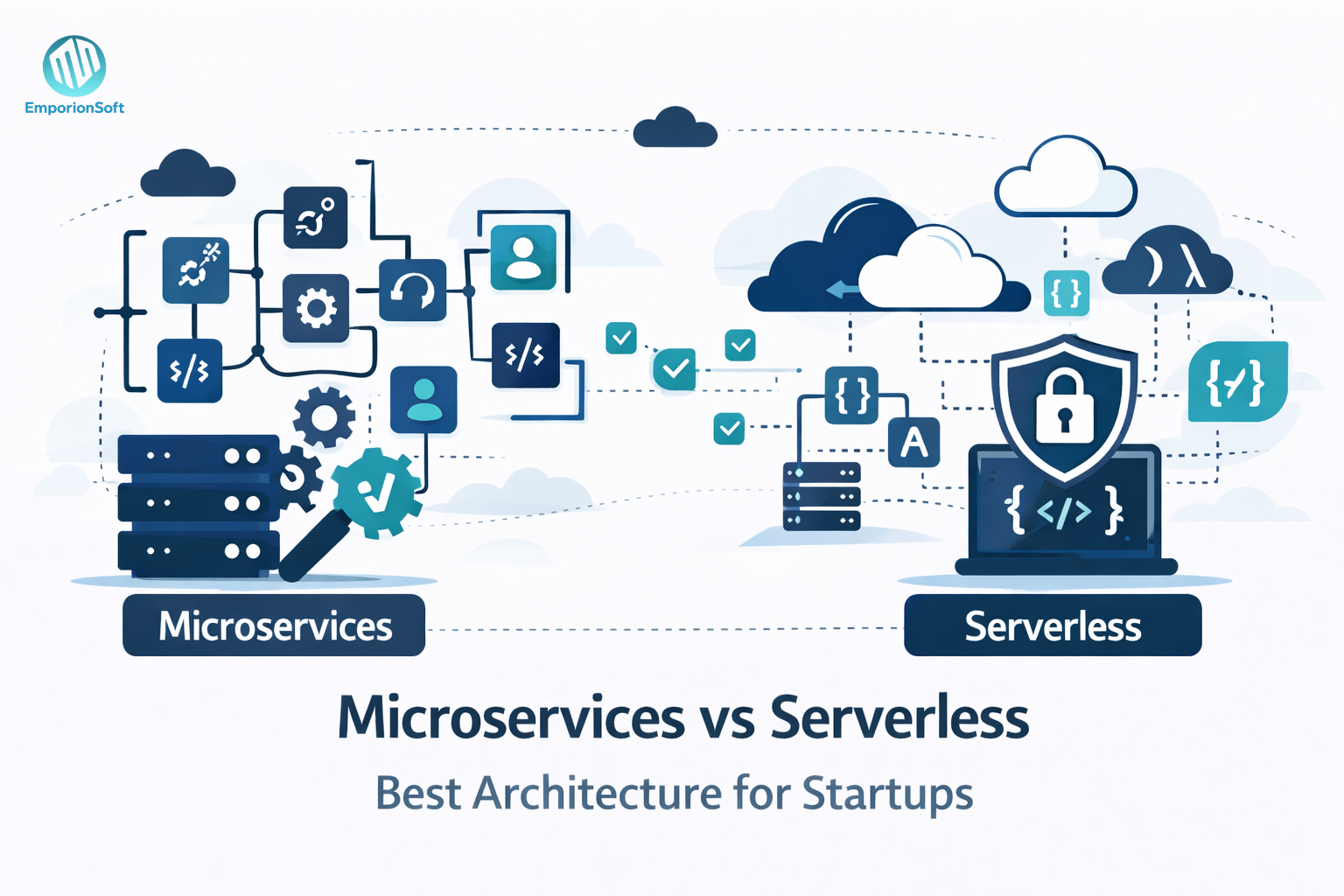
The comparison between serverless vs microservices is often misunderstood. Both favour modular design, but they operate at different levels.
Microservices focus on service boundaries and organisational alignment. Serverless focuses on execution and scaling. Serverless functions can support a microservices-style system, but they do not replace architectural discipline.
Serverless simplifies deployment but can complicate system visibility. Tracing behaviour across dozens of event-driven functions is harder than tracing service-to-service calls. Debugging becomes more abstract, especially as systems grow.
The Constraints Startups Must Factor In
Vendor lock-in is a genuine concern. Serverless applications often rely heavily on provider-specific services. Migrating later can be costly and complex.
Cold starts also matter. When functions are idle, the first request can experience latency. While this has improved, it remains relevant for user-facing applications.
Debugging and testing are more difficult in distributed, event-driven environments. Observability requires additional tooling and discipline.
Architectural constraints are the hidden cost. Stateless execution, limited runtime control, and event-driven design shape the entire system. These constraints are manageable early on, but they influence long-term flexibility.
As startups push into real-time processing, streaming data, or AI-driven workflows, these trade-offs become more visible. The tension between speed and control is especially clear in production systems handling live data, a challenge explored in EmporionSoft’s discussion on real-time AI in production: https://blogs.emporionsoft.com/real-time-ai-in-production/
Serverless architecture offers genuine advantages for startups under pressure. But those advantages are conditional. They trade operational simplicity today for architectural commitments tomorrow. Understanding that exchange is what separates confident adoption from accidental lock-in.
Choosing the Right Architecture: Fit Beats Fashion Every Time
There is no universal “best” architecture. Startups that chase a single winning model often discover too late that context matters more than convention. Architecture succeeds when it fits the team, the product, and the constraints of the business at a specific moment in time.
The real challenge for founders is not understanding the options. It is knowing which trade-offs they can live with today, and which ones will quietly limit growth tomorrow. A comparison-driven framework helps replace opinion with intent.
Microservices vs Serverless: Structure or Speed?
This decision often reflects how a startup balances organisational growth against delivery velocity.
Microservices favour structure. They work best when teams are growing and responsibilities need clear boundaries. Independent services support parallel development and controlled scaling, but require operational discipline.
Serverless favours speed. It reduces infrastructure work and accelerates deployment. For small teams, this can dramatically increase output. The trade-off is tighter platform constraints and long-term flexibility risks.
Consider microservices when:
-
Multiple teams work in parallel
-
Services need independent lifecycles
-
Operational maturity already exists
Consider serverless when:
-
Teams are small and resource-constrained
-
Time to market matters more than fine-grained control
-
Workloads are variable or event-driven
Neither option is superior by default. The right choice depends on whether coordination or execution speed is the primary bottleneck.
Serverless vs Containers: Abstraction or Control?
The serverless vs containers decision centres on how much infrastructure control a startup wants to retain.
Containers provide a consistent runtime and predictable behaviour. Teams define how applications run and scale. This suits products with steady workloads or specific runtime needs.
Serverless removes that responsibility. Infrastructure decisions are delegated to the cloud provider. This reduces operational overhead but imposes execution limits and architectural constraints.
Choose containers when:
-
Predictable performance is critical
-
Custom runtimes or long-running processes are required
-
Teams can manage orchestration and monitoring
Choose serverless when:
-
Infrastructure management is a distraction
-
Cost efficiency at low scale matters
-
Rapid iteration outweighs control
This comparison is less about technology and more about appetite for abstraction.
Monolith vs Microservices vs Serverless: Matching Maturity to Model
Looking at monolith vs microservices vs serverless together reveals a common pattern. Each model aligns with a different stage of organisational maturity.
A monolithic architecture excels when clarity and simplicity matter most. It supports fast learning and minimal coordination. The limitation is scaling complexity as products and teams expand.
Microservices architecture supports organisational scaling. It distributes ownership and reduces coupling at the cost of operational overhead.
Serverless architecture optimises early execution. It removes infrastructure friction but introduces long-term design constraints.
A practical way to frame the choice is by assessing readiness:
-
Team size: Small teams benefit from monoliths or serverless. Larger teams benefit from microservices.
-
Product maturity: Early validation favours simplicity. Proven demand supports architectural investment.
-
Compliance needs: Regulated environments often require more control and predictability.
-
Scalability patterns: Uneven demand favours serverless. Predictable growth favours containers or microservices.
-
Cost predictability: Fixed workloads suit containers. Variable workloads suit serverless.
According to McKinsey’s research on cloud operating models, organisations that align architecture with operating maturity see faster delivery and lower long-term cost volatility. This reinforces the importance of timing over trend.
Learning From Real-World Outcomes
Founders rarely get architecture right on the first attempt. What matters is avoiding irreversible decisions too early. Systems that evolve incrementally tend to outperform those designed for hypothetical scale.
Studying how other startups navigated similar trade-offs can provide clarity without copying blindly. Patterns emerge when architecture follows business reality rather than aspiration. EmporionSoft’s real-world delivery experience across diverse products highlights these patterns through practical case studies: https://blogs.emporionsoft.com/case-studies/
Architecture is not a declaration of intent. It is a reflection of current capability. The best decisions accept today’s constraints while leaving room for tomorrow’s growth.
Where Architecture Decisions Are Really Won or Lost
Architecture rarely fails on whiteboards. It fails in production, during on-call incidents, rushed releases, and unexpected growth. What looks elegant in planning often becomes fragile when real users, real data, and real deadlines collide.
For startups, execution is the truth test. Microservices and serverless systems only deliver value when the organisation can operate them reliably, not just design them convincingly.
DevOps Maturity Is the Hidden Prerequisite
Both microservices and serverless demand a higher level of DevOps maturity than many startups expect. Automated builds, tests, and deployments are no longer optional. Without them, release cycles slow down and risk increases.
Continuous integration ensures changes are validated early. Continuous delivery reduces manual intervention, which is where errors usually occur. In distributed systems, manual deployment quickly becomes unmanageable.
Startups often underestimate the cultural shift involved. DevOps is not a toolset. It is a way of working that emphasises ownership, automation, and fast feedback.
Monitoring and Observability Are Non-Negotiable
As systems become distributed, visibility becomes harder. In monoliths, logs and metrics live in one place. In microservices and serverless systems, behaviour is fragmented across services and functions.
Effective monitoring requires more than uptime checks. Teams need metrics, logs, and traces that show how requests flow through the system. Without this, diagnosing issues turns into guesswork.
Serverless systems add another layer of abstraction. Execution environments are short-lived, making traditional debugging techniques less effective. Observability must be designed into the system from day one.
The same challenges appear in modern AI-driven workflows, where real-time monitoring is critical to reliability and performance. These operational realities are explored further in EmporionSoft’s analysis of LLMOps in production environments: https://blogs.emporionsoft.com/llmops-scaling-monitoring-and-optimising-large-language-models-in-real-world-apps/
Security Moves From Perimeter to Process
Security changes shape as architecture evolves. In distributed systems, there is no single perimeter to defend. Each service or function becomes a potential entry point.
Microservices require strong identity management between services. Secrets handling, access control, and network policies must be explicit. Relying on implicit trust between components is a common and costly mistake.
Serverless reduces infrastructure exposure but introduces new risks. Permissions are often broad by default. Misconfigured roles can expose data or functionality unintentionally. Security reviews must keep pace with deployment speed.
For startups, the challenge is balancing speed with responsibility. Security must be built into pipelines, not bolted on later.
Maintainability Is a Long-Term Commitment
Short-term wins can hide long-term costs. Microservices that are poorly defined become tightly coupled through data or logic. Serverless functions that grow organically can turn into unmanageable webs of dependencies.
Maintainability depends on discipline. Clear ownership, documentation, and versioning practices prevent decay. Without them, systems become harder to change with each release.
This is where many startups struggle. Early success creates pressure to ship faster, not cleaner. Over time, that pressure erodes the very flexibility these architectures were meant to provide.
Common Execution Mistakes Startups Make
Certain patterns appear repeatedly in early-stage teams:
-
Premature scaling, where microservices are introduced before coordination becomes a problem
-
Architectural overengineering, driven by future fears rather than present needs
-
Tool overload, adding complexity without improving reliability
-
Ignoring operational costs, both financial and cognitive
These mistakes are rarely caused by lack of talent. They stem from optimism and ambition outpacing operational readiness.
Architecture is not proven by diagrams. It is proven by how calmly teams respond when things go wrong. For startups, success lies in matching architectural ambition to execution capability, and evolving both together rather than betting everything on one early decision.
When Early Architecture Decisions Become Long-Term Liabilities
Many startup failures do not come from bad ideas or weak execution. They come from early architectural decisions that quietly harden into constraints. What felt like a sensible shortcut at launch can become an invisible ceiling years later, limiting speed, inflating costs, and exhausting teams.
The danger is subtle. Architecture rarely breaks overnight. It erodes flexibility gradually, often unnoticed until change becomes painful and expensive.
Architectural Lock-In Is Harder to Escape Than It Looks
One of the earliest risks is architectural lock-in. This happens when a system becomes deeply tied to a specific pattern, platform, or set of assumptions that no longer match the business.
Tightly coupled services, provider-specific features, or rigid data models can all trap a product. Migrating later requires large rewrites, parallel systems, or prolonged freezes on feature development. For startups, that opportunity cost is often higher than the technical cost itself.
Lock-in is not always caused by poor choices. It is often caused by success. As usage grows, dependencies deepen, and changing direction becomes politically and operationally harder.
Cloud Costs That Grow Faster Than Revenue
Another long-term risk is ballooning cloud costs. Early architectures are often optimised for speed, not efficiency. That is sensible at the start, but it can become dangerous if left unchecked.
Distributed systems multiply infrastructure components. Each service, function, or integration adds baseline cost. Networking, observability, and data transfer fees quietly accumulate.
Startups often assume scale will justify the expense. In reality, cost curves can outpace revenue if architecture and usage patterns are misaligned. According to Google Cloud’s research on cloud cost optimisation, lack of architectural cost visibility is one of the most common reasons teams overspend at scale.
When costs become unpredictable, strategic planning suffers. Investment decisions become reactive rather than deliberate.
Operational Drag Slows Momentum Over Time
Operational drag is rarely discussed early, yet it is one of the most damaging long-term effects. Complex architectures demand more monitoring, more coordination, and more specialised knowledge.
As systems grow, the cognitive load on engineers increases. Simple changes require understanding multiple services or workflows. Onboarding slows. Incident response becomes stressful and prolonged.
This drag reduces delivery speed, even when teams grow. The organisation moves more people to keep pace, rather than moving faster with clarity. Over time, operational effort crowds out innovation.
Organisational Friction Mirrors Architectural Complexity
Architecture shapes how teams interact. When systems are overly fragmented too early, organisational friction increases.
Unclear service boundaries create ownership disputes. Dependencies between teams introduce waiting time. Decision-making slows as more stakeholders become involved.
Conversely, overly rigid architectures can centralise control, creating bottlenecks and burnout. In both cases, the structure of the system begins to dictate how the organisation behaves.
These effects are rarely anticipated during early design. They emerge gradually, shaped by real usage rather than initial intent.
The Cost of Reversal Is Often Underestimated
Startups frequently assume they can “fix it later.” In practice, reversing architectural direction is one of the hardest forms of change. Data migrations, contract rewrites, and retraining all compete with product delivery.
By the time leadership recognises the issue, the system is already supporting revenue, customers, and commitments. Change becomes risky, even when staying the same is worse.
This is why thoughtful architectural guidance early on can prevent years of friction. Founders who sense misalignment often seek external perspective to reassess direction before costs escalate further. In those moments, a structured architectural review can clarify options and risks, a need often addressed through targeted technical consultation: https://blogs.emporionsoft.com/consultation/
Choosing the wrong architecture early does not doom a startup. But it does tax every future decision. The long-term cost is rarely technical alone. It is strategic, operational, and human. Understanding those risks early helps founders choose paths that remain adaptable as success reshapes the business.
Choosing Between Microservices vs Serverless Is a Strategic Act
The debate around microservices vs serverless is often framed as a technical preference. In reality, it is a strategic choice that shapes how a startup grows, hires, ships, and adapts. Architecture does not simply support the business. Over time, it becomes part of the business.
What this article has shown is that there is no universally correct answer. Each model carries advantages that surface under specific conditions, and costs that emerge when those conditions are ignored. The real risk lies not in choosing one approach over another, but in choosing without understanding the long-term implications.
What the Comparisons Ultimately Reveal
Monolithic systems reward focus and simplicity. They help teams move quickly when clarity matters more than scale. Their limitations appear gradually, often when coordination becomes the real bottleneck.
Microservices reward organisational maturity. They enable parallel progress, independent scaling, and resilience, but only when supported by strong DevOps practices and disciplined execution. Without those foundations, complexity grows faster than value.
Serverless rewards speed and efficiency. It reduces infrastructure burden and aligns costs with usage, which suits early-stage uncertainty. Over time, however, platform constraints, observability challenges, and lock-in risks shape how far the system can evolve.
Containers sit between these worlds. They provide control and portability, but do not solve architectural problems on their own. Used well, they enable flexibility. Used blindly, they add operational overhead without clarity.
Across all models, the same pattern appears. Architecture works when it reflects the current reality of the team and product, not an imagined future state.
Execution Is Where Architecture Proves Itself
A recurring theme has been execution. CI/CD, monitoring, security, and maintainability are not secondary concerns. They are the mechanisms that turn architectural intent into daily reliability.
Many startups fail not because their architecture was wrong in theory, but because it was misaligned with their ability to operate it. Premature scaling, overengineering, and tool-driven decisions consistently create drag that slows momentum.
Long-term costs amplify these mistakes. Cloud spend rises unpredictably. Teams fragment. Change becomes risky. None of this happens suddenly. It accumulates quietly until the organisation feels constrained by choices it barely remembers making.
Architecture as an Evolving Decision
The most resilient startups treat architecture as an evolving decision, not a one-time commitment. They optimise for learning early, then introduce structure as complexity demands it. They delay irreversible choices and invest in clarity where it matters most.
This mindset is visible across modern software organisations that balance ambition with realism. It is also reflected in how engineering partners collaborate across ecosystems. For example, insights from delivery-focused teams in the UK software space, such as those contributing to architectural thinking at https://thecodev.co.uk/, reinforce the value of pragmatism over pattern-chasing.
When to Seek Architectural Guidance
There is a point where internal debate stops being productive. When trade-offs affect hiring plans, budgets, or delivery timelines, external perspective can bring clarity. Not to dictate solutions, but to frame decisions in context.
EmporionSoft’s experience across diverse systems and growth stages informs this kind of guidance. The focus is not on promoting a specific architecture, but on aligning technical direction with business reality. For founders weighing microservices vs serverless, that alignment is often the difference between controlled growth and constant rework.
Thoughtful architecture rarely draws attention to itself. It fades into the background, enabling teams to focus on building value. Making that possible is not about choosing the most fashionable model. It is about choosing deliberately, revisiting assumptions, and staying adaptable as the startup evolves.
The right decision today is the one that keeps tomorrow flexible.
Leave a Reply