Category: Industry Trends

Stay ahead with expert insights into 2025’s top software industry trends. Discover innovations, challenges, and growth areas shaping the tech world.

  • Pakistan IT Industry 2026: Growth, Exports Overview

    Pakistan IT Industry 2026: Growth, Exports Overview

    The Current State of Pakistan’s IT Industry in 2026

    The Pakistan IT industry in 2026 has moved beyond its early growth phase into a more structured and globally visible sector. What was once a fragmented mix of software houses and freelancers has evolved into a layered ecosystem that includes export-oriented firms, product startups, enterprise service providers, and a large independent workforce.

    At a structural level, the industry now operates across three core segments. The first is IT services, which includes software development, outsourcing, and managed services delivered by established firms. The second is the product and startup ecosystem, which is still maturing but gaining traction in fintech, SaaS, and AI-driven applications. The third is freelancing, where Pakistan continues to rank among the top global contributors in remote digital services.

    According to recent data from the Pakistan Software Export Board, the number of registered IT companies has steadily increased, reflecting both domestic expansion and formalisation of previously informal businesses. This growth is not only numerical but also qualitative. Companies are gradually shifting from low-value services to more complex engineering work, including cloud systems, enterprise platforms, and data-driven applications.

    Geographically, the industry remains concentrated in three major hubs. Lahore has established itself as a centre for software engineering talent and mid-sized firms. Karachi leads in terms of scale and enterprise-level operations, supported by its commercial infrastructure. Islamabad has emerged as a hub for startups, public sector collaboration, and international development projects. Together, these cities form the backbone of Pakistan’s digital economy, while secondary cities are beginning to contribute through distributed teams and remote work models.

    Freelancing continues to play a significant role in shaping the overall landscape. Platforms and independent contracting have enabled thousands of professionals to access global markets without traditional organisational structures. Insights from the Pakistan Software Houses Association highlight that this segment not only contributes to export inflows but also acts as a talent pipeline for formal IT companies. Many engineers transition from freelance work into structured teams, bringing with them international exposure and client experience.

    Another defining characteristic of the Pakistan IT industry in 2026 is its cost-to-quality positioning. Compared to other outsourcing destinations, Pakistan offers competitive pricing while maintaining a growing pool of technically skilled professionals. This balance has made it increasingly attractive for startups and SMEs looking to build products or scale engineering capacity without the overhead of Western markets.

    At the same time, the industry is becoming more aligned with global standards. There is a visible shift towards better engineering practices, improved documentation, and adoption of modern architectures. Companies are investing in long-term capability building rather than short-term project delivery. This transition reflects a broader understanding that sustainable growth depends on reliability, not just cost advantage.

    From a business perspective, this evolving landscape creates a more predictable environment for partnerships and investment. Organisations exploring technology solutions or outsourcing options can now engage with firms that offer structured processes and domain expertise. This is evident in how service providers, including EmporionSoft, position themselves as long-term technology partners rather than transactional vendors.

    In summary, the Pakistan IT industry in 2026 stands at an important point of maturity. It is no longer defined solely by potential or low-cost labour. Instead, it is characterised by a growing base of skilled professionals, a more organised company structure, and increasing relevance in the global digital economy.

    IT Export Growth and Revenue Trends Shaping the Sector

    The expansion of IT exports is one of the clearest indicators of how the Pakistan IT industry in 2026 is evolving. Over the past few years, export revenues have shown consistent upward movement, supported by global demand for software services, remote engineering talent, and digital transformation initiatives across industries.

    Data published by the Pakistan Software Export Board shows that IT exports have crossed significant milestones, with year-on-year growth driven by both formal companies and independent professionals. This growth is not limited to volume alone. There is a gradual shift in the type of services being exported, moving from basic development tasks to higher-value offerings such as cloud architecture, AI integration, and enterprise system design.

    One of the key patterns shaping export trends is diversification of client markets. Historically, a large share of Pakistan’s IT exports was concentrated in North America. While the United States remains a major destination, companies are increasingly expanding into the United Kingdom, Europe, the Middle East, and Australia. This diversification reduces dependency on a single region and improves resilience against economic fluctuations.

    Another important factor is the growing role of digital payments infrastructure. Improvements in cross-border payment systems have made it easier for freelancers and companies to receive international revenue. Insights from the State Bank of Pakistan highlight the expansion of digital payment channels and regulatory support for IT exporters. These developments have reduced friction in financial transactions and encouraged more professionals to operate within the formal economy.

    Revenue growth is also closely tied to the increasing maturity of service offerings. Earlier, many firms operated on a project-by-project basis with limited long-term contracts. In 2026, there is a visible shift towards recurring revenue models. Managed services, SaaS platforms, and long-term outsourcing agreements are becoming more common. This transition improves revenue predictability and allows companies to invest in capability building rather than focusing solely on short-term delivery.

    The relationship between exports and domestic economic conditions is another aspect worth noting. IT exports provide a relatively stable source of foreign exchange compared to traditional sectors. According to data referenced by Trading Economics, technology services are contributing an increasing share to the overall export mix. This positions the IT sector as a strategic component of Pakistan’s broader economic planning.

    Freelancing continues to influence export figures in a meaningful way. A large portion of inflows comes from independent professionals working on global platforms. While this segment is often less visible in official statistics, it plays a critical role in sustaining growth. Over time, as more freelancers register formal businesses, their contributions are increasingly captured within official export data.

    From a business standpoint, these revenue trends signal a shift in how Pakistan is perceived in the global market. The country is no longer viewed only as a low-cost outsourcing destination. Instead, it is gradually being recognised for its ability to deliver complex solutions and long-term value. This perception is reinforced by firms that focus on structured delivery models and measurable outcomes, as discussed in technology ROI frameworks.

    At the same time, the growth in exports places new demands on companies. Clients expect consistency, scalability, and adherence to international standards. This requires investment in infrastructure, talent development, and process maturity. Businesses that fail to evolve risk being limited to low-margin work, while those that adapt can capture higher-value opportunities.

    In practical terms, the export trajectory of the Pakistan IT industry in 2026 reflects both progress and transition. Growth is no longer driven only by increasing headcount or project volume. It is increasingly linked to the ability to deliver specialised services, build long-term client relationships, and operate within a structured global framework.

    Key Drivers Behind Pakistan’s Tech Sector Expansion

    The growth of the Pakistan IT industry in 2026 is not accidental. It is the result of several structural drivers working together over time. These drivers span talent supply, cost dynamics, global demand, and increasing digital adoption within and outside the country.

    One of the most significant factors is the steady expansion of the talent pool. Pakistan produces a large number of STEM graduates each year, many of whom enter the technology workforce. Universities and private institutes have increased their focus on software engineering, data science, and emerging technologies. While the quality of education still varies, the overall volume of technically trained individuals provides a strong foundation for industry growth.

    This talent base is further strengthened by the freelancing ecosystem. Pakistan consistently ranks among the top countries in global freelancing platforms. The Pakistan Software Houses Association highlights how freelancers contribute not only to export earnings but also to skill development. Working directly with international clients exposes professionals to global standards, tools, and workflows. Over time, this experience feeds back into the formal sector as freelancers transition into full-time roles or launch their own companies.

    Cost competitiveness remains another core driver. Compared to many established outsourcing destinations, Pakistan offers lower operational costs without a proportional drop in capability. This creates a favourable environment for startups and SMEs that need to optimise budgets while maintaining technical quality. For businesses evaluating long-term investments, cost efficiency combined with a growing talent pool becomes a practical advantage rather than a short-term incentive.

    Global demand for digital transformation also plays a central role. Organisations across industries are modernising their systems, adopting cloud infrastructure, and integrating data-driven processes. This shift increases demand for software development, system integration, and ongoing technical support. Pakistan-based firms are increasingly participating in this demand by offering services aligned with modern architectures and scalable platforms, as explored in discussions around scalable API design.

    Another important driver is the gradual improvement in infrastructure and connectivity. Internet penetration has expanded, and access to cloud services has become more reliable. While challenges still exist, especially outside major cities, the overall direction supports distributed work models. This enables companies to build teams across different regions rather than being limited to a single urban centre.

    The rise of the digital economy within Pakistan also contributes to sector growth. Local businesses are adopting digital tools for operations, customer engagement, and payments. This creates internal demand for software solutions and encourages the development of locally relevant products. Areas such as fintech, e-commerce, and logistics technology are seeing increased activity as a result of this shift.

    Policy direction, although still evolving, has also influenced expansion. Government initiatives aimed at promoting IT exports, supporting startups, and improving ease of doing business have created a more enabling environment. While these policies are not always consistent, they signal a broader recognition of the sector’s importance.

    From a technology perspective, there is a visible move towards modern development practices. Companies are adopting cloud-native approaches, automation, and AI-driven solutions. For organisations planning long-term growth, structured approaches such as those outlined in an AI adoption roadmap are becoming increasingly relevant.

    Finally, global remote work trends have accelerated the integration of Pakistan’s workforce into international markets. The shift towards distributed teams has reduced the importance of physical location, allowing companies to access talent regardless of geography. This has lowered entry barriers for both individuals and firms, contributing to faster industry expansion.

    Taken together, these drivers explain why the Pakistan IT industry in 2026 continues to grow despite structural challenges. The combination of talent availability, cost efficiency, global demand, and gradual ecosystem maturity creates a foundation that supports sustained expansion.

    Structural Challenges and Risks Facing IT Companies

    Despite steady growth, the Pakistan IT industry in 2026 continues to face structural challenges that affect scalability, consistency, and long-term competitiveness. These risks do not negate the sector’s potential, but they shape how companies operate and how investors assess the market.

    One of the most persistent challenges is talent retention. While Pakistan produces a large number of graduates, experienced engineers often migrate to international markets or shift to remote roles with foreign companies. This creates a gap between entry-level supply and senior-level expertise. For IT firms, the issue is not just hiring but maintaining continuity in teams, especially for long-term projects that require stable leadership and deep technical knowledge.

    Closely related to this is the variation in skill quality. Not all graduates are industry-ready, which means companies must invest in training and onboarding before engineers can contribute effectively. This increases operational costs and delays project timelines. Without structured learning systems, many organisations struggle to scale beyond a certain size. The impact of unmanaged capability gaps often appears as delivery inconsistency or accumulated technical inefficiencies, similar to patterns discussed in technical debt management.

    Infrastructure limitations also remain a concern. While connectivity has improved in major cities, reliability issues still affect productivity in smaller regions. Power outages, inconsistent internet quality, and limited access to advanced data infrastructure can disrupt workflows. For companies operating distributed teams, these factors introduce operational risk that must be managed through redundancy and contingency planning.

    Regulatory uncertainty is another structural constraint. Policies related to taxation, foreign exchange, and digital services are evolving, but not always in a predictable manner. Businesses need clarity to plan long-term investments, especially when dealing with international clients and cross-border transactions. While organisations like the Pakistan Software Export Board provide guidance and support, gaps in policy consistency can still affect decision-making.

    Data protection and compliance requirements are becoming increasingly important as companies engage with global clients. Many international partners expect adherence to strict data privacy standards. For local firms, this requires investment in secure systems, governance frameworks, and compliance processes. Without these measures, companies risk losing access to high-value contracts. The importance of structured approaches to data governance is reflected in broader discussions on data privacy frameworks.

    Another challenge lies in scaling business operations. Many IT companies start with a project-based model but struggle to transition into structured organisations with repeatable processes. This limits their ability to handle larger contracts or expand into new markets. Operational maturity, including standardised workflows, quality assurance systems, and performance tracking, is still uneven across the industry.

    Access to capital also plays a role, particularly for startups and product-focused firms. While service-based companies can grow through client revenue, product development requires upfront investment and longer timelines. The local funding ecosystem is improving, but it is still not as mature as in more established tech markets. This affects the pace at which innovative products can be developed and scaled.

    Security risks are another area of concern. As companies handle more sensitive data and integrate with global systems, the need for robust cybersecurity practices increases. Smaller firms, in particular, may lack the resources to implement comprehensive security measures. Adopting disciplined approaches such as those outlined in DevSecOps practices can help mitigate these risks, but adoption is not yet universal.

    Finally, perception remains a subtle but important challenge. While Pakistan is gaining recognition as a technology destination, some international clients still associate it primarily with low-cost outsourcing. Changing this perception requires consistent delivery of high-quality work, strong communication, and a focus on long-term partnerships rather than short-term engagements.

    In practical terms, these structural challenges define the operating environment of the Pakistan IT industry in 2026. Companies that recognise and address these risks are better positioned to scale sustainably. Those that ignore them often face limitations in growth, client retention, and market positioning.

    Government Policies, Incentives and Regulatory Landscape

    The policy environment surrounding the Pakistan IT industry in 2026 has become more structured, though it continues to evolve. Government initiatives are increasingly focused on positioning technology as a strategic export sector, with a mix of incentives, regulatory adjustments, and institutional support aimed at accelerating growth.

    One of the most visible policy instruments is the framework around tax incentives for IT exporters. Companies operating in the software and services domain benefit from reduced tax rates and, in some cases, exemptions tied to export income. These measures are designed to encourage formalisation and attract both local and foreign investment. Details of export facilitation and registration processes are outlined by the Pakistan Software Export Board, which acts as a central body supporting IT companies in compliance and market access.

    Another key initiative is the development of Special Technology Zones. The Special Technology Zones Authority has been tasked with creating dedicated environments where technology companies can operate with infrastructural support and fiscal incentives. These zones aim to provide reliable utilities, streamlined regulatory processes, and proximity to research and development resources. For businesses evaluating long-term presence in Pakistan, such zones offer a more predictable operational setting compared to traditional setups.

    Industry representation also plays a role in shaping policy direction. Organisations like the Pakistan Software Houses Association engage with government bodies to advocate for industry needs. Their involvement helps bridge the gap between policymakers and private sector stakeholders, particularly in areas such as taxation, export regulations, and talent development. While alignment is not always perfect, this interaction has improved the visibility of industry concerns.

    Regulatory frameworks around digital transactions and foreign exchange have also seen gradual refinement. The State Bank of Pakistan has introduced measures to facilitate cross-border payments for IT exporters, making it easier to receive and repatriate earnings. These changes reduce friction in financial operations and encourage companies to operate within formal channels. At the same time, compliance requirements remain important, particularly for businesses dealing with international clients and large transaction volumes.

    Data governance is becoming an increasingly relevant area within the regulatory landscape. As companies handle more sensitive information, expectations around data protection and privacy are rising. While Pakistan’s regulatory framework is still developing in this domain, businesses are expected to align with international standards when working with global partners. This creates a need for structured governance approaches, similar to those discussed in AI governance frameworks for SMEs, where compliance is integrated into operational design rather than treated as an afterthought.

    Government support for digital transformation is also influencing the broader ecosystem. Initiatives aimed at digitising public services, promoting fintech adoption, and encouraging e-commerce are creating indirect demand for IT services. As more sectors move towards digital operations, local technology companies gain opportunities to participate in national-scale projects.

    However, policy consistency remains a point of attention. While incentives and initiatives are in place, businesses often require long-term clarity to make strategic decisions. Changes in tax structures, regulatory requirements, or administrative processes can introduce uncertainty. For companies planning multi-year investments, stability is as important as the incentives themselves.

    Infrastructure policy is another area where progress is visible but incomplete. Efforts to improve connectivity, expand broadband access, and support cloud adoption are ongoing. These developments are essential for enabling distributed teams and supporting high-performance applications. Discussions around hybrid cloud strategies highlight how businesses can navigate infrastructure constraints while maintaining operational efficiency.

    From a business perspective, the regulatory environment in 2026 offers both opportunity and responsibility. Incentives can reduce operational costs and improve margins, but they come with compliance expectations that require structured processes. Companies that align with policy frameworks and invest in governance are better positioned to benefit from the ecosystem.

    In summary, government policies and incentives are playing a meaningful role in shaping the Pakistan IT industry in 2026. While the direction is broadly supportive, the effectiveness of these measures depends on execution, consistency, and the ability of businesses to integrate regulatory considerations into their strategic planning.

    Business Opportunities Across Startups, SMEs and Enterprises

    The Pakistan IT industry in 2026 presents a range of opportunities that vary by business size, maturity, and strategic intent. While growth in exports and talent availability creates a favourable backdrop, the real value lies in how different segments can position themselves within the ecosystem.

    For startups, the opportunity is closely tied to product innovation and niche problem solving. Pakistan’s digital economy is still developing, which means there are gaps across sectors such as fintech, logistics, healthcare, and education technology. Startups that focus on localised solutions have the advantage of understanding user behaviour and operational constraints within the region. At the same time, globally oriented SaaS products are gaining traction, particularly in areas where cost-effective development can support competitive pricing in international markets.

    Access to global platforms and remote work has lowered entry barriers for early-stage companies. Founders can build distributed teams, validate ideas quickly, and reach international customers without significant upfront infrastructure. However, success in this segment depends on disciplined execution, clear product-market fit, and the ability to scale beyond initial traction. Decisions around architecture and scalability, such as those explored in microservices versus serverless models, become critical as products grow.

    For SMEs, the opportunity often lies in service expansion and operational maturity. Many mid-sized IT companies in Pakistan operate as outsourcing partners for international clients. In 2026, there is a clear shift towards offering more specialised services, including cloud migration, AI integration, and enterprise system development. SMEs that move beyond generic development work and build domain expertise can access higher-value contracts and long-term partnerships.

    Another important area for SMEs is the transition from project-based work to recurring revenue models. Managed services, maintenance contracts, and platform-based offerings provide more predictable income streams. This shift requires investment in processes, customer success functions, and performance tracking. The decision between building custom systems or adopting existing platforms, as discussed in custom CRM versus SaaS approaches, often shapes how these businesses structure their offerings.

    Enterprises, both local and international, encounter a different set of opportunities. For large organisations, Pakistan offers a scalable talent pool that can support complex engineering operations. This includes building dedicated development centres, outsourcing specific functions, or forming long-term strategic partnerships with local firms. The cost advantage, combined with increasing technical capability, makes such models viable for organisations looking to optimise global delivery.

    At the same time, enterprises operating within Pakistan are undergoing their own digital transformation journeys. Traditional industries are adopting technology to improve efficiency, customer engagement, and data management. This creates demand for enterprise-grade solutions, system integration, and long-term support services. IT companies that can operate at this level need to demonstrate reliability, security, and the ability to manage large-scale deployments.

    The freelancing ecosystem also intersects with these opportunities. Independent professionals often act as an entry point for international clients. Over time, successful freelancers either build small teams or collaborate with established firms, contributing to the overall growth of the sector. This fluid movement between individual and organisational work models adds flexibility to the market.

    From an investment perspective, the Pakistan IT industry in 2026 offers multiple entry points. Investors can engage through startups, service companies, or hybrid models that combine product and services. Each path carries different risk and return profiles, but all benefit from the underlying growth of the sector.

    Practical execution remains the defining factor. Opportunities exist across the board, but capturing them requires structured planning, technical depth, and a clear understanding of market dynamics. Case-based learning and real-world implementation insights, such as those found in EmporionSoft’s case studies, illustrate how businesses translate opportunity into measurable outcomes.

    Overall, the opportunity landscape is broad but not uniform. Startups, SMEs, and enterprises each operate under different constraints and advantages. Understanding these differences is essential for making informed decisions within the Pakistan IT industry in 2026.

    Strategic Framework for Entering or Scaling in Pakistan’s IT Market

    Entering or scaling within the Pakistan IT industry in 2026 requires more than recognising growth potential. It demands a structured approach that accounts for talent dynamics, operational constraints, and long-term positioning. Businesses that succeed in this market tend to follow clear frameworks rather than relying on opportunistic expansion.

    The first step is defining the mode of entry. Organisations typically choose between three models. The first is direct outsourcing, where work is assigned to an existing Pakistani firm. The second is establishing a dedicated offshore team, either independently or through a local partner. The third is forming a strategic partnership or joint venture with a local company. Each model has different implications for control, cost, and scalability.

    For early-stage or exploratory engagement, outsourcing is often the most practical option. It allows businesses to test capabilities without committing to long-term infrastructure. However, as dependency increases, companies often transition towards dedicated teams to gain better alignment and continuity. Frameworks such as the build versus buy decision model provide a structured way to evaluate when this transition makes sense.

    The second element of the framework is partner selection and evaluation. Not all IT companies operate at the same level of maturity. Businesses need to assess technical capability, communication standards, and delivery processes. This includes reviewing past projects, understanding team composition, and evaluating how the company manages quality assurance and deadlines. Structured evaluation criteria, similar to those used in enterprise architecture planning, help reduce the risk of misalignment.

    Talent strategy is another critical component. Whether building an internal team or working with external partners, access to skilled engineers must be planned carefully. This involves identifying required skill sets, defining onboarding processes, and ensuring knowledge transfer mechanisms are in place. Given the competitive nature of the talent market, retention strategies also become important. Without continuity, even well-designed projects can face delays and inconsistencies.

    Operational design follows talent strategy. Companies need to establish clear workflows, communication channels, and performance metrics. Distributed teams require structured coordination to maintain efficiency. This includes defining sprint cycles, documentation standards, and reporting mechanisms. For organisations scaling engineering operations, considerations around system design and performance, such as those discussed in scalable API development, become increasingly relevant.

    Risk management is an integral part of the framework. Businesses must account for factors such as regulatory changes, infrastructure reliability, and currency fluctuations. Mitigation strategies may include diversifying teams across locations, implementing backup systems, and maintaining financial buffers. A proactive approach to risk ensures that operations remain stable even when external conditions change.

    Technology alignment is equally important. Companies entering the Pakistan IT market should ensure that their technology stack and development practices are compatible with local capabilities. While the talent pool is broad, expertise in specific tools or frameworks may vary. Aligning expectations with available skills reduces friction during execution and improves delivery outcomes.

    Scaling introduces additional complexity. As operations grow, informal processes become insufficient. Organisations need to invest in governance structures, performance tracking, and continuous improvement systems. This transition from small-scale execution to structured operations often determines whether a company can handle larger contracts and long-term engagements.

    Finally, long-term positioning should guide all decisions. Businesses that treat Pakistan as a strategic extension of their operations, rather than a temporary cost-saving measure, tend to achieve better results. This involves building relationships, investing in capability development, and aligning incentives with local teams.

    For companies seeking structured guidance, engaging with experienced partners such as EmporionSoft’s consultation services can help translate strategy into execution. The focus should remain on creating sustainable systems rather than short-term gains.

    In practical terms, a clear framework transforms market entry from a series of isolated decisions into a coordinated strategy. Within the Pakistan IT industry in 2026, this structured approach is often the difference between limited engagement and long-term success.

    Long-Term Outlook and Strategic Positioning for Global Businesses

    The long-term outlook for the Pakistan IT industry in 2026 is shaped by a combination of sustained export growth, expanding talent capacity, and increasing integration into the global digital economy. While short-term fluctuations may occur due to economic or regulatory factors, the underlying trajectory remains upward.

    From a macroeconomic perspective, technology exports are expected to play a larger role in Pakistan’s overall export mix. As global demand for software services, cloud solutions, and AI-driven systems continues to rise, countries with scalable talent pools are positioned to benefit. Pakistan fits this profile, particularly as more professionals gain experience working with international clients and complex systems. Projections and development insights from the World Bank indicate that emerging digital economies can accelerate growth by strengthening their technology sectors.

    One of the defining trends for the coming years is the shift from volume-driven growth to value-driven growth. In earlier stages, expansion was largely based on increasing the number of developers and projects. Going forward, the focus is expected to move towards higher-value services such as product engineering, platform development, and long-term digital transformation partnerships. This shift aligns with global expectations, where clients prioritise reliability, domain expertise, and measurable outcomes over simple cost advantages.

    For global businesses, this transition creates a more compelling proposition. Pakistan is no longer just a destination for outsourced development. It is becoming a viable location for building integrated engineering capabilities. Companies can establish dedicated teams, develop proprietary products, and manage end-to-end technology functions within the country. This level of integration supports long-term scalability and operational efficiency.

    At the same time, the competitive landscape will continue to evolve. Other emerging markets are also investing in their technology sectors, which means Pakistan must maintain momentum in areas such as education, infrastructure, and policy stability. Reports from the International Monetary Fund highlight how consistent policy frameworks and investment in human capital are critical for sustaining growth in developing economies. For Pakistan, this translates into a need for continuous improvement rather than reliance on existing advantages.

    Digital transformation within the country will further influence the industry’s direction. As local businesses adopt technology at a larger scale, internal demand for software solutions will increase. This dual demand, both domestic and international, creates a more balanced ecosystem. It reduces dependency on external markets while still allowing companies to benefit from global opportunities.

    For decision-makers, the key consideration is how to position their organisations within this evolving landscape. Businesses that approach the market with a long-term perspective are more likely to realise value. This includes investing in partnerships, building internal capabilities, and aligning operations with global standards. Short-term cost savings may offer immediate benefits, but sustainable success depends on consistency and strategic alignment.

    Another important aspect is risk management over the long term. Factors such as regulatory changes, currency fluctuations, and talent mobility will continue to influence operations. Companies need to incorporate these variables into their planning rather than treating them as external uncertainties. Structured governance, clear processes, and diversified operational models can help manage these risks effectively.

    For organisations exploring entry or expansion, the focus should be on creating a stable and scalable presence. This often involves working with experienced partners who understand both local dynamics and global expectations. Engaging with a firm such as EmporionSoft can provide a structured pathway from initial assessment to execution, ensuring that strategy is translated into practical outcomes.

    In summary, the Pakistan IT industry in 2026 is positioned for continued growth, but the nature of that growth is changing. It is becoming more structured, more competitive, and more integrated into global systems. Businesses that recognise this shift and adapt their strategies accordingly will be better placed to capture long-term value.
  • Tech ROI Metrics: How CEOs & CTOs Measure Technology Value

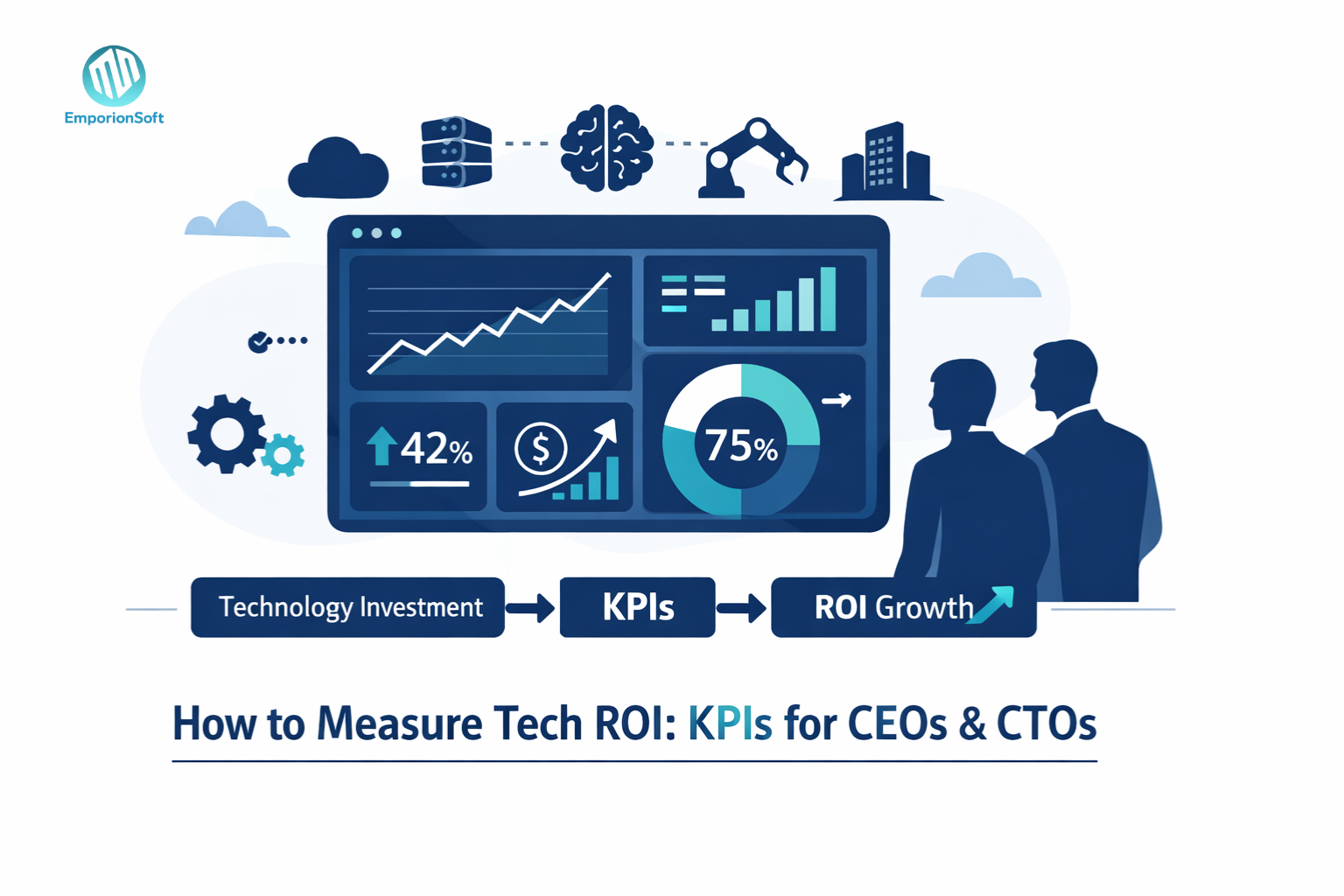
    Tech ROI Metrics: How CEOs & CTOs Measure Technology Value

    How to Measure Tech ROI: Why It’s Now a Boardroom Imperative

    Technology spending has quietly become one of the largest balance-sheet commitments for modern organisations. Yet many leaders still struggle to answer a simple question with confidence: Is our technology actually paying off? In 2026, intuition is no longer enough. Tech ROI metrics have moved from IT dashboards into boardroom conversations, shaping funding decisions, growth strategies, and competitive advantage.

    For CEOs and CTOs, measuring the return on technology investments is no longer optional. It is a strategic discipline.

    The New Reality of Technology ROI

    A decade ago, ROI discussions focused on hardware costs and headcount reduction. Today, investments span cloud platforms, SaaS subscriptions, AI models, cybersecurity, automation, and continuous software upgrades. These initiatives rarely deliver value in neat, linear ways.

    This is why measuring ROI for tech investments feels complex, fragmented, and often frustrating.

    Traditional financial ROI models struggle to capture outcomes such as faster decision-making, improved developer productivity, reduced technical debt, or enhanced customer experience. Yet these outcomes directly influence revenue, resilience, and scalability.

    This gap between spend and insight is where Tech ROI metrics become essential.

    What Are Tech ROI Metrics?

    At their core, Tech ROI metrics are structured indicators used to evaluate whether technology investments generate measurable business value. They go beyond basic cost-versus-revenue calculations.

    Modern technology investment ROI metrics consider financial returns, operational efficiency, risk reduction, and strategic enablement. For example, a cloud migration may not immediately increase revenue. However, it may reduce downtime, improve deployment speed, and enable faster market entry.

    When measured correctly, these outcomes translate into long-term value.

    Why CEOs and CTOs Struggle With ROI Visibility

    Many leadership teams face the same challenges:

    • Technology value is spread across departments

    • Benefits appear over time, not instantly

    • Metrics are owned by IT, not the business

    • Dashboards track activity, not impact

    As a result, ROI conversations become reactive. Decisions are driven by urgency rather than evidence.

    This is especially risky during digital transformation ROI metrics discussions. Transformation initiatives often fail not because the technology is wrong, but because success was never clearly measured.

    From Cost Centres to Value Engines

    The most successful organisations have reframed technology from a cost centre into a value engine. They align Tech ROI metrics with business outcomes such as growth, agility, and customer trust.

    This shift requires a shared language between technology and leadership.

    For instance, instead of asking how much a system costs, executives ask:

    • How does this reduce time-to-market?

    • How does this improve operational resilience?

    • How does this support long-term scalability?

    These questions sit at the heart of modern ROI analysis.

    Why a Structured ROI Framework Matters

    Without a consistent framework, ROI measurement becomes subjective. Teams cherry-pick metrics that support existing decisions. This creates blind spots and misaligned priorities.

    A structured approach to Tech ROI metrics allows organisations to:

    • Compare investments objectively

    • Prioritise initiatives with the highest impact

    • Justify budgets with evidence, not assumptions

    • Align IT strategy with business goals

    At EmporionSoft, we see this challenge across global projects. Whether organisations are adopting emerging technologies or modernising legacy systems, ROI clarity is the common success factor. Insights shared in our exploration of new technology trends highlight how fast innovation outpaces measurement.

    Setting the Stage for Smarter Decisions

    This guide is designed to give leaders a practical, executive-level understanding of Tech ROI metrics. It connects financial logic with modern technology realities.

    In the sections ahead, we will break down definitions, KPIs, tools, benchmarks, and real-world examples. Each part builds toward a clear goal: helping you measure what truly matters.

    Tech ROI Metrics Explained: Foundations Every Leader Must Understand

    Before organisations can improve returns, they must first agree on what they are measuring. Many ROI conversations fail because teams use the same words but mean different things. This section establishes a shared foundation for Tech ROI metrics, ensuring clarity for CEOs, CTOs, and CFOs alike.

    Clear definitions lead to better decisions.

    What Do We Mean by Tech ROI Metrics?

    Tech ROI metrics are structured measurements that evaluate the business value created by technology investments. Unlike traditional ROI, they account for both financial and non-financial outcomes.

    These metrics answer questions such as:

    • Is this technology improving efficiency?

    • Is it reducing long-term operational risk?

    • Is it enabling future growth?

    This broader lens is essential when evaluating modern digital systems.

    Core Categories of Technology ROI

    Technology value rarely appears in a single number. Effective Tech ROI key performance indicators usually fall into three interconnected categories.

    Financial ROI

    • Revenue uplift from new capabilities

    • Cost reduction through automation

    • Lower infrastructure or maintenance spend

    Operational ROI

    • Faster deployment cycles

    • Reduced downtime and incident rates

    • Improved team productivity

    Strategic ROI

    • Scalability for future growth

    • Faster innovation cycles

    • Reduced technical debt exposure

    Leaders who track only financial outcomes miss the bigger picture.

    How to Calculate Tech ROI in Practice

    At a basic level, the formula for ROI remains familiar:

    ROI (%) = (Net Benefit ÷ Total Investment) × 100

    However, this formula alone is insufficient for technology initiatives.

    To accurately reflect value, organisations must first define “net benefit” clearly. For IT systems, this often includes:

    • Direct revenue gains

    • Cost avoidance

    • Time savings converted into financial value

    For example, a platform that reduces release cycles by 30% may not generate revenue directly. Yet it enables faster product launches and quicker market response. That capability has measurable value.

    This is why how to calculate tech ROI always starts with aligning metrics to business outcomes.

    ROI Metrics for IT Projects and Systems

    ROI metrics for IT projects differ from traditional capital investments. Technology assets evolve, integrate, and compound over time.

    Common ROI metrics for business technology include:

    • Cost per transaction

    • Time-to-market improvement

    • System availability percentages

    • User adoption rates

    When combined, these indicators show whether a system is delivering sustainable value.

    Organisations modernising legacy platforms often uncover hidden ROI by addressing technical debt. Our deep dive into technical debt management explains how unmanaged systems silently erode ROI.

    Why Qualitative ROI Still Matters

    Not every benefit fits neatly into a spreadsheet. Security posture, compliance readiness, and customer trust are difficult to quantify but critical to long-term success.

    Ignoring qualitative ROI leads to short-term optimisation and long-term risk.

    This is especially true in adaptive environments. As outlined in our guide to adaptive software development, flexibility itself is a form of measurable value.

    Building a Shared ROI Language

    The most effective organisations use Tech ROI metrics as a common language across leadership, finance, and engineering teams. This alignment reduces friction and accelerates decision-making.

    According to Harvard Business Review, organisations that link technology metrics directly to business strategy outperform peers in long-term value creation. This reinforces the importance of moving beyond isolated IT reporting.

    Once definitions and calculations are clear, the next challenge emerges. Leaders must decide which metrics matter most at the executive level. That is where KPI frameworks come into play.

    Tech ROI KPIs That Matter Most to CEOs, CTOs, and CFOs

    Tracking every possible metric creates noise, not insight. Senior leaders need focus. The real challenge is identifying Tech ROI metrics that align with decision-making at the highest level. This section breaks down the KPIs that matter most, based on executive priorities rather than technical activity.

    The right KPIs turn data into direction.

    Why Executive-Level KPIs Are Different

    Operational teams track utilisation, uptime, and velocity. Executives track outcomes. When these perspectives are misaligned, ROI conversations stall.

    Effective Tech ROI key performance indicators connect technology performance directly to business impact. They answer one critical question: Is this investment moving the organisation forward?

    This distinction is essential for meaningful ROI analysis.

    CEO-Focused Tech ROI Metrics

    CEOs view technology through the lens of growth, resilience, and competitive advantage.

    High-impact Tech ROI metrics for CEOs include:

    • Revenue growth enabled by technology

    • Speed of market entry

    • Customer experience improvements

    • Business scalability indicators

    For example, faster product launches supported by modern platforms often correlate with increased market share. These outcomes rarely appear in traditional IT reports, yet they define strategic success.

    CTO-Focused Tech ROI KPIs

    CTOs are responsible for execution, sustainability, and innovation. Their KPIs focus on how effectively technology enables the organisation.

    Key Tech ROI KPIs for CTOs include:

    • Deployment frequency and release stability

    • Infrastructure cost efficiency

    • Technical debt reduction rates

    • Platform reliability and uptime

    When tracked consistently, these metrics reveal whether systems are enabling innovation or slowing it down.

    Organisations using structured tools for planning and delivery often gain clearer ROI visibility. Insights from modern project management tools for tech companies highlight how governance improves outcome tracking.

    CFO-Focused ROI Metrics for Technology

    CFOs care about predictability, risk, and financial return. Their perspective anchors ROI discussions in fiscal reality.

    Critical Tech ROI metrics for CFOs include:

    • Total cost of ownership

    • Cost savings versus baseline spend

    • Budget variance and forecast accuracy

    • Return timelines

    These ROI metrics for enterprise software help finance teams justify ongoing investments while managing exposure.

    SaaS, Cloud, and Productivity Metrics

    Modern technology stacks require modern KPIs. SaaS tech ROI metrics often focus on:

    • Cost per active user

    • Feature adoption rates

    • Churn reduction

    Similarly, Tech ROI metrics for cloud services prioritise:

    • Cost elasticity

    • Resource utilisation efficiency

    • Downtime avoidance

    Comparing these against Tech ROI vs productivity metrics helps leaders see whether tools are empowering teams or simply adding complexity.

    Our analysis of the future of cloud computing explores how cloud ROI shifts as organisations scale.

    Dashboard Metrics That Drive Decisions

    Dashboards should simplify, not overwhelm. Effective Tech ROI dashboard metrics present:

    • Trends over time

    • Outcome-based indicators

    • Clear financial and operational links

    When KPIs are role-aligned, leadership discussions become faster and more confident.

    According to Deloitte, organisations that align technology KPIs with executive objectives are significantly more likely to achieve digital transformation goals. This reinforces the importance of choosing fewer, better metrics.

    With the right KPIs defined, the next step is applying them correctly across different technologies. ROI measurement changes depending on whether the investment is SaaS, AI, cloud, or automation.

    Tech ROI Metrics by Technology Type: One Size Never Fits All

    Not all technology investments behave the same way. Measuring ROI for a CRM system is very different from evaluating an AI model or a cloud migration. This is why applying generic formulas often produces misleading results. Effective Tech ROI metrics must adapt to the technology category being assessed.

    Context is everything.

    SaaS Tech ROI Metrics

    SaaS platforms dominate modern tech stacks, yet their ROI is frequently misunderstood. Subscription pricing hides long-term costs and value.

    Key SaaS tech ROI metrics include:

    • Cost per active user

    • Feature adoption rate

    • Process time reduction

    • Customer or employee retention impact

    High adoption often signals value, but only when tied to measurable outcomes. A tool used daily but delivering no efficiency gains still erodes ROI.

    Tech ROI Metrics for AI and Machine Learning

    AI investments promise transformative gains, but their ROI takes time to materialise. Leaders must track progress beyond early experimentation.

    Important Tech ROI metrics for AI adoption include:

    • Accuracy improvement over baseline

    • Decision time reduction

    • Cost avoidance through automation

    • Model performance stability

    For ROI metrics for machine learning investments, data quality and retraining costs are equally important. A high-performing model today may underperform tomorrow without proper governance.

    Our exploration of AI-driven software development shows how ROI improves when AI is embedded into workflows, not isolated pilots.

    Cloud Migration and Infrastructure ROI

    Cloud projects often promise savings but deliver value through flexibility rather than pure cost reduction. Measuring success requires a broader lens.

    Effective ROI metrics in cloud migration projects include:

    • Infrastructure cost elasticity

    • Downtime reduction

    • Deployment speed improvements

    • Scalability without capital expenditure

    Tech ROI metrics for cloud services should reflect business agility. Faster scaling during peak demand often outweighs marginal cost increases.

    Insights from our work on real-time AI in production demonstrate how cloud-native design amplifies long-term ROI.

    Automation Tools and Process ROI

    Automation investments deliver some of the clearest ROI when measured correctly. However, over-automation can introduce hidden complexity.

    Key Tech ROI metrics for automation tools include:

    • Hours saved per process

    • Error rate reduction

    • Cycle time improvement

    • Cost per transaction

    The most valuable automation targets repetitive, high-volume tasks. Automating unstable processes often reduces ROI.

    Looking Ahead: Tech ROI Metrics Examples 2026

    By 2026, ROI measurement is shifting toward outcome-based analytics. Forward-looking Tech ROI metrics examples 2026 include:

    • AI-assisted productivity uplift

    • Time-to-insight reduction

    • Platform reuse rates

    • Sustainability and energy efficiency metrics

    These indicators reflect how technology supports long-term competitiveness.

    According to MIT Sloan research, organisations measuring technology ROI by outcomes rather than outputs achieve stronger financial performance over time. This trend reinforces the need for adaptive metrics.

    Once metrics are defined by technology type, leaders face another challenge. They must choose the right tools and dashboards to track them effectively, without overwhelming teams or budgets.

    Tools, Dashboards, and Low-Cost Ways to Measure Tech ROI Metrics

    Measuring ROI is only effective when the data is visible, trusted, and easy to interpret. Many organisations fail here, not because metrics are wrong, but because tools are fragmented or overly complex. The right platforms turn Tech ROI metrics into daily decision assets rather than quarterly reports.

    Simplicity drives adoption.

    Choosing the Right Tech ROI Measurement Tools

    There is no universal tool for ROI measurement. The best choice depends on company size, tech maturity, and budget.

    Leading categories of best tech ROI measurement tools include:

    • Financial analytics platforms

    • Product and usage analytics tools

    • Cloud cost management solutions

    • Business intelligence dashboards

    For executives, the goal is not more data. It is clearer insight into value creation.

    Tech ROI Metrics Tools Comparison by Business Size

    A practical Tech ROI metrics tools comparison helps organisations avoid overspending while maintaining visibility.

    Enterprise-level tools

    • Integrated ERP and BI platforms

    • Advanced cloud cost optimisation tools

    • Custom executive dashboards

    Mid-market solutions

    • SaaS analytics platforms

    • Project ROI tracking tools

    • Cloud-native BI systems

    Startup and SMB-friendly tools

    • Spreadsheet-based ROI templates

    • Usage analytics tools

    • Lightweight BI dashboards

    These options support Tech ROI metrics for small business without requiring heavy investment.

    Building Effective Tech ROI Dashboards

    Dashboards should tell a story. They must highlight outcomes, not just activity.

    High-impact Tech ROI dashboard metrics include:

    • Trends over time, not snapshots

    • Financial and operational metrics together

    • Clear links between investment and outcome

    Avoid vanity metrics. If a metric does not influence a decision, it does not belong on the dashboard.

    Our work with scalable data platforms, explored in data lake-driven development, shows how unified data sources dramatically improve ROI visibility.

    Low Cost Tech ROI Measurement That Still Works

    Not every organisation needs enterprise tooling. Low cost tech ROI measurement can be highly effective when designed correctly.

    Practical approaches include:

    • Defining baseline performance before investment

    • Tracking 3 to 5 outcome-driven metrics

    • Reviewing ROI monthly, not annually

    Even simple reporting frameworks can deliver clarity when consistently applied.

    Tech ROI Analytics Metrics in Modern Stacks

    Modern stacks generate rich data streams. The challenge is integration.

    Key Tech ROI analytics metrics often pull from:

    • Usage analytics

    • Cloud billing data

    • Delivery and deployment pipelines

    Organisations investing in AI and analytics platforms often see improved ROI reporting maturity. Our insights into LLMOps and model optimisation demonstrate how operational metrics evolve into financial insight.

    For teams seeking external perspectives on cost-effective development and ROI alignment, resources such as https://thecodev.co.uk/ offer useful comparative viewpoints.

    According to Gartner, organisations that standardise ROI dashboards across departments improve investment decision speed significantly. This highlights the value of consistency over complexity.

    With tools and dashboards in place, leaders can move beyond measurement into optimisation. The next step is understanding benchmarks, real-world case studies, and best practices that separate average ROI from exceptional performance.

    Tech ROI Benchmarks, Case Studies, and Best Practices That Deliver Results

    Measuring ROI in isolation creates false confidence. Without benchmarks, organisations cannot tell whether performance is strong or merely acceptable. Context transforms Tech ROI metrics from internal reports into strategic signals.

    Benchmarks reveal where value is truly being created.

    Understanding Tech ROI Benchmarks and Metrics

    Tech ROI benchmarks and metrics provide reference points based on industry, company size, and technology type. They help leaders answer critical questions:

    • Are our returns aligned with market expectations?

    • Are we underperforming in specific areas?

    • Which investments deserve acceleration or correction?

    Benchmarks should guide decisions, not dictate them. Every organisation has unique constraints and goals.

    Real-World Tech ROI Metrics Case Studies

    Case studies reveal how theory works in practice. Across industries, successful organisations share common patterns.

    Tech ROI metrics case studies often highlight:

    • Clear baseline measurement before investment

    • Focus on outcome-driven KPIs

    • Continuous review and adjustment

    For example, startups tracking Tech ROI metrics for startups often prioritise speed, user adoption, and burn efficiency. Enterprises, by contrast, focus on resilience, scalability, and risk reduction.

    Insights from our global delivery work are reflected in EmporionSoft case studies, where ROI clarity played a decisive role in long-term success.

    Best Practices for Tech ROI Reporting

    Effective reporting turns metrics into action.

    Proven best practices for tech ROI reporting include:

    • Aligning metrics with strategic objectives

    • Limiting reports to decision-relevant KPIs

    • Reviewing ROI at regular intervals

    • Sharing insights across leadership teams

    Transparency builds trust and accelerates alignment between technology and business functions.

    A Practical Tech ROI Metrics Checklist

    A simple checklist helps maintain consistency.

    Tech ROI metrics checklist:

    • Defined investment objectives

    • Baseline performance recorded

    • Financial and non-financial metrics selected

    • Ownership assigned for each KPI

    • Regular review cadence established

    This approach supports ROI metrics for enterprise tech spending while remaining adaptable.

    ROI Metrics for Small Business and Enterprises

    Smaller organisations often assume ROI frameworks are too complex. This is rarely true.

    Tech ROI metrics for small business focus on:

    • Cash flow impact

    • Time savings

    • Customer acquisition efficiency

    Enterprises prioritise:

    • System resilience

    • Compliance readiness

    • Portfolio-level ROI visibility

    Both benefit from the same principles, scaled appropriately.

    Our broader analysis on evolving software practices, available in EmporionSoft insights, shows how maturity in ROI reporting correlates with sustained growth.

    According to the World Economic Forum, organisations that benchmark digital investments outperform peers during economic uncertainty. This reinforces the value of external perspective.

    With benchmarks and best practices established, leaders are ready for the final step. They must turn insight into strategy, improve ROI continuously, and ensure future technology investments deliver measurable value

    Turning Tech ROI Metrics into Strategy, Growth, and Confident Decisions

    Measuring technology ROI is not the finish line. It is the starting point for smarter strategy. Organisations that consistently outperform competitors use Tech ROI metrics as a living system, not a static report. They review, refine, and act on insights continuously.

    This is where measurement becomes momentum.

    Building a Sustainable Tech ROI Metrics Strategy

    A strong Tech ROI metrics strategy connects investment decisions to long-term business outcomes. It aligns leadership, finance, and engineering around shared goals.

    Effective strategies focus on:

    • Fewer, high-impact metrics

    • Clear ownership and accountability

    • Regular review cycles

    • Alignment with business priorities

    This approach ensures ROI discussions remain proactive rather than reactive.

    How to Improve Tech ROI Metrics Over Time

    Improvement begins with discipline. Organisations that excel at ROI treat measurement as an evolving capability.

    Practical ways to improve tech ROI metrics include:

    • Replacing vanity metrics with outcome-driven KPIs

    • Updating baselines after major changes

    • Comparing performance against benchmarks

    • Reviewing assumptions behind each metric

    As technologies mature, so should the metrics used to evaluate them.

    How to Track Tech ROI Metrics Effectively

    Tracking ROI requires consistency and clarity.

    To track Tech ROI metrics effectively:

    • Integrate data from finance, operations, and delivery tools

    • Use dashboards designed for decision-makers

    • Review metrics monthly, not annually

    This approach supports measuring ROI of software upgrades and ongoing optimisation.

    ROI Metrics for Emerging and Advanced Technologies

    Emerging technologies introduce new measurement challenges.

    Key ROI metrics for emerging technologies include:

    • Time-to-value

    • Adoption velocity

    • Operational risk reduction

    • Strategic optionality

    For advanced use cases, Tech ROI metrics for AI adoption, ROI metrics for machine learning investments, and Tech ROI metrics for IoT deployment focus heavily on scalability and sustainability rather than short-term gain.

    From Metrics to Meaningful Outcomes

    The most successful organisations use ROI insights to prioritise initiatives, allocate budgets, and retire underperforming systems. This clarity transforms technology from an expense into a growth enabler.

    At EmporionSoft Pvt Ltd, we help organisations design, build, and optimise technology with measurable value at the core. From ROI-driven software development to digital transformation and enterprise strategy, our approach ensures technology investments deliver outcomes that matter.

    If your organisation is investing in complex technologies but lacks clear ROI visibility, now is the time to act.

    Speak with our experts to build a technology strategy grounded in measurable impact.
    Start your journey with a tailored consultation at https://blogs.emporionsoft.com/consultation/ or reach out directly via https://blogs.emporionsoft.com/contact-us/.

    When technology decisions are guided by the right metrics, confidence follows

  • AR and VR in Business: The Next Frontier for Startup Engagement | EmporionSoft

    AR and VR in Business: The Next Frontier for Startup Engagement | EmporionSoft

    AR and VR in Business: The Next Frontier for Startup Engagement

    The Rise of AR and VR in Modern Business

    In 2025, startups stand on the edge of a new technological revolution — one powered by Augmented Reality (AR) and Virtual Reality (VR). Once confined to gaming and entertainment, these technologies have evolved into essential business tools, transforming how companies market, train, and collaborate. Across the UK and beyond, innovative startups are now using AR VR business applications to design immersive customer experiences, improve remote workflows, and reimagine how products and services are delivered.

    According to PwC’s Global Economic Impact of VR and AR Report, immersive technologies are projected to contribute over $1.5 trillion to the global economy by 2030, with the most significant growth coming from enterprise AR VR solutions that enable smarter business operations and real-time collaboration. For agile startups and fast-scaling enterprises, this signals not just opportunity — but a necessity to adapt and lead.

    At EmporionSoft Pvt Ltd, we help businesses harness the full power of these technologies through tailored software development and immersive digital experiences. From custom AR visualisations to VR-based training simulations, our team designs solutions that unlock innovation and long-term engagement for businesses worldwide. Explore our services to see how we help startups adopt the tools of the future — today.


    How Immersive Tech is Reshaping the Startup Landscape

    Startups thrive on agility — the ability to test, iterate, and scale faster than traditional enterprises. This is where AR and VR technologies shine. By merging physical and digital worlds, they enable startups to prototype faster, market smarter, and collaborate without boundaries.

    In marketing, immersive marketing solutions have redefined consumer engagement. Instead of static ads or two-dimensional websites, businesses can now build interactive 3D environments where customers can explore products in real time. From virtual showrooms to augmented reality product visualisation apps, these experiences create emotional connections that increase both conversion rates and brand loyalty.

    In education and workforce training, AR and VR are closing the gap between theory and practice. A growing number of startups are deploying VR-based training platforms that allow employees to practise real-world tasks in safe, controlled virtual environments — reducing costs and improving skill retention. Similarly, AR overlays help field technicians visualise complex systems during maintenance, guided by digital cues that boost accuracy and efficiency.

    Collaboration, too, has entered a new dimension. With remote and hybrid work now the global norm, VR collaboration tools are allowing teams to co-create in shared 3D spaces, conduct immersive meetings, and visualise data spatially. For startups, this not only fosters creativity but also bridges geographic barriers, offering a new level of inclusivity and productivity.

    Industry analysts such as Gartner predict that by 2027, more than 40% of large enterprises will integrate AR or VR into their employee training and customer experience strategies — a trend already visible in forward-thinking startups. These immersive ecosystems are setting the benchmark for modern business innovation, giving startups the same tools once reserved for global enterprises.

    At EmporionSoft, we recognise that the future of business engagement is immersive, data-driven, and human-centred. Our expertise in enterprise AR VR solutions empowers startups to deploy scalable, high-performance systems that transform ideas into experiences. Whether developing an AR-powered retail app or designing a VR training platform, we ensure technology amplifies creativity, not replaces it.


    Looking Ahead: A New Era of Business Innovation

    The evolution of AR VR business applications marks a defining moment for startups entering 2025. As these tools become more accessible and cost-efficient, barriers to innovation continue to fall. What was once experimental is now practical — and what’s practical today will soon become the standard for how businesses operate and engage with customers.

    Immersive technologies are no longer futuristic concepts; they are the new foundation of competitive strategy. From immersive marketing solutions that captivate audiences to enterprise AR VR platforms that reshape workflows, startups that embrace these innovations early will be the ones leading tomorrow’s digital economy.

    EmporionSoft stands at the intersection of creativity and technology, helping startups worldwide turn vision into virtual reality. As we step into this new era, one truth is clear — the future of business isn’t just digital; it’s immersive.

    Immersive Marketing: A New Era for Startups

    In today’s digital-first economy, attention is the new currency — and startups are learning that immersive experiences are the best way to earn it. As consumers become desensitised to traditional ads and flat online content, Augmented Reality (AR) and Virtual Reality (VR) are stepping in to redefine engagement. By blending storytelling with interactivity, startups are creating experiences that customers can feel, not just see.

    The rise of AR VR for digital marketing is more than a trend; it’s a shift in how businesses communicate value. According to Forbes, brands using AR in their campaigns report average engagement rates 200% higher than those relying on standard digital content. This surge in engagement stems from the emotional impact immersive experiences deliver — users don’t just view a product; they experience it first-hand.

    For innovative startups, the implications are immense. Instead of competing for clicks, they’re now competing for presence — building memorable, emotionally resonant experiences that drive loyalty and long-term growth. At EmporionSoft Pvt Ltd, we help startups design such experiences through custom AR and VR marketing solutions that bring products to life and transform the way audiences interact with brands.

    Discover how immersive marketing is reshaping industries in our case studies and explore strategic insights on the future of innovation through our insights page.


    From Virtual Showrooms to AR Product Visualisation

    Imagine walking into a showroom from your living room — no travel, no appointments, just a headset or a smartphone. That’s the power of virtual showrooms, one of the fastest-growing AR VR business applications for startups. By replicating physical spaces in high-fidelity 3D, brands allow customers to explore, customise, and interact with products in real time.

    TheCodeV (https://thecodev.co.uk/) notes that companies embracing virtual tours for business see up to 40% higher customer retention, particularly in industries like retail, automotive, and real estate. For instance, furniture brands use AR VR for product visualization to let customers preview items in their homes before purchase — significantly reducing return rates. Similarly, automotive startups showcase vehicle interiors using VR environments, giving buyers a tactile sense of space and comfort without a physical test drive.

    In the real estate sector, virtual tours for business have become a cornerstone of remote engagement. A startup showcasing luxury apartments can now invite global buyers to walk through photorealistic spaces, examine details, and even toggle between day and night lighting — all from a browser or VR headset. These experiences shorten the sales cycle, eliminate geographic barriers, and enhance decision-making confidence.

    What makes these tools so powerful is the sense of control they give the user. Customers are not passive viewers; they become participants in their own buying journey. That interactivity fosters trust — and trust, in turn, drives conversions.


    Building Emotional Connections Through Immersive Media

    The most effective marketing doesn’t just inform — it makes people feel. AR and VR are helping brands tap into that emotional layer by turning digital content into lived experiences. Startups can now guide users through interactive AR experiences that tell a story while showcasing a product’s value in context.

    Consider how fashion brands use AR filters on social media to let users virtually “try on” clothing or accessories. Or how travel startups use VR to transport potential customers to destinations, letting them experience before they buy. These immersive touchpoints trigger emotions, making brand interactions memorable and personal.

    HubSpot reports that immersive experiences increase brand recall by up to 70%, as users are far more likely to remember interactive encounters than static ads. This means startups investing in AR VR for digital marketing gain more than visibility — they gain memorability, the foundation of modern brand equity.

    EmporionSoft’s approach to immersive marketing goes beyond visuals. We focus on crafting interactive ecosystems where emotion meets technology — whether through VR storytelling, AR-enhanced product journeys, or 3D brand experiences that live across web, mobile, and headset platforms.


    The Future of Engagement is Immersive

    As technology continues to evolve, immersive marketing solutions are becoming the new baseline for digital competitiveness. The combination of virtual product demos, AR-enhanced visuals, and virtual showrooms enables startups to scale customer engagement without scaling costs.

    Looking ahead, AI integration will make these experiences even smarter — adapting in real time to user behaviour and preferences. The startups that embrace AR and VR early will not only capture attention but redefine what customer experience means in the next decade.

    At EmporionSoft, we believe this evolution is already underway. We work with visionary founders who understand that immersive technology is not a luxury — it’s the new language of business growth. By blending creativity, analytics, and engineering excellence, we help startups build marketing ecosystems that don’t just tell stories — they let customers step inside them.

    Revolutionising Corporate Training Through Immersive Technologies

    The global shift toward digital transformation has brought learning and professional development into a new dimension — quite literally. Traditional training methods, once dominated by lectures, manuals, and static e-learning modules, are being replaced by immersive learning platforms powered by Augmented Reality (AR) and Virtual Reality (VR). These tools enable employees to learn by doing, offering safe, realistic environments that simulate real-world conditions without real-world risks.

    Startups, in particular, are leading this charge. With limited resources and a strong need for innovation, they’re finding that AR VR for training and simulation offers a high return on investment — not just in cost savings, but in productivity, retention, and engagement. According to Deloitte Insights, organisations using immersive learning technologies experience up to 60% improvement in training efficiency and a 40% reduction in training time, as employees retain knowledge faster through experiential learning.

    At EmporionSoft Pvt Ltd, we help companies implement these innovations through customised software solutions and scalable AR/VR training ecosystems. Our services empower startups and enterprises alike to transform onboarding, upskilling, and compliance training into interactive experiences that drive measurable results.


    The Power of AR and VR in Skill Development and Simulation

    Imagine a new employee learning to operate complex machinery — not through a textbook or static video, but within a fully immersive VR simulation that replicates every control, sound, and motion of the real equipment. This is the reality of modern corporate VR training, where mistakes no longer lead to damage or injury, but to deeper understanding.

    AR VR for training and simulation enables learners to interact with digital environments that mimic their work conditions. In sectors like healthcare, aviation, or construction, trainees can practise intricate procedures repeatedly, gaining mastery before stepping into live scenarios. Harvard Business Review highlights that immersive learning “enhances muscle memory, decision-making, and emotional engagement,” making it far more effective than conventional classroom methods.

    These platforms are not limited to high-risk industries. Startups across marketing, retail, and customer service now use immersive learning platforms to enhance soft skills, such as leadership, negotiation, and communication. Employees engage with virtual avatars, handle simulated customer interactions, and receive AI-driven feedback on tone, response speed, and empathy. The result? Teams that are more confident, more prepared, and better aligned with company values.

    At EmporionSoft, our development process integrates simulation realism with data analytics, enabling businesses to measure skill progress and adapt training modules dynamically. Through agile and adaptive software development, we design learning ecosystems that evolve with each employee’s journey — offering personalised, on-demand experiences that maximise retention and impact.


    Making Training Accessible and Scalable for Startups

    One of the biggest challenges for startups is scaling their workforce without sacrificing quality or consistency in training. Immersive technologies offer an elegant solution. Corporate VR training can be deployed remotely, enabling new hires anywhere in the world to experience the same high-quality onboarding as in-office employees. This is especially valuable for distributed teams and hybrid organisations, where standardisation often becomes a logistical hurdle.

    Moreover, the affordability of AR/VR tools has improved dramatically. With standalone headsets and browser-based AR now accessible to most users, immersive learning platforms no longer require large enterprise budgets. Startups can deploy lightweight, scalable solutions that grow with their teams — a key advantage in fast-paced industries like software development, logistics, and manufacturing.

    These technologies also reduce downtime and minimise safety risks. For instance, maintenance teams can rehearse procedures using AR overlays that guide them step-by-step in real-time, while customer-facing employees can practise dealing with complex situations in a controlled VR space. Such experiential learning not only improves performance but also builds confidence — a critical ingredient for long-term employee satisfaction and retention.


    A Future of Smarter, Safer, and More Engaging Learning

    As technology continues to evolve, AR VR for training and simulation is set to become a cornerstone of corporate learning strategies. With AI-driven adaptation, biometric feedback, and cloud scalability, the next generation of immersive learning platforms will deliver hyper-personalised training experiences that mirror real-world performance in real time.

    For startups aiming to compete with larger organisations, the ability to onboard, educate, and retain talent efficiently can be a defining advantage. By integrating corporate VR training into their digital ecosystems, they not only future-proof their workforce but also establish a culture of continuous learning and innovation.

    EmporionSoft believes that learning should never feel like a chore — it should be an experience. Our team is committed to helping businesses design immersive educational environments that combine technology, creativity, and data to shape the professionals of tomorrow. In a world where skills evolve as fast as software, AR and VR are not just training tools; they are the architects of a smarter, safer, and more empowered workforce.

    The Future of Collaboration: Virtual Spaces & Real Results

    The modern workplace is no longer defined by walls, offices, or even time zones. As hybrid and remote work models become the global standard, startups and enterprises alike are turning to Augmented Reality (AR) and Virtual Reality (VR) to bridge geographical gaps and foster real-time collaboration. What was once a futuristic concept — teams working together in shared virtual environments — has now become an operational necessity.

    Through AR VR for remote collaboration, businesses are reimagining meetings, project management, and even hands-on work in industries like construction, engineering, and healthcare. Gartner’s Digital Workplace Trends Report predicts that by 2027, over 50% of enterprise collaboration platforms will integrate immersive or XR (Extended Reality) technologies, enabling employees to interact more intuitively across virtual spaces.

    At EmporionSoft Pvt Ltd, we help organisations embrace this evolution by building scalable, enterprise-grade VR software and AR-based collaboration tools that bring distributed teams closer — no matter where they are. From virtual meeting rooms to real-time design reviews, we empower companies to communicate, visualise, and innovate more effectively in the digital age.

    Discover how these collaborative technologies are reshaping the workplace in our article on cloud computing, and if you’re ready to explore immersive collaboration tools for your business, reach out through our contact page.


    How Startups are Building Global Teams in Virtual Environments

    For startups, agility and speed are everything — but maintaining both in a remote setting is a challenge. That’s where VR meeting platforms and AR collaboration tools come in. These technologies are redefining the way distributed teams brainstorm, design, and make decisions.

    With enterprise-grade VR software, teams can enter fully interactive virtual workspaces that simulate real-world meeting dynamics. Instead of video calls with limited engagement, VR meetings allow participants to share ideas spatially — sketching on virtual whiteboards, manipulating 3D models, or analysing data visualisations in real-time. This immersive environment creates a sense of presence and focus that traditional collaboration tools can’t replicate.

    AR, on the other hand, adds digital layers to the physical world. Engineers, designers, and field workers can share their perspectives using AR-enabled devices, overlaying digital information directly onto real-world objects. For instance, AR for field service operations allows technicians to visualise internal components, follow guided repair instructions, and even receive expert support from remote supervisors who see the same view in real-time. This not only improves accuracy but dramatically reduces the time and cost of on-site visits.

    In architecture and design, teams use XR business applications to collaborate on 3D building models that everyone can explore virtually — walking through proposed spaces, identifying structural concerns, and applying design changes instantly. Similarly, in engineering, remote teams can perform industrial inspections using AR overlays, enhancing safety and efficiency while eliminating unnecessary travel.


    Breaking Barriers and Reducing Costs

    The financial and environmental implications of AR and VR collaboration are profound. Remote coordination powered by AR VR for remote collaboration significantly reduces the need for business travel, cutting carbon emissions and expenses simultaneously. According to Gartner, companies adopting immersive collaboration tools can reduce travel-related operational costs by up to 30% annually while maintaining — or even improving — productivity levels.

    These technologies also foster inclusivity. By removing the physical constraints of office locations, startups can hire talent from across the globe without worrying about relocation or commuting. This democratisation of opportunity creates more diverse, innovative teams while maintaining a unified company culture through shared digital spaces.

    Moreover, XR business applications are becoming more accessible than ever. Cloud-based rendering and AI-driven automation mean that startups can implement immersive tools without massive hardware investments. Employees can access VR workspaces using standalone headsets or even standard laptops and mobile devices, making the shift to immersive collaboration both affordable and scalable.


    The Human Element of Digital Connection

    While AR and VR are driven by advanced engineering, their ultimate success lies in their ability to strengthen human connection. VR meeting platforms create empathy by replicating non-verbal communication cues — eye contact, gestures, and spatial awareness — which are often lost in traditional video conferencing. Meanwhile, AR enables real-time feedback and problem-solving, keeping teams synchronised even when separated by thousands of miles.

    At EmporionSoft, we understand that technology is only as powerful as the people who use it. That’s why our solutions combine usability, security, and innovation — ensuring that immersive collaboration becomes a seamless part of everyday operations. Whether you’re managing a global design project or conducting AR for field service operations, our systems are built to enhance efficiency without sacrificing human interaction.

    The rise of AR VR for remote collaboration marks a turning point in how businesses operate. No longer confined by geography or device, teams can now innovate freely within digital environments that feel as real as physical ones. For startups looking to scale globally without losing cohesion, these immersive tools aren’t just the future of collaboration — they’re the foundation of a smarter, more connected world.

    Transforming Industry with AR and VR Innovation

    The industrial landscape is undergoing a radical shift, powered by the rise of industrial AR VR solutions that are redefining how factories, logistics networks, and commercial enterprises operate. As businesses continue to embrace digital transformation, immersive technologies such as Augmented Reality (AR) and Virtual Reality (VR) are no longer experimental — they are becoming integral components of modern operations.

    According to PwC’s “Seeing Is Believing” report, immersive technologies could add $1.5 trillion to the global economy by 2030, with the largest impact projected in manufacturing, healthcare, and retail. Startups that once struggled to compete with industrial giants are now leveraging AR VR for business innovation to streamline workflows, reduce downtime, and enhance decision-making through real-time 3D visualisation and simulation.

    At EmporionSoft Pvt Ltd, we’re helping businesses across the globe harness these technologies through tailored, enterprise-grade software development. Our expertise spans from industrial inspection systems to immersive design visualisations and digital factory training modules. Explore real-world transformations in our case studies or learn how decentralised systems complement this evolution in our article on Blockchain Beyond Crypto.


    From Smart Factories to Real Estate Immersion

    The industrial sector has long been defined by precision, efficiency, and safety — all of which are being reimagined through industrial AR VR solutions. In manufacturing, VR for manufacturing operations allows engineers and operators to simulate complex assembly lines before physical implementation. By testing processes in virtual environments, companies can identify bottlenecks, optimise layouts, and train workers — all without halting production.

    Accenture’s Technology Vision report highlights that 68% of industrial executives believe AR and VR will be crucial for creating more resilient, adaptive, and efficient factories. Virtual twins of production systems — often integrated with IoT data — allow teams to monitor machine performance, predict maintenance needs, and plan upgrades with minimal disruption. Startups adopting these tools are gaining a competitive edge through lower costs, safer environments, and faster time-to-market.

    In logistics and field services, AR for industrial inspection is transforming the way maintenance and quality assurance are conducted. Technicians can use AR headsets to overlay diagnostic information, assembly guides, or remote expert support directly onto machinery. This minimises human error and ensures accuracy even in high-pressure conditions. Moreover, companies in oil, energy, and utilities are deploying AR for field service operations to monitor pipelines and infrastructure remotely — reducing on-site visits and enhancing worker safety.


    Designing the Future: Architecture, Real Estate & Beyond

    Beyond manufacturing, immersive technologies are revolutionising architecture and design. Architects and urban planners are using AR VR for architecture and design to visualise buildings before they exist — walking through scaled environments, testing lighting conditions, and adjusting materials interactively. These visualisations accelerate decision-making, improve client communication, and reduce costly revisions later in the construction cycle.

    The impact extends to real estate marketing, where AR VR in real estate marketing has become a defining trend. Virtual tours and 3D walkthroughs allow potential buyers or investors to explore properties remotely, experiencing scale, atmosphere, and detail in a way static images cannot deliver. MIT Technology Review notes that immersive property marketing increases buyer confidence and decreases decision times by up to 35%, especially for international clients.

    Similarly, AR VR in e-commerce is creating new dimensions of product engagement. Customers can visualise furniture in their living rooms, test-fit machinery in industrial spaces, or explore architectural components before purchase. Startups are adopting this approach to deliver interactive, customer-centric shopping experiences that rival in-person engagement — blending practicality with innovation.


    Driving Business Innovation Through Immersion

    The convergence of AR, VR, and data analytics is pushing industrial innovation into a new era — one where efficiency and creativity coexist. From smart factories and digital twins to virtual showrooms, immersive technologies are no longer isolated solutions but interconnected elements of a larger Industry 4.0 ecosystem.

    For startups, this presents a unique opportunity to lead rather than follow. By adopting AR VR for business innovation, they can transform traditional workflows into intelligent, data-driven systems. For example, a logistics startup can implement AR-assisted navigation to optimise warehouse routes, while an architectural firm can build a VR-driven client engagement platform that doubles as a design review tool.

    At EmporionSoft, we view AR and VR as strategic enablers of industrial growth — not just tools for visualisation. Our developers and solution architects design applications that integrate seamlessly with enterprise systems, enabling real-time collaboration, predictive analytics, and immersive operations. Whether it’s AR for industrial inspection or VR for manufacturing simulations, our mission is to empower organisations with cutting-edge solutions that enhance precision, efficiency, and innovation.

    Immersive technology is no longer a futuristic concept — it’s a practical asset for industries ready to evolve. As the line between digital and physical continues to blur, industrial AR VR solutions are shaping a smarter, safer, and more connected business world — one where imagination meets engineering to redefine what’s possible.

    How AR VR Development Companies Power Startup Innovation

    The global surge in immersive technology has given rise to an entire ecosystem of AR VR development companies, startups, and B2B service providers committed to redefining digital engagement. As AR and VR move beyond gaming into business, healthcare, education, and enterprise collaboration, the demand for expert development partners has never been higher. For startups, partnering with the right AR/VR specialist can mean the difference between a one-time novelty and a transformative, scalable solution that drives long-term value.

    In this evolving landscape, EmporionSoft Pvt Ltd stands as a strategic innovation partner, helping startups and enterprises design cost-effective AR VR solutions tailored to their business needs. By combining technical expertise with creative vision, we enable organisations to integrate immersive technology into their digital ecosystems — whether for customer engagement, industrial training, or data-driven simulation.

    The global AR and VR market is expected to exceed $200 billion by 2030, according to VentureBeat, with startups contributing significantly to this momentum through niche innovations and rapid prototyping. However, building a sustainable immersive product requires more than just creativity — it demands engineering precision, platform integration, and a deep understanding of user experience. That’s where professional AR VR consultancy and development firms come into play.

    At EmporionSoft, our services cover the full project lifecycle — from concept design to deployment and maintenance. We work with clients to assess technical feasibility, design high-performance architectures, and deliver immersive applications that run seamlessly across devices and operating systems.


    Partnering with Experts for Custom AR and VR Experiences

    Every startup has a vision, but turning that vision into an immersive experience requires collaboration with professionals who understand both technology and business strategy. Top AR VR development companies serve as innovation accelerators — providing technical expertise, creative direction, and scalability options that help startups bring ideas to market faster.

    At EmporionSoft, our development approach centres on flexibility and value. We believe that cost-effective AR VR solutions don’t mean compromising quality. Instead, our teams use agile methodologies and modular architecture to build solutions that scale with business growth. This adaptability ensures that startups can start small — validating concepts quickly — and then expand into full-scale deployments once product-market fit is achieved.

    A strong example of how strategic partnerships enable success can be seen across the global tech community. TechCrunch reports that B2B collaborations in the AR/VR sector have accelerated innovation across industries — from virtual design reviews in construction to immersive product visualisation in retail. These partnerships empower businesses to experiment and innovate without the heavy upfront investment of building in-house immersive teams.

    Furthermore, TheCodeV (https://thecodev.co.uk/) notes that companies integrating immersive technologies into their workflows are seeing tangible ROI — from increased employee efficiency to higher customer retention. This demonstrates that the future of digital engagement lies in collaborative ecosystems, where developers, designers, and business strategists co-create solutions that are both technically sound and commercially viable.

    For startups, partnering with an experienced AR VR consultancy offers access to resources and expertise that might otherwise be out of reach. From choosing the right 3D engine to integrating backend systems and cloud infrastructure, these firms act as end-to-end enablers of innovation.


    Scalability, Integration, and Long-Term Value

    Beyond development, sustainability and scalability are the hallmarks of successful AR/VR projects. A well-designed immersive platform must integrate with existing enterprise systems — CRMs, ERPs, and analytics platforms — to generate actionable insights and measurable outcomes. This seamless integration ensures that immersive solutions become a core part of an organisation’s digital transformation journey rather than an isolated experiment.

    EmporionSoft specialises in this kind of AR VR integration, ensuring that immersive experiences connect smoothly with data pipelines, APIs, and user management systems. Our team focuses on delivering long-term value — building systems that can evolve with market trends and technological advancements.

    Our consultation page provides startups and enterprises with the opportunity to explore how immersive technologies can align with their specific business goals. Whether it’s virtual prototyping for manufacturing, training simulations for enterprise learning, or interactive AR applications for retail, EmporionSoft provides expert guidance from initial strategy through final implementation.

    The ecosystem of AR VR development companies represents a powerful shift in how businesses innovate. No longer reserved for large corporations, immersive technologies are now accessible, scalable, and deeply transformative for startups seeking to compete in a global marketplace.

    By partnering with experienced AR VR consultancy firms like EmporionSoft, businesses gain access to the tools, talent, and technology required to unlock this potential. Together, these collaborations are shaping the next generation of digital experiences — where interaction becomes immersion, and innovation becomes reality.

    Immersive technology is not just about seeing the future; it’s about building it — one virtual experience at a time.

    The Metaverse and Beyond: Expanding the AR VR Frontier

    As the lines between the physical and digital worlds continue to blur, Augmented Reality (AR) and Virtual Reality (VR) are becoming the foundational layers of a new business frontier — the metaverse. Far from being a buzzword, the metaverse represents a convergence of immersive technologies, real-time data, and decentralised digital ecosystems, enabling companies to operate in virtual spaces that are just as impactful as physical ones.

    For startups and enterprises alike, this shift is creating opportunities to redefine customer engagement, workforce collaboration, and operational efficiency. According to McKinsey’s Metaverse Report (2023), the metaverse could generate up to $5 trillion in global value by 2030, with the largest impact expected in e-commerce, professional training, and remote collaboration. This transformation will be driven not only by immersive hardware but also by AR VR innovation in business, where digital twins, 3D visualisation services, and virtual workspaces become mainstream tools for growth.

    At EmporionSoft Pvt Ltd, we view this evolution as more than a technological shift — it’s a strategic reimagination of how businesses create value. Through our expertise in AI, software engineering, and immersive systems, we help companies transition from traditional digital platforms to immersive business ecosystems that connect people, products, and data seamlessly. Explore more on this transformation in our articles on AI and software development and thought leadership pieces on our insights page.


    How Startups are Preparing for the Next Immersive Economy

    Startups, by nature, thrive on innovation — and nowhere is this more evident than in the growing ecosystem of AR VR startups shaping the metaverse economy. These companies are pioneering virtual reality solutions for business, ranging from 3D product design and immersive analytics dashboards to digital offices and training environments that redefine the workplace experience.

    The World Economic Forum highlights that the metaverse will be a “persistent, decentralised environment where business transactions, learning, and collaboration can occur in real-time.” For startups, this means an opportunity to build business models that are borderless, sustainable, and experiential. Imagine an architecture firm that operates entirely in a 3D virtual environment, allowing clients to tour digital blueprints; or a logistics company that uses AR overlays to track shipments and optimise delivery routes in real time. These aren’t hypothetical ideas — they’re the emerging reality of AR VR innovation in business.

    EmporionSoft helps startups integrate these innovations into scalable, high-performance systems. Our teams develop metaverse-ready platforms that support 3D visualisation services, interactive data visualisation, and digital commerce experiences — bridging the gap between Web 2.0 and Web 3.0. We believe that accessibility and interoperability will define success in this new economy. That’s why our immersive software solutions are designed for cross-platform compatibility, ensuring that businesses can operate seamlessly across VR headsets, mobile devices, and desktop environments.


    Redefining the Future Workplace through Immersive Collaboration

    The future of work will not be confined to physical offices or static digital tools. Instead, employees will engage in immersive collaboration tools that allow them to meet, design, and innovate in shared 3D spaces. These virtual environments will function as dynamic offices where ideas can be visualised, prototypes can be built collaboratively, and teams can co-create in real-time — regardless of geography.

    Startups experimenting with metaverse business applications are already seeing early success. McKinsey reports that organisations using immersive collaboration platforms experience a 35% boost in creativity and engagement, alongside significant reductions in meeting fatigue and communication barriers. By replacing passive online meetings with interactive, spatially aware collaboration, AR and VR technologies bring the human element back to remote work — empathy, body language, and connection.

    Beyond internal collaboration, the metaverse opens new frontiers for customer interaction. Imagine hosting global trade fairs, training sessions, or product demos entirely within virtual reality solutions for business — no travel, no physical setup, just pure interaction. These experiences not only reduce operational costs but also allow businesses to measure engagement in ways traditional channels never could.

    At EmporionSoft, we’re already helping clients build the foundations for this future. Our development of enterprise AR and VR ecosystems focuses on real-world scalability — integrating AI-driven analytics, blockchain-based identity verification, and cloud synchronisation to create truly immersive and secure virtual workplaces.


    A Vision of 2030: Connected, Immersive, Intelligent

    By 2030, immersive technologies will no longer be optional — they will be essential for competitive advantage. Businesses will move beyond screens into persistent digital environments where every interaction, product, and decision can be visualised in 3D. Metaverse business applications will underpin everything from marketing and education to manufacturing and healthcare.

    Startups that embrace this shift now will lead the next wave of digital transformation. The combination of AR VR innovation in business, AI intelligence, and blockchain infrastructure will give rise to an economy that is immersive, data-driven, and human-centred.

    EmporionSoft is committed to guiding companies through this evolution — helping them envision, design, and implement immersive strategies that prepare them for the decade ahead. By blending advanced engineering with creative design, we turn visionary concepts into functional, future-proof solutions that empower businesses to thrive in the immersive age.

    The future of digital business isn’t just about transformation — it’s about transcendence. And with the metaverse expanding at unprecedented speed, those who innovate today will define the reality of tomorrow.

    AR and VR: Powering the Next Era of Startup Engagement

    The digital world is evolving at a speed never seen before — and startups that embrace immersive innovation are the ones defining its future. Over the past decade, Augmented Reality (AR) and Virtual Reality (VR) have evolved from experimental tools into core drivers of business transformation. From redefining marketing to revolutionising training, collaboration, and industrial operations, AR VR business applications are now the foundation of a more interactive, efficient, and intelligent startup ecosystem.

    As explored in this series, immersive technology is far more than visual novelty — it’s a strategic enabler. In marketing, immersive marketing solutions and virtual product demos have empowered brands to build emotional connections with their audiences, turning engagement into loyalty. In education and professional development, AR VR for training and simulation has replaced outdated models with interactive learning environments that improve performance, confidence, and retention. Meanwhile, AR VR for remote collaboration has reshaped how teams communicate and create, enabling global startups to operate as seamlessly as if they were in the same room.

    In industrial contexts, AR VR innovation in business has opened new frontiers in manufacturing, logistics, and real estate — from AR for industrial inspection to VR for manufacturing operations and immersive architectural design. As industries digitalise, immersive tools are bridging physical and virtual worlds, optimising production and visualisation in ways unimaginable just a few years ago.

    This technological convergence is not limited to enterprise giants. Startups — agile, creative, and adaptive — are using these same tools to gain competitive advantage. The rise of cost-effective AR VR solutions has democratised access, allowing smaller teams to harness technologies once reserved for global corporations. According to Harvard Business Review, immersive technologies are now one of the top three areas of investment for innovation-led startups worldwide, driving measurable growth through enhanced customer experience and data-driven insights.

    EmporionSoft Pvt Ltd understands this shift better than most. As a forward-thinking software company with a global footprint, we’ve seen first-hand how startups can achieve exponential growth by integrating AR and VR into their digital ecosystems. These tools are not just reshaping industries — they’re redefining what it means to engage, collaborate, and compete in a connected world.


    Partner with EmporionSoft to Build Immersive, Future-Ready Solutions

    The next decade will belong to those who master immersion — startups that don’t just adapt to change but create it. As metaverse business applications, immersive learning environments, and virtual reality solutions for business continue to expand, forward-thinking companies need partners who understand both technology and vision.

    At EmporionSoft, we empower startups and enterprises to unlock the full potential of AR and VR. From interactive AR experiences to enterprise-grade VR training systems, we design and deploy custom-built immersive platforms tailored to your industry, objectives, and scale. Our approach combines strategic consultancy, cutting-edge development, and end-to-end integration — ensuring that every immersive solution we deliver is scalable, measurable, and future-proof.

    Whether your goal is to transform customer engagement, optimise training, or build immersive collaboration environments, our team can guide you every step of the way. Explore our wide range of services, or begin your transformation journey by booking a personalised consultation with our experts. If you’re ready to take the next leap toward digital innovation, you can reach out directly via our contact page.

    Startups are no longer competing on product or price alone — they’re competing on experience. And in this new reality, immersive technology is the key to lasting differentiation. AR and VR give startups the power to build worlds around their ideas — worlds where customers interact, learn, and collaborate in ways that feel authentic and unforgettable.

    Forbes Future Tech predicts that immersive ecosystems will become the foundation of business operations by 2030, integrating with AI, blockchain, and cloud computing to create fully connected digital enterprises. At EmporionSoft, we’re already helping clients prepare for that future — turning abstract visions into tangible, profitable realities.

    The time to act is now. Every innovation wave rewards early adopters — those who see possibilities before they become norms. By embracing AR VR business applications today, your startup can position itself at the forefront of tomorrow’s immersive economy.

    EmporionSoft stands ready to be your partner in that journey — combining creative design, technical mastery, and strategic foresight to help your business build, grow, and lead in the immersive era. Together, we can turn imagination into innovation — and innovation into impact.

  • Climate Tech Startups: Software Solutions for a Sustainable Future

    Climate Tech Startups: Software Solutions for a Sustainable Future

    The Rise of Climate Tech Startups in the UK

    In an era where the consequences of climate change are no longer distant forecasts but present realities, the global startup ecosystem is responding with unprecedented innovation. From carbon accounting platforms to AI-powered energy management systems, climate tech startups are shaping a new generation of sustainable businesses. Across the UK, this movement has gained powerful momentum — combining cutting-edge software solutions with a collective drive towards net-zero emissions and long-term environmental resilience.

    Recent data from PwC’s State of Climate Tech 2024 report reveals that global investment in climate technology surpassed $70 billion, with the UK securing a growing share of this capital. This surge highlights how the nation’s green technology startups are emerging as key players in tackling carbon-intensive industries and redefining sustainability through digital transformation.


    Why Climate Tech Matters

    The urgency to combat climate change has never been greater. Global temperatures are rising faster than expected, and industries face increasing pressure to decarbonise. This is where climate tech startups UK are stepping in — developing software platforms that help businesses monitor, measure, and reduce their environmental impact.

    These startups are no longer niche players; they represent the front line of climate innovation. From carbon tracking software that enables companies to quantify their emissions, to energy optimisation platforms powered by machine learning, software now sits at the core of every climate tech solution.

    Moreover, sustainable tech startups UK are not just creating tools; they are building ecosystems. Cloud-based systems integrate IoT sensors, AI models, and big data analytics to streamline environmental reporting and ESG compliance. This convergence of software and sustainability is accelerating the UK’s path to a low-carbon economy — aligning perfectly with national and international climate objectives.


    The UK’s Net-Zero Vision

    The UK climate tech ecosystem stands among the most dynamic in the world. Bolstered by government initiatives such as the Net Zero Innovation Portfolio and Clean Growth Strategy, the nation is investing heavily in technologies that reduce emissions across transport, energy, and construction sectors. According to GOV.UK, the UK aims to cut greenhouse gas emissions by 68% by 2030, making innovation-led entrepreneurship essential to achieving this goal.

    Cities like London, Manchester, and Oxford have evolved into hotbeds for net zero startups UK, hosting accelerators, incubators, and research partnerships dedicated to clean growth. Companies like Octopus Energy, Carbon Clean, and Oxwash exemplify how British startups are leveraging software engineering to scale sustainable solutions that have global impact.

    As the climate emergency intensifies, the fusion of environmental science and digital innovation is proving indispensable. And at the forefront of this movement are green technology startups UK, whose digital ingenuity is shaping the roadmap for a sustainable and profitable future.


    At EmporionSoft, we recognise the transformative role of software in building a greener world. Our team helps startups and enterprises alike develop scalable digital products that support sustainability goals and operational efficiency. Explore more insights on how emerging technologies are shaping global innovation on our Insights page.

    Authoritative Source: GOV.UK – Net Zero Strategy

    Software-Driven Climate Innovation

    In the rapidly evolving landscape of climate tech startups, software has become the driving force behind measurable, scalable climate solutions. The integration of artificial intelligence, cloud computing, and data analytics is accelerating climate innovation in the UK, enabling both startups and enterprises to track emissions, optimise renewable systems, and forecast environmental outcomes with remarkable precision.

    As industries strive to decarbonise and governments tighten sustainability regulations, green innovation companies UK are responding by deploying powerful digital tools that turn complex environmental data into actionable insights. This software-led transformation is not just supporting policy compliance — it’s redefining how sustainability is engineered, measured, and scaled.


    Carbon Management Platforms & AI Optimisation

    At the heart of clean growth innovation UK lies the rise of intelligent carbon management platforms — advanced software systems that quantify, analyse, and report on corporate carbon footprints in real time. Using machine learning and cloud-based data pipelines, these tools help organisations automate the tracking of Scope 1, 2, and 3 emissions, ensuring transparency across the supply chain.

    AI-driven optimisation systems are particularly transformative for renewable energy startups UK. By leveraging predictive analytics, artificial intelligence can anticipate fluctuations in solar, wind, or hydro energy output and adjust distribution to reduce waste. For instance, AI-based grid management systems are helping cities dynamically balance renewable inputs, minimising reliance on fossil fuels while stabilising energy delivery.

    Companies such as EmporionSoft are leading this shift by developing custom digital tools that empower sustainable business transformation — from automated ESG dashboards to carbon accounting applications that integrate directly with enterprise systems. These solutions not only enhance compliance but also support smarter, data-backed decision-making for climate-conscious organisations.
    Learn more about how EmporionSoft builds bespoke climate software through their Services page.

    External research supports this growing trend: According to a 2025 analysis by Tech Nation and PwC, over 60% of UK climate startups now incorporate AI or data science components into their sustainability solutions. This technological sophistication is what differentiates today’s climate tech sector from its predecessors — precision, automation, and scalability.


    Predictive Tools for Net-Zero Roadmaps

    Beyond immediate emission tracking, predictive analytics has become indispensable in shaping net-zero strategies. Modern data-driven systems use historical patterns, environmental modelling, and sensor data to simulate carbon reduction outcomes before they are implemented. This approach allows organisations to test the impact of policy, technology, and operational changes virtually — dramatically reducing risk and improving cost-efficiency.

    For example, software-led scenario modelling helps renewable energy startups UK determine optimal infrastructure placement for solar arrays or wind farms by combining geographic data, weather forecasting, and machine learning predictions. Similarly, urban planners are using AI simulations to identify the most effective pathways to achieve localised net-zero goals, from energy-efficient buildings to electrified transport networks.

    These predictive tools are not isolated innovations but part of a broader clean growth ecosystem — one where data platforms, APIs, and interoperable software layers collaborate to create real-time environmental intelligence.

    For startups and businesses seeking strategic technology partners in this domain, agencies like TheCodeV demonstrate how integrated digital partnerships can turn visionary sustainability ideas into practical, software-powered solutions that scale globally.

    By combining software engineering excellence with sustainability intelligence, climate tech startups are proving that digital innovation is not merely an enabler — it is the cornerstone of the UK’s transition toward a cleaner, smarter, and more resilient future.

    The UK Cleantech Ecosystem: Startups Leading the Charge

    The United Kingdom has emerged as one of the most dynamic ecosystems for cleantech startups UK, blending policy support, venture capital, and world-class talent to fuel sustainable innovation. With a strong national commitment to achieving net-zero emissions by 2050, the country has become a thriving hub for climate tech startups London, Manchester, and Oxford — cities that are now synonymous with clean growth and green entrepreneurship.

    These UK cleantech clusters are home to hundreds of pioneering companies redefining how energy, waste, transport, and manufacturing systems operate. What sets the UK apart is its ability to connect cutting-edge software innovation with real-world sustainability challenges — from carbon capture and renewable integration to recycling and supply chain transparency.


    Government-Backed Clusters and Innovation Hubs

    The UK government has actively supported the rise of green startup hub UK initiatives through organisations like Innovate UK, Tech Nation, and the Department for Energy Security and Net Zero. These programmes channel millions of pounds into research, pilot projects, and startup acceleration to ensure that innovation thrives across every region.

    In London, several high-impact accelerators, such as the Carbon13 Climate Venture Builder and Tech Nation’s Net Zero Programme, are nurturing early-stage ventures focused on sustainability-driven technologies. Meanwhile, Manchester — through its Greater Manchester Combined Authority’s Green Growth programme — is becoming a regional centre for smart energy and low-carbon mobility innovation.

    Further south, Oxford’s Science and Innovation Campus continues to play a pivotal role in supporting climate innovators, offering incubation support to deep-tech ventures tackling emissions and resource management challenges. These climate tech venture hub UK initiatives collectively contribute to a vibrant ecosystem that connects entrepreneurs, investors, and researchers for collaborative growth.

    For a deeper understanding of how innovation ecosystems can withstand disruption while remaining sustainable, see EmporionSoft’s insight on Building Resilient Software: Strategies for Disaster Recovery and Business Continuity.


    Top UK Climate Tech Success Stories

    The UK’s climate tech movement is defined by its success stories — startups that began with bold ideas and are now global leaders in sustainability technology.

    1. Octopus Energy (London)

    Perhaps the most recognisable name among climate tech startups London, Octopus Energy is revolutionising the renewable energy market with its AI-powered Kraken platform. This system enables real-time optimisation of energy supply and demand, integrating millions of data points to manage green energy distribution efficiently. The company’s valuation surpassed £4 billion, proving that cleantech can be both profitable and transformative.

    2. Carbon Clean (London & India)

    Another standout, Carbon Clean, focuses on carbon capture technology for industrial facilities. Its modular systems reduce emissions from cement and steel plants, with global clients in over 40 countries. Recognised by Tech Nation and the Financial Times, Carbon Clean has become a benchmark for UK cleantech clusters scaling internationally.

    3. Oxwash (Oxford)

    From Oxford’s innovation ecosystem, Oxwash exemplifies circular economy principles through its software-integrated laundry logistics platform. By using electric cargo bikes and advanced water recycling, Oxwash delivers carbon-neutral services to major clients, including hotels and universities. It demonstrates how even traditional industries can be transformed by digital-first, eco-friendly operations.

    Beyond these pioneers, hundreds of cleantech startups UK are pushing boundaries in areas like smart grids, sustainable construction, and waste-to-energy innovation — many of which are supported by incubators such as GreenTech South, Energy Systems Catapult, and Cambridge Cleantech.


    The Collaborative Power of Cleantech Clusters

    The success of the UK cleantech ecosystem lies not only in individual breakthroughs but in the collaborative networks that unite academia, enterprise, and government. These clusters foster shared learning, access to green financing, and the cross-pollination of ideas across disciplines.

    By bridging the gap between research and commercial deployment, the UK is transforming sustainability into a data-driven, software-powered sector that attracts investors worldwide.

    To see how digital innovation underpins climate resilience and clean growth, explore EmporionSoft’s Case Studies showcasing scalable software solutions built for environmental and business sustainability.

    Authoritative Source: Innovate UK – Clean Growth and Infrastructure

    Emerging Climate Tech Software Trends

    The next wave of sustainable innovation is being shaped by intelligent, data-driven systems that are redefining what’s possible in climate technology. Across the UK, sustainable tech startups UK are merging environmental science with advanced software engineering to accelerate the global transition to net-zero. From connected sensors to predictive AI models and blockchain-based traceability tools, the landscape of clean growth innovation UK is evolving faster than ever.

    As industries demand greater transparency, efficiency, and accountability, emerging climate tech companies UK are seizing the opportunity to build platforms that not only measure sustainability impact but actively optimise it. These innovations are positioning the UK as a leader in digital sustainability — where software becomes the engine of green transformation.


    AI for Environmental Efficiency

    Artificial intelligence has become one of the most powerful enablers for green innovation companies UK. AI algorithms can process vast environmental datasets to reveal insights that were once impossible to identify. From optimising renewable energy grids to predicting air quality fluctuations, machine learning is empowering businesses to act with precision and foresight.

    For example, predictive AI models are being used to fine-tune wind turbine operations, improving energy yield and reducing mechanical stress. Meanwhile, data-driven forecasting tools help cities optimise heating, cooling, and traffic systems to cut emissions in real time.

    Many sustainable tech startups UK are building custom AI-driven sustainability dashboards that track performance against ESG and carbon reduction goals — allowing companies to make decisions rooted in evidence, not estimation. These tools bridge the gap between environmental ambition and measurable results.

    For organisations exploring intelligent automation, AI in Software Development by EmporionSoft provides insights into how machine learning architectures are reshaping industries far beyond traditional tech.


    IoT for Energy Optimisation

    The Internet of Things (IoT) is playing an equally vital role in enabling clean growth innovation UK. Through a network of smart sensors and connected devices, IoT solutions collect granular data on energy use, waste management, and environmental performance.

    Industrial facilities, for instance, deploy IoT-based monitoring systems to detect inefficiencies in energy consumption, helping reduce both operational costs and carbon footprints. In residential and urban contexts, IoT platforms integrate with smart grids to manage electricity flow dynamically, ensuring renewable energy sources are used to their fullest potential.

    By merging IoT data streams with AI analytics, emerging climate tech companies UK are developing integrated sustainability ecosystems — capable of self-correcting inefficiencies and predicting energy demands before they occur. The result is a smarter, more adaptive infrastructure supporting the UK’s journey to net zero.


    Blockchain for Green Transparency

    Transparency is at the core of sustainable progress — and blockchain technology is redefining how trust and accountability are maintained across global supply chains. For green innovation companies UK, distributed ledger systems offer a secure, tamper-proof method to track every stage of a product’s lifecycle, from raw material extraction to final delivery.

    This approach is particularly impactful for sectors like manufacturing, food production, and renewable energy, where stakeholders require proof of sustainable sourcing and ethical operations. Blockchain’s immutability ensures that sustainability claims are verifiable — reducing “greenwashing” and strengthening consumer trust.

    Additionally, blockchain-powered carbon credit systems are emerging as scalable solutions for emission tracking and trading. These digital ledgers allow businesses to offset emissions transparently while ensuring regulatory compliance.

    EmporionSoft explores this transformative technology in Blockchain Beyond Crypto, illustrating how decentralised systems are revolutionising more than finance — they’re redefining environmental accountability.

    Building Scalable Climate Tech Software Platforms

    As the climate technology sector matures, scalability has become a defining factor separating promising prototypes from globally impactful solutions. Today’s climate tech startups UK are not just developing environmental software—they’re engineering cloud-native platforms capable of processing vast datasets, deploying AI-driven insights, and integrating seamlessly with IoT and ESG systems.

    To achieve this, startups are adopting modern development methodologies and architectures rooted in agility, cloud computing, and data intelligence. From data lakes to LLMOps, these software practices are empowering low carbon startups UK to innovate rapidly while maintaining flexibility, reliability, and sustainability at scale.


    Scaling with Data-Driven Infrastructure

    At the heart of every scalable climate solution lies data—from satellite imagery and weather forecasts to emissions tracking and predictive energy analytics. To handle this complexity, sustainable entrepreneurship UK increasingly depends on data lake architectures, which store and organise massive volumes of structured and unstructured information from diverse sources.

    Unlike traditional databases, data lakes enable near real-time analytics, supporting predictive models for carbon reduction, energy demand forecasting, and climate risk assessment. They also serve as the foundation for advanced AI and machine learning models that drive intelligent decision-making within climate intelligence systems.

    For example, a renewable energy platform might use a data lake to aggregate IoT sensor data from solar panels and wind turbines, allowing AI algorithms to predict optimal production schedules. This level of insight is essential for both scalability and measurable environmental impact.

    EmporionSoft’s insight, Harnessing the Power of Data Lakes for Scalable Data-Driven Software Development, explores how data lake ecosystems empower climate startups to build smarter, faster, and greener.

    By leveraging the elasticity of cloud infrastructure (AWS, Azure, Google Cloud), startups can dynamically scale their operations to meet global sustainability demands without heavy upfront costs or carbon-intensive hardware.


    Software Architecture for Sustainability

    Scalable climate tech platforms require software architectures designed around resilience, modularity, and continuous delivery. Agile development methodologies allow teams to adapt quickly to evolving environmental data, regulation updates, and market dynamics. This iterative approach ensures that sustainability solutions remain relevant and responsive to real-world needs.

    Cloud-native frameworks such as Kubernetes, Docker, and microservices architecture are redefining how climate tech startups UK build and deploy their systems. These tools enable distributed computing, fault tolerance, and flexible scaling—critical capabilities for startups managing volatile energy data and global sustainability metrics.

    Moreover, LLMOps (Large Language Model Operations) is now being integrated into climate software pipelines to automate analysis and decision support. LLMOps allows startups to train and deploy AI models that interpret sustainability reports, generate compliance summaries, and even recommend data-driven emission strategies.

    EmporionSoft explores this innovation in LLMOps: Scaling, Monitoring, and Optimising Large Language Models in Real-World Apps, showcasing how operationalising AI enhances environmental intelligence systems.

    By combining agile practices, modular architectures, and AI-driven automation, climate tech startup accelerator UK programmes are enabling founders to bring scalable, low-carbon digital products to market faster than ever.


    The Future of Scalable Green Platforms

    The convergence of cloud infrastructure, AI, and sustainability analytics has made scalability synonymous with impact. Low carbon startups UK that prioritise flexible, data-centric architectures can evolve quickly, adapt globally, and deliver measurable contributions to decarbonisation goals.

    In this new era of sustainable entrepreneurship UK, scalability is more than a technical capability—it’s a sustainability strategy in itself, allowing startups to amplify positive change through intelligent, software-driven ecosystems.

    Challenges in Building a Green Startup

    While the UK has become a global leader in climate innovation, the road to success for green technology startups UK is far from straightforward. Founders in this fast-evolving sector face a complex mix of policy, funding, and technical challenges — each shaping how sustainable innovation takes root and scales. Yet, amid these constraints, the UK’s position as a thriving green startup hub UK offers immense opportunity for those who can adapt, innovate, and leverage software-driven efficiency to overcome systemic barriers.

    As net zero startups UK pursue climate-positive transformation, their ability to navigate regulation, secure funding, and design resilient software architectures will determine their long-term sustainability — both environmentally and commercially.


    Regulatory, Technical, and Funding Barriers

    For many early-stage ventures, navigating the regulatory environment is one of the most significant hurdles. The UK government’s evolving sustainability frameworks — including the Net Zero Strategy and Clean Growth Plan — introduce compliance complexities around data reporting, carbon accounting, and ESG transparency. While these policies are designed to encourage cleaner practices, they can create administrative overhead for startups lacking resources or technical infrastructure.

    Funding remains another substantial obstacle. Despite record-breaking investment in climate innovation, a PwC Net Zero Future50 report notes that over 70% of green startups still struggle to secure consistent early-stage capital. Investors often require proof of scalability and revenue models, which can be difficult for companies developing research-intensive or regulatory-dependent technologies.

    On the technical side, software scalability and interoperability pose growing challenges. Many climate solutions rely on integrating multiple systems — from IoT sensors and data lakes to carbon analytics and energy management platforms. Without agile architecture, these integrations can become costly, fragmented, and inefficient.

    To mitigate these issues, startups are increasingly turning to adaptive and modular development frameworks. EmporionSoft discusses this in detail in Adaptive Software Development, explaining how flexibility and iteration can help climate-focused ventures evolve alongside policy and market shifts.


    Unlocking Opportunities with Scalable Software

    Despite these challenges, the opportunities for sustainable business incubators UK and entrepreneurs in the green tech space are growing rapidly. Government-backed programmes such as Innovate UK’s Net Zero Innovation Portfolio and London’s Green Finance Institute are providing financial and technical support for scaling sustainable solutions.

    At the same time, software innovation continues to unlock new efficiencies. Cloud-native systems, AI analytics, and digital twins allow startups to model, test, and optimise environmental outcomes before deployment. These tools reduce the cost of experimentation and improve scalability, giving smaller companies a competitive edge in a data-driven economy.

    Furthermore, the collaborative environment of the green startup hub UK — connecting universities, corporate partners, and tech consultancies — fosters cross-sector partnerships essential for growth. Organisations like Tech Nation and Cambridge Cleantech are building ecosystems where climate innovation thrives through shared data, open APIs, and co-development models.

    For climate entrepreneurs seeking expert guidance on software design, innovation strategy, or digital sustainability transformation, EmporionSoft offers tailored Consultation services designed to help startups align their technology with both business and environmental goals.

    The lesson is clear: while barriers exist, they are not insurmountable. With strategic partnerships, adaptable architectures, and a commitment to continuous improvement, net zero startups UK can transform today’s obstacles into tomorrow’s competitive advantages.

    Investment and Policy Landscape Powering UK Climate Innovation

    The United Kingdom’s transformation into a global climate tech venture hub UK has been driven by a powerful combination of private capital, progressive policy, and corporate sustainability initiatives. As global investors prioritise environmental, social, and governance (ESG) alignment, the UK has emerged as a frontrunner in attracting funding for clean growth innovation UK and climate-positive technology.

    In 2024 alone, Climate Tech VC reported that over £6.5 billion was invested in UK-based cleantech and sustainability startups — a 28% increase from the previous year. This surge reflects the growing confidence of venture capitalists and policymakers in the potential of green innovation companies UK to generate both environmental and economic returns.


    Venture Capital and Private Investment Momentum

    Private capital has played a crucial role in accelerating climate innovation. Funds such as Energy Impact Partners, Octopus Ventures, and Clean Growth Fund have become major backers of UK cleantech clusters, investing in technologies ranging from carbon capture and energy storage to AI-based resource optimisation.

    These funds are increasingly focusing on software-first climate startups — companies that build digital tools for carbon management, energy forecasting, and ESG analytics. Investors recognise that software-driven solutions can scale globally with minimal environmental footprint, amplifying climate impact per investment pound.

    The concentration of climate venture capital around London, Cambridge, and Oxford has also reinforced the UK’s leadership in green entrepreneurship. These regions now host some of Europe’s most active startup accelerators and research partnerships, including Carbon13, Tech Nation’s Net Zero Programme, and Green Angel Syndicate.

    EmporionSoft’s insight on Project Management Tools for Tech Companies highlights how structured planning and agile execution are critical in managing such large-scale innovation projects — especially those involving complex, multi-stakeholder climate technologies.


    Government Incentives and Policy Support

    The UK government has created a robust policy framework that nurtures clean growth innovation UK through both financial incentives and regulatory clarity. Key programmes such as the Net Zero Innovation Portfolio, Clean Growth Fund, and Industrial Energy Transformation Fund have collectively allocated billions to climate technology research, commercialisation, and deployment.

    Tax relief initiatives like the Enterprise Investment Scheme (EIS) and R&D Tax Credits have further encouraged private investors and startups to engage in sustainable innovation. Meanwhile, policies under the UK Net Zero Strategy ensure that innovation funding aligns with long-term emission reduction goals.

    These coordinated efforts have positioned the UK not only as an early adopter but as a policy-driven incubator for green technologies. They also create a stable environment for green innovation companies UK to scale their digital platforms and infrastructure without excessive policy risk.


    Corporate Sustainability Investments

    Alongside startups and VCs, large enterprises are increasingly contributing to the UK cleantech clusters through direct investment and strategic partnerships. Major corporations — from BP Ventures to National Grid — are funding early-stage pilots that blend software, renewable energy, and data science to meet corporate sustainability targets.

    This cross-sector collaboration has led to a surge in demand for enterprise-grade software solutions that facilitate carbon auditing, energy optimisation, and supply chain transparency. Many of these projects rely on cloud infrastructure and big data analytics — technologies central to sustainable scaling.

    EmporionSoft’s resource on the Future of Cloud Computing illustrates how cloud-native platforms are accelerating innovation across cleantech industries, offering scalable performance with reduced energy consumption.


    The Financial Future of Climate Innovation

    As the UK cements its reputation as Europe’s premier climate tech venture hub, financial institutions and policymakers are working hand-in-hand to sustain momentum. Initiatives from London & Partners and the UK Infrastructure Bank are bridging capital gaps by connecting impact investors with promising green innovation companies UK.

    This synergy between public policy and private finance ensures that sustainability is no longer treated as a moral imperative alone — but as a viable, high-return investment class. The combination of strategic funding, supportive governance, and a thriving innovation culture continues to propel clean growth innovation UK, setting the standard for how digital transformation can enable a truly sustainable economy.

    The Future of Climate Tech Software

    The rise of climate tech startups marks a defining moment in how technology is being used to tackle the planet’s most urgent challenge. Across the globe—and particularly within the United Kingdom—innovation in software, artificial intelligence, and cloud computing is accelerating the world’s shift toward net zero. These digital breakthroughs are helping organisations monitor emissions, predict environmental impact, and optimise renewable systems with unprecedented accuracy.

    Through a combination of AI-driven analytics, scalable cloud infrastructure, and data intelligence, the UK has positioned itself at the forefront of climate innovation UK. The country’s strong research base, forward-thinking policies, and growing community of renewable energy startups UK have collectively built a foundation for a greener, more resilient digital economy.

    From smart grid optimisation to carbon tracking platforms and ESG dashboards, climate tech startups are redefining what sustainable business means in the 21st century. Software no longer merely supports operations — it drives measurable change. Every line of code, every algorithm, and every connected device contributes to a vision where innovation serves the environment rather than depletes it.

    This shift represents more than just technological evolution; it is the emergence of sustainable entrepreneurship UK — a new paradigm in which businesses, investors, and developers unite to deliver profitability with purpose. By leveraging scalable, data-driven platforms, these innovators are transforming sustainability into both a moral responsibility and a competitive advantage.

    As the International Energy Agency (IEA) notes, digital technologies will be central to achieving global decarbonisation, enabling smarter energy management and sustainable economic growth. Similarly, the UN Climate Reports emphasise the role of software and AI in accelerating sustainable transformation at scale. Together, these perspectives highlight how the digital revolution can align seamlessly with the environmental one.


    Partnering for a Greener Digital World

    At the heart of this transformation are technology partners who understand the intersection of innovation and sustainability. EmporionSoft Pvt Ltd stands at the forefront of this change — crafting intelligent, cloud-based software that empowers climate-focused organisations to scale their impact globally.

    From building AI-driven carbon analytics platforms to designing sustainable digital infrastructures, our team combines expertise in modern software engineering with a commitment to climate responsibility. Whether you are an early-stage startup or an established green enterprise, EmporionSoft offers the technological foundation to help you achieve your environmental and business goals.

    At EmporionSoft, we empower green innovators with intelligent, scalable software solutions that drive measurable sustainability impact. Ready to lead the change? Contact our team today or explore our Services to start building your next climate innovation.

    With the UK leading the charge in climate innovation UK, the future of sustainability is being written in code — and the world is ready to follow.