How to Implement the 3-2-1 Backup Strategy in Pakistan
Putting the 3-2-1 backup strategy into practice doesn’t require an enterprise-sized budget or a full IT department. In fact, the framework is designed to be simple enough for any organisation to apply, whether you’re a new startup in Karachi or an established SME in Lahore. The key is understanding how to select the right storage methods, how often to back up, and how to maintain a system that keeps running even when things go wrong. If you’ve ever wondered how to implement 3-2-1 backup strategy in Pakistan, this section walks you through every step in a practical, business-friendly way.
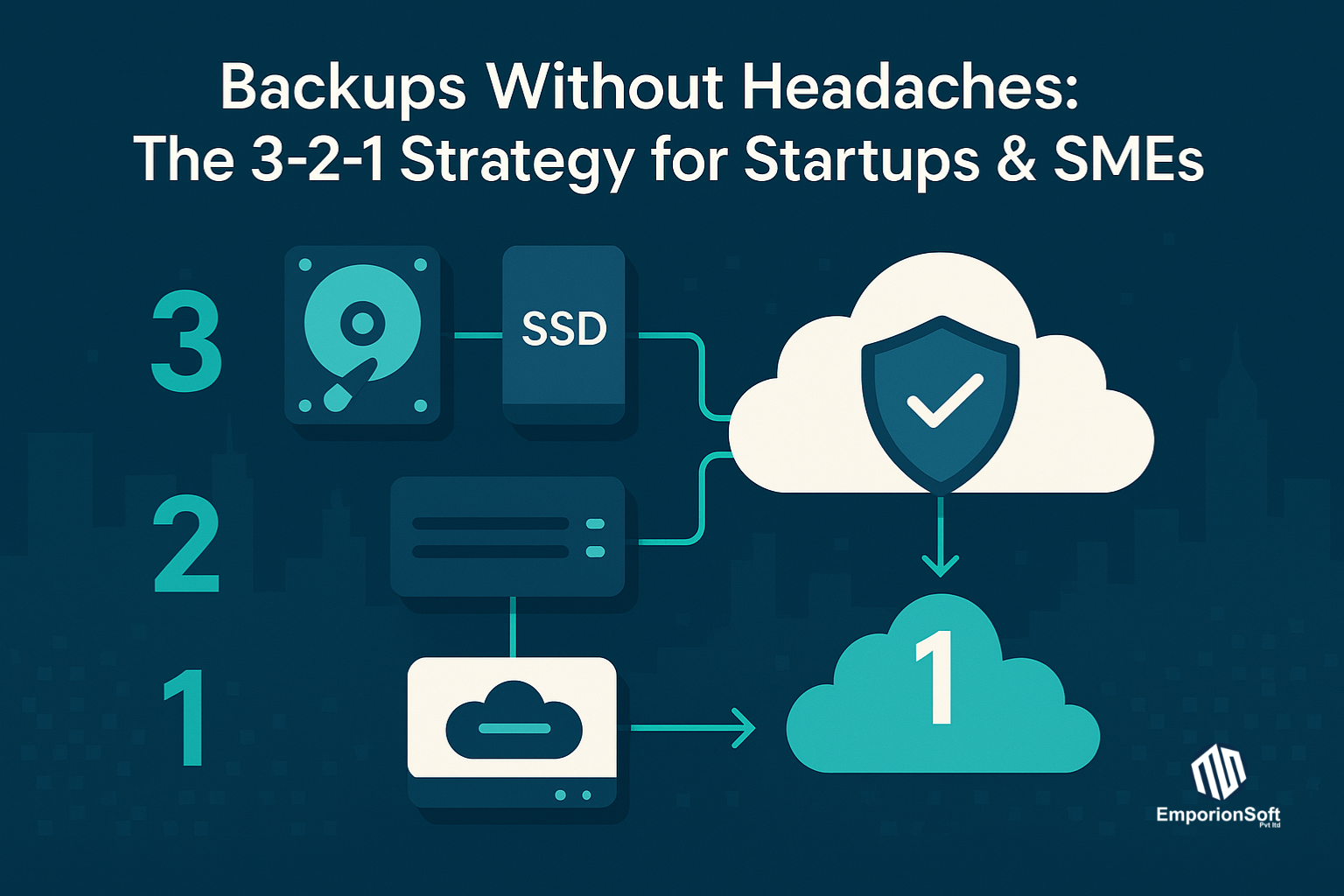
The first stage is selecting your backup media. You need a combination that supports the “3” and “2” components of the rule. Many Pakistani companies begin by using their daily working files stored on local machines or a shared office server. For the second copy, an external hard drive (HDD), solid-state drive (SSD), or a NAS device is ideal. HDDs offer large storage at low cost, SSDs provide faster performance and durability, while NAS systems act as mini-servers that multiple team members can access. Each business can choose based on budget and data size.
The third copy should sit off-site—and this is where cloud solutions shine. Services like Google Cloud, iCloud, OneDrive, or S3-compatible platforms have made the cloud backup Pakistan 3-2-1 rule far easier to follow. Even small companies can store encrypted backups in the cloud with automated schedules. This becomes your ultimate safety net if your office environment is ever compromised due to theft, fire, hardware failure, or a cyberattack.
Step-by-Step Breakdown for Startups & SMEs
1. Pick Your Storage Combination
A practical starter setup for Pakistani SMEs might look like this:
-
Copy 1 (Primary): Your live working files stored on laptops or a shared office server.
-
Copy 2 (Secondary Local Copy): A weekly or daily backup stored on an SSD or NAS device.
-
Copy 3 (Off-Site Copy): A cloud backup synced automatically on a secure account.
This hybrid setup fits the hybrid backup solutions Pakistan 3-2-1 approach—fast recovery locally, long-term safety in the cloud.
2. Automate Your Backups
Manual backups are risky because someone inevitably forgets. Automation is essential. Most NAS systems come with built-in scheduling tools, and cloud platforms allow automated syncs at set intervals. Even external drives can use lightweight backup software to run daily or weekly jobs without relying on human memory. The goal is to ensure consistency and minimise room for error.
3. Decide Your Backup Frequency
Different businesses need different rhythms. A design agency might back up once a day, while a SaaS startup handling rapid code changes might do it hourly. Retail or trading companies may only need daily backups of sales and inventory records. The general rule is simple: back up as frequently as you can without interrupting operations.
For growing organisations with increasing data volumes, automation helps keep the process smooth and hands-free.
4. Make Off-Site Storage Mandatory
Local backups are convenient, but off-site storage protects you from disasters. Cloud storage is the easiest method, but some companies may store removable encrypted drives at a separate office location. The point is redundancy—keeping at least one copy well away from the physical environment of your business.
5. Test Backup Integrity Regularly
Many SMEs make the mistake of backing up everything but never checking if those backups actually work. At least once a month, restore a few files to verify integrity. Recovering is just as important as storing. Without testing, you only have a false sense of security.
6. Start Small if Your Budget Is Limited
You don’t need enterprise-grade infrastructure on day one. A Lahore-based small business can begin with a simple SSD for local backups and a basic cloud plan. As data grows, the system can scale—bigger drives, more advanced NAS setups, or automated cloud versioning.
7. Bring in Specialists When Needed
When data grows too complex or when a business relies heavily on digital operations, involving a professional partner becomes wise. EmporionSoft can help organisations design secure, scalable backup workflows that avoid common pitfalls and align with long-term digital strategy. Explore more on the Services page or request guidance through Consultation.
A structured implementation ensures that the 3-2-1 rule becomes second nature—a dependable part of how your business operates every day.
Costs, Tools, and Budgeting for the 3-2-1 Backup Strategy
Budgeting for the 3-2-1 backup strategy doesn’t need to feel overwhelming. One reason this model is so widely adopted is its flexibility—it scales for small startups in Lahore just as well as for mid-sized enterprises in Karachi or Islamabad. You can begin with low-cost tools, expand gradually, or invest in enterprise-grade storage depending on your business needs. Understanding the true costs—from hardware to cloud subscriptions—helps you build a resilient data system without overspending.
The first component of the model usually involves local storage. HDDs remain the most budget-friendly option for Pakistani businesses, with 1TB drives costing anywhere between PKR 9,000–12,000. SSDs—while faster and more durable—cost more, typically PKR 15,000–22,000 for similar capacity. NAS devices, which allow multiple users to back up data simultaneously, range from PKR 35,000 for basic two-bay units to over PKR 120,000 for higher-end systems. For many SMEs, combining an SSD for quick recovery and a NAS for centralised storage strikes the right balance between price and performance.
The second cost layer comes from cloud solutions. Cloud pricing varies depending on the provider and the storage tier. In Pakistan, access to major players like Google Cloud, AWS, and Azure is straightforward, and prices are generally quoted in USD. Google Cloud charges around $0.020–$0.026 per GB per month for standard storage. AWS S3 falls in a similar range, with their official pricing page offering granular cost breakdowns based on usage tiers. Microsoft Azure’s calculator also shows pricing between $0.018–$0.025 per GB, making all three providers fairly comparable. Many SMEs find cloud storage affordable because they only pay for what they use, and they can scale at any pace.
For companies searching for free or low-cost tools, open-source options are attractive. Solutions like Duplicati, UrBackup, and Restic offer encrypted backups, automation, and cross-platform compatibility at zero licensing cost. When used with a NAS or an inexpensive cloud provider, they form a strong foundation for a Pakistani company backup strategy 3-2-1 without significant investment.
However, cost isn’t only about hardware or cloud subscriptions. Businesses often overlook the hidden expenses: the time spent setting up backup workflows, the cost of migrating data from old machines, and the ongoing need to test backups. Neglecting testing can turn even the best-planned system into a false safety net. Monthly integrity checks and occasional restoration drills should be part of your operational planning, even if they require a little extra time or staff training.
Another factor to consider is the hardware-versus-software trade-off. Local hardware offers quick recovery times and low long-term costs but requires physical maintenance and occasional upgrades. Cloud software removes physical handling, ensures geographic redundancy, and automates much of the process, but it introduces recurring subscription fees. Most Pakistani SMEs opt for a hybrid approach, using hardware for speed and convenience, and software-based cloud storage for long-term off-site protection.
Cities like Lahore, Karachi, and Islamabad present varying cost landscapes. Urban SMEs often face higher operational expenses, so cloud-first strategies may be more appealing for their predictability. Smaller businesses or those in developing areas may prioritise local storage to avoid reliance on inconsistent connectivity. On average, most SMEs in major cities spend between PKR 3,000–15,000 monthly on cloud services and PKR 20,000–80,000 upfront for hardware, depending on the scale of their data.
For companies researching which cloud option suits them best, EmporionSoft’s guides on the Future of Cloud Computing and the Cloud Providers Comparison 2025 offer detailed insights into pricing structures, performance, and strategic fit. These resources help organisations match their backup budgets with long-term operational plans.
In the end, understanding the 3-2-1 backup strategy cost Pakistan landscape isn’t about hitting an exact number—it’s about building a system that fits your needs, balances cost and protection, and evolves as your data grows. Whether you use enterprise solutions or a mix of affordable tools and cloud tiers, the data backup strategy Pakistan 3-2-1 principle remains the most reliable, budget-conscious way to secure business continuity.
Common Backup Mistakes Pakistani SMEs Make
Despite growing awareness, many small and medium-sized businesses still struggle with effective data protection. Even when owners have heard of the 3-2-1 backup strategy, they often misunderstand how to apply it. These missteps usually don’t seem dangerous—until a crisis hits and everything unravels at once. The result is preventable downtime, lost revenue, and damaged client trust. Understanding where businesses commonly go wrong is the first step toward stronger resilience.
One of the most frequent oversights is relying on a single local backup, usually stored on the same machine or in the same office. A shop in Lahore might keep customer ledgers on a laptop and store a backup on an external USB drive in the same drawer. When that laptop gets infected with malware, or when the shop faces a power surge, both copies can become corrupted instantly. This is exactly why the layered design of 3-2-1 data backup Pakistan is so essential.
Another recurring problem is misconfiguration—especially when cloud services are involved. Many founders assume that because their files sync to Google Drive or OneDrive, they are automatically protected. But cloud sync is not the same as a backup. If someone accidentally deletes a critical project folder or overwrites an important document, the cloud service often syncs that deletion across every device. The entire file history disappears unless versioning is manually enabled. This misunderstanding leaves many businesses believing they are safe when they are actually exposed to major risk.
A related issue is assuming cloud providers automatically manage everything. Misplaced settings, weak passwords, disabled 2FA, and unrestricted access permissions can create vulnerabilities that allow ransomware or insider errors to spread quickly. Without the structured layers defined in the 3-2-1 backup methodology Pakistan, even cloud-centric businesses can fall victim to complete data loss.
Testing is another major blind spot. Many SMEs perform backups but never verify whether those backups actually work. Without regular testing, corrupt files and incomplete syncs remain unnoticed until a real emergency occurs—and by then, it is too late. Proper testing is a core element of a mature disaster recovery backup Pakistan 3-2-1 strategy, but it’s also one of the most ignored.
Malware can also wipe out poorly structured backups. If a company relies only on a plug-in external drive, sophisticated ransomware can target that device as well. Many attacks are designed to destroy or encrypt every storage medium connected to the infected system. Without an off-site or cloud-based copy, recovery becomes nearly impossible.
These issues aren’t theoretical—they reflect real experiences from businesses across Pakistan. And for organisations wanting to strengthen resilience further, EmporionSoft’s insights on Disaster Recovery & Business Continuity provide deeper strategic guidance.
Real Situations Where the 3-2-1 Rule Could Have Saved the Day
Real-world examples show how quickly a small mistake can snowball into a significant operational crisis.
Consider a small digital marketing agency in Islamabad. Their designers stored branding assets on a shared PC and backed them up weekly to a portable drive. One evening, the office was hit by ransomware. The malware encrypted not only the main machine but also the USB drive plugged into it. With no off-site copy, months of client work vanished instantly. A simple implementation of the 3-2-1 backup strategy—with at least one cloud copy—would have preserved everything.
Another example involves a Karachi-based online store. Their product database lived on a local server, with a secondary copy synced to Google Drive. When a new team member mistakenly deleted a master folder, Google Drive treated the deletion as an instruction and synced the removal everywhere. No version history was enabled. Had they followed the 3-2-1 data backup Pakistan approach and kept an isolated third copy on a cloud backup platform, the loss would have been trivial instead of devastating.
A textile business in Faisalabad faced a different issue. Their NAS device was configured incorrectly, causing backups to fail silently for nearly six months. No one noticed until a hardware crash highlighted the problem. Regular testing—part of a healthy disaster recovery backup Pakistan 3-2-1 strategy—would have exposed the issue early and prevented panic.
Another common situation involves theft. Many SMEs keep storage drives in the same office where laptops, desktops, and POS systems operate. When a Lahore-based retail outlet experienced a break-in, thieves stole both the primary systems and the local backup drives. Only an insured, off-site cloud copy would have protected their financial records and inventory data.
These situations highlight why the 3-2-1 backup methodology Pakistan works across industries. The model ensures at least one copy stays out of harm’s way—away from theft, malware, misconfiguration, and accidental deletion.
For organisations seeking personalised guidance on designing a safer backup structure, EmporionSoft can be reached through Contact Us for tailored support.
The 3-2-1 Backup Strategy: Your Blueprint for a Stress-Free Future
In the fast-moving world of modern business, unpredictability is the only constant. Devices fail, ransomware evolves, human error slips through, and cloud platforms misbehave when you least expect it. That’s exactly why the 3-2-1 backup strategy stands as one of the most reliable long-term shields for both Pakistani SMEs and international startups. It isn’t just a technical framework—it’s business insurance, operational confidence, and peace of mind wrapped into a simple, structured approach.
Over the course of this guide, you’ve seen how this rule offers protection from every angle. Three copies ensure redundancy. Two different media types minimise risk from single-point failures. One off-site copy safeguards your organisation against disasters—natural or digital. Whether you operate in Lahore, Karachi, Islamabad, or serve clients around the world, the resilience of your business depends on how well your data is protected. For companies exploring 3-2-1 backup strategy cost Pakistan considerations, the core value isn’t just in saving money—it’s in preserving continuity and avoiding catastrophic downtime.
The importance of this model becomes even clearer when looking at global research. Gartner’s studies on cyber-resilience highlight that most breaches escalate not because organisations lack tools, but because they lack structured, multi-layered backup systems. That’s exactly where the 3-2-1 model excels. It’s simple enough for non-technical teams, but powerful enough to meet international standards for security and disaster recovery.
Throughout this article, we’ve explored how implementation works in real life—choosing the right media types, combining local and cloud storage, automating backups, and testing data integrity regularly. Hybrid setups show particular strength, blending fast local recovery with the safety of off-site or cloud-based protection. For tech-forward businesses or fast-scaling startups, hybrid backups are the easiest way to future-proof operations while keeping systems agile.
We’ve also looked at common mistakes—misconfigurations, relying solely on Google Drive sync, storing all backups in one location, skipping testing, or using outdated hardware. These are pitfalls many SMEs encounter unintentionally, especially when operating without dedicated IT teams. The structured nature of the data backup strategy Pakistan 3-2-1 approach eliminates these vulnerabilities with clear, practical safeguards that stay consistent over time.
Above all, the 3-2-1 method works because it adapts to your scale. Whether you’re running a three-person agency, a SaaS startup, an e-commerce brand, a retail shop, or a production house—the core rule stays the same. You don’t need enterprise budgets or complex data centres. You simply need discipline, consistency, and a smart combination of local, cloud, and off-site storage.
Ready to Protect Your Business? EmporionSoft Can Help.
Data resilience isn’t something to postpone until “next quarter” or “after the next release cycle.” Every business—big or small—has moments when one unexpected event can disrupt everything. The real question isn’t whether something will go wrong; it’s whether your business will be ready when it does.
EmporionSoft helps companies across Pakistan and around the world turn the 3-2-1 rule into a customised, automated, and future-proof system. Whether you need help designing a hybrid setup, integrating cloud services, automating backups, improving recovery time, or aligning with global best practices, our experts are here to guide you step by step.
If you’re considering a modern Pakistani company backup strategy 3-2-1 or want to strengthen your disaster-recovery posture, now is the perfect moment to act. Your data deserves more than a single USB drive or a cloud sync folder—you need a structure that stands strong through hardware failures, cyberattacks, accidental deletions, and operational growth.
Take the first step toward complete peace of mind:
👉 Discuss your needs with us:
https://blogs.emporionsoft.com/contact-us/
👉 Book a consultation for a tailored backup assessment:
https://blogs.emporionsoft.com/consultation/
👉 Explore our full suite of services:
https://blogs.emporionsoft.com/services/
Your data is the engine of your business. Protect it with a strategy built to last—and a team that understands how to safeguard your success.
Leave a Reply