Author: EmporionSoft Pvt Ltd

  • Beta Testing Guide for Web & Mobile App Launches

    Beta Testing Guide for Web & Mobile App Launches

    How a Strong Beta Testing Strategy Makes or Breaks Your App

    Most web and mobile apps don’t fail because of bad ideas.
    They fail because real users expose problems too late.

    Teams rush to launch, trust internal testing, and hope for the best. Once users arrive, bugs surface, UX gaps appear, and retention drops fast. This is where a structured beta testing guide becomes critical. Beta testing is not a final polish. It is a strategic validation phase that decides whether your product is ready for the real world.

    For startups and growing businesses, beta testing often marks the difference between momentum and rework. A well-run beta uncovers usability issues, performance gaps, and feature misunderstandings before they damage trust or brand perception.

    Why Modern Products Can’t Skip Beta Testing

    Today’s users expect stability, speed, and clarity from day one.
    They compare your app against polished global products, not local competitors.

    A proper beta testing guide helps teams validate assumptions early. It exposes how real users behave, not how teams expect them to behave. This insight is especially important for SaaS platforms, mobile apps, and complex web systems built under tight timelines.

    Many teams confuse beta testing with internal QA. They are not the same. Internal testing checks if features work. Beta testing checks if features make sense to users.

    EmporionSoft works with global clients to design scalable testing workflows alongside development. These workflows align closely with modern delivery models such as those outlined in adaptive software development practices, where feedback loops drive continuous improvement rather than late-stage fixes.

    Beta Testing vs Alpha Testing: A Critical Distinction

    Understanding beta testing vs alpha testing is essential before planning execution.

    Alpha testing happens in controlled environments. It focuses on functional correctness and major defects. Beta testing moves the product into real-world conditions. It tests usability, reliability, and user perception.

    In a beta phase, users don’t follow scripts. They explore freely. That freedom is exactly what reveals hidden risks.

    A practical software beta testing guide treats beta users as collaborators, not testers. Their behaviour highlights friction points that analytics alone cannot explain.

    According to industry research from Gartner’s software quality insights, organisations that integrate user-driven testing earlier reduce post-launch defects significantly. This reinforces why beta testing should be planned, not improvised.

    Who Needs a Beta Testing Guide the Most?

    Beta testing is valuable for all products, but it is essential for fast-moving teams.
    This includes SaaS startups, enterprise platforms, and mobile-first businesses.

    A structured beta testing guide is especially critical for teams balancing speed and quality. It provides clarity on scope, users, timelines, and success criteria. Without structure, beta tests often turn into untracked feedback and missed insights.

    Companies investing in scalable software architectures, like those discussed in EmporionSoft’s building resilient software strategies, benefit most when beta testing validates both functionality and resilience under real usage.

    Setting the Stage for the Beta Testing Process

    Before diving into tools, timelines, or users, teams need alignment.
    What does success look like? What risks matter most?

    This is where a beta testing guide provides strategic direction. It connects business goals with user feedback and technical validation. It also ensures beta testing supports product strategy rather than delaying release.

    If you are building a web or mobile application and planning for launch, beta testing should be treated as a core phase, not an optional step. When aligned with experienced development partners like EmporionSoft’s software services, beta testing becomes a growth enabler rather than a bottleneck.

    Beta Testing Fundamentals and Methodology Explained

    A successful beta phase is never improvised.
    It follows a clear structure, purpose, and measurable goals.

    This section of the beta testing guide breaks down what beta testing really means in practice and how modern teams apply a proven beta testing methodology to reduce launch risk. When done correctly, beta testing becomes a learning system, not a bug hunt.

    What Beta Testing Really Is (and What It Is Not)

    Beta testing is the first time your product meets real users in real environments.
    Devices vary. Networks fail. Behaviour becomes unpredictable.

    Unlike internal QA, beta testing focuses on experience. It answers questions that automated tests cannot. Can users complete key tasks easily? Do features match expectations? Where do users hesitate or abandon flows?

    A proper software beta testing guide treats beta users as early adopters. They are not looking for perfection, but they do expect stability and clarity. Their feedback reflects real market conditions rather than lab scenarios.

    Core Principles of Beta Testing Methodology

    An effective beta testing methodology is built on three principles.

    First, limited scope.
    Beta testing is not about validating every feature. It targets high-risk areas such as onboarding, payments, performance, and core workflows.

    Second, real-world exposure.
    Beta tests must run in live-like environments. This includes real devices, varied user locations, and natural usage patterns.

    Third, structured feedback loops.
    Unstructured feedback creates noise. A strong beta testing guide defines how insights are collected, prioritised, and acted upon.

    These principles align closely with delivery models highlighted in the software developer’s roadmap for 2025, where continuous validation replaces long release cycles.

    Closed Beta Testing vs Open Beta Testing

    Choosing between closed beta testing and open beta testing depends on product maturity and risk tolerance.

    Closed beta testing involves a small, carefully selected group. It works best for early-stage products, regulated platforms, or complex systems. Teams gain focused feedback and can respond quickly.

    Open beta testing invites a broader audience. It helps test scalability, performance, and edge cases. However, it requires stronger monitoring and support processes.

    When to choose each approach:

    • Closed beta

      • Early product stages

      • High-risk features

      • Sensitive data or workflows

    • Open beta

      • Near-launch products

      • Performance and load testing

      • Market validation

    EmporionSoft often advises clients to start with a closed beta, then expand gradually. This staged approach reduces risk while maintaining momentum.

    Beta Testing Best Practices Teams Often Miss

    Many beta programmes fail because they lack intention.
    Following beta testing best practices keeps the process focused and effective.

    Clear objectives matter. Every beta test should answer specific questions. Without them, teams collect opinions instead of insights.

    Communication also matters. Beta users need context, expectations, and clear channels. Silent testers rarely provide useful feedback.

    Finally, iteration matters. Beta testing is not a one-time gate. It is a loop. Teams that integrate beta insights continuously see stronger post-launch stability.

    These practices reflect guidance from Google Cloud’s software testing lifecycle, which emphasises early feedback and rapid response.

    Aligning Beta Testing with Product Strategy

    A beta testing guide should never exist in isolation.
    It must support broader product and business goals.

    Teams building scalable systems, like those described in building resilient software strategies, use beta testing to validate reliability under real pressure.

    The Complete Beta Testing Process and Key Phases

    A strong beta programme succeeds because it follows a clear path.
    Without structure, feedback becomes scattered and decisions stall.

    This part of the beta testing guide walks through the full beta testing process, from early planning to actionable outcomes. Each phase has a purpose, and skipping one often leads to missed insights or delayed launches.

    Phase 1: Planning the Beta Test with Clear Objectives

    Every effective beta test starts with intent.
    Teams must define what they want to learn before inviting users.

    This is where a beta testing plan template becomes useful. While formats vary, the core elements remain consistent. Define the product scope, target users, testing duration, and success indicators. Focus on high-risk features rather than the entire product.

    Planning also includes deciding whether the beta supports usability validation, performance testing, or market readiness. Clear goals prevent feedback overload and help teams prioritise fixes.

    Many product teams align beta planning with structured delivery frameworks, similar to those discussed in project management tools for tech companies, where scope control and accountability are critical.

    Phase 2: Preparing the Environment and Users

    Once objectives are clear, preparation begins.
    This phase ensures testers and systems are ready.

    Technical readiness matters. Builds should be stable enough for real use, even if not feature-complete. Logging, crash reporting, and analytics must be enabled before users join.

    User preparation matters just as much. Beta testers need guidance on what to test and how to report issues. Clear instructions increase response quality and reduce confusion.

    A practical beta testing checklist at this stage often includes:

    • Stable beta build deployment

    • Feedback channels defined

    • User access and permissions verified

    • Data tracking enabled

    Skipping preparation leads to incomplete feedback and wasted cycles.

    Phase 3: Executing the Beta Testing Process

    Execution is where theory meets reality.
    Users begin interacting with the product in their own environments.

    During this phase, teams observe behaviour rather than assumptions. The beta testing process should allow testers to explore naturally while still encouraging feedback on priority areas.

    Monitoring is critical. Teams should track crashes, performance dips, and usage patterns daily. Quick responses show testers their input matters, which increases engagement.

    This execution mindset aligns with modern practices described in adaptive software development, where responsiveness outweighs rigid plans.

    Phase 4: Managing the Beta Testing Timeline

    Timing can make or break a beta test.
    A poorly planned beta testing timeline either rushes feedback or drags momentum.

    Most beta tests run between two and six weeks. Shorter cycles work for focused feature validation. Longer cycles suit complex platforms or multi-region products.

    Teams should schedule mid-cycle reviews rather than waiting until the end. Early patterns often reveal the most critical issues. Adjusting scope mid-test is not a failure; it is a sign of learning.

    According to guidance from Atlassian’s product development lifecycle, iterative checkpoints significantly improve release quality.

    Phase 5: Transitioning from Testing to Action

    The final phase bridges testing and decision-making.
    Feedback must turn into clear actions.

    Teams review insights against original objectives. Bugs, usability gaps, and performance issues are categorised by impact and effort. This prepares the ground for fixes, retesting, or launch decisions.

    A well-managed beta testing process does not end with feedback collection. It ends when teams know exactly what to fix, what to delay, and what is ready.

    User Recruitment, Beta Testing Tools, and Real-World Execution

    Even the best beta plan fails without the right people and tools.
    Execution is where most beta programmes either shine or quietly collapse.

    This section of the beta testing guide focuses on how to recruit meaningful users, select effective beta testing tools, and run beta tests that reflect real-world conditions rather than ideal scenarios.

    How to Recruit the Right Beta Testing Users

    Beta testing user recruitment is about quality, not volume.
    A small group of relevant users often delivers more insight than a large, unfocused crowd.

    Start by defining your ideal beta tester profile. This could include early adopters, existing customers, internal stakeholders, or users who match your target market closely. Each group uncovers different risks.

    For example, power users often reveal workflow inefficiencies. New users expose onboarding and clarity issues. A balanced mix provides a more accurate product signal.

    Recruitment channels commonly include email invitations, in-app prompts, and community outreach. Many teams also leverage existing customer relationships built through professional partners like EmporionSoft’s global software services, where user access and consent are already established.

    Incentivising Participation Without Bias

    Motivation matters, but incentives must be handled carefully.
    Over-rewarding testers can distort feedback.

    Effective incentives include early access, feature influence, recognition, or limited perks. The goal is engagement, not praise. Testers should feel encouraged to report friction honestly.

    Clear expectations also help. Let testers know what kind of feedback matters most. This keeps responses focused and actionable.

    Choosing the Right Beta Testing Tools

    The right tools reduce friction for both users and teams.
    Strong beta testing tools simplify distribution, feedback, and monitoring.

    Most beta tool stacks include three layers:

    • Distribution tools for delivering beta builds

    • Feedback tools for collecting structured insights

    • Monitoring tools for tracking crashes and performance

    Popular options vary by platform. Mobile teams often rely on TestFlight or Google Play Console. Web teams focus on feature flags, analytics, and session tracking.

    When evaluating tools, prioritise ease of use and integration. Complex setups discourage feedback and slow response times. This principle aligns with productivity-focused workflows discussed in boosting developer productivity with Cursor AI.

    Authoritative guidance from Google Play Console beta testing documentation highlights the importance of staged rollouts and controlled user groups to manage risk effectively.

    Executing Beta Tests in Real-World Conditions

    Execution is where assumptions are challenged.
    Real users behave differently than test scripts predict.

    Encourage testers to use the product naturally. Avoid rigid instructions that limit exploration. At the same time, guide attention toward critical workflows such as onboarding, payments, or performance-sensitive features.

    Active monitoring is essential. Teams should track issues daily and respond quickly. Even simple acknowledgements increase tester engagement and trust.

    For cross-platform products, execution complexity rises. Different devices, operating systems, and network conditions introduce variables that internal testing cannot replicate. This is where beta testing delivers its highest value.

    Teams building multi-platform solutions often benefit from insights shared in cross-platform app development tools, where consistency and performance across environments are key concerns.

    Learning from Real Beta Testing Examples

    Effective beta testing examples share a common trait.
    They treat beta as a collaboration, not a checklist.

    Successful teams adjust scope mid-test, release quick fixes, and communicate openly. Failed beta tests usually collect feedback without acting on it.

    Execution is not about perfection. It is about learning fast and responding faster.

    Beta Testing Feedback Collection, Metrics, and Insight Analysis

    Feedback is only valuable when it leads to decisions.
    Raw opinions without structure slow teams down instead of guiding them forward.

    This section of the beta testing guide explains how to design effective beta testing feedback collection, track the right beta testing metrics, and perform beta testing feedback analysis that supports confident product decisions.

    Designing Feedback Collection That Produces Signal, Not Noise

    Most beta tests collect too much feedback and still miss the point.
    The problem is not participation. It is structure.

    Strong beta testing feedback collection starts with intentional channels. Open text alone creates noise. Structured inputs guide users toward useful insights.

    Effective beta programmes combine multiple methods:

    • Short in-app surveys for usability insights

    • Bug reports with context and reproduction steps

    • Usage analytics for behaviour patterns

    • Direct interviews with selected testers

    Each method answers a different question. Together, they provide clarity rather than contradiction.

    Teams working on data-heavy platforms often align feedback flows with analytics strategies like those discussed in harnessing the power of data lakes, where structured data enables faster insight extraction.

    Defining Beta Testing Metrics That Actually Matter

    Not all metrics are equal.
    Vanity numbers create false confidence.

    Meaningful beta testing metrics align directly with beta objectives. If onboarding clarity is a risk, completion rates matter. If performance is a concern, load times and crash rates matter.

    Key beta metrics often fall into two categories:

    Quantitative metrics

    • Crash frequency

    • Task completion rates

    • Feature adoption

    • Session duration

    Qualitative metrics

    • User-reported friction

    • Confusion points

    • Feature expectations

    • Satisfaction trends

    Balancing both prevents misinterpretation. High engagement with poor sentiment is still a risk. Positive sentiment with low usage also signals problems.

    Modern teams increasingly combine qualitative feedback with real-time data streams, similar to approaches described in real-time AI in production environments, where timely insight enables rapid response.

    Analysing Beta Feedback Without Bias

    Analysis is where beta tests succeed or fail.
    Teams often overreact to loud voices and ignore patterns.

    Effective beta testing feedback analysis focuses on frequency, impact, and alignment with goals. One complaint may be anecdotal. Repeated patterns indicate systemic issues.

    Start by grouping feedback into themes. Prioritise issues that block core workflows or affect many users. Avoid perfectionism. Beta testing is about readiness, not flawlessness.

    Cross-functional reviews improve objectivity. When product, design, and engineering analyse feedback together, blind spots shrink and decisions improve.

    According to usability research from Nielsen Norman Group, pattern-based analysis consistently outperforms isolated feedback interpretation when improving user experience.

    Turning Insights into Actionable Outcomes

    Feedback without action erodes trust.
    Testers notice when reports disappear into silence.

    Translate insights into clear actions. Assign ownership. Define timelines. Communicate progress back to testers when possible. This closes the loop and increases engagement.

    For organisations delivering complex systems at scale, like those supported by EmporionSoft’s software development services, structured feedback analysis ensures beta testing strengthens product confidence rather than delaying launch.

    Beta Testing Common Mistakes, Reporting, and Test Case Design

    Many beta tests fail quietly.
    Not because teams skip testing, but because they repeat avoidable mistakes.

    This section of the beta testing guide focuses on beta testing common mistakes, how to structure beta testing reporting, and why well-defined beta testing test cases improve clarity, speed, and decision-making.

    The Most Common Beta Testing Mistakes Teams Make

    Beta testing often breaks down due to misalignment, not effort.
    Teams collect feedback but struggle to act on it.

    One frequent mistake is inviting too many users too early. Large beta groups generate noise without clear direction. Smaller, focused groups usually deliver stronger insights.

    Another common issue is vague objectives. Without defined goals, teams cannot decide which feedback matters. This leads to endless iterations and delayed launches.

    Ignoring negative feedback is equally damaging. Beta users surface uncomfortable truths. Dismissing them creates blind spots that reappear after launch.

    These mistakes often appear in fast-moving teams dealing with growing complexity, similar to challenges described in technical debt explained, where unresolved issues compound over time.

    Why Beta Testing Reporting Matters More Than Raw Feedback

    Feedback alone does not drive decisions.
    Clear reporting does.

    Effective beta testing reporting transforms scattered input into a shared understanding across teams. Reports should highlight patterns, risks, and recommendations rather than listing every comment.

    Strong beta reports usually include:

    • Summary of testing objectives

    • Key findings and recurring issues

    • Impact assessment on launch readiness

    • Recommended actions and priorities

    Visual clarity matters. Simple summaries help stakeholders grasp risk quickly without reading raw logs or transcripts.

    Teams using structured delivery frameworks, like those outlined in project management tools for tech companies, benefit most when beta insights are documented clearly and shared consistently.

    According to Harvard Business Review’s research on decision-making, structured reporting significantly improves the quality and speed of organisational decisions.

    Writing Effective Beta Testing Test Cases

    Many teams underestimate the value of clear beta testing test cases.
    They assume beta users will “figure it out.”

    Test cases do not restrict exploration. They provide direction. A good test case highlights critical workflows while still allowing natural usage.

    Effective beta test cases focus on outcomes rather than steps. Instead of telling users exactly what to click, they describe goals. This reveals whether the product communicates clearly.

    Well-written test cases typically include:

    • Scenario description

    • Expected user outcome

    • Context or constraints

    • Feedback prompts

    This approach reduces confusion and ensures feedback aligns with objectives rather than personal preferences.

    Preventing Rework Through Better Beta Discipline

    Most post-launch issues trace back to ignored beta signals.
    Fixing them later costs more and damages trust.

    Avoiding common mistakes, reporting insights clearly, and using thoughtful test cases strengthens the entire beta testing process. It also shortens the path to confident release decisions.

    Teams that apply these practices consistently see beta testing as a strategic advantage rather than a hurdle. This mindset reflects modern development philosophies discussed in adaptive software development, where learning speed matters more than rigid plans.

    Beta Testing Exit Criteria, Launch Readiness, and Confident Release Decisions

    A beta test is only successful when it ends with clarity.
    Not when feedback stops, but when decisions become obvious.

    This final part of the beta testing guide focuses on defining clear beta testing exit criteria, evaluating beta testing launch readiness, and deciding when a web or mobile app is genuinely ready for the market.

    Defining Clear Beta Testing Exit Criteria

    Without exit criteria, beta testing drags on.
    Teams keep fixing, retesting, and second-guessing.

    Beta testing exit criteria set boundaries. They define what “ready” actually means for your product. These criteria should be agreed upon before the beta starts, not after fatigue sets in.

    Common exit signals include:

    • No critical or blocking issues remaining

    • Core workflows completed successfully by most users

    • Performance and stability within acceptable thresholds

    • Feedback trends stabilising rather than escalating

    Exit criteria are not about perfection. They are about acceptable risk. Every product launches with known limitations. Beta testing ensures those limitations are understood and manageable.

    Teams that align exit criteria with broader engineering goals, like those discussed in building resilient software strategies, release with far greater confidence.

    Assessing True Beta Testing Launch Readiness

    Launch readiness is not a feeling.
    It is an evidence-based decision.

    Beta testing launch readiness combines technical stability, user confidence, and operational preparedness. A product may work technically but still fail if users feel confused or unsupported.

    Ask the right questions before release. Can users complete key tasks without guidance? Are support teams prepared for real-world usage? Do analytics confirm expected behaviour patterns?

    Readiness also includes internal alignment. Product, engineering, and stakeholders must share the same understanding of risks and priorities. Clear beta testing reporting, reviewed collectively, makes this alignment possible.

    Guidance from Gartner’s release management research consistently shows that teams with structured readiness reviews experience fewer post-launch disruptions.

    Making the Go or No-Go Decision with Confidence

    The final decision should feel deliberate, not rushed.
    Beta testing exists to remove doubt, not add delay.

    A confident launch decision acknowledges known issues while trusting validated core experiences. If beta insights show consistent user success, stable performance, and manageable risks, the product is ready to move forward.

    This decision-making discipline mirrors mature delivery practices seen across high-performing software teams. It also reflects the mindset promoted by EmporionSoft’s software development services, where quality, scalability, and user trust guide every release.

    Turning Beta Testing into a Long-Term Advantage

    A strong beta testing guide does more than support one launch.
    It builds organisational muscle.

    Teams that treat beta testing as a strategic capability improve faster with every release. Feedback becomes sharper. Decisions become clearer. Launches become calmer.

    Whether you are a startup validating product-market fit or an established business scaling globally, beta testing protects both reputation and investment. When done right, it becomes a competitive advantage rather than a checkpoint.

    If you are planning a web or mobile app launch and want beta testing embedded into your development lifecycle, EmporionSoft Pvt Ltd can help. Explore real-world outcomes in our case studies, learn more about our team, or book a strategy discussion through our consultation page.

    A confident launch starts with informed testing.
    Beta testing is where that confidence is earned.
  • Cloud Cost Optimization: A Beginner’s Practical Guide

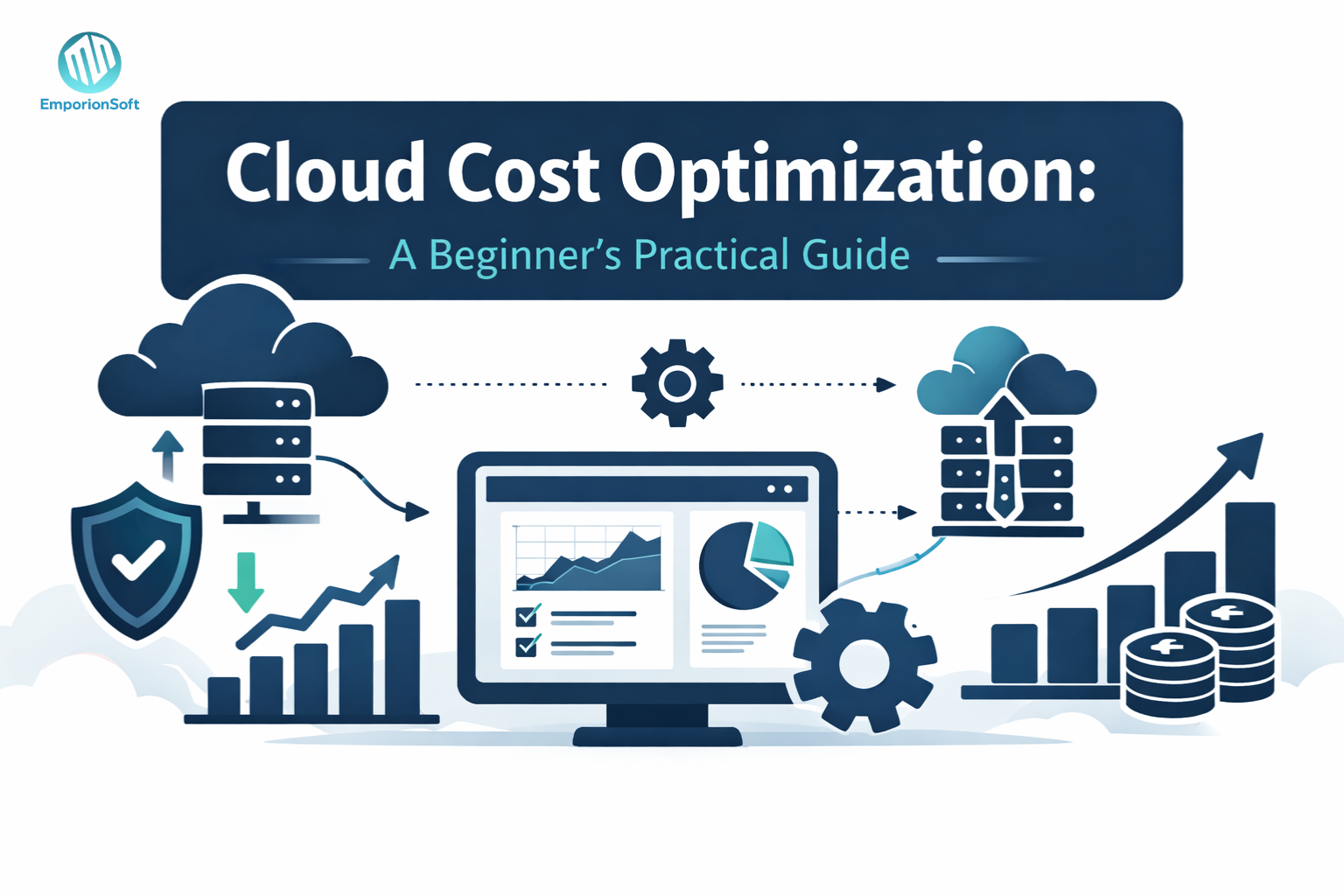
    Cloud Cost Optimization: A Beginner’s Practical Guide

    A Beginner’s Guide to Cloud Cost Optimization

    Understanding the Foundations Before You Spend More Than You Should

    Cloud adoption has transformed how organisations build, scale, and deliver software. Businesses can deploy globally in minutes, scale instantly, and pay only for what they use. However, this flexibility often comes with an unexpected downside. Cloud costs tend to grow quietly and rapidly, especially when environments are not actively monitored or governed. Many organisations realise too late that their cloud spend has outpaced their actual business growth.

    This is precisely where cloud cost optimization becomes critical. It is not about cutting corners or reducing innovation. Instead, it focuses on aligning cloud usage with real business value. Without a structured approach, teams often pay for idle resources, overprovisioned services, and inefficient configurations. Over time, these small inefficiencies accumulate into significant financial waste.

    What Is Cloud Cost Optimization?

    Cloud cost optimization is the disciplined practice of analysing, managing, and improving cloud spending while maintaining performance, security, and reliability. It ensures that every pound spent on cloud infrastructure delivers measurable value to the organisation. Rather than reacting to high invoices, cloud optimization introduces proactive cost awareness into daily engineering and business decisions.

    Unlike traditional IT environments, cloud infrastructure is highly dynamic. Resources scale automatically, pricing models vary by service, and usage patterns shift constantly. This makes manual tracking ineffective. Cloud cost optimization introduces structured processes, metrics, and tooling that allow organisations to stay in control even as their environments grow in complexity.

    At its core, cloud optimization is about balance. It aligns speed with sustainability, performance with efficiency, and innovation with financial discipline.

    Cloud Cost Management vs Traditional IT Cost Control

    Traditional IT cost control was largely predictable. Hardware investments were planned upfront, budgets were fixed annually, and infrastructure changes happened slowly. Once servers were purchased, costs remained stable regardless of actual usage. Cloud environments have fundamentally changed this model.

    With cloud platforms, costs fluctuate daily based on consumption. Engineering choices directly impact financial outcomes. A single misconfigured resource can generate unnecessary spend for months without being noticed. This shift has made cloud cost management a shared responsibility between finance, engineering, and operations teams.

    Modern organisations must treat cloud spending as an operational metric, not just a finance report. Cloud cost optimization enables teams to understand cost implications in real time, ensuring that technical decisions support business objectives rather than undermine them.

    Why Cloud Cost Optimization Matters Today

    Cloud services now power mission-critical systems across industries. From customer-facing platforms to data analytics and artificial intelligence workloads, the cloud has become the backbone of modern digital operations. As reliance increases, so does the financial impact of inefficiency.

    Industry research from Gartner highlights that a significant portion of cloud spend is wasted due to poor visibility, unused resources, and lack of governance
    (Gartner cloud cost management insights opens in a new tab). For startups, this waste can slow growth. For established enterprises, it quietly erodes margins and operational efficiency.

    Cloud computing cost optimization ensures that innovation remains sustainable. It allows organisations to scale confidently while maintaining control over financial performance. Without it, cloud spending becomes reactive rather than strategic.

    Key Benefits of Cloud Cost Optimization

    Effective cloud cost optimization delivers benefits far beyond immediate savings. It creates clarity, accountability, and long-term financial stability. Organisations gain better insight into where money is being spent and why. This transparency improves decision-making across both technical and business teams.

    Optimised environments also perform better. Right-sized resources reduce waste while improving application responsiveness. Teams can forecast costs more accurately, plan growth with confidence, and eliminate surprise bills. Over time, these improvements compound into stronger operational resilience and higher return on cloud investments.

    At EmporionSoft, cloud optimization is treated as a strategic capability rather than a billing exercise. Our teams design cloud architectures where efficiency, scalability, and performance evolve together
    EmporionSoft homepage.

    Introducing FinOps at a High Level

    As cloud complexity increased, organisations recognised the need for a new operating model. This led to the emergence of FinOps, short for Financial Operations. FinOps brings finance, engineering, and leadership together around shared visibility and accountability for cloud spending.

    FinOps does not restrict innovation or slow development. Instead, it empowers teams with real-time cost data and clear ownership. Engineers understand the financial impact of their decisions, while finance teams gain transparency into technical usage patterns. Leadership can then make informed decisions grounded in both performance and cost.

    While this guide will explore FinOps in more detail later, it is important to understand that successful cloud cost optimization is rarely achieved without FinOps principles at its core.

    The Real Challenge Isn’t Price — It’s Control

    Cloud providers offer competitive and transparent pricing. The real challenge lies in managing complexity across services, regions, and scaling rules. As environments grow, manual oversight becomes impossible. Without clear governance, even well-intentioned teams lose control over spending.

    This is why many organisations partner with experienced cloud specialists. EmporionSoft helps businesses design cost-aware cloud architectures from the outset, ensuring long-term efficiency rather than short-term fixes
    EmporionSoft services .

    Before any optimisation strategy can succeed, one question must be answered.
    Where exactly do cloud costs go wrong?

    Why Cloud Costs Spiral Out of Control: The Most Common Mistakes Organisations Make

    Cloud platforms are designed to deliver speed, flexibility, and near-unlimited scalability. However, these same strengths are often the reason cloud costs grow beyond expectations. Most organisations do not overspend because they misuse the cloud intentionally. They overspend because cloud environments expand faster than the processes designed to control them. What starts as a lean setup quickly becomes a complex mix of services, regions, and workloads, making cloud cost optimization increasingly difficult without deliberate oversight.

    A major cause of uncontrolled cloud spend is the absence of a structured cloud cost governance framework. Many businesses migrate to the cloud without clearly defining who owns cost decisions. Engineering teams provision resources to meet delivery deadlines, finance teams review invoices after costs are incurred, and leadership steps in only when spending becomes alarming. This reactive approach prevents effective cloud cost management and leaves little room for proactive optimisation. Governance does not limit innovation; it ensures that growth happens within financially sustainable boundaries.

    Overprovisioning is another widespread issue that undermines cloud resource optimization. To reduce the risk of performance issues, teams often allocate more capacity than applications actually require. While this creates a sense of safety, it leads to persistent underutilisation across compute, storage, and database services. Over time, these oversized resources become permanent fixtures, quietly inflating cloud bills month after month. Without regular rightsizing and performance reviews, these inefficiencies remain hidden and accepted as normal operating costs.

    Idle workloads and forgotten resources also contribute heavily to unnecessary cloud spending. Temporary environments created for testing, development, or experimentation are frequently left running long after their purpose has ended. These unused services continue to incur charges while delivering no value to the business. Effective cloud waste reduction strategies focus on identifying idle resources, automating shutdown schedules, and enforcing cleanup policies. Without these practices, organisations unknowingly pay for infrastructure that no one is using.

    Limited visibility into cloud billing further complicates optimisation efforts. Many organisations rely on high-level invoices that provide little insight into which teams, applications, or services are driving costs. This lack of transparency makes cloud billing optimization nearly impossible. Engineers cannot see the financial impact of their architectural decisions, and finance teams struggle to interpret technical usage patterns. Without detailed cost allocation and reporting, cloud cost benchmarking and informed decision-making become extremely difficult.

    Another common challenge is the lack of shared ownership between finance and engineering teams. Cloud cost optimization fails when these groups operate in silos. Engineering teams focus on performance and delivery speed, while finance teams concentrate on budgets and forecasts. Without collaboration, optimisation initiatives lose momentum and accountability. Successful organisations treat cloud spending as a joint responsibility, aligning technical decisions with financial outcomes through shared metrics and visibility.

    Cloud providers offer powerful tools, but they do not automatically optimise costs on behalf of customers. Platforms such as AWS and Google Cloud clearly state that users are responsible for managing efficiency and usage. Without deliberate optimisation strategies, cloud platforms simply scale inefficiencies faster. EmporionSoft has observed across multiple client engagements that sustainable savings only emerge when visibility, governance, and accountability are addressed together. For real-world examples, explore our cloud transformation work in the EmporionSoft case studies.

    For a deeper understanding of how unmanaged complexity impacts long-term efficiency, our analysis on technical debt explains how hidden inefficiencies accumulate over time.

    Before any cost reduction initiative can succeed, organisations must first understand where their cloud spending is going and why. In the next section, we’ll explore cloud cost analysis best practices and the performance metrics that truly matter for building sustainable cloud cost optimization strategies

    Cloud Cost Analysis Best Practices and Performance Metrics That Truly Matter

    Before any meaningful cloud cost optimization can take place, organisations must first understand exactly where their cloud spending is going. Many businesses rush into cost-cutting initiatives without proper analysis, which often leads to short-term savings but long-term inefficiencies. Cloud environments are highly dynamic, with costs shifting daily based on usage, scaling rules, and service configurations. Without structured cloud cost analysis best practices, optimisation efforts become reactive rather than strategic.

    The foundation of effective analysis is complete visibility across cloud services and workloads. This means tracking costs by application, environment, team, and business function instead of relying on high-level monthly invoices. When spending is broken down into meaningful categories, organisations can clearly identify which workloads deliver value and which contribute to waste. This level of insight transforms cloud cost management from a finance-only activity into a shared operational responsibility across teams.

    Cost allocation and tagging play a critical role in cloud cost optimization. By assigning costs to specific teams or projects, organisations create accountability and encourage responsible usage. Engineers gain awareness of the financial impact of architectural decisions, while finance teams gain clarity into technical spending patterns. This alignment supports sustainable cloud spend optimization and eliminates the common issue of shared costs with no clear ownership.

    Tracking the right cloud cost performance metrics is essential for ongoing optimisation. Metrics such as cost per user, cost per transaction, and cost per environment provide far more insight than total spend alone. These indicators allow organisations to measure efficiency as they scale and identify early warning signs of inefficiency. Monitoring these metrics over time enables continuous improvement in cloud computing cost optimization and supports data-driven decision-making.

    A centralised cloud cost insights dashboard brings cost data and performance metrics together in one place. Dashboards allow teams to monitor real-time spending trends, detect anomalies, and forecast future costs with confidence. Native tools provided by major cloud platforms make this process accessible, including
    AWS Cost Explorer ,
    Azure Cost Management , and
    Google Cloud Billing reports .
    These tools form the backbone of effective cloud cost analysis when used consistently.

    Forecasting and modelling further strengthen cloud cost optimization efforts. Using tools such as a cloud savings calculator allows organisations to estimate the financial impact of optimisation decisions before implementing them. Whether evaluating reserved pricing models, autoscaling policies, or storage optimisation, forecasting helps prioritise actions with the highest potential return. This approach directly supports stronger cloud optimization ROI strategies and reduces unnecessary risk.

    At EmporionSoft, cloud cost analysis is treated as a continuous discipline rather than a one-time exercise. Our teams help organisations design cost-aware cloud architectures supported by clear metrics, dashboards, and governance models
    (learn more about our approach on the
    EmporionSoft Services page . We also explore how evolving cloud models influence cost efficiency in our article on the
    future of cloud computing .

    Industry guidance reinforces the importance of ongoing measurement. The
    AWS Well-Architected Framework – Cost Optimization Pillar  highlights continuous monitoring and analysis as core principles of sustainable cost control. Similar recommendations appear across Azure and Google Cloud best practices, underlining that visibility is the starting point for all successful optimisation strategies.

    Once organisations clearly understand their cloud cost drivers and performance metrics, optimisation becomes far more effective. Analysis turns raw billing data into actionable insight. In the next section, we’ll explore proven cloud cost reduction strategies and optimisation techniques that organisations can confidently apply using these insights as their foundation.

    Proven Cloud Cost Reduction Strategies and Optimization Techniques That Deliver Real Savings

    Once cloud spending is clearly analysed and measured, organisations can move confidently into action. This is where cloud cost optimization shifts from theory to tangible results. Effective optimisation is not about aggressive cost-cutting or compromising performance. It focuses on aligning cloud usage with actual demand, eliminating waste, and choosing pricing models that match real workloads. When done correctly, cloud cost reduction strengthens both financial control and system reliability.

    One of the most impactful cloud optimization techniques is rightsizing resources. Many workloads are deployed with far more capacity than they ever use. Virtual machines, databases, and container clusters often run below 30 percent utilisation for long periods. Cloud rightsizing resources involves adjusting compute, memory, and storage to match actual usage patterns. This simple step alone can unlock immediate savings without affecting application performance, making it a cornerstone of sustainable cloud resource optimization.

    Pricing model optimisation is another powerful lever. Cloud providers offer multiple pricing options designed for different usage patterns, yet many organisations rely solely on on-demand pricing. Reserved instances and savings plans allow businesses to commit to predictable workloads in exchange for lower rates. This form of cloud pricing model optimization is especially effective for steady production environments. Platforms such as
    AWS Savings Plans ,
    Azure Reserved Instances , and
    Google Committed Use Discounts  provide significant long-term cost reductions when applied strategically.

    Autoscaling is another essential component of cloud cost reduction strategies. Instead of running infrastructure at peak capacity around the clock, autoscaling adjusts resources dynamically based on demand. This ensures systems scale up during high traffic periods and scale down when demand drops. Autoscaling not only improves performance but also plays a major role in cloud spend optimization by preventing unnecessary overprovisioning during low-usage periods.

    Storage optimisation is frequently overlooked, yet it represents a major opportunity for savings. Data often accumulates rapidly, and not all of it requires high-performance storage. By moving infrequently accessed data to lower-cost storage tiers, organisations can significantly reduce ongoing expenses. Implementing lifecycle policies and retention rules helps automate this process, supporting long-term cloud billing optimization without manual intervention.

    Another highly effective technique involves scheduling non-production environments. Development, testing, and staging systems rarely need to run continuously. By shutting down these environments outside working hours, organisations can eliminate a large portion of wasted spend. This approach is a core part of many cloud waste reduction strategies and delivers measurable savings with minimal effort.

    At EmporionSoft, these optimisation techniques are applied as part of a broader, outcome-driven strategy. We help organisations identify which actions deliver the highest impact based on their unique workloads and business goals
    (learn more about our optimisation approach on the
    EmporionSoft consultation page . Our experience across multiple cloud providers allows us to tailor optimisation strategies rather than apply generic fixes.

    Choosing the right optimisation techniques is not about applying everything at once. It is about prioritisation. When optimisation decisions are guided by accurate cost analysis and aligned with business objectives, the return on investment becomes clear and measurable. For deeper insight into how different platforms compare from a cost-efficiency perspective, explore our detailed
    cloud providers comparison for 2025 .

    Cloud Cost Optimization Tools and Platforms Across AWS, Azure, and Google Cloud

    As cloud environments grow in scale and complexity, manual cost control quickly becomes ineffective. This is where cloud cost optimization tools play a critical role. These tools provide visibility, automation, and insights that help organisations control spending without slowing innovation. When used correctly, they transform cloud cost optimization from a periodic exercise into a continuous, data-driven process embedded in daily operations.

    Most organisations begin with native tools provided by their cloud platforms. These tools are tightly integrated into the cloud ecosystem and offer reliable baseline capabilities for monitoring, reporting, and forecasting. For businesses running workloads on Amazon Web Services, AWS Cost Explorer and AWS Budgets provide detailed breakdowns of usage and spend, helping teams identify trends and anomalies early. These tools are often the first step toward structured cloud cost management within AWS environments.

    Microsoft Azure offers robust cost optimisation features through Azure Cost Management. It enables organisations to track spending across subscriptions, allocate costs to teams, and forecast future expenses. Azure’s integration with governance policies makes it particularly effective for enterprises that require strong cost controls alongside compliance. When used consistently, Azure’s tooling supports both short-term savings and long-term cloud spend optimization.

    Google Cloud takes a data-driven approach to cost optimisation. Google Cloud Billing reports and cost breakdowns allow teams to analyse spending at a granular level and compare usage across services. Google Cloud’s commitment-based discounts further support cloud pricing model optimization for predictable workloads. These native tools provide strong visibility for organisations operating at scale within GCP environments.

    While native tools are powerful, they are not always sufficient for complex, multi-cloud setups. This is where third-party cloud cost optimization tools add value. FinOps platforms aggregate data across providers, centralise reporting, and offer advanced analytics. They enable organisations to manage cloud cost optimization across AWS, Azure, and Google Cloud from a single interface, reducing operational overhead and improving decision-making.

    Selecting the right tool depends on business maturity and cloud strategy. Smaller teams often benefit most from native tooling combined with strong governance practices. Larger organisations or those operating across multiple providers typically require more advanced platforms to support cross-cloud visibility and automation. The key is to avoid tool sprawl and focus on solutions that align with existing workflows and optimisation goals.

    At EmporionSoft, tool selection is driven by outcomes rather than features. We help organisations evaluate cloud cost optimization tools based on real-world usage patterns and business objectives
    (learn more about our approach on the EmporionSoft services page: https://blogs.emporionsoft.com/services/). Our teams also guide clients through multi-cloud cost challenges explored in our cloud providers comparison for 2025: https://blogs.emporionsoft.com/cloud-providers-comparison-2025/.

    Authoritative guidance from cloud providers reinforces the importance of using built-in optimisation tools effectively. AWS, Microsoft, and Google all emphasise that tooling must be paired with governance and continuous monitoring to deliver sustained value. Cloud cost optimization succeeds not through tools alone, but through how consistently and intelligently those tools are applied.

    With the right platforms in place, organisations gain visibility and control over cloud spending at scale. In the next section, we’ll explore how FinOps practices and cloud cost governance frameworks help sustain savings long after the initial optimisation efforts are complete.

    FinOps Practices and Cloud Cost Governance for Long-Term Cost Control

    Short-term savings are easy to achieve. Long-term control is not. This is where many cloud cost optimization initiatives fall apart. Organisations implement rightsizing, adjust pricing models, and clean up waste, only to see costs creep back within months. Sustainable results require more than tools and tactics. They require structure, accountability, and culture. This is exactly what cloud FinOps practices and governance frameworks are designed to deliver.

    FinOps, short for Financial Operations, is an operating model that aligns finance, engineering, and business teams around shared cloud cost responsibility. Instead of treating cloud spending as a finance-only concern, FinOps embeds cost awareness directly into engineering workflows. Teams gain real-time visibility into spending and understand how architectural decisions affect financial outcomes. This collaboration transforms cloud cost optimization from a reactive exercise into a continuous discipline.

    A strong cloud cost governance framework provides the structure needed to support FinOps at scale. Governance defines who can provision resources, how budgets are enforced, and which policies guide usage. Without governance, even the best optimisation efforts quickly lose impact. Clear policies ensure that cloud usage aligns with business priorities while still allowing teams to innovate and move quickly.

    One of the most effective governance practices is establishing cost ownership at the team level. When teams are accountable for their own cloud spend, behaviour changes naturally. Engineers become more mindful of resource usage, and optimisation becomes part of everyday decision-making rather than an occasional clean-up task. This approach strengthens cloud spend optimization while preserving autonomy and speed.

    Automation plays a critical role in enforcing governance without slowing teams down. Budget alerts, policy-based restrictions, and automated approvals help prevent overspending before it happens. These controls allow organisations to maintain financial discipline while supporting growth. When combined with FinOps reporting, automation ensures that cloud cost optimization scales alongside the business.

    FinOps also encourages continuous learning and iteration. Cloud usage patterns evolve as products grow, customer demand shifts, and new services are adopted. Regular reviews of cloud cost performance metrics help teams adapt quickly and refine optimisation strategies. This ongoing feedback loop ensures that savings are not only achieved but sustained over time.

    At EmporionSoft, governance and FinOps are treated as strategic enablers rather than compliance exercises. We help organisations design governance models that balance control with flexibility, ensuring that cloud investments deliver consistent value
    (learn more about our approach on the EmporionSoft about page: https://blogs.emporionsoft.com/about/). Our experience building resilient systems also informs how governance supports long-term stability, as explored in our article on building resilient software strategies: https://blogs.emporionsoft.com/building-resilient-software-strategies-for-disaster-recovery-and-business-continuity/.

    Industry guidance strongly supports this approach. The FinOps Foundation outlines best practices for aligning teams, measuring value, and continuously optimising cloud spend. Cloud providers such as AWS, Azure, and Google Cloud also emphasise governance and shared accountability as core pillars of effective cloud cost management.

    When FinOps and governance are implemented together, cloud cost optimization becomes repeatable and predictable. Savings compound over time, decision-making improves, and financial surprises disappear. In the final section, we’ll bring everything together with a practical cloud cost optimization checklist and show how organisations can turn these principles into measurable business outcomes.

    Cloud Cost Optimization Checklist, Key Takeaways, and a Smarter Way Forward

    After understanding cloud cost drivers, analysing spend, applying optimisation techniques, and establishing governance, the final step is bringing everything together into a repeatable system. Cloud cost optimization is not a one-time project. It is an ongoing capability that evolves alongside your business. Organisations that succeed treat cost efficiency as part of their operating model, not a periodic clean-up exercise.

    A structured checklist helps teams maintain discipline as cloud environments grow. It ensures that optimisation principles are applied consistently, even as workloads, teams, and technologies change. This approach supports long-term cloud cost management while protecting performance, security, and scalability.

    Cloud Cost Optimization Checklist

    Use this checklist to evaluate and strengthen your optimisation efforts:

    • Gain full visibility into cloud spend across services, teams, and environments

    • Implement clear cost allocation and tagging standards

    • Track meaningful cloud cost performance metrics, not just total spend

    • Rightsize compute, storage, and database resources regularly

    • Optimise pricing models using reservations or committed usage where appropriate

    • Enable autoscaling to align capacity with real demand

    • Eliminate idle workloads and enforce environment scheduling

    • Use native and third-party cloud cost optimization tools effectively

    • Establish a cloud cost governance framework with clear ownership

    • Apply cloud FinOps practices to align finance, engineering, and leadership

    This checklist turns cloud cost savings tips into actionable habits rather than one-off actions. When followed consistently, it supports predictable spending and measurable ROI.

    Turning Optimization Into Business Value

    The real value of cloud cost optimization lies beyond reduced invoices. Optimised cloud environments scale more efficiently, perform better, and support faster innovation. Teams make decisions with confidence because they understand both technical and financial impact. Leadership gains predictability, which improves planning and investment decisions.

    Organisations that embed cost awareness into their cloud strategy also gain a competitive advantage. They can experiment faster, launch new features with confidence, and reinvest savings into growth initiatives. This is where cloud optimization ROI strategies become visible, not just on paper but in operational outcomes.

    Why Strategic Guidance Makes the Difference

    While tools and frameworks are essential, they are not enough on their own. Every cloud environment is different. Workload patterns, business goals, and growth trajectories all influence the right optimisation approach. This is why many organisations partner with specialists who understand both cloud engineering and financial strategy.

    EmporionSoft works with startups and enterprises across the UK and globally to design cost-efficient, high-performance cloud architectures. Our teams help organisations move beyond reactive cost cutting toward sustainable cloud cost optimization aligned with long-term business goals. You can explore how we approach complex cloud challenges through our services overview at https://blogs.emporionsoft.com/services/ and see real-world outcomes in our case studies at https://blogs.emporionsoft.com/case-studies/.

    If your organisation is looking to gain control over cloud spending without sacrificing performance or growth, a structured optimisation strategy is the right place to start. You can discuss your requirements directly with our cloud specialists by booking a consultation at https://blogs.emporionsoft.com/consultation/ or reaching out through our contact page at https://blogs.emporionsoft.com/contact-us/.

  • SQL vs NoSQL Database: How to Choose the Right One

    Why Your Database Choice Can Make or Break a Product

    The database you choose quietly shapes everything. Performance. Scalability. Cost. Even how fast your team can ship features. Yet many projects still begin with the wrong foundation.

    The SQL vs NoSQL database debate is not about trends. It is about aligning technology with business reality. Choose well, and growth feels natural. Choose poorly, and technical debt starts early.

    Modern applications demand flexibility. Cloud-native architectures, AI workloads, and real-time data streams have changed expectations. Understanding the difference between SQL and NoSQL databases is now a strategic decision, not a purely technical one.

    At EmporionSoft, database choices often define project outcomes across startups and global enterprises alike.


    SQL vs NoSQL Database Explained Simply

    Before comparisons get complex, clarity matters.

    What Is an SQL Database?

    SQL databases are relational by design. Data lives in structured tables with predefined schemas. Relationships are enforced using keys and constraints.

    Common characteristics include:

    • Fixed schema and structured data

    • Strong data integrity rules

    • ACID-compliant transactions

    • Powerful query language using SQL

    This model suits systems where accuracy and consistency are critical. Financial platforms, ERP systems, and CRM tools often rely on SQL foundations.

    When teams need predictable structure, SQL offers confidence.


    What Is a NoSQL Database?

    NoSQL databases follow a different philosophy. They prioritise flexibility, scale, and speed over rigid structure.

    Instead of tables, data may be stored as:

    • Documents

    • Key-value pairs

    • Wide columns

    • Graph relationships

    Schemas are dynamic. Data models evolve without heavy migrations. This makes NoSQL popular for fast-changing products.

    Applications handling massive datasets, real-time analytics, or unstructured data often favour NoSQL solutions.


    Relational vs Non Relational Databases: The Core Difference

    The real distinction lies in structure and relationships.

    Relational Databases

    • Data organised into tables

    • Strong relationships between records

    • Schema changes require planning

    • Excellent for complex joins and reporting

    Non Relational Databases

    • Data stored in flexible formats

    • Relationships handled at application level

    • Schema evolves naturally

    • Designed for horizontal scalability

    This relational vs non relational databases divide explains why one size never fits all.


    SQL vs NoSQL Database in Modern Software Development

    The rise of cloud platforms and distributed systems reshaped database thinking.

    Microservices prefer autonomy. Real-time apps demand speed. AI pipelines ingest unpredictable data. These pressures pushed NoSQL adoption forward.

    Yet SQL remains essential. Regulatory systems, transactional workflows, and enterprise reporting still depend on structured data.

    This is why the SQL vs NoSQL database decision is contextual. It depends on workload, growth expectations, and risk tolerance.

    EmporionSoft often helps teams blend both models, creating hybrid architectures that balance reliability with scale. This approach aligns well with modern software strategies discussed across our insights hub at https://blogs.emporionsoft.com/our-insights/.


    Why Businesses Must Rethink Database Choices Early

    Database decisions are expensive to reverse. Migrations cost time, money, and customer trust.

    Early-stage startups may prioritise speed and flexibility. Enterprises focus on governance and compliance. Web applications often balance both.

    Understanding the difference between SQL and NoSQL databases early prevents architectural bottlenecks later.

    If your product roadmap includes cloud scaling, AI integration, or global users, database strategy deserves board-level attention.

    Teams exploring scalable architectures often combine insights from data platforms and cloud services, similar to patterns described in modern software discussions at https://blogs.emporionsoft.com/services/.


    The Foundation for Smarter Decisions Ahead

    This introduction sets the stage. SQL and NoSQL are not rivals. They are tools built for different realities.

    In the next section, we move deeper into a structured SQL vs NoSQL databases comparison, examining schema design, data modelling, and architectural trade-offs that influence long-term success.

    Choosing wisely starts with understanding the fundamentals.

    Why Architecture Matters More Than Features

    Databases fail silently when architecture is ignored. Performance drops. Scaling becomes painful. Development slows.

    A clear SQL vs NoSQL databases comparison begins with how each system is designed. Architecture dictates flexibility, speed, and long-term maintainability.

    Understanding schema design and data modelling helps teams avoid costly redesigns later.


    SQL vs NoSQL Schema Design Explained

    Schema design is the first major divide.

    SQL Schema Design: Structured and Predictable

    SQL databases enforce a predefined schema. Every table, column, and relationship is defined upfront.

    Key characteristics include:

    • Fixed table structures

    • Strong data types

    • Referential integrity through keys

    • Controlled schema migrations

    This approach shines when data structure is stable. It reduces ambiguity and improves data quality.

    However, schema changes require planning. Altering tables in large systems can be slow and risky.

    These are common SQL database advantages and disadvantages teams must weigh carefully.


    NoSQL Schema Design: Flexible by Default

    NoSQL databases remove rigid schema constraints. Each record can evolve independently.

    Typical benefits include:

    • Schema-less or schema-on-read design

    • Faster iteration cycles

    • Easy adaptation to changing requirements

    • Reduced migration overhead

    This flexibility supports rapid product development. Startups and fast-moving teams often benefit early.

    The trade-off appears later. Without discipline, inconsistent data structures may emerge.

    These are key NoSQL database advantages and disadvantages seen in real-world systems.


    SQL vs NoSQL Data Modeling Approaches

    Data modelling shapes how applications think.

    SQL Data Modeling

    Relational models focus on normalisation. Data is split into related tables to reduce redundancy.

    Advantages include:

    • Efficient storage

    • Clear relationships

    • Powerful joins for reporting

    This works well for transactional systems and analytics-heavy platforms.

    The downside is complexity. Joins across large datasets can impact performance at scale.


    NoSQL Data Modeling

    NoSQL models embrace denormalisation. Data is stored as it is accessed.

    Common patterns include:

    • Embedded documents

    • Pre-aggregated views

    • Read-optimised structures

    This reduces query complexity and improves speed. It also shifts responsibility to application logic.

    This SQL vs NoSQL data modeling difference influences developer productivity significantly.


    Tables vs Documents vs Key-Value Stores

    NoSQL is not one technology. It is a category.

    Common NoSQL models include:

    • Document databases for JSON-like data

    • Key-value stores for caching and sessions

    • Column-family databases for large-scale analytics

    • Graph databases for relationship-heavy data

    SQL databases remain table-centric.

    Choosing the right model depends on access patterns, not popularity.


    Architectural Fit for Modern Applications

    Modern software architectures favour modularity. Microservices, APIs, and cloud-native platforms thrive on autonomy.

    NoSQL aligns well with distributed systems. SQL excels in centralised, transaction-heavy cores.

    Many organisations now use both. Hybrid architectures combine reliability with flexibility.

    This approach mirrors strategies discussed in scalable software design and case studies at https://blogs.emporionsoft.com/case-studies/.


    Industry Perspective on Database Design

    Leading cloud providers emphasise choosing databases by workload. AWS and Google Cloud both advocate polyglot persistence.

    Their guidance reinforces one truth. Architecture should follow usage patterns, not assumptions.
    For deeper technical context, AWS provides a solid overview of database models at https://aws.amazon.com/products/databases/.


    What This Means for Decision Makers

    The SQL vs NoSQL databases comparison is not about better or worse. It is about fit.

    Schema rigidity versus flexibility. Normalisation versus speed. Governance versus agility.

    In the next section, we examine how these design choices impact performance, scalability, and big data workloads in real production environments.

    Performance Is Not About Speed Alone

    Database performance is rarely just about fast queries. It is about how systems behave under pressure. Traffic spikes. Data growth. Global users.

    This is where the SQL vs NoSQL performance comparison becomes critical. Performance and scalability are inseparable in modern software.

    Choosing the wrong model often works fine until growth arrives.


    SQL vs NoSQL Scalability: Two Very Different Paths

    Scalability defines how a database grows with demand.

    SQL Scalability Explained

    Traditional SQL databases scale vertically. This means upgrading hardware.

    Common characteristics include:

    • Strong performance on single machines

    • Predictable behaviour under load

    • Expensive scaling at higher volumes

    Vertical scaling has limits. Hardware costs rise quickly. Downtime becomes a concern.

    This approach suits stable workloads and enterprise systems with controlled growth.


    NoSQL Scalability Explained

    NoSQL databases are built for horizontal scaling. Nodes are added as demand increases.

    Key advantages include:

    • Linear scalability

    • Fault tolerance through replication

    • Designed for distributed environments

    This makes NoSQL attractive for global applications and cloud-native platforms.

    The trade-off is complexity. Distributed systems require careful design and monitoring.

    This difference drives many SQL vs NoSQL scalability decisions.


    SQL vs NoSQL Query Performance in Practice

    Query performance depends on access patterns.

    SQL Query Performance

    SQL excels at:

    • Complex joins

    • Aggregations

    • Analytical queries

    Well-indexed relational databases handle structured queries efficiently.

    However, joins across massive datasets can slow response times at scale.


    NoSQL Query Performance

    NoSQL optimises for:

    • High read and write throughput

    • Simple queries

    • Pre-structured access patterns

    Data is often duplicated intentionally. This reduces query cost.

    This design boosts speed but increases storage usage.

    Understanding SQL vs NoSQL query performance means knowing how your application reads data.


    SQL vs NoSQL for Big Data Workloads

    Big data changes everything.

    High-volume, high-velocity data overwhelms traditional architectures.

    Why NoSQL Dominates Big Data

    NoSQL systems handle:

    • Massive datasets

    • Real-time ingestion

    • Distributed processing

    They integrate naturally with data lakes and analytics pipelines.

    This makes SQL vs NoSQL for big data an easy choice in many cases.

    EmporionSoft often aligns NoSQL platforms with data lake strategies, similar to those discussed in scalable data engineering practices at
    https://blogs.emporionsoft.com/harnessing-the-power-of-data-lakes-for-scalable-data-driven-software-development/.


    Where SQL Still Fits in Big Data

    SQL has not disappeared from big data ecosystems.

    Modern cloud data warehouses bring SQL querying to massive datasets.

    They offer:

    • Familiar query language

    • Strong governance

    • High-performance analytics

    This hybrid approach blends SQL reliability with NoSQL scale.


    Cloud-Native Performance Considerations

    Cloud platforms changed database economics.

    Auto-scaling, managed services, and global replication reduce operational burden.

    NoSQL systems benefit most from this shift. They scale elastically with demand.

    SQL databases in the cloud are improving too. Managed services reduce maintenance overhead.

    Understanding cloud performance patterns supports smarter architectural choices. Insights into cloud evolution are explored further at
    https://blogs.emporionsoft.com/future-of-cloud-computing/.


    Industry Benchmarks and Real-World Guidance

    Leading vendors emphasise workload-based selection.

    MongoDB highlights horizontal scalability and flexible data models in its official documentation at https://www.mongodb.com/docs/.

    Microsoft Azure promotes both SQL and NoSQL services, stressing performance optimisation through correct use cases.

    These perspectives reinforce a key lesson. Performance is contextual.


    Preparing for the Next Layer of Complexity

    Scalability and speed are only part of the equation.

    Consistency, transactions, and data integrity introduce new trade-offs.

    In the next section, we explore SQL vs NoSQL consistency models, including ACID vs BASE and how they impact reliability in real-world systems.

    Why Consistency Is a Business Decision

    Data consistency sounds technical. In reality, it affects trust, revenue, and user experience.

    A delayed bank balance, a duplicated order, or a missing notification can damage confidence fast. This is where SQL vs NoSQL consistency becomes a strategic concern.

    To understand it, we need to explore how databases handle transactions and guarantees.


    SQL vs NoSQL ACID vs BASE Explained Simply

    At the heart of the debate are two models.

    ACID: The SQL Foundation

    Most SQL databases follow ACID principles.

    ACID stands for:

    • Atomicity: All parts of a transaction succeed or fail together

    • Consistency: Data remains valid after every transaction

    • Isolation: Transactions do not interfere with each other

    • Durability: Data persists after commits

    This model ensures accuracy. Financial systems, inventory platforms, and enterprise applications rely on it.

    These guarantees make SQL ideal when errors are unacceptable.


    BASE: The NoSQL Philosophy

    NoSQL systems often follow BASE principles.

    BASE stands for:

    • Basically Available

    • Soft state

    • Eventually consistent

    Instead of strict guarantees, NoSQL prioritises availability and speed.

    Data may take time to synchronise across nodes. Temporary inconsistencies are acceptable.

    This approach supports scale and resilience but requires thoughtful design.

    This is the core of SQL vs NoSQL ACID vs BASE.


    SQL vs NoSQL Transactions in Real Systems

    Transactions protect data integrity.

    SQL Transactions

    SQL databases support:

    • Multi-row transactions

    • Rollbacks

    • Strong locking mechanisms

    These features simplify development. Business rules live safely inside the database.

    However, heavy locking can reduce performance under extreme concurrency.


    NoSQL Transactions

    Historically, NoSQL avoided complex transactions.

    Modern systems now offer:

    • Limited multi-document transactions

    • Eventual consistency safeguards

    Despite improvements, transactions remain more constrained than SQL.

    This makes SQL vs NoSQL transactions an important evaluation point for critical workflows.


    The CAP Theorem and Distributed Reality

    The CAP theorem explains trade-offs in distributed systems.

    It states that a database can only fully guarantee two of:

    • Consistency

    • Availability

    • Partition tolerance

    SQL systems traditionally favour consistency. NoSQL systems prioritise availability and partition tolerance.

    Neither approach is wrong. Each fits different failure scenarios.

    Understanding CAP helps teams align database behaviour with user expectations.


    Consistency and Real-Time Applications

    Real-time systems add pressure.

    Messaging apps, IoT platforms, and live analytics require speed. Delays are acceptable. Downtime is not.

    NoSQL fits naturally here. Eventual consistency keeps systems responsive during network issues.

    For real-time AI pipelines and adaptive systems, these patterns are common. Similar architectural considerations are discussed in
    https://blogs.emporionsoft.com/real-time-ai-in-production/.


    When Strong Consistency Still Wins

    Some domains demand certainty.

    Examples include:

    • Payments

    • Healthcare records

    • Legal systems

    • Enterprise reporting

    In these cases, SQL remains dominant.

    EmporionSoft often advises hybrid designs. Core transactions use SQL. Scalable services use NoSQL.

    This balance supports growth without compromising trust.

    Adaptive development models discussed at
    https://blogs.emporionsoft.com/adaptive-software-development/ often reflect this blended approach.


    What Decision Makers Should Remember

    Consistency is not abstract. It defines how systems behave when things go wrong.

    The difference between SQL and NoSQL databases becomes clear under failure, not success.

    In the next section, we move beyond behaviour and examine security, cost, and cloud considerations, where commercial realities shape final decisions.

    Technology Choices Always Have Commercial Consequences

    Database decisions extend beyond engineering. Security risks, compliance exposure, and long-term cost often matter more than raw performance.

    This is where the SQL vs NoSQL security comparison becomes essential. The wrong choice can inflate cloud bills or introduce compliance gaps.

    Understanding these trade-offs early protects both budgets and reputations.


    SQL vs NoSQL Security Comparison

    Security models differ significantly.

    SQL Database Security Strengths

    SQL databases are mature. Decades of enterprise use shaped strong security practices.

    Key advantages include:

    • Role-based access control

    • Fine-grained permissions

    • Built-in auditing and logging

    • Strong encryption standards

    These features align well with regulated industries.

    This maturity makes SQL popular for enterprise systems handling sensitive data.


    NoSQL Database Security Considerations

    NoSQL security has improved rapidly, especially in managed cloud services.

    Modern NoSQL platforms offer:

    • Encryption at rest and in transit

    • Identity-based access controls

    • Network isolation and firewalls

    However, flexibility introduces risk. Poor schema discipline or misconfigured permissions can expose data.

    This highlights common NoSQL database advantages and disadvantages in real deployments.


    SQL vs NoSQL Cost Comparison

    Cost is often underestimated.

    SQL Cost Dynamics

    SQL databases can become expensive as scale increases.

    Cost drivers include:

    • Vertical scaling requirements

    • Licensing fees for enterprise editions

    • Infrastructure and maintenance overhead

    Managed cloud SQL services reduce operational effort but still scale upward in price.


    NoSQL Cost Dynamics

    NoSQL systems often scale horizontally. Costs grow with usage.

    Advantages include:

    • Pay-as-you-grow pricing

    • Efficient handling of high-volume workloads

    • Lower cost for massive datasets

    However, inefficient data models can increase storage and network usage.

    This makes SQL vs NoSQL cost comparison highly workload-dependent.


    SQL vs NoSQL Cloud Databases

    Cloud platforms reshaped database adoption.

    SQL in the Cloud

    Managed SQL services offer:

    • Automated backups

    • High availability

    • Reduced maintenance

    They suit organisations migrating legacy systems to the cloud.

    Governance and compliance remain strong selling points.


    NoSQL in the Cloud

    NoSQL thrives in cloud-native environments.

    Benefits include:

    • Elastic scaling

    • Global replication

    • Built-in resilience

    This makes NoSQL ideal for modern web and mobile platforms.

    Cloud providers increasingly encourage polyglot persistence. Use the right database for each service.

    This approach aligns with future-facing cloud strategies explored at
    https://blogs.emporionsoft.com/cloud-providers-comparison-2025/.


    Compliance and Governance Factors

    Compliance frameworks demand control.

    SQL databases simplify:

    • Data lineage tracking

    • Audit trails

    • Regulatory reporting

    NoSQL compliance is achievable but requires careful configuration.

    Privacy, access policies, and encryption strategies must be designed intentionally. This aligns closely with best practices outlined in
    https://blogs.emporionsoft.com/privacy-policy/.


    Real-World Security Lessons

    Security failures rarely stem from technology alone. They result from misconfiguration.

    Whether SQL or NoSQL, success depends on:

    • Clear access policies

    • Continuous monitoring

    • Regular audits

    External industry perspectives often stress this balance between flexibility and discipline. Independent engineering consultancies such as https://thecodev.co.uk/ highlight similar cloud security realities.


    Preparing for Practical Decision-Making

    Security, cost, and cloud readiness often decide projects more than technical elegance.

    The SQL vs NoSQL database debate becomes clearer when viewed through operational realities.

    In the next section, we move from theory to action, exploring SQL vs NoSQL use cases, examples, and when each database truly fits.

    The Right Database Depends on the Problem, Not the Trend

    Many teams ask which database is better. The better question is where each one fits.

    The SQL vs NoSQL database decision becomes clearer when grounded in real use cases. Context matters more than popularity.

    Let’s explore where each approach delivers the most value.


    When to Use SQL vs NoSQL Databases

    Clear decision rules reduce costly mistakes.

    Use SQL Databases When

    SQL works best when structure and accuracy are non-negotiable.

    Typical scenarios include:

    • Financial transactions and payments

    • Inventory and order management

    • CRM and ERP systems

    • Compliance-heavy enterprise platforms

    If your application depends on complex relationships and reporting, SQL excels.

    This clarity defines many SQL database advantages and disadvantages.


    Use NoSQL Databases When

    NoSQL shines where flexibility and scale dominate.

    Common use cases include:

    • Real-time analytics dashboards

    • Content management systems

    • IoT data ingestion

    • Personalisation engines

    If schemas change frequently or data volume grows fast, NoSQL adapts easily.

    These strengths highlight common NoSQL database advantages and disadvantages.


    SQL vs NoSQL for Web Applications

    Web applications often blend both models.

    SQL for Web Applications

    SQL fits:

    • User accounts

    • Authentication

    • Billing systems

    Data integrity and transactional safety matter here.


    NoSQL for Web Applications

    NoSQL supports:

    • Session storage

    • Activity feeds

    • Search indexing

    • Caching layers

    This balance explains many SQL vs NoSQL for web applications architectures.

    EmporionSoft frequently designs layered systems where SQL handles core data and NoSQL powers speed-critical features.


    SQL vs NoSQL for Startups

    Startups face unique pressures.

    SQL for Startups

    SQL offers:

    • Simpler data governance

    • Strong consistency

    • Familiar tooling

    It suits products with predictable workflows.


    NoSQL for Startups

    NoSQL enables:

    • Rapid iteration

    • Flexible product pivots

    • Low-latency global access

    This makes SQL vs NoSQL for startups a question of growth strategy, not budget alone.

    Many early-stage teams adopt NoSQL first, then introduce SQL as operations mature.


    SQL vs NoSQL for Enterprise Applications

    Enterprises prioritise control.

    SQL in Enterprise Environments

    Enterprises value:

    • Governance

    • Auditing

    • Long-term stability

    SQL remains dominant in regulated industries.


    NoSQL in the Enterprise

    Enterprises now use NoSQL for:

    • Customer experience platforms

    • Big data analytics

    • AI-driven services

    This explains rising adoption of SQL vs NoSQL for enterprise applications in hybrid environments.


    SQL vs NoSQL for Big Data and Analytics

    Big data workloads change priorities.

    NoSQL handles:

    • Massive write throughput

    • Distributed storage

    • Event-driven pipelines

    SQL supports:

    • Structured analytics

    • Business intelligence

    • Data warehousing

    This makes SQL vs NoSQL for big data less of a rivalry and more of a partnership.


    Popular SQL Databases

    Widely used SQL databases include:

    • MySQL

    • PostgreSQL

    • Microsoft SQL Server

    • Oracle Database

    They dominate transactional and enterprise systems.


    Popular NoSQL Databases

    Common NoSQL platforms include:

    • MongoDB

    • Apache Cassandra

    • Redis

    • Amazon DynamoDB

    They power high-scale and real-time workloads.


    Turning Use Cases into Architecture

    The smartest teams avoid extremes.

    They choose SQL where structure protects value. They choose NoSQL where scale drives growth.

    This balanced mindset reflects modern engineering practices discussed in AI-driven development contexts such as
    https://blogs.emporionsoft.com/how-ai-is-revolutionizing-software-development/ and operational tooling strategies at
    https://blogs.emporionsoft.com/project-management-tools-for-tech-companies/.

    The Database Decision That Shapes Everything

    Choosing a database is not a one-time technical task. It is a strategic commitment that influences performance, security, scalability, and cost for years.

    The SQL vs NoSQL database debate has no universal winner. What matters is clarity. When teams understand trade-offs, they avoid painful rewrites and stalled growth.

    This final section brings the full picture together.


    SQL vs NoSQL Pros and Cons at a Glance

    Every database model brings strengths and limitations.

    SQL Database Advantages and Disadvantages

    Advantages

    • Strong consistency and ACID compliance

    • Mature security and governance

    • Ideal for complex queries and reporting

    • Well-suited for enterprise applications

    Disadvantages

    • Rigid schema design

    • Vertical scaling limitations

    • Higher cost at massive scale

    SQL remains the backbone of transactional systems where accuracy is critical.


    NoSQL Database Advantages and Disadvantages

    Advantages

    • Flexible schema design

    • Horizontal scalability

    • High availability in distributed systems

    • Excellent for real-time and big data workloads

    Disadvantages

    • Eventual consistency trade-offs

    • More responsibility on application logic

    • Governance requires discipline

    NoSQL excels when speed, scale, and adaptability matter most.


    When to Use SQL vs NoSQL: A Practical Framework

    Instead of asking which is better, ask these questions.

    • Is data structure stable or evolving?

    • Do transactions require absolute consistency?

    • Will data volume grow unpredictably?

    • Is global availability more important than immediate accuracy?

    • Are compliance and audits mandatory?

    If structure and certainty dominate, SQL fits naturally.
    If scale and flexibility lead, NoSQL often wins.

    Most modern systems blend both.


    SQL vs NoSQL Interview Questions Leaders Should Ask

    Technical interviews often reveal architectural maturity.

    Key SQL vs NoSQL interview questions include:

    • Where do we need ACID guarantees?

    • Which services must scale independently?

    • How will schema changes be managed?

    • What consistency level do users expect?

    • How does cost grow with usage?

    Clear answers signal thoughtful engineering.


    Hybrid Architectures Are Now the Norm

    The future is not SQL or NoSQL. It is SQL and NoSQL.

    Core systems rely on relational databases. Customer-facing and data-heavy services scale with NoSQL.

    This hybrid approach supports innovation without sacrificing stability.

    It also aligns with cloud-native strategies, AI-driven platforms, and global software delivery models.


    Why Expert Guidance Matters

    Database mistakes rarely appear on day one. They surface at scale.

    Performance bottlenecks. Rising cloud bills. Data integrity risks. These issues are expensive to fix late.

    This is why experienced guidance matters early.

    EmporionSoft Pvt Ltd works with startups, scale-ups, and enterprises worldwide to design database architectures that grow safely and efficiently. From cloud-native platforms to regulated enterprise systems, our teams align technology with business outcomes.

    If you are planning a new product, modernising legacy systems, or scaling globally, expert insight can save months of rework.

    👉 Book a strategic consultation with EmporionSoft
    https://blogs.emporionsoft.com/consultation/

    👉 Talk to our engineering experts about your database strategy
    https://blogs.emporionsoft.com/contact-us/

    The right database choice is not just technical. It is foundational.
    Make it with confidence.

  • Custom CRM vs SaaS: Cost, Scalability & Business Fit Guide

    Custom CRM vs SaaS: Cost, Scalability & Business Fit Guide

    Building a Custom CRM vs Using SaaS Tools: Why This Decision Matters More Than Ever

    Choosing the right CRM often feels like choosing a long-term business partner.
    One wrong move can slow growth, fracture data, and frustrate teams.
    That is why Custom CRM vs SaaS has become a critical boardroom conversation.

    As businesses scale, customer data multiplies, processes mature, and compliance pressures rise.
    What worked at ten employees may collapse at one hundred.
    This is where the difference between custom CRM and SaaS CRM becomes impossible to ignore.

    Some organisations thrive on ready-made platforms.
    Others outgrow them faster than expected.
    Understanding why is the first step toward a smarter CRM investment.

    Custom CRM vs SaaS: A Strategic Crossroads for Growing Businesses

    CRM software is no longer just a sales tool.
    It now sits at the centre of operations, analytics, marketing, and support.

    The debate around Custom CRM vs SaaS is not about features alone.
    It is about control, adaptability, and long-term cost efficiency.

    Off-the-shelf tools promise speed and simplicity.
    Custom-built platforms promise precision and ownership.
    Both sound attractive, yet they serve very different business realities.

    For UK-based and global organisations alike, this choice influences how securely data is stored, how easily systems integrate, and how confidently teams can scale.

    Why CRM Decisions Are Becoming More Complex

    The modern digital ecosystem is crowded.
    CRMs must now integrate with AI tools, analytics platforms, ERP systems, and cloud infrastructure.

    This complexity exposes a clear divide between custom CRM vs off the shelf CRM solutions.

    SaaS CRMs are designed for the average user.
    They prioritise standardisation over specialisation.
    That trade-off becomes visible as workflows grow unique.

    By contrast, an in-house solution is built around real operational needs.
    This is why many leaders now compare SaaS CRM vs in house CRM models earlier in their growth journey.

    According to Gartner, CRM adoption failures often stem from poor process alignment rather than missing features.
    That insight alone reshapes how this decision should be approached.
    Source: https://www.gartner.com/en/sales/insights/customer-relationship-management

    The Rising Demand for Ownership and Data Control

    Data has become a business asset, not just a by-product.
    Where it lives and who controls it matters.

    SaaS platforms typically store data on shared cloud infrastructure.
    That can raise concerns around compliance, latency, and access control.
    These concerns intensify for regulated industries and enterprises.

    A custom-built CRM allows full visibility into data flows.
    It also supports tailored security models and regional compliance requirements.

    This is one reason why global software teams increasingly explore custom solutions alongside cloud strategies.
    EmporionSoft’s insights on cloud evolution explain this shift clearly.
    https://blogs.emporionsoft.com/future-of-cloud-computing/

    Why This Guide Exists

    Many blogs oversimplify this topic.
    They frame it as flexibility versus convenience.
    The reality is far more nuanced.

    This guide breaks down Custom CRM vs SaaS across cost, scalability, security, and long-term value.
    It is written for founders, CTOs, and decision-makers who need clarity, not marketing noise.

    Throughout this guide, we will explore practical scenarios, real constraints, and growth-stage decisions.
    We will also reference proven engineering perspectives drawn from real-world software delivery.

    For deeper technical perspectives on sustainable systems, EmporionSoft regularly shares expert analysis here:
    https://blogs.emporionsoft.com/our-insights/

    Industry leaders like HubSpot also highlight how CRM needs evolve as companies mature.

    The question is no longer which CRM is popular.
    The real question is which CRM will still serve your business three years from now.

    That is where the Custom CRM vs SaaS conversation truly begins.

    What Is the Difference Between Custom CRM and SaaS CRM?

    At first glance, all CRM systems appear similar.
    They store contacts, track sales, and manage customer interactions.
    The real distinction emerges when you examine how they are built, owned, and evolved.

    Understanding the difference between custom CRM and SaaS CRM helps businesses avoid costly misalignment later.
    This section breaks both models down in practical, business-first terms.

    What Is a Custom CRM?

    A custom CRM is purpose-built software designed around your organisation’s workflows.
    It is developed specifically for your teams, processes, and long-term goals.

    Unlike ready-made platforms, a custom CRM adapts to the business.
    The business does not adapt to the software.

    This approach is often described as custom built CRM vs SaaS, because ownership sits entirely with the company.
    You decide how data is stored, how features evolve, and how integrations work.

    Key characteristics of a custom CRM include:

    • Full ownership of source code and data

    • Tailored workflows aligned with real operations

    • Custom integrations with internal systems

    • Freedom to scale features without licensing limits

    This is why many growing organisations evaluate custom CRM vs ready made CRM earlier than expected.
    When processes are unique, standardisation becomes a bottleneck.

    For businesses embracing adaptive development models, custom systems often deliver greater long-term stability.
    EmporionSoft explores this mindset in depth here:
    https://blogs.emporionsoft.com/adaptive-software-development/

    What Is a SaaS CRM?

    A SaaS CRM is a cloud-based subscription platform.
    It is built for mass adoption and rapid onboarding.

    These tools are hosted and maintained by third-party vendors.
    Users access them through browsers or APIs, usually with monthly or annual fees.

    SaaS platforms shine in speed and accessibility.
    They are ideal for teams needing immediate functionality without development overhead.

    However, SaaS CRMs are designed around common use cases.
    Customisation exists, but within strict boundaries.

    This is where the SaaS CRM vs in house CRM debate becomes relevant.
    As businesses mature, rigid frameworks can restrict innovation.

    Typical SaaS CRM characteristics include:

    • Shared cloud infrastructure

    • Predefined feature sets

    • Limited control over data architecture

    • Ongoing per-user licensing costs

    Many SaaS tools also rely on third-party plugins for advanced workflows.
    Over time, this can increase complexity rather than reduce it.

    Custom CRM vs Cloud-Based CRM: Clearing the Confusion

    A common misconception is that custom CRMs are not cloud-based.
    In reality, many modern custom solutions are cloud-native.

    The real comparison is custom CRM vs cloud based CRM ownership models.
    Cloud hosting does not automatically mean SaaS dependency.

    A custom CRM can run on private or hybrid cloud infrastructure.
    This provides scalability without surrendering control.

    EmporionSoft’s perspective on evolving cloud architectures explains this distinction clearly:
    https://blogs.emporionsoft.com/future-of-cloud-computing/

    Ownership, Control, and Strategic Fit

    The core difference between these models is ownership.
    SaaS users rent functionality.
    Custom CRM owners build assets.

    With SaaS, feature roadmaps belong to vendors.
    With custom systems, roadmaps align with business strategy.

    This distinction becomes critical when integrating advanced analytics, AI workflows, or proprietary processes.
    External research from McKinsey reinforces how platform ownership impacts digital maturity.
    https://www.mckinsey.com/capabilities/mckinsey-digital/our-insights

    Some companies thrive on SaaS simplicity.
    Others outgrow it quietly, then suddenly.

    Understanding this foundational difference sets the stage for deeper comparisons around cost, scalability, and performance.
    That is where the Custom CRM vs SaaS discussion truly becomes strategic rather than technical.

    Custom CRM vs SaaS Cost Comparison: What Are You Really Paying For?

    Cost is often the deciding factor in CRM selection.
    Yet many businesses only see the surface numbers.
    The true comparison between Custom CRM vs SaaS costs unfolds over time.

    Upfront pricing tells one story.
    Long-term ownership tells another.

    Understanding both prevents expensive surprises later.

    Upfront Costs: Build vs Subscribe

    SaaS CRMs are attractive because of low entry costs.
    Most platforms charge per user, per month.
    This makes budgeting feel predictable at the start.

    Custom CRM development requires higher upfront investment.
    Costs include design, development, testing, and deployment.
    For many teams, this initial spend feels intimidating.

    This contrast fuels the custom CRM development vs SaaS pricing debate.
    Short-term affordability often wins early decisions.

    However, upfront cost alone rarely reflects total value.

    Hidden Costs of SaaS CRM Platforms

    As teams grow, SaaS expenses scale aggressively.
    Each new user increases recurring fees.
    Advanced features often require premium plans.

    Over time, organisations also pay for:

    • Add-on integrations

    • API access limits

    • Third-party plugins

    • Data storage upgrades

    These costs rarely appear in early projections.
    This is where custom CRM long term cost vs SaaS becomes clearer.

    Forrester research shows that subscription software can exceed initial estimates by over 40 percent within three years.
    Source: https://www.forrester.com/bold/

    Long-Term Economics of a Custom CRM

    A custom CRM has a different cost curve.
    Investment happens early, then stabilises.

    Once built, there are no per-user fees.
    No forced upgrades.
    No feature gating.

    Maintenance costs exist, but they are predictable.
    They often scale with business value, not headcount.

    This model supports sustainable growth.
    It also reduces technical debt when designed correctly.

    EmporionSoft highlights this principle in its analysis of long-term system health:
    https://blogs.emporionsoft.com/technical-debt-explained-identify-manage-eliminate/

    ROI and Strategic Value Over Time

    The real question is not cost alone.
    It is return on investment.

    A custom CRM aligns precisely with workflows.
    This improves efficiency, reduces manual work, and accelerates decision-making.

    SaaS CRMs may require teams to work around limitations.
    Those workarounds cost time and morale.
    They also slow innovation.

    This leads many leaders to ask, is custom CRM better than SaaS?
    The answer depends on growth ambition.

    Deloitte’s digital transformation studies show that tailored systems often outperform generic tools at scale.
    Source: https://www.deloitte.com/global/en/services/consulting.html

    Cost Comparison Summary

    When evaluating custom CRM vs SaaS cost comparison, consider more than invoices.

    SaaS CRM costs include:

    • Ongoing subscriptions

    • Scaling user fees

    • Feature-based pricing

    • Vendor dependency

    Custom CRM costs include:

    • One-time development investment

    • Predictable maintenance

    • Infrastructure costs you control

    For businesses planning rapid growth, these differences compound quickly.

    Real-world examples across EmporionSoft’s case studies show how early investment reduces long-term spend.
    https://blogs.emporionsoft.com/case-studies/

    Cost clarity sets the foundation for smarter decisions.
    Next, scalability and flexibility reveal how each model performs under pressure.

    Scalability, Flexibility, and Performance: How Each CRM Handles Growth

    Growth is rarely linear.
    Teams expand, data volumes spike, and customer journeys become more complex.
    This is where the real test of Custom CRM vs SaaS begins.

    A CRM that works today must still perform tomorrow.
    Scalability and flexibility determine whether it becomes a growth enabler or a silent constraint.

    Custom CRM vs SaaS CRM: Scalability Under Pressure

    SaaS platforms scale by design.
    They add users quickly and handle basic growth well.
    For early-stage teams, this is often enough.

    Problems emerge when growth is uneven.
    Sales may scale faster than support.
    Regions may grow at different speeds.

    SaaS CRMs scale horizontally, not strategically.
    You get more of the same structure, not a smarter one.
    This limitation often triggers concerns around custom CRM scalability vs SaaS CRM.

    A custom CRM scales with intent.
    Modules expand where demand grows.
    Infrastructure can be tuned for specific workloads.

    This approach supports complex growth patterns without performance degradation.

    Flexibility: Adapting to Real Business Processes

    Every business evolves differently.
    New pricing models, sales motions, and compliance rules appear over time.

    SaaS CRMs allow configuration, not reinvention.
    Fields can be added, workflows tweaked, and reports adjusted.
    Beyond that, flexibility stops.

    This is the core issue behind custom CRM flexibility vs SaaS comparisons.
    Rigid frameworks force teams to change behaviour instead of software.

    A custom CRM mirrors real operations.
    Processes are coded, not approximated.
    This reduces friction across departments.

    EmporionSoft often applies adaptive development principles to support evolving requirements:
    https://blogs.emporionsoft.com/adaptive-software-development/

    Performance at Scale: Speed, Latency, and Reliability

    Performance is often overlooked until it degrades.
    Slow dashboards and delayed updates erode trust quickly.

    SaaS platforms operate on shared infrastructure.
    Peak usage by other tenants can affect response times.
    Custom performance tuning is rarely available.

    This is where custom CRM performance vs SaaS becomes visible.
    Dedicated infrastructure ensures consistent speed.

    Custom CRMs can prioritise mission-critical operations.
    Data queries, reporting engines, and APIs are optimised for actual usage patterns.

    EmporionSoft’s work with real-time systems highlights the importance of performance engineering:
    https://blogs.emporionsoft.com/real-time-ai-in-production/

    Integration Capabilities: Plug-Ins vs Native Design

    Modern CRMs must integrate with analytics, finance, AI, and operational tools.
    SaaS CRMs rely heavily on plugins and middleware.

    Each integration adds dependency and cost.
    It also increases failure points.

    This exposes common SaaS CRM limitations.
    Complex workflows become fragile.

    A custom CRM integrates natively.
    APIs are designed around internal systems.
    This improves reliability and data consistency.

    Scalable data strategies further amplify this advantage.
    EmporionSoft explores this in depth here:
    https://blogs.emporionsoft.com/harnessing-the-power-of-data-lakes-for-scalable-data-driven-software-development/

    Scalability and Flexibility in Summary

    When comparing Custom CRM vs SaaS, growth readiness matters.

    SaaS CRMs offer:

    • Fast initial scaling

    • Standardised performance

    • Limited flexibility

    Custom CRMs offer:

    • Strategic scalability

    • Tailored performance optimisation

    • Full process alignment

    As businesses grow more complex, flexibility becomes non-negotiable.
    Next, security and data control reveal why many organisations reassess their CRM foundations.

    Security, Compliance, and Data Control: Who Really Owns Your CRM?

    Security is no longer a backend concern.
    It is a board-level priority.
    When comparing Custom CRM vs SaaS, data ownership often becomes the tipping point.

    Customer data carries legal, financial, and reputational risk.
    How it is stored, accessed, and protected matters as much as how it is used.

    Custom CRM vs SaaS: Data Ownership and Control

    SaaS CRMs operate on vendor-controlled infrastructure.
    Your data lives in their environment, under their policies.
    Access rules are defined by shared frameworks.

    This model works for general use cases.
    It becomes restrictive when businesses need fine-grained control.

    The custom CRM data control vs SaaS debate centres on visibility.
    Custom systems give full oversight of data flows, storage, and permissions.

    You decide where data resides.
    You define who can access it and how.
    This is critical for regulated sectors and enterprises.

    Security Architecture: Shared vs Dedicated

    SaaS vendors invest heavily in baseline security.
    However, their environments are multi-tenant by nature.
    Security models are designed for scale, not specialisation.

    A custom CRM runs on dedicated infrastructure.
    Security controls align with internal risk models.
    Encryption, authentication, and monitoring are fully configurable.

    This distinction underpins custom CRM security vs SaaS discussions.
    One offers standard protection.
    The other enables tailored defence strategies.

    EmporionSoft explores decentralised identity and secure authentication models here:
    https://blogs.emporionsoft.com/decentralized-identity-and-authentication/

    Compliance and Regulatory Readiness

    Compliance requirements continue to expand.
    GDPR, data residency laws, and industry standards evolve constantly.

    SaaS platforms aim for broad compliance.
    They may not address niche or regional regulations effectively.

    Custom CRMs adapt faster.
    Compliance logic is built directly into workflows.
    Auditing becomes simpler and more transparent.

    This agility is essential for businesses operating across borders.
    UK-based organisations with global reach often find this flexibility decisive.

    The UK Information Commissioner’s Office outlines strict expectations around data control.
    Source: https://ico.org.uk/for-organisations/

    Maintenance, Updates, and Risk Management

    SaaS vendors control updates.
    Changes may be beneficial or disruptive.
    You have limited influence.

    This can introduce unexpected training needs or workflow changes.
    It also affects uptime planning.

    Custom CRM maintenance is deliberate.
    Updates occur when business readiness aligns.
    Testing happens in controlled environments.

    This clarity strengthens custom CRM maintenance vs SaaS advantages.
    Risk becomes manageable, not reactive.

    EmporionSoft’s perspective on resilient system design reinforces this approach:
    https://blogs.emporionsoft.com/building-resilient-software-strategies-for-disaster-recovery-and-business-continuity/

    Security and Compliance Summary

    When evaluating Custom CRM vs SaaS, security is about control, not fear.

    SaaS CRMs provide:

    • Vendor-managed security

    • Shared compliance frameworks

    • Limited customisation

    Custom CRMs provide:

    • Full data ownership

    • Tailored security architecture

    • Adaptive compliance workflows

    As data sensitivity increases, control becomes strategic.
    Next, real-world use cases reveal which CRM model fits different business stages.

    Custom CRM vs SaaS: Use Cases Across Startups, Scale-Ups, and Enterprises

    There is no universal answer to the CRM question.
    The right choice depends on business stage, complexity, and growth intent.
    That is why real-world custom CRM use cases provide the clearest guidance.

    This section breaks down when each model works best.

    Custom CRM for Startups vs SaaS: Speed vs Strategic Fit

    Early-stage startups prioritise speed.
    They need tools that work immediately.
    SaaS CRMs often fit this phase well.

    With minimal setup, teams can manage leads, pipelines, and customer interactions.
    Costs remain manageable at small scale.

    However, startups with complex products or regulated markets often hit limits early.
    Custom workflows, unconventional pricing models, or deep integrations become difficult.

    This is where the custom CRM for startups vs SaaS decision shifts.
    Founder-led teams with strong product-market fit may benefit from early customisation.

    SaaS works best when:

    • Processes are simple

    • Teams are small

    • Speed outweighs differentiation

    Custom CRM works better when:

    • Workflows are unique

    • Data models are complex

    • Long-term scalability is a priority

    EmporionSoft’s insights on AI-driven development highlight how early technical decisions shape future agility.
    https://blogs.emporionsoft.com/how-ai-is-revolutionizing-software-development/

    Growing Businesses: Where SaaS Starts to Strain

    Scale-ups often feel CRM friction first.
    User counts increase.
    Departments diversify.

    At this stage, businesses ask about the best CRM for growing businesses custom vs SaaS.

    SaaS platforms begin to show cracks:

    • Rising subscription costs

    • Workflow constraints

    • Integration sprawl

    Teams start building workarounds.
    Spreadsheets return.
    Data consistency suffers.

    Custom CRM adoption often happens here.
    It replaces fragmented tools with a unified system.

    This transition aligns with broader operational maturity.
    EmporionSoft explores tooling alignment for tech companies here:
    https://blogs.emporionsoft.com/project-management-tools-for-tech-companies/

    Custom CRM for Enterprises vs SaaS CRM

    Enterprises operate at a different scale entirely.
    They manage high data volumes, multiple regions, and strict compliance rules.

    SaaS CRMs struggle with:

    • Complex approval chains

    • Custom security models

    • Deep legacy integrations

    This is why custom CRM for enterprises vs SaaS CRM comparisons heavily favour bespoke solutions.

    Enterprises need:

    • Role-based access control

    • Custom reporting logic

    • Data residency control

    A custom CRM becomes a strategic platform, not just software.
    It aligns sales, operations, analytics, and compliance into one ecosystem.

    This also strengthens custom CRM integration vs SaaS CRM capabilities.
    Internal systems connect directly, without brittle plugins.

    When to Choose Custom CRM

    The question is not whether custom CRM is better.
    It is when it becomes necessary.

    You should consider custom development when:

    • SaaS limits block growth

    • Data ownership becomes critical

    • Integration complexity increases

    • Subscription costs escalate rapidly

    This is the heart of when to choose custom CRM decisions.

    Custom systems are not about replacing tools prematurely.
    They are about building foundations that support ambition.

    Across startups, scale-ups, and enterprises, the pattern is clear.
    SaaS accelerates beginnings.
    Custom CRM sustains growth.

    Custom CRM vs SaaS: Final Verdict and the Smarter Way Forward

    By now, one truth should be clear.
    The Custom CRM vs SaaS debate is not about right or wrong.
    It is about timing, intent, and long-term vision.

    Both models solve problems.
    They simply solve different ones.

    Custom CRM vs SaaS Pros and Cons at a Glance

    SaaS CRM platforms excel in accessibility.
    They reduce setup time and simplify early operations.
    For many teams, that speed is invaluable.

    However, SaaS tools trade depth for convenience.
    As complexity increases, limitations surface.

    This is where custom CRM advantages over SaaS become visible.

    SaaS CRM pros include:

    • Fast deployment

    • Lower upfront cost

    • Vendor-managed infrastructure

    SaaS CRM limitations include:

    • Rising long-term costs

    • Restricted flexibility

    • Limited data control

    Custom CRM pros include:

    • Full ownership and control

    • Tailored workflows

    • Seamless internal integrations

    Custom CRM challenges include:

    • Higher initial investment

    • Need for technical partnership

    • Ongoing maintenance planning

    This balanced view defines custom CRM vs SaaS pros and cons clearly.

    Integration, Ownership, and Strategic Control

    Modern businesses rely on interconnected systems.
    CRMs must integrate deeply with analytics, finance, AI, and operations.

    SaaS platforms rely on external connectors.
    These add cost and risk.

    Custom systems are designed with integration in mind.
    This strengthens custom CRM integration vs SaaS CRM outcomes significantly.

    Ownership also changes decision-making.
    With SaaS, roadmaps follow vendors.
    With custom CRM, roadmaps follow strategy.

    This distinction is subtle at first.
    It becomes decisive at scale.

    So, Is Custom CRM Better Than SaaS?

    The honest answer depends on growth ambition.

    If your business prioritises speed and simplicity, SaaS delivers value.
    If your business prioritises differentiation, scalability, and control, custom CRM wins.

    This is why many organisations start with SaaS and evolve toward custom solutions.
    It is not a replacement strategy.
    It is a maturity strategy.

    EmporionSoft has seen this transition repeatedly across industries and regions.
    What matters is building systems that support where you are going, not just where you are.

    Choosing the Right Partner Matters

    A custom CRM is not just software.
    It is a long-term digital asset.

    Success depends on architecture, scalability planning, and technical leadership.
    The wrong implementation creates more problems than it solves.

    That is why businesses partner with teams who understand growth, not just code.

    EmporionSoft Pvt Ltd is a UK-based software company delivering projects globally.
    The team specialises in building scalable, secure, and future-ready software systems.
    From CRM platforms to AI-driven applications, solutions are designed around real business needs.

    If you are evaluating Custom CRM vs SaaS and want clarity tailored to your organisation, expert guidance makes all the difference.

    Let’s Build What Your Business Actually Needs

    Whether you are outgrowing SaaS tools or planning a custom CRM from day one, the next step should be informed, not reactive.

    Discuss your goals, constraints, and growth plans with a team that builds for the long term.

    Explore how EmporionSoft can help you design and develop a CRM that fits your business today and scales confidently into tomorrow.

    👉 Start the conversation here:
    https://blogs.emporionsoft.com/consultation/
    https://blogs.emporionsoft.com/contact-us/
    https://blogs.emporionsoft.com/about/

    The right CRM is not the most popular one.
    It is the one that grows with you.

    Custom CRM Implementation Challenges vs SaaS Limitations: What to Expect in Reality

    Every CRM decision comes with trade-offs.
    Understanding challenges early prevents failed implementations later.
    This section addresses custom CRM implementation challenges alongside common SaaS CRM limitations.

    Custom CRM Implementation Challenges You Should Plan For

    A custom CRM is not a plug-and-play tool.
    It is a strategic software initiative.
    That reality introduces responsibility.

    The most common challenges include:

    • Clear requirement definition

    • Stakeholder alignment across teams

    • Phased rollout planning

    • Ongoing governance and ownership

    Without clarity, custom projects can drift.
    That risk is real, but manageable.

    Successful teams treat CRM development as a product, not a project.
    They prioritise iterative delivery and continuous feedback.

    EmporionSoft often applies this mindset using adaptive delivery frameworks:
    https://blogs.emporionsoft.com/adaptive-software-development/

    When executed correctly, complexity becomes structured, not overwhelming.

    Time-to-Value: Custom CRM vs SaaS

    SaaS CRMs deliver faster initial value.
    They are operational within days.
    This speed is appealing.

    Custom CRM timelines are longer.
    Design and development take time.
    However, that time is invested, not lost.

    The trade-off is depth versus immediacy.
    SaaS offers quick wins.
    Custom CRM offers lasting alignment.

    This distinction explains why many businesses delay custom development until SaaS friction becomes visible.

    SaaS CRM Limitations That Surface Over Time

    SaaS tools rarely fail immediately.
    They fail gradually.

    Common SaaS CRM limitations include:

    • Feature rigidity

    • Vendor-driven updates

    • Limited custom reporting

    • Scaling costs tied to headcount

    Workarounds emerge quietly.
    Manual processes return.
    Data becomes fragmented.

    At this stage, teams often feel locked in.
    Migration becomes harder, not easier.

    This is why early awareness of SaaS CRM limitations matters.
    It allows proactive planning rather than reactive replacement.

    Managing Risk Through the Right Technical Partner

    Custom CRM success depends heavily on execution quality.
    Architecture decisions made early have long-term impact.

    Strong partners focus on:

    • Scalable system design

    • Security-by-default architecture

    • Integration-first development

    • Clear documentation and ownership

    EmporionSoft’s work in resilient system design highlights how structured planning reduces operational risk:
    https://blogs.emporionsoft.com/building-resilient-software-strategies-for-disaster-recovery-and-business-continuity/

    This approach transforms implementation challenges into controlled milestones.

    Challenges as Decision Signals, Not Barriers

    Challenges are not warnings to avoid custom CRM.
    They are signals to prepare properly.

    If your organisation can define processes, commit stakeholders, and think long term, custom CRM becomes an asset.
    If speed and simplicity outweigh strategic control, SaaS remains effective.

    Recognising these signals early sharpens the Custom CRM vs SaaS decision.

    With a clear view of challenges and limitations, the final step is aligning technology choices with business ambition.

    Ready to Choose the Right CRM for Your Business?

    The Custom CRM vs SaaS decision is not just a technology choice.
    It is a growth decision.

    If your business is outgrowing off-the-shelf tools, struggling with integrations, or facing rising SaaS costs, it may be time to rethink your CRM strategy.
    A well-designed custom CRM can give you control, scalability, and long-term value that generic platforms cannot match.

    EmporionSoft Pvt Ltd is a software development company delivering custom solutions for businesses worldwide.
    From strategy and architecture to development and long-term support, EmporionSoft builds CRM systems that align with real business processes, not assumptions.

    Whether you are:

    • Evaluating custom CRM vs SaaS for the first time

    • Planning to replace a restrictive SaaS CRM

    • Looking for a scalable CRM tailored to your operations

    Expert guidance can save you time, cost, and future rework.

    👉 Book a consultation to discuss your CRM goals:
    https://blogs.emporionsoft.com/consultation/

    👉 Contact the EmporionSoft team directly:
    https://blogs.emporionsoft.com/contact-us/

    👉 Learn more about EmporionSoft’s expertise:
    https://blogs.emporionsoft.com/about/

    Build a CRM that grows with your business, not against it.

  • Tech ROI Metrics: How CEOs & CTOs Measure Technology Value

    Tech ROI Metrics: How CEOs & CTOs Measure Technology Value

    How to Measure Tech ROI: Why It’s Now a Boardroom Imperative

    Technology spending has quietly become one of the largest balance-sheet commitments for modern organisations. Yet many leaders still struggle to answer a simple question with confidence: Is our technology actually paying off? In 2026, intuition is no longer enough. Tech ROI metrics have moved from IT dashboards into boardroom conversations, shaping funding decisions, growth strategies, and competitive advantage.

    For CEOs and CTOs, measuring the return on technology investments is no longer optional. It is a strategic discipline.

    The New Reality of Technology ROI

    A decade ago, ROI discussions focused on hardware costs and headcount reduction. Today, investments span cloud platforms, SaaS subscriptions, AI models, cybersecurity, automation, and continuous software upgrades. These initiatives rarely deliver value in neat, linear ways.

    This is why measuring ROI for tech investments feels complex, fragmented, and often frustrating.

    Traditional financial ROI models struggle to capture outcomes such as faster decision-making, improved developer productivity, reduced technical debt, or enhanced customer experience. Yet these outcomes directly influence revenue, resilience, and scalability.

    This gap between spend and insight is where Tech ROI metrics become essential.

    What Are Tech ROI Metrics?

    At their core, Tech ROI metrics are structured indicators used to evaluate whether technology investments generate measurable business value. They go beyond basic cost-versus-revenue calculations.

    Modern technology investment ROI metrics consider financial returns, operational efficiency, risk reduction, and strategic enablement. For example, a cloud migration may not immediately increase revenue. However, it may reduce downtime, improve deployment speed, and enable faster market entry.

    When measured correctly, these outcomes translate into long-term value.

    Why CEOs and CTOs Struggle With ROI Visibility

    Many leadership teams face the same challenges:

    • Technology value is spread across departments

    • Benefits appear over time, not instantly

    • Metrics are owned by IT, not the business

    • Dashboards track activity, not impact

    As a result, ROI conversations become reactive. Decisions are driven by urgency rather than evidence.

    This is especially risky during digital transformation ROI metrics discussions. Transformation initiatives often fail not because the technology is wrong, but because success was never clearly measured.

    From Cost Centres to Value Engines

    The most successful organisations have reframed technology from a cost centre into a value engine. They align Tech ROI metrics with business outcomes such as growth, agility, and customer trust.

    This shift requires a shared language between technology and leadership.

    For instance, instead of asking how much a system costs, executives ask:

    • How does this reduce time-to-market?

    • How does this improve operational resilience?

    • How does this support long-term scalability?

    These questions sit at the heart of modern ROI analysis.

    Why a Structured ROI Framework Matters

    Without a consistent framework, ROI measurement becomes subjective. Teams cherry-pick metrics that support existing decisions. This creates blind spots and misaligned priorities.

    A structured approach to Tech ROI metrics allows organisations to:

    • Compare investments objectively

    • Prioritise initiatives with the highest impact

    • Justify budgets with evidence, not assumptions

    • Align IT strategy with business goals

    At EmporionSoft, we see this challenge across global projects. Whether organisations are adopting emerging technologies or modernising legacy systems, ROI clarity is the common success factor. Insights shared in our exploration of new technology trends highlight how fast innovation outpaces measurement.

    Setting the Stage for Smarter Decisions

    This guide is designed to give leaders a practical, executive-level understanding of Tech ROI metrics. It connects financial logic with modern technology realities.

    In the sections ahead, we will break down definitions, KPIs, tools, benchmarks, and real-world examples. Each part builds toward a clear goal: helping you measure what truly matters.

    Tech ROI Metrics Explained: Foundations Every Leader Must Understand

    Before organisations can improve returns, they must first agree on what they are measuring. Many ROI conversations fail because teams use the same words but mean different things. This section establishes a shared foundation for Tech ROI metrics, ensuring clarity for CEOs, CTOs, and CFOs alike.

    Clear definitions lead to better decisions.

    What Do We Mean by Tech ROI Metrics?

    Tech ROI metrics are structured measurements that evaluate the business value created by technology investments. Unlike traditional ROI, they account for both financial and non-financial outcomes.

    These metrics answer questions such as:

    • Is this technology improving efficiency?

    • Is it reducing long-term operational risk?

    • Is it enabling future growth?

    This broader lens is essential when evaluating modern digital systems.

    Core Categories of Technology ROI

    Technology value rarely appears in a single number. Effective Tech ROI key performance indicators usually fall into three interconnected categories.

    Financial ROI

    • Revenue uplift from new capabilities

    • Cost reduction through automation

    • Lower infrastructure or maintenance spend

    Operational ROI

    • Faster deployment cycles

    • Reduced downtime and incident rates

    • Improved team productivity

    Strategic ROI

    • Scalability for future growth

    • Faster innovation cycles

    • Reduced technical debt exposure

    Leaders who track only financial outcomes miss the bigger picture.

    How to Calculate Tech ROI in Practice

    At a basic level, the formula for ROI remains familiar:

    ROI (%) = (Net Benefit ÷ Total Investment) × 100

    However, this formula alone is insufficient for technology initiatives.

    To accurately reflect value, organisations must first define “net benefit” clearly. For IT systems, this often includes:

    • Direct revenue gains

    • Cost avoidance

    • Time savings converted into financial value

    For example, a platform that reduces release cycles by 30% may not generate revenue directly. Yet it enables faster product launches and quicker market response. That capability has measurable value.

    This is why how to calculate tech ROI always starts with aligning metrics to business outcomes.

    ROI Metrics for IT Projects and Systems

    ROI metrics for IT projects differ from traditional capital investments. Technology assets evolve, integrate, and compound over time.

    Common ROI metrics for business technology include:

    • Cost per transaction

    • Time-to-market improvement

    • System availability percentages

    • User adoption rates

    When combined, these indicators show whether a system is delivering sustainable value.

    Organisations modernising legacy platforms often uncover hidden ROI by addressing technical debt. Our deep dive into technical debt management explains how unmanaged systems silently erode ROI.

    Why Qualitative ROI Still Matters

    Not every benefit fits neatly into a spreadsheet. Security posture, compliance readiness, and customer trust are difficult to quantify but critical to long-term success.

    Ignoring qualitative ROI leads to short-term optimisation and long-term risk.

    This is especially true in adaptive environments. As outlined in our guide to adaptive software development, flexibility itself is a form of measurable value.

    Building a Shared ROI Language

    The most effective organisations use Tech ROI metrics as a common language across leadership, finance, and engineering teams. This alignment reduces friction and accelerates decision-making.

    According to Harvard Business Review, organisations that link technology metrics directly to business strategy outperform peers in long-term value creation. This reinforces the importance of moving beyond isolated IT reporting.

    Once definitions and calculations are clear, the next challenge emerges. Leaders must decide which metrics matter most at the executive level. That is where KPI frameworks come into play.

    Tech ROI KPIs That Matter Most to CEOs, CTOs, and CFOs

    Tracking every possible metric creates noise, not insight. Senior leaders need focus. The real challenge is identifying Tech ROI metrics that align with decision-making at the highest level. This section breaks down the KPIs that matter most, based on executive priorities rather than technical activity.

    The right KPIs turn data into direction.

    Why Executive-Level KPIs Are Different

    Operational teams track utilisation, uptime, and velocity. Executives track outcomes. When these perspectives are misaligned, ROI conversations stall.

    Effective Tech ROI key performance indicators connect technology performance directly to business impact. They answer one critical question: Is this investment moving the organisation forward?

    This distinction is essential for meaningful ROI analysis.

    CEO-Focused Tech ROI Metrics

    CEOs view technology through the lens of growth, resilience, and competitive advantage.

    High-impact Tech ROI metrics for CEOs include:

    • Revenue growth enabled by technology

    • Speed of market entry

    • Customer experience improvements

    • Business scalability indicators

    For example, faster product launches supported by modern platforms often correlate with increased market share. These outcomes rarely appear in traditional IT reports, yet they define strategic success.

    CTO-Focused Tech ROI KPIs

    CTOs are responsible for execution, sustainability, and innovation. Their KPIs focus on how effectively technology enables the organisation.

    Key Tech ROI KPIs for CTOs include:

    • Deployment frequency and release stability

    • Infrastructure cost efficiency

    • Technical debt reduction rates

    • Platform reliability and uptime

    When tracked consistently, these metrics reveal whether systems are enabling innovation or slowing it down.

    Organisations using structured tools for planning and delivery often gain clearer ROI visibility. Insights from modern project management tools for tech companies highlight how governance improves outcome tracking.

    CFO-Focused ROI Metrics for Technology

    CFOs care about predictability, risk, and financial return. Their perspective anchors ROI discussions in fiscal reality.

    Critical Tech ROI metrics for CFOs include:

    • Total cost of ownership

    • Cost savings versus baseline spend

    • Budget variance and forecast accuracy

    • Return timelines

    These ROI metrics for enterprise software help finance teams justify ongoing investments while managing exposure.

    SaaS, Cloud, and Productivity Metrics

    Modern technology stacks require modern KPIs. SaaS tech ROI metrics often focus on:

    • Cost per active user

    • Feature adoption rates

    • Churn reduction

    Similarly, Tech ROI metrics for cloud services prioritise:

    • Cost elasticity

    • Resource utilisation efficiency

    • Downtime avoidance

    Comparing these against Tech ROI vs productivity metrics helps leaders see whether tools are empowering teams or simply adding complexity.

    Our analysis of the future of cloud computing explores how cloud ROI shifts as organisations scale.

    Dashboard Metrics That Drive Decisions

    Dashboards should simplify, not overwhelm. Effective Tech ROI dashboard metrics present:

    • Trends over time

    • Outcome-based indicators

    • Clear financial and operational links

    When KPIs are role-aligned, leadership discussions become faster and more confident.

    According to Deloitte, organisations that align technology KPIs with executive objectives are significantly more likely to achieve digital transformation goals. This reinforces the importance of choosing fewer, better metrics.

    With the right KPIs defined, the next step is applying them correctly across different technologies. ROI measurement changes depending on whether the investment is SaaS, AI, cloud, or automation.

    Tech ROI Metrics by Technology Type: One Size Never Fits All

    Not all technology investments behave the same way. Measuring ROI for a CRM system is very different from evaluating an AI model or a cloud migration. This is why applying generic formulas often produces misleading results. Effective Tech ROI metrics must adapt to the technology category being assessed.

    Context is everything.

    SaaS Tech ROI Metrics

    SaaS platforms dominate modern tech stacks, yet their ROI is frequently misunderstood. Subscription pricing hides long-term costs and value.

    Key SaaS tech ROI metrics include:

    • Cost per active user

    • Feature adoption rate

    • Process time reduction

    • Customer or employee retention impact

    High adoption often signals value, but only when tied to measurable outcomes. A tool used daily but delivering no efficiency gains still erodes ROI.

    Tech ROI Metrics for AI and Machine Learning

    AI investments promise transformative gains, but their ROI takes time to materialise. Leaders must track progress beyond early experimentation.

    Important Tech ROI metrics for AI adoption include:

    • Accuracy improvement over baseline

    • Decision time reduction

    • Cost avoidance through automation

    • Model performance stability

    For ROI metrics for machine learning investments, data quality and retraining costs are equally important. A high-performing model today may underperform tomorrow without proper governance.

    Our exploration of AI-driven software development shows how ROI improves when AI is embedded into workflows, not isolated pilots.

    Cloud Migration and Infrastructure ROI

    Cloud projects often promise savings but deliver value through flexibility rather than pure cost reduction. Measuring success requires a broader lens.

    Effective ROI metrics in cloud migration projects include:

    • Infrastructure cost elasticity

    • Downtime reduction

    • Deployment speed improvements

    • Scalability without capital expenditure

    Tech ROI metrics for cloud services should reflect business agility. Faster scaling during peak demand often outweighs marginal cost increases.

    Insights from our work on real-time AI in production demonstrate how cloud-native design amplifies long-term ROI.

    Automation Tools and Process ROI

    Automation investments deliver some of the clearest ROI when measured correctly. However, over-automation can introduce hidden complexity.

    Key Tech ROI metrics for automation tools include:

    • Hours saved per process

    • Error rate reduction

    • Cycle time improvement

    • Cost per transaction

    The most valuable automation targets repetitive, high-volume tasks. Automating unstable processes often reduces ROI.

    Looking Ahead: Tech ROI Metrics Examples 2026

    By 2026, ROI measurement is shifting toward outcome-based analytics. Forward-looking Tech ROI metrics examples 2026 include:

    • AI-assisted productivity uplift

    • Time-to-insight reduction

    • Platform reuse rates

    • Sustainability and energy efficiency metrics

    These indicators reflect how technology supports long-term competitiveness.

    According to MIT Sloan research, organisations measuring technology ROI by outcomes rather than outputs achieve stronger financial performance over time. This trend reinforces the need for adaptive metrics.

    Once metrics are defined by technology type, leaders face another challenge. They must choose the right tools and dashboards to track them effectively, without overwhelming teams or budgets.

    Tools, Dashboards, and Low-Cost Ways to Measure Tech ROI Metrics

    Measuring ROI is only effective when the data is visible, trusted, and easy to interpret. Many organisations fail here, not because metrics are wrong, but because tools are fragmented or overly complex. The right platforms turn Tech ROI metrics into daily decision assets rather than quarterly reports.

    Simplicity drives adoption.

    Choosing the Right Tech ROI Measurement Tools

    There is no universal tool for ROI measurement. The best choice depends on company size, tech maturity, and budget.

    Leading categories of best tech ROI measurement tools include:

    • Financial analytics platforms

    • Product and usage analytics tools

    • Cloud cost management solutions

    • Business intelligence dashboards

    For executives, the goal is not more data. It is clearer insight into value creation.

    Tech ROI Metrics Tools Comparison by Business Size

    A practical Tech ROI metrics tools comparison helps organisations avoid overspending while maintaining visibility.

    Enterprise-level tools

    • Integrated ERP and BI platforms

    • Advanced cloud cost optimisation tools

    • Custom executive dashboards

    Mid-market solutions

    • SaaS analytics platforms

    • Project ROI tracking tools

    • Cloud-native BI systems

    Startup and SMB-friendly tools

    • Spreadsheet-based ROI templates

    • Usage analytics tools

    • Lightweight BI dashboards

    These options support Tech ROI metrics for small business without requiring heavy investment.

    Building Effective Tech ROI Dashboards

    Dashboards should tell a story. They must highlight outcomes, not just activity.

    High-impact Tech ROI dashboard metrics include:

    • Trends over time, not snapshots

    • Financial and operational metrics together

    • Clear links between investment and outcome

    Avoid vanity metrics. If a metric does not influence a decision, it does not belong on the dashboard.

    Our work with scalable data platforms, explored in data lake-driven development, shows how unified data sources dramatically improve ROI visibility.

    Low Cost Tech ROI Measurement That Still Works

    Not every organisation needs enterprise tooling. Low cost tech ROI measurement can be highly effective when designed correctly.

    Practical approaches include:

    • Defining baseline performance before investment

    • Tracking 3 to 5 outcome-driven metrics

    • Reviewing ROI monthly, not annually

    Even simple reporting frameworks can deliver clarity when consistently applied.

    Tech ROI Analytics Metrics in Modern Stacks

    Modern stacks generate rich data streams. The challenge is integration.

    Key Tech ROI analytics metrics often pull from:

    • Usage analytics

    • Cloud billing data

    • Delivery and deployment pipelines

    Organisations investing in AI and analytics platforms often see improved ROI reporting maturity. Our insights into LLMOps and model optimisation demonstrate how operational metrics evolve into financial insight.

    For teams seeking external perspectives on cost-effective development and ROI alignment, resources such as https://thecodev.co.uk/ offer useful comparative viewpoints.

    According to Gartner, organisations that standardise ROI dashboards across departments improve investment decision speed significantly. This highlights the value of consistency over complexity.

    With tools and dashboards in place, leaders can move beyond measurement into optimisation. The next step is understanding benchmarks, real-world case studies, and best practices that separate average ROI from exceptional performance.

    Tech ROI Benchmarks, Case Studies, and Best Practices That Deliver Results

    Measuring ROI in isolation creates false confidence. Without benchmarks, organisations cannot tell whether performance is strong or merely acceptable. Context transforms Tech ROI metrics from internal reports into strategic signals.

    Benchmarks reveal where value is truly being created.

    Understanding Tech ROI Benchmarks and Metrics

    Tech ROI benchmarks and metrics provide reference points based on industry, company size, and technology type. They help leaders answer critical questions:

    • Are our returns aligned with market expectations?

    • Are we underperforming in specific areas?

    • Which investments deserve acceleration or correction?

    Benchmarks should guide decisions, not dictate them. Every organisation has unique constraints and goals.

    Real-World Tech ROI Metrics Case Studies

    Case studies reveal how theory works in practice. Across industries, successful organisations share common patterns.

    Tech ROI metrics case studies often highlight:

    • Clear baseline measurement before investment

    • Focus on outcome-driven KPIs

    • Continuous review and adjustment

    For example, startups tracking Tech ROI metrics for startups often prioritise speed, user adoption, and burn efficiency. Enterprises, by contrast, focus on resilience, scalability, and risk reduction.

    Insights from our global delivery work are reflected in EmporionSoft case studies, where ROI clarity played a decisive role in long-term success.

    Best Practices for Tech ROI Reporting

    Effective reporting turns metrics into action.

    Proven best practices for tech ROI reporting include:

    • Aligning metrics with strategic objectives

    • Limiting reports to decision-relevant KPIs

    • Reviewing ROI at regular intervals

    • Sharing insights across leadership teams

    Transparency builds trust and accelerates alignment between technology and business functions.

    A Practical Tech ROI Metrics Checklist

    A simple checklist helps maintain consistency.

    Tech ROI metrics checklist:

    • Defined investment objectives

    • Baseline performance recorded

    • Financial and non-financial metrics selected

    • Ownership assigned for each KPI

    • Regular review cadence established

    This approach supports ROI metrics for enterprise tech spending while remaining adaptable.

    ROI Metrics for Small Business and Enterprises

    Smaller organisations often assume ROI frameworks are too complex. This is rarely true.

    Tech ROI metrics for small business focus on:

    • Cash flow impact

    • Time savings

    • Customer acquisition efficiency

    Enterprises prioritise:

    • System resilience

    • Compliance readiness

    • Portfolio-level ROI visibility

    Both benefit from the same principles, scaled appropriately.

    Our broader analysis on evolving software practices, available in EmporionSoft insights, shows how maturity in ROI reporting correlates with sustained growth.

    According to the World Economic Forum, organisations that benchmark digital investments outperform peers during economic uncertainty. This reinforces the value of external perspective.

    With benchmarks and best practices established, leaders are ready for the final step. They must turn insight into strategy, improve ROI continuously, and ensure future technology investments deliver measurable value

    Turning Tech ROI Metrics into Strategy, Growth, and Confident Decisions

    Measuring technology ROI is not the finish line. It is the starting point for smarter strategy. Organisations that consistently outperform competitors use Tech ROI metrics as a living system, not a static report. They review, refine, and act on insights continuously.

    This is where measurement becomes momentum.

    Building a Sustainable Tech ROI Metrics Strategy

    A strong Tech ROI metrics strategy connects investment decisions to long-term business outcomes. It aligns leadership, finance, and engineering around shared goals.

    Effective strategies focus on:

    • Fewer, high-impact metrics

    • Clear ownership and accountability

    • Regular review cycles

    • Alignment with business priorities

    This approach ensures ROI discussions remain proactive rather than reactive.

    How to Improve Tech ROI Metrics Over Time

    Improvement begins with discipline. Organisations that excel at ROI treat measurement as an evolving capability.

    Practical ways to improve tech ROI metrics include:

    • Replacing vanity metrics with outcome-driven KPIs

    • Updating baselines after major changes

    • Comparing performance against benchmarks

    • Reviewing assumptions behind each metric

    As technologies mature, so should the metrics used to evaluate them.

    How to Track Tech ROI Metrics Effectively

    Tracking ROI requires consistency and clarity.

    To track Tech ROI metrics effectively:

    • Integrate data from finance, operations, and delivery tools

    • Use dashboards designed for decision-makers

    • Review metrics monthly, not annually

    This approach supports measuring ROI of software upgrades and ongoing optimisation.

    ROI Metrics for Emerging and Advanced Technologies

    Emerging technologies introduce new measurement challenges.

    Key ROI metrics for emerging technologies include:

    • Time-to-value

    • Adoption velocity

    • Operational risk reduction

    • Strategic optionality

    For advanced use cases, Tech ROI metrics for AI adoption, ROI metrics for machine learning investments, and Tech ROI metrics for IoT deployment focus heavily on scalability and sustainability rather than short-term gain.

    From Metrics to Meaningful Outcomes

    The most successful organisations use ROI insights to prioritise initiatives, allocate budgets, and retire underperforming systems. This clarity transforms technology from an expense into a growth enabler.

    At EmporionSoft Pvt Ltd, we help organisations design, build, and optimise technology with measurable value at the core. From ROI-driven software development to digital transformation and enterprise strategy, our approach ensures technology investments deliver outcomes that matter.

    If your organisation is investing in complex technologies but lacks clear ROI visibility, now is the time to act.

    Speak with our experts to build a technology strategy grounded in measurable impact.
    Start your journey with a tailored consultation at https://blogs.emporionsoft.com/consultation/ or reach out directly via https://blogs.emporionsoft.com/contact-us/.

    When technology decisions are guided by the right metrics, confidence follows

  • DevSecOps for Small Teams: Practical Guide to Secure Delivery

    DevSecOps for Small Teams: Practical Guide to Secure Delivery

    Why DevSecOps Matters for Small Tech Teams in 2025

    Small tech teams are under pressure from every direction. Release cycles are accelerating, customers expect reliability by default, and regulators are less forgiving than ever. At the same time, security threats have shifted from rare, headline-grabbing breaches to constant, low-level attacks that quietly exploit weak processes. For many growing teams, this tension exposes a hard truth: speed without security is no longer sustainable.

    The hidden cost of moving fast without security

    Most small teams adopt DevOps to ship faster and compete with larger players. Automation, CI/CD pipelines, and cloud platforms make it possible to do more with fewer people. But security is often bolted on later—handled by periodic audits, manual checks, or a single overstretched engineer. This creates blind spots that grow as the product scales.

    Every shortcut compounds technical debt. Vulnerabilities linger in dependencies. Secrets leak into repositories. Misconfigured infrastructure becomes normalised. Over time, teams spend more effort reacting to incidents than delivering value. What began as a productivity gain turns into operational drag.

    This is where DevSecOps for small teams becomes less of an aspiration and more of a necessity.

    Why traditional DevOps isn’t enough anymore

    DevOps was never designed to ignore security, but in practice it often does. The focus on velocity and automation can push security concerns to the edges of the workflow. For small teams, this is understandable—there is rarely a dedicated security function, and specialist skills are expensive.

    However, the threat landscape has changed. Supply-chain attacks, compliance requirements, and customer expectations around data protection mean security can no longer be treated as a final gate. The debate around DevOps vs DevSecOps is not academic. It reflects a real shift in responsibility: security must be embedded into daily engineering decisions, not reviewed after the fact.

    DevSecOps reframes security as a shared concern. It integrates risk awareness into how code is written, tested, and deployed, without slowing teams down unnecessarily.

    Small teams face unique DevSecOps challenges

    Large enterprises can afford complex frameworks and specialist roles. Small teams cannot. Limited headcount means individuals wear multiple hats. Budgets constrain tooling choices. Processes must remain lightweight or they collapse under their own weight.

    This is why many generic DevSecOps models fail when applied to smaller organisations. They assume scale, redundancy, and formal governance structures that simply do not exist. A practical approach for small teams must be adaptive, incremental, and focused on impact rather than maturity for its own sake.

    Done well, DevSecOps reduces cognitive load instead of adding to it. It replaces manual checks with automated safeguards and makes secure behaviour the default, not an exception.

    DevSecOps as a response to growth pressure

    As products gain traction, the cost of failure rises sharply. A single breach can erode trust overnight. Compliance gaps can block enterprise deals. Even internal stakeholders begin to question delivery confidence. At this stage, security is no longer a technical detail—it becomes a business risk.

    DevSecOps addresses this by aligning engineering outcomes with organisational resilience. It helps teams maintain speed while improving reliability, auditability, and confidence in releases. Importantly, it does this without demanding enterprise-grade overhead.

    Many teams reach this inflection point while modernising platforms, refactoring legacy systems, or scaling infrastructure—often alongside broader delivery improvements supported by experienced partners such as EmporionSoft through its end-to-end engineering and delivery capabilities: https://blogs.emporionsoft.com/services/

    Setting the foundation for a sustainable approach

    DevSecOps is not a toolset or a certification. It is an operating mindset that recognises security as part of quality, not a blocker to progress. For small teams, the goal is not perfection, but consistency—reducing avoidable risk while keeping momentum.

    The next step is understanding what DevSecOps actually looks like in practice today, beyond buzzwords and vendor promises. To do that, we first need to clarify what DevSecOps really means for small, fast-moving teams—and what it does not.

    What DevSecOps Really Means in 2025 (Beyond Buzzwords)

    DevSecOps has been talked about for years, yet many small teams still struggle to explain what it actually changes in day-to-day work. For some, it is mistaken for a new set of security tools. For others, it is treated as DevOps with an extra approval step. Both views miss the point—and often lead to frustration rather than improvement.

    Moving past the “security added later” mindset

    At its core, DevSecOps challenges a deeply ingrained habit: treating security as a separate phase. In traditional DevOps setups, teams focus on speed first, assuming risks can be reviewed just before release. This approach might work briefly, but it does not scale. Vulnerabilities introduced early become harder and more expensive to fix later.

    The real shift in DevOps vs DevSecOps is not tooling, but ownership. DevSecOps assumes that everyone involved in building software shares responsibility for its security. Developers, testers, and operations engineers all contribute to reducing risk as part of normal delivery, not as a special task.

    What DevSecOps actually looks like for small teams

    For small teams, DevSecOps is less about formal frameworks and more about intent. It means designing workflows where secure choices are the easiest choices. Security checks run automatically. Risky patterns are flagged early. Feedback is fast and actionable.

    This is why asking “what is DevSecOps?” often leads to confusion. There is no single definition that fits every organisation. In practice, DevSecOps is a set of principles that guide how teams balance speed, quality, and protection. The emphasis is on integration, not interruption.

    A useful way to think about DevSecOps is as an extension of quality engineering. Just as testing moved left over the past decade, security now follows the same path—closer to design, coding, and continuous integration.

    DevSecOps versus DevOps: a practical distinction

    The difference between DevOps and DevSecOps becomes clearer when things go wrong. In a DevOps-only setup, security issues often surface late, during audits or incidents. In a DevSecOps approach, risks are surfaced continuously, while changes are still small and manageable.

    This distinction matters more for small teams than large ones. With fewer people, there is less room for rework and firefighting. Embedding security into the delivery flow protects focus and reduces long-term drag on productivity.

    Importantly, DevSecOps does not mean slowing down releases. When implemented thoughtfully, it reduces friction by replacing manual reviews with automated, repeatable checks.

    Principles over platforms

    Many teams assume DevSecOps adoption starts with buying tools. In reality, tools only amplify existing habits. Without clear principles, even the best platforms create noise instead of value.

    Effective DevSecOps is guided by ideas often captured in the DevSecOps manifesto and CALMS thinking—culture, automation, lean processes, measurement, and sharing. For small teams, culture is the most critical element. If security is seen as someone else’s job, no pipeline will fix that.

    This principle-first approach also aligns with broader modern delivery practices, including real-time feedback and observability in production systems: https://blogs.emporionsoft.com/real-time-ai-in-production/

    Why clarity matters before implementation

    Misunderstanding DevSecOps leads to overengineering. Teams add scanners everywhere, generate alerts no one reviews, and conclude that DevSecOps is “too heavy” for their size. The problem is not the concept, but the interpretation.

    Before discussing maturity models or pipelines, small teams need a clear, shared understanding of what DevSecOps is meant to achieve for them. Only then can implementation choices be evaluated sensibly.

    Authoritative industry research consistently reinforces this point, emphasising that successful DevSecOps adoption is driven by organisational behaviour rather than tools alone (Gartner).

    With this foundation in place, the next step is to translate intent into a realistic path forward—one that reflects how small teams actually grow and evolve. That is where a DevSecOps maturity model designed for smaller organisations becomes essential.

    A Practical DevSecOps Maturity Model for Small Teams

    Most DevSecOps maturity models are designed with large enterprises in mind. They assume dedicated security teams, formal governance, and layered approval processes. For small tech teams, this creates an immediate mismatch. The result is either overengineering or abandonment. A realistic DevSecOps maturity model for small teams must reflect how teams actually grow—incrementally, under pressure, and with limited resources.

    Why small teams need a different maturity lens

    Maturity in DevSecOps is often misunderstood as a destination. In reality, it is a progression of capability and confidence. Small teams rarely move in neat phases. They evolve in response to incidents, customer demands, and scaling pain points.

    The goal is not to “reach the highest level,” but to reduce risk at each stage without slowing delivery. A good maturity model helps teams identify what matters now and what can wait.

    Stage 1: Reactive security awareness

    At the earliest stage, security exists, but only when something goes wrong. Vulnerabilities are discovered through incidents, customer reports, or last-minute audits. Fixes are manual and disruptive.

    This stage is common for startups and early-stage teams. There is usually no formal DevSecOps implementation, only good intentions. The key signal here is fragility: releases feel risky, and security fixes derail planned work.

    Progress from this stage begins with visibility—knowing what you are shipping and where the obvious risks sit.

    Stage 2: Basic automation and shared responsibility

    In the next stage, teams start embedding simple security checks into existing workflows. Dependency scanning, basic static analysis, and secrets detection are introduced into CI pipelines. Ownership shifts slightly, with developers becoming more aware of security implications.

    This is often the first point where teams consciously adopt DevSecOps practices. Importantly, tools are lightweight and feedback is fast. Security is no longer an afterthought, but it is not yet systematic.

    Teams at this stage begin to see fewer surprises late in the release cycle.

    Stage 3: Integrated DevSecOps workflows

    At this level, security becomes part of how work is planned and delivered. Threat considerations influence design decisions. Security checks are standardised and consistently enforced across projects. Failures are treated as quality issues, not exceptions.

    This stage represents meaningful DevSecOps implementation for most small teams. Automation replaces manual review wherever possible. Risk is managed continuously, not periodically.

    Teams here often align security feedback with broader delivery intelligence, such as runtime behaviour and production signals, to tighten learning loops and reduce uncertainty.

    Stage 4: Proactive, risk-informed delivery

    The most mature small teams do not chase completeness—they optimise for insight. Security data informs prioritisation. Controls are tuned based on real exposure, not theoretical risk. Teams understand which threats matter most to their business.

    At this stage, DevSecOps supports strategic decision-making. It enables faster releases because confidence is higher. Security is no longer seen as a cost, but as an enabler of growth and trust.

    Using maturity as a guide, not a scorecard

    A DevSecOps maturity model should never become a checklist. Small teams move forward by solving immediate problems, not by copying enterprise patterns. The value lies in knowing what to focus on next and what to ignore for now.

    Once teams understand where they sit on this curve, the next challenge becomes practical execution. Translating maturity into day-to-day delivery requires a clear, lightweight DevSecOps pipeline—one that fits naturally into existing workflows rather than fighting them.

    Designing a Practical DevSecOps Pipeline for Small Teams

    For small tech teams, the DevSecOps pipeline is where strategy meets reality. This is the point at which good intentions either become daily habits or quietly fade under delivery pressure. A practical pipeline does not try to do everything. It focuses on flow—ensuring that security checks support delivery rather than interrupt it.

    Start with flow, not tools

    Many teams design pipelines by stacking tools on top of each other. The result is noise, slow feedback, and frustrated developers. A more effective approach begins by mapping how code moves from commit to production. Only then should security controls be added where they provide the most value.

    In a DevSecOps context, the pipeline exists to surface risk early and cheaply. Every check should answer a simple question: does this reduce uncertainty at a point where action is still easy?

    Shifting security left without slowing delivery

    The core principle of a DevSecOps pipeline is early feedback. Static analysis, dependency checks, and secrets scanning belong as close to code creation as possible. When issues are caught at commit or pull request stage, fixes are small and predictable.

    For small teams, this shift is essential. There is rarely spare capacity to revisit old work. By integrating security into CI stages, teams protect momentum while improving quality.

    This approach also reframes security failures. A failed build due to a vulnerability becomes no different from a failed test—an expected signal, not a crisis.

    Key stages in a lean DevSecOps pipeline

    A lightweight DevSecOps process flow typically includes a few well-chosen stages. Code commits trigger automated checks. CI pipelines run security scans alongside tests. Deployment stages enforce baseline policies. Post-deployment monitoring closes the loop.

    Crucially, not every stage needs deep scanning. For small teams, depth should increase only where risk justifies it. Fast checks run frequently. Slower, more intensive checks run less often or on higher-risk changes.

    This balance keeps pipelines fast while still meaningful.

    Automating the boring, preserving human judgement

    Automation is not about removing people from decisions. It is about freeing them from repetitive tasks. In an effective DevSecOps pipeline, automation handles detection, while humans handle prioritisation.

    Alerts should be actionable and limited. When everything is flagged, nothing is trusted. Small teams benefit most from pipelines that highlight the few issues that truly matter, allowing engineers to respond quickly and confidently.

    Over time, this discipline reduces alert fatigue and builds trust in the system.

    Aligning pipelines with real-world production signals

    A DevSecOps pipeline does not end at deployment. Runtime insight matters. Observability, usage patterns, and incident data all inform where security effort should be focused next. This creates a feedback loop between development and operations.

    Teams that combine pipeline checks with production learning make better trade-offs. They invest security effort where exposure is real, not hypothetical.

    This kind of feedback-driven delivery aligns closely with modern engineering practices already familiar to teams working with real-time systems and production intelligence: https://blogs.emporionsoft.com/boost-developer-productivity-with-cursor-ai/

    Preparing for the right tooling choices

    Once a pipeline is clearly defined, tooling decisions become simpler. Instead of asking “which DevSecOps tools should we use?”, teams can ask “which tools support this flow with the least friction?”

    That shift sets the stage for selecting the right DevSecOps tools and open-source components—without overloading the team or the pipeline.

    DevSecOps Tools and Open-Source Stacks That Actually Work for Small Teams

    Tooling is often where DevSecOps efforts derail. Small teams either underinvest—relying on ad-hoc scripts—or overinvest by adopting heavyweight platforms designed for enterprises. The result is the same: low adoption and limited impact. A sustainable DevSecOps toolset starts with clarity about purpose, not feature lists.

    Choose tools that reinforce behaviour, not complexity

    The most effective DevSecOps tools quietly reinforce good habits. They integrate naturally into existing workflows, provide fast feedback, and avoid unnecessary configuration. For small teams, simplicity is a strength. Every additional tool increases cognitive load and maintenance cost.

    Instead of asking for the “best DevSecOps tools,” it is more useful to think in terms of categories that support the pipeline already defined. Tools should fit the flow, not redefine it.

    Core DevSecOps tool categories for small teams

    A lean DevSecOps tools list usually spans a few essential areas. Static application security testing (SAST) helps catch common coding flaws early. Dependency and supply-chain scanning highlights vulnerable libraries before they reach production. Secrets detection prevents credentials from leaking into repositories. Infrastructure checks reduce misconfiguration risk in cloud environments.

    Open-source DevSecOps tools often excel in these areas. They are transparent, widely reviewed, and easy to automate. For small teams, this openness matters more than advanced dashboards or vendor promises.

    Open-source first, commercial where it counts

    Many teams assume commercial platforms are inherently safer. In practice, open-source tools form the backbone of most modern DevSecOps pipelines. Their strength lies in community scrutiny and rapid evolution. When combined thoughtfully, they provide robust coverage without significant cost.

    Commercial tools can still play a role, particularly where reporting, compliance evidence, or centralised management becomes important. The key is restraint. Introduce paid solutions only when a clear gap exists, not as a default.

    Avoiding tool sprawl and alert fatigue

    One of the most common DevSecOps failure modes is tool sprawl. Each new scanner produces alerts, dashboards, and configuration files. Over time, teams stop paying attention. Security signals lose credibility.

    Small teams benefit from fewer tools, tuned carefully. Alerts should be actionable and prioritised. If an issue does not require a decision, it should not interrupt the workflow. This discipline keeps DevSecOps supportive rather than obstructive.

    Aligning tools with team maturity

    Tool choice should evolve with maturity. Early-stage teams need fast, low-friction feedback. More advanced teams can layer in deeper analysis where risk justifies it. This staged approach prevents burnout and keeps adoption high.

    Industry guidance increasingly supports this incremental model, emphasising integration and automation over sheer tool count (Microsoft).

    Teams navigating this balance often benefit from experienced engineering partners who understand how tooling choices align with delivery realities, such as those offered through EmporionSoft’s software engineering and DevSecOps-aligned services: https://blogs.emporionsoft.com/services/

    From tools to capability

    Tools alone do not deliver DevSecOps. They enable it. Real value emerges when teams understand who owns outcomes and how insights are acted upon. That human dimension—roles, skills, and responsibility—ultimately determines whether DevSecOps succeeds.

    This naturally leads to the next question: how small teams structure responsibilities, develop capability, and define the role of a DevSecOps engineer without adding unnecessary overhead.

    People, Roles, and Skills: Making DevSecOps Work in Small Teams

    DevSecOps succeeds or fails on human behaviour, not tooling. Small teams often assume they lack the capacity for formal roles or specialist skills, yet this is precisely where clarity matters most. When responsibilities are vague, security becomes nobody’s priority. When ownership is shared but undefined, risks slip through unnoticed.

    Rethinking the DevSecOps engineer role

    In small teams, the DevSecOps engineer is rarely a standalone position. More often, it is a set of responsibilities distributed across existing roles. A developer may own secure coding practices. An operations lead may manage infrastructure safeguards. A tech lead may act as the point of coordination.

    This flexible interpretation is critical. The DevSecOps engineer job description in a small team is less about job titles and more about accountability. Someone must ensure that security concerns are surfaced, understood, and addressed within delivery timelines.

    Skills that matter more than certifications

    Certifications and formal DevSecOps training can add value, but they are not a substitute for practical competence. Small teams benefit most from engineers who understand how security decisions affect delivery, performance, and user trust.

    Key skills include threat awareness, automation literacy, and the ability to interpret security signals without panic. Communication is equally important. Engineers must be able to explain risk in business terms, not just technical language.

    Certifications can support learning, but they should complement hands-on experience rather than replace it.

    Shared ownership without chaos

    DevSecOps promotes shared responsibility, but shared does not mean vague. Clear boundaries prevent confusion. Developers should know which security checks they own. Operations should understand which controls they maintain. Leadership should set expectations around acceptable risk.

    This structure keeps DevSecOps lightweight while still effective. It also prevents the common failure mode where security tasks are endlessly deferred because “someone else will handle it.”

    Building capability incrementally

    Small teams rarely have time for extensive retraining. Capability grows through small, deliberate improvements. Pairing engineers on security-related tasks, reviewing incidents together, and embedding security discussions into planning sessions all contribute to gradual skill development.

    Learning resources such as DevSecOps books and targeted workshops can support this process, but only when aligned with real work. Abstract learning without application rarely sticks.

    Culture as a force multiplier

    Culture determines whether DevSecOps feels like protection or punishment. Teams that treat security findings as learning opportunities build trust. Teams that assign blame discourage transparency.

    Leadership plays a quiet but decisive role here. By modelling curiosity rather than fear, leaders create space for security to improve without slowing progress. Over time, this cultural shift reduces friction and increases delivery confidence.

    Organisations that have successfully navigated this balance often share common patterns in how roles evolve and responsibilities mature, as reflected in real-world delivery case studies: https://blogs.emporionsoft.com/case-studies/

    Preparing for the hard conversations

    Even with the right roles and skills, DevSecOps is not frictionless. Trade-offs remain. Deadlines collide with risk. Tooling generates false positives. Teams must decide what to fix now and what to accept temporarily.

    Understanding these tensions prepares teams for the next stage: recognising where DevSecOps commonly breaks down, and how to avoid the pitfalls that undermine even well-intentioned implementations.

    Common Pitfalls, Risks, and Where DevSecOps Breaks Down

    DevSecOps often fails quietly. Pipelines keep running, tools keep scanning, and yet real risk continues to grow. For small teams, these failures are rarely caused by a lack of effort. They are usually the result of misaligned priorities, unchecked assumptions, and process overload.

    When tools create noise instead of insight

    One of the most common DevSecOps pitfalls is alert saturation. Teams add scanners at every stage, hoping to increase coverage. Instead, they generate hundreds of findings with little context. Engineers stop trusting alerts because too many of them are irrelevant.

    This problem is especially damaging for small teams. Limited attention means that every interruption matters. When security tools behave like background noise, critical signals are missed. Effective DevSecOps requires discipline—fewer alerts, clearer prioritisation, and an understanding of what truly matters.

    Mistaking activity for progress

    Another failure mode is confusing motion with maturity. Running more scans does not automatically reduce risk. Teams may proudly report on tool usage while ignoring whether vulnerabilities are actually resolved.

    This creates a false sense of security. Leadership believes DevSecOps is “in place,” while engineers quietly work around broken or ignored checks. Over time, this gap erodes trust in both the process and the data.

    Real progress is measured by reduced exposure and faster, calmer responses to issues—not by the number of tools in the pipeline.

    Overengineering before readiness

    DevSecOps frameworks designed for large organisations often find their way into small teams unchanged. Complex approval gates, heavy reporting, and rigid controls slow delivery without meaningfully improving security.

    Small teams need proportionality. Introducing enterprise-grade processes too early increases friction and encourages bypass behaviour. When security becomes an obstacle, teams will find ways around it.

    A sustainable approach grows controls alongside maturity, not ahead of it.

    Cultural resistance and silent workarounds

    DevSecOps can fail even with the right tools and pipelines if culture is ignored. When developers feel punished for security findings, they learn to hide problems. When security reviews feel adversarial, collaboration breaks down.

    These dynamics are subtle but damaging. They create blind spots where the most serious risks often live. Teams must actively counter this by treating security as a shared learning process, not a compliance exercise.

    Ethical considerations also surface here. Decisions about acceptable risk, data handling, and user trust cannot be left to tools alone. They require deliberate discussion and responsible leadership, particularly as software systems become more complex: https://blogs.emporionsoft.com/ethics-in-ai/

    Ignoring the business context

    DevSecOps is not just a technical discipline. It exists to protect business outcomes. Teams that focus purely on vulnerabilities without understanding customer impact, regulatory exposure, or reputational risk often misallocate effort.

    For small teams, this misalignment is costly. Time spent fixing low-impact issues is time not spent addressing real threats. Effective DevSecOps requires constant recalibration between technical findings and business priorities.

    Learning from failure, not avoiding it

    Breakdowns in DevSecOps are not signs of incompetence. They are signals that the system needs adjustment. Teams that treat failures as data improve faster than those that deny them.

    Recognising these pitfalls prepares teams to approach DevSecOps with realism rather than idealism. The final step is pulling these lessons together—understanding how small teams can run DevSecOps effectively, sustainably, and with confidence over the long term.

    Running DevSecOps Successfully as a Small Team

    Effective DevSecOps in small teams is not about matching enterprise sophistication. It is about consistency, intent, and proportionality. Teams that succeed do not eliminate risk entirely; they make risk visible, manageable, and aligned with delivery goals. That shift alone changes how confidently software can be released.

    What successful small teams do differently

    High-performing small teams treat DevSecOps as part of engineering quality, not a parallel discipline. Security checks live alongside tests. Risk discussions happen during planning, not post-release. Automation supports judgement rather than replacing it.

    Most importantly, these teams accept that DevSecOps is iterative. They start small, learn from incidents, and refine controls as products evolve. This keeps momentum intact while steadily raising the security baseline.

    DevSecOps as a growth enabler, not overhead

    When implemented pragmatically, DevSecOps reduces friction instead of adding it. Fewer late-stage surprises mean fewer emergency fixes. Clearer ownership leads to faster decisions. Confidence in the pipeline enables teams to move faster, not slower.

    For growing organisations, this confidence becomes a competitive advantage. Customers trust platforms that behave predictably. Partners prefer teams that understand risk. Internal stakeholders gain visibility into delivery health without micromanagement.

    Pulling the pieces together

    Running DevSecOps effectively as a small team comes down to a few disciplined choices:

    • Understand what DevSecOps really means for your size and context

    • Adopt a maturity model that guides focus, not ego

    • Design pipelines around flow and feedback

    • Choose tools that support behaviour, not complexity

    • Invest in people and shared responsibility

    • Watch for pitfalls before they quietly undermine progress

    These elements reinforce each other. Miss one, and the system weakens. Align them, and DevSecOps becomes sustainable rather than burdensome.

    Where experienced guidance adds value

    Many teams reach a point where internal effort alone is not enough—particularly when scaling, modernising legacy systems, or preparing for regulated markets. At that stage, external perspective can accelerate progress by avoiding costly trial and error.

    EmporionSoft works with small and mid-sized teams to design DevSecOps approaches that fit real delivery constraints, not theoretical models. The focus is always on practical outcomes: secure releases, resilient systems, and teams that move with confidence. If you are exploring how DevSecOps fits into your broader engineering roadmap, a structured consultation can help clarify next steps: https://blogs.emporionsoft.com/consultation/

    It is also worth learning from complementary delivery perspectives and real-world engineering insights shared by trusted partners such as https://thecodev.co.uk/, where modern software practices are examined through a delivery-first lens.

    DevSecOps is not a destination. For small teams, it is a way of working—one that balances speed and security without forcing a choice between them.

  • Hybrid Cloud Strategies for Growing Businesses in 2026

    Hybrid Cloud Strategies for Growing Businesses in 2026

    Why Growing Businesses Are Rethinking Cloud Decisions in 2026

    Boardrooms across the UK are facing a familiar tension. Growth is accelerating, digital demand is rising, yet cloud costs and complexity are no longer predictable. In this environment, hybrid cloud strategies are emerging not as a technology choice, but as a business response to competing pressures.

    For many growing organisations, the cloud conversation has shifted from speed alone to balance. Leaders are now weighing agility against control, innovation against compliance, and scale against long-term sustainability.

    The Collision of Scale, Cost, and Control

    Growth brings uneven workloads, unpredictable traffic patterns, and sudden infrastructure demands. Public cloud platforms scale fast, but cost volatility has become harder to justify at board level. Monthly bills fluctuate, forecasting accuracy drops, and optimisation efforts consume senior engineering time.

    At the same time, performance expectations continue to rise. Customers expect low latency and reliability regardless of location, while internal teams push for faster development cycles without operational risk.

    Compliance, Data Residency, and Regulatory Pressure

    Regulatory scrutiny in 2026 is no longer limited to large enterprises. Growing businesses now face sector-specific compliance rules, stricter data residency requirements, and increased accountability for customer data handling. These obligations often clash with one-size-fits-all cloud deployments.

    Data location matters. Control over sensitive workloads matters. Pure public cloud models frequently struggle to accommodate both without compromise.

    Legacy Systems Still Anchor the Business

    Despite modernisation efforts, legacy systems remain deeply embedded in many organisations. Replacing them entirely is costly, risky, and often unnecessary. Yet integrating them with cloud-native services introduces architectural and operational complexity.

    This creates a strategic gap. Businesses must innovate without destabilising core systems that still run critical operations.

    Hybrid Cloud as a Strategic Response

    Hybrid cloud strategies are increasingly viewed as a way to reconcile these opposing forces. They allow organisations to place workloads where they make the most sense, rather than forcing uniformity across diverse needs.

    This shift is less about infrastructure preference and more about intentional design. It requires clear priorities, architectural discipline, and an operating model aligned with growth objectives. Many organisations begin this journey by reassessing how their technology platforms support broader business goals, often with guidance from experienced digital delivery partners offering structured cloud and platform services through providers such as EmporionSoft’s core service offerings at https://blogs.emporionsoft.com/services/.

    Setting the Stage for Strategic Clarity

    What separates successful hybrid cloud adoption from fragmented implementation is not tooling, but strategy. Without a clear definition of intent, businesses risk recreating complexity instead of reducing it.

    The next step is understanding what a modern hybrid cloud strategy actually means in 2026—and how it differs from outdated infrastructure blending. That clarity forms the foundation for every architectural and operational decision that follows.

    What “Hybrid Cloud Strategy” Really Means in 2026

    For many organisations, hybrid cloud still carries an outdated label. It is often reduced to a simple mix of public and private infrastructure, stitched together to meet short-term needs. In 2026, that interpretation no longer holds. A modern hybrid cloud strategy is not about where servers live, but about how the business deliberately operates across environments.

    The misconception is costly. Treating hybrid cloud as a technical compromise rather than a strategic model leads to fragmented platforms, rising operational overheads, and unclear accountability.

    Moving Beyond Infrastructure-Led Thinking

    In 2026, hybrid cloud strategies are defined by intent, not assets. Growing businesses are designing environments around workload behaviour, regulatory context, and business criticality, rather than defaulting to a single vendor or deployment pattern.

    This shift reframes key questions:

    • Which workloads demand elasticity and rapid experimentation?

    • Which require tight governance, predictable performance, or data sovereignty?

    • Where does long-term cost control outweigh short-term speed?

    Answering these questions upfront separates strategy from improvisation.

    The Hybrid Cloud Operating Model

    A modern hybrid cloud operating model establishes how teams build, deploy, secure, and govern systems across multiple environments. It aligns technology decisions with organisational structure, financial controls, and risk tolerance.

    Rather than treating public and private platforms as separate worlds, mature organisations define consistent principles for identity, security, observability, and lifecycle management. This is particularly important for data-intensive and AI-driven workloads, where real-time processing and controlled environments often coexist, as explored in EmporionSoft’s perspective on production-grade AI systems: https://blogs.emporionsoft.com/real-time-ai-in-production/.

    Architectural Strategy, Not Vendor Strategy

    One of the most significant changes in 2026 is the move away from single-vendor cloud thinking. Hybrid cloud architecture strategies prioritise portability, integration, and resilience over platform loyalty.

    This does not mean avoiding hyperscalers. It means designing systems so that business-critical workloads are not tightly coupled to one provider’s limitations, pricing shifts, or regional constraints. Architectural discipline becomes a form of risk management.

    Design Principles That Guide Hybrid Cloud Decisions

    Successful hybrid cloud strategies are underpinned by a small set of clear design principles. These typically include workload placement logic, data gravity awareness, latency sensitivity, and compliance alignment.

    Industry research increasingly reinforces this approach, noting that organisations with defined hybrid operating models achieve better cost predictability and operational resilience than those driven by ad hoc cloud adoption, as highlighted in recent Gartner analysis on hybrid and distributed cloud strategies.

    Preparing for Architectural Decisions Ahead

    Understanding what hybrid cloud truly means in 2026 is a prerequisite, not an endpoint. Once definitions are clear, the next challenge is execution—designing architectures that scale, integrate cleanly, and avoid long-term lock-in.

    Designing Hybrid Cloud Architectures That Scale Without Lock-In

    Scaling is no longer the hard part. Scaling well is. In 2026, many growing businesses discover that rapid cloud expansion can quietly hard-wire long-term constraints into their platforms. Hybrid cloud architecture is where strategic intent is either preserved—or lost.

    The goal is not to build more infrastructure. It is to design systems that scale predictably, adapt to change, and retain negotiating power over time.

    Workload-First Architecture, Not Platform-First

    Modern hybrid cloud architectures start with workload behaviour. Each system is assessed by performance sensitivity, data gravity, regulatory exposure, and change frequency. This avoids the trap of forcing every workload into the same operational mould.

    Elastic, customer-facing services may thrive in public cloud environments. Stable, data-sensitive, or latency-critical systems often benefit from more controlled platforms. The architecture emerges from these realities, not from vendor defaults.

    Data Gravity and Integration Boundaries

    As businesses grow, data accumulates unevenly. Moving it becomes expensive, slow, and sometimes legally constrained. Hybrid cloud design in 2026 acknowledges data gravity as a primary architectural force, not an afterthought.

    Clear integration boundaries reduce risk. APIs, event streams, and message brokers allow systems to interact without tight coupling. This separation protects the business from cascading failures and future migration costs.

    Avoiding Vendor Lock-In by Design

    Vendor lock-in rarely happens overnight. It emerges through convenience decisions made under delivery pressure. Proprietary services, tightly coupled managed offerings, and opaque billing models gradually narrow future options.

    Hybrid cloud architecture strategies counter this by prioritising portability where it matters most. Standardised runtimes, abstraction layers, and open interfaces allow critical workloads to evolve without being trapped by a single provider’s roadmap.

    Performance, Resilience, and Operational Reality

    High availability is no longer a differentiator—it is expected. Hybrid architectures must account for failure scenarios across environments, regions, and networks. This requires deliberate redundancy planning and realistic assumptions about connectivity.

    Performance optimisation also shifts left. Latency-sensitive components are placed closer to users or dependent systems, while background processing is consolidated where efficiency is highest.

    Managing Architectural Debt as You Scale

    Poor hybrid design decisions compound over time. What begins as a tactical shortcut often becomes structural debt that limits speed and increases operational cost. Addressing this early is critical, especially for organisations balancing growth with stability.

    Many teams now treat architectural debt with the same seriousness as technical debt, embedding governance and review processes to prevent erosion of strategic flexibility. A deeper look at how unmanaged complexity slows delivery is outlined in EmporionSoft’s analysis of identifying and eliminating technical debt: https://blogs.emporionsoft.com/technical-debt-explained-identify-manage-eliminate/.

    From Architecture to Real-World Application

    A well-designed hybrid cloud architecture is invisible when it works. Teams move faster, systems remain resilient, and costs stay explainable. The real test comes when strategy meets reality—industry constraints, customer demands, and operational pressure.

    Hybrid Cloud in Practice: Real-World Use Cases for Growing Businesses

    Hybrid cloud strategies prove their value not in diagrams, but in day-to-day operational pressure. In 2026, growing businesses are applying hybrid models to solve concrete problems—where performance, compliance, and cost efficiency collide.

    These use cases are not abstract patterns. They reflect how organisations are navigating real constraints without slowing momentum.

    Regulated Industries Balancing Innovation and Control

    Firms operating in finance, healthcare, and professional services face rising regulatory oversight alongside digital growth targets. Public cloud enables rapid product iteration, yet sensitive data often cannot leave controlled environments.

    Hybrid cloud allows innovation layers—such as customer portals or analytics—to scale publicly, while regulated datasets remain tightly governed. This separation preserves compliance without blocking delivery velocity.

    Data-Intensive Platforms Managing Gravity and Cost

    As data volumes expand, moving large datasets becomes both expensive and operationally risky. Many growing SaaS platforms now anchor data-heavy workloads in private or sovereign environments, while running compute-intensive processing in public cloud.

    This model reduces egress costs, improves predictability, and keeps data residency aligned with regional requirements. The result is a platform that scales intelligently, not indiscriminately.

    AI and Advanced Analytics Workloads

    AI adoption accelerates in 2026, but not all workloads belong in the same place. Training models may require elastic compute and specialised accelerators, while inference and real-time decisioning demand low latency and stability.

    Hybrid cloud strategies allow organisations to separate experimentation from production. This reduces risk and ensures performance remains consistent as AI capabilities mature.

    Geographic Expansion Without Platform Fragmentation

    International growth introduces latency challenges, local compliance rules, and uneven infrastructure maturity. Relying on a single deployment model often leads to compromised user experience or regulatory exposure.

    Hybrid cloud enables regional optimisation. Businesses can place customer-facing services closer to users, while centralising core systems for governance and oversight. This approach supports expansion without multiplying complexity.

    Legacy-Dependent Organisations Modernising Safely

    Many growing businesses still depend on legacy systems that cannot be replaced quickly. Hybrid cloud allows these systems to remain operational while modern services are layered around them.

    Rather than forcing disruptive migrations, teams integrate legacy platforms through APIs and event-driven architectures. This reduces risk while enabling gradual modernisation aligned with business priorities.

    Patterns Seen Across Real Client Engagements

    Across multiple industries, consistent patterns emerge. Successful organisations treat hybrid cloud as a strategic operating model, not a transitional phase. They invest early in architecture, governance, and workload clarity.

    Practical examples of this approach can be seen across EmporionSoft’s client delivery portfolio, where hybrid architectures support growth without sacrificing control: https://blogs.emporionsoft.com/case-studies/.

    Evidence From Industry Research

    Independent research supports these observations. Recent analysis from McKinsey highlights that organisations adopting hybrid and distributed cloud models outperform peers on cost predictability and operational resilience when strategy precedes tooling.

    Bridging Use Cases to Execution Discipline

    These use cases illustrate possibility, not completion. Applying hybrid cloud successfully requires more than selecting the right workloads. Governance, security, and financial control determine whether benefits compound or erode over time.

    Governance, Security, and Cost Control in Hybrid Cloud Environments

    As hybrid cloud adoption matures, complexity shifts from architecture to operations. The real risk in 2026 is not technical failure, but unmanaged sprawl—where environments multiply faster than controls. Governance is what turns hybrid cloud from an engineering achievement into a sustainable business platform.

    Without clear guardrails, flexibility quickly becomes fragmentation.

    Governance as an Operating Discipline

    Effective hybrid cloud governance defines how decisions are made, not just where workloads run. This includes ownership models, approval paths, and clear accountability across environments.

    Growing businesses increasingly align governance with business domains rather than infrastructure silos. Product teams retain delivery speed, while central policies enforce consistency in security, compliance, and lifecycle management.

    Security Boundaries Across Mixed Environments

    Hybrid cloud security in 2026 is built on identity, not perimeter. As workloads span public and private platforms, traditional network-centric models struggle to keep pace.

    Consistent identity and access management, unified policy enforcement, and shared observability are critical. Security controls must travel with workloads, ensuring the same standards apply regardless of location. This approach reduces blind spots created by environment-specific tooling.

    Compliance and Data Protection by Design

    Regulatory compliance cannot be bolted on after deployment. Hybrid cloud strategies embed compliance into architecture decisions from the outset, especially where data residency and sector-specific rules apply.

    Clear data classification, controlled access paths, and auditable processes allow organisations to demonstrate compliance without slowing delivery. Ethical considerations increasingly influence these decisions, particularly as AI-driven systems process sensitive information, a topic explored further in EmporionSoft’s discussion on responsible and ethical AI practices: https://blogs.emporionsoft.com/ethics-in-ai/.

    Financial Control Beyond Cost Optimisation

    Cost control in hybrid environments extends beyond reducing cloud bills. It requires financial visibility that maps spending to business value. In 2026, growing businesses focus on cost predictability rather than short-term savings.

    Hybrid models support this by placing stable, long-running workloads in controlled environments while reserving elastic platforms for variable demand. Clear chargeback or showback models help leadership make informed investment decisions.

    Avoiding Operational Drift

    One of the most common hybrid cloud failures is operational drift. Over time, exceptions accumulate, standards erode, and environments diverge from their original design.

    Successful organisations counter this with regular architectural reviews, automated policy enforcement, and shared metrics across teams. Governance becomes a continuous process rather than a one-time framework.

    Preparing for Strategic Trade-Offs

    Governance, security, and cost control introduce trade-offs. Stricter controls can slow experimentation, while excessive flexibility increases risk. Hybrid cloud strategies succeed when these tensions are acknowledged and managed deliberately.

    Implementation Pitfalls and Strategic Mistakes to Avoid in Hybrid Cloud Adoption

    Hybrid cloud strategies often fail quietly. Not through outages or headline incidents, but through slow erosion of clarity and control. By 2026, the most common problems stem from strategic missteps made early in adoption, long before systems reach scale.

    Understanding these pitfalls is essential for organisations aiming to avoid complexity disguised as flexibility.

    Treating Hybrid Cloud as a Compromise, Not a Strategy

    One of the most persistent mistakes is adopting hybrid cloud as a temporary fix. When organisations treat it as a halfway point between legacy and modern platforms, architectural discipline weakens.

    This mindset leads to duplicated tooling, unclear ownership, and inconsistent standards. Hybrid cloud only delivers value when it is designed as a long-term operating model, not an interim state.

    Over-Engineering Before Business Clarity

    In an effort to future-proof systems, teams sometimes introduce excessive abstraction early on. Complex orchestration layers, premature standardisation, and overly generic platforms slow delivery without clear benefit.

    Hybrid cloud strategies in 2026 succeed when architecture evolves alongside business needs. Simplicity, aligned with growth stages, often outperforms theoretical completeness.

    Underestimating Organisational Readiness

    Technology rarely fails in isolation. Hybrid cloud introduces new operational demands across security, finance, and governance. Without organisational alignment, even well-designed architectures struggle.

    Skills gaps, unclear decision rights, and misaligned incentives create friction. Successful adoption requires investment in processes and people, not just platforms.

    Fragmented Data and AI Workflows

    As AI and analytics become core to business operations, fragmented data landscapes pose increasing risk. Poorly integrated hybrid environments can create inconsistent data pipelines and governance blind spots.

    Organisations that rush AI adoption without addressing underlying platform coherence often amplify technical debt rather than innovation. A broader view of how AI reshapes software delivery highlights why platform discipline matters: https://blogs.emporionsoft.com/how-ai-is-revolutionizing-software-development/.

    Ignoring External Signals and Industry Guidance

    Another strategic error is designing hybrid cloud strategies in isolation. Industry research consistently shows that organisations benefit from aligning internal practices with proven models and emerging standards.

    Insights from OpenAI and Google emphasise the importance of scalable, responsible platform design when deploying advanced workloads across distributed environments.

    Learning Before Scaling

    The most resilient hybrid cloud implementations follow an iterative path. They validate assumptions, refine governance, and adjust architectures before scaling aggressively.

    Mistakes are inevitable, but repeating them at scale is not. By recognising common pitfalls early, growing businesses protect strategic flexibility and operational stability.

    Bringing Hybrid Cloud Strategy Together for Sustainable Growth

    By 2026, hybrid cloud strategies are no longer optional for growing businesses operating under real-world constraints. They represent a deliberate response to competing priorities—speed versus control, innovation versus compliance, flexibility versus cost predictability. Throughout this article, one theme has remained consistent: success depends on intent, not infrastructure.

    Organisations that thrive are those that define why workloads belong where they do, how teams operate across environments, and what governance keeps complexity in check as scale increases.

    From Tactical Decisions to Strategic Advantage

    Hybrid cloud delivers value when it is treated as a business operating model rather than a collection of technical choices. Clear workload placement logic, disciplined architecture, and consistent governance transform complexity into resilience.

    Equally important is timing. Growing businesses that establish strategy early avoid the structural debt that slows delivery later. Those that delay often find themselves constrained by decisions made under pressure, not by design.

    The Role of Experience and Execution

    Designing and operating hybrid cloud environments requires more than theoretical knowledge. It demands experience across industries, regulatory landscapes, and growth stages. Execution quality—how architecture, security, and cost control are aligned in practice—ultimately determines outcomes.

    Many organisations benefit from external perspective at this stage, particularly when balancing legacy systems, modern platforms, and future expansion plans. Structured guidance helps ensure that hybrid cloud strategies remain adaptable rather than brittle.

    Looking Ahead With Confidence

    Hybrid cloud is not about choosing sides between public and private platforms. It is about retaining strategic choice as the business evolves. With the right foundations, organisations gain the freedom to adopt new technologies, enter new markets, and respond to regulatory change without re-architecting under pressure.

    For businesses seeking clarity and long-term confidence, working with experienced partners can accelerate this journey. EmporionSoft supports organisations in designing and delivering hybrid cloud strategies aligned with growth objectives through tailored consultation and delivery expertise: https://blogs.emporionsoft.com/consultation/.

    In parallel, insights from specialist digital delivery teams such as https://thecodev.co.uk/ can further inform how modern platforms are built and scaled in practice, particularly for organisations navigating rapid product and engineering growth.

    Taken together, these perspectives reinforce a simple conclusion: hybrid cloud strategies succeed when they are intentional, disciplined, and aligned with the realities of growth—not when they are treated as a trend to follow.

  • Data Privacy Frameworks Every Tech Startup Should Know

    Data Privacy Frameworks Every Tech Startup Should Know

    Data breaches no longer feel like distant headlines affecting only global giants. For today’s tech startups, a single privacy incident can unravel months of hard-earned trust overnight. Regulators are tightening oversight, customers are becoming more privacy-aware, and investors are asking tougher questions about how data is handled from day one. In this environment, data privacy is no longer a “later-stage” concern—it is a foundational business requirement.

    Modern startups operate in a world where personal data flows constantly through applications, APIs, cloud services, and analytics platforms. Whether it is user profiles, behavioural data, payment information, or operational logs, even early-stage products collect far more data than founders often realise. Without a clear structure to govern how that data is collected, processed, stored, and shared, risk compounds quickly as the product scales.

    Why Data Privacy Frameworks Matter for Startups

    Data privacy frameworks provide that structure. At their core, they are organised sets of principles, policies, and controls that help organisations manage personal data responsibly and consistently. Rather than reacting to privacy issues after they occur, frameworks allow startups to design privacy into their systems, workflows, and decision-making from the outset.

    For startups, this matters because growth rarely happens in neat, linear steps. A product that serves hundreds of users today may serve hundreds of thousands within months. Infrastructure evolves, teams expand, and new integrations are added under pressure. Without a privacy framework guiding these changes, data handling becomes fragmented, undocumented, and difficult to defend under scrutiny.

    What Is Data Privacy, in Simple Terms?

    Data privacy focuses on how personal data is collected, used, shared, and retained. It is about respecting individuals’ rights and expectations around their information. This includes transparency about what data is gathered, limiting its use to clear purposes, and ensuring individuals have control over how their data is treated.

    Data privacy is often confused with data security, but they are not the same. Security is about protecting data from unauthorised access or breaches. Privacy is about whether the data should have been collected in the first place, how long it should be kept, and who is allowed to use it. A system can be technically secure and still violate privacy if data is over-collected or misused.

    Data Privacy vs Data Protection and Security

    Data protection is the broader umbrella that includes both privacy and security. It covers legal obligations, organisational policies, and technical safeguards designed to protect personal data throughout its lifecycle. Security controls such as encryption, access management, and monitoring are essential, but they only address part of the problem.

    Privacy frameworks bring the missing context. They align legal requirements, ethical considerations, and business goals into a coherent approach. For startups operating across borders or serving international users, this alignment becomes critical as privacy expectations and regulations vary by region.

    The Startup Reality: Speed, Scale, and the Cloud

    Most startups are cloud-first by default. They rely on third-party platforms for hosting, analytics, messaging, and payments. While this accelerates development, it also introduces shared responsibility and visibility gaps around data flows. Founders must understand not only what data they collect, but where it travels and who can access it.

    Limited resources add another layer of complexity. Startups rarely have dedicated privacy teams, yet they face the same regulatory and reputational risks as larger organisations. A well-chosen data privacy framework helps prioritise effort, reduce ambiguity, and support compliant growth without slowing innovation.

    For teams looking to embed privacy into product development rather than bolt it on later, structured support and technical guidance can make a measurable difference. Many startups turn to experienced partners to help align privacy, architecture, and delivery through services like those offered at https://blogs.emporionsoft.com/services/.

    As regulatory pressure increases and customer trust becomes a competitive differentiator, understanding the principles behind effective data privacy frameworks is the logical next step.

    Most data privacy failures are not the result of malicious intent or careless employees. They are architectural by nature. Privacy breaks when systems are designed without clear rules for how data should flow, who should access it, and why it is collected at all. Once those decisions are baked into software, fixing them later becomes expensive, disruptive, and often incomplete. This is why strong foundations matter.

    Core Data Privacy Principles That Shape Effective Frameworks

    At the heart of every robust data protection privacy & security framework lies a set of shared principles. These principles are technology-agnostic, yet highly practical. They guide design choices across SaaS platforms, mobile applications, cloud infrastructure, and increasingly, AI-driven systems.

    For startups, understanding these principles early can mean the difference between scalable compliance and constant remediation.

    Data Minimisation: Collect Less, Risk Less

    Data minimisation is one of the most critical data privacy principles. It requires organisations to collect only the data that is strictly necessary to deliver a defined service.

    In startup environments, it is tempting to collect everything “just in case” it becomes useful later. Analytics, behavioural tracking, and AI training datasets often grow unchecked. However, excess data increases legal exposure, storage costs, and breach impact. Architecting systems to limit collection by default reduces risk while keeping systems lean and focused.

    Purpose Limitation and Clear Intent

    Purpose limitation means data should only be used for the specific reason it was collected. If the purpose changes, the justification must be reassessed.

    This principle is particularly relevant for SaaS products that evolve rapidly. Features expand, integrations are added, and data begins to serve multiple teams. Without clearly defined purposes at the architectural level, data reuse becomes informal and difficult to govern, undermining both trust and compliance.

    Consent and User Control

    Consent is not a checkbox exercise. Effective frameworks treat consent as an ongoing relationship with users, not a one-time event.

    For mobile apps and AI-powered platforms, consent must be granular and meaningful. Users should understand what they are agreeing to and retain control over their data. From a technical standpoint, this requires systems that can respect consent states dynamically, rather than hardcoding assumptions into logic.

    Transparency as a Design Requirement

    Transparency is often treated as a policy concern, but it is fundamentally a system design issue. Users, regulators, and partners must be able to understand how data is handled.

    This affects how logs are generated, how data flows are documented, and how privacy notices align with actual system behaviour. Transparent systems are easier to audit, easier to explain, and more resilient when scrutiny increases.

    Accountability and Ownership

    Accountability ensures that responsibility for data privacy is clearly assigned. In startups, blurred ownership is common, especially when teams move fast and wear multiple hats.

    Privacy frameworks encourage explicit roles, decision records, and review processes. This reduces dependency on individual memory and ensures continuity as teams grow or change. Accountability is also what allows organisations to demonstrate compliance, not just claim it.

    Privacy by Design and by Default

    Privacy by design embeds privacy considerations into every stage of system development. It shifts privacy from a legal afterthought to an engineering discipline.

    In practice, this means:

    • Default settings favour privacy, not maximum data exposure

    • Access controls are restrictive by default

    • AI models are trained with governance in mind, not retrofitted later

    This approach aligns closely with responsible AI development and ethical system design, areas increasingly explored in discussions such as https://blogs.emporionsoft.com/ethics-in-ai/.

    Why These Principles Matter for Startups

    The importance of data privacy becomes most visible during growth. As startups scale across regions and industries, these principles provide consistency amid change. They allow teams to innovate without constantly renegotiating privacy decisions from scratch.

    Major technology providers reinforce these ideas in their own guidance, including Microsoft’s privacy and compliance documentation, which emphasises privacy-first system design across cloud and AI services.

    With these principles established, the next challenge is understanding how they translate into legal obligations and regulatory frameworks that startups must navigate as they expand into global markets.

    Modern data privacy frameworks do not exist in isolation. They are shaped, refined, and enforced by data privacy laws that now extend far beyond national borders. For startups, understanding these regulations is less about legal theory and more about knowing the rules of the markets they want to enter, serve, or scale into.

    Major Data Privacy Laws Shaping Modern Frameworks

    While dozens of privacy laws exist globally, a small number of influential regulations have set the tone for how data protection and privacy laws are interpreted and applied in practice. These laws influence product design, data architecture, and governance decisions even for startups that are not formally headquartered in regulated regions.

    GDPR: The Global Benchmark for Data Privacy

    The General Data Protection Regulation (GDPR) remains the most influential data privacy law worldwide. Applicable across the EU and retained in the UK as UK GDPR, it establishes clear expectations around lawful data processing, user rights, transparency, and accountability.

    What makes GDPR especially relevant for startups is its extraterritorial reach. If a product processes personal data belonging to individuals in the EU or UK—whether through a SaaS platform, mobile app, or analytics service—GDPR obligations can apply regardless of where the company is based. This has effectively made GDPR a baseline standard for many global privacy frameworks.

    Official guidance from EU regulators, such as that provided by the European Data Protection Board, offers practical interpretations of GDPR principles and remains a key reference point for organisations designing compliant systems.

    CCPA and CPRA: California’s Expanding Privacy Model

    In the United States, California’s privacy regime has emerged as the most comprehensive. The California Consumer Privacy Act (CCPA), strengthened by the California Privacy Rights Act (CPRA), gives consumers greater control over how their data is collected, shared, and sold.

    Although narrower in scope than GDPR, these laws matter for startups offering services to US users, particularly in consumer-facing technology. CPRA introduces clearer limitations on data retention and use, pushing companies toward stronger internal governance and documentation. For startups, this reinforces the need for privacy frameworks that can adapt to differing regional expectations without fragmenting systems.

    Emerging Global Regulations and Regional Momentum

    Beyond Europe and the US, many countries are introducing or updating their own data protection and privacy laws. Nations across Asia, the Middle East, and Latin America are aligning their legislation with GDPR-inspired principles such as transparency, consent, and purpose limitation.

    This global momentum means startups cannot assume regulatory distance offers protection. Investors, enterprise clients, and platform partners increasingly expect privacy practices that meet international standards, even when local enforcement is still developing.

    Why Startups Outside the EU and US Are Still Affected

    For startups operating outside regulated regions, the impact of these laws is often indirect but unavoidable. Data crosses borders easily through cloud infrastructure, third-party services, and global user bases. A single international customer or partner can trigger compliance expectations.

    In addition, major platforms and enterprise buyers frequently require vendors to demonstrate alignment with recognised data privacy frameworks as part of procurement and risk assessment. This makes regulatory awareness a commercial necessity, not just a legal one.

    For early-stage teams, navigating this landscape alone can be challenging. Many seek structured guidance to align product architecture with regulatory realities, often through advisory and technical support such as that offered via https://blogs.emporionsoft.com/consultation/.

    Regulation as a Design Influence, Not a Constraint

    Importantly, modern data privacy laws are not intended to halt innovation. They are designed to shape responsible system design. When startups understand regulatory expectations early, they can embed them into architecture decisions rather than retrofitting controls under pressure.

    These laws set the “why” behind privacy requirements. The next step is understanding the “how”: the formal frameworks and standards that translate legal obligations into practical, repeatable processes for engineering and operations teams.

    Once regulatory expectations are understood, startups face a practical question: how do those requirements translate into day-to-day engineering and operational decisions? This is where formal frameworks become valuable. A well-chosen data privacy framework converts abstract obligations into structured processes that teams can apply consistently as products scale.

    Widely Adopted Data Privacy and Security Frameworks

    Not all frameworks serve the same purpose. Some focus on governance and risk management, others on operational controls or audit readiness. Understanding what each framework solves helps startups select what fits their maturity and business model, rather than chasing certifications prematurely.

    NIST Privacy Framework: Privacy as a System Capability

    The NIST Privacy Framework was designed to help organisations manage privacy risk in a flexible, technology-neutral way. Unlike compliance-heavy models, it treats privacy as an outcome of good system design.

    For startups, its strength lies in structure without rigidity. The framework is organised around core functions such as identifying data processing activities, governing privacy risk, controlling data use, and communicating transparently. This makes it especially useful for SaaS and API-driven platforms where data flows are complex and evolving.

    From an engineering perspective, NIST encourages teams to map data flows early and align privacy decisions with architecture. It does not prescribe specific tools, which allows startups to adapt controls to their stack while maintaining consistency as they grow.

    ISO/IEC 27701: Extending Security into Privacy Governance

    ISO/IEC 27701 builds on existing information security standards by adding a dedicated privacy layer. It extends ISO/IEC 27001 to include requirements for managing personal data, roles, and responsibilities across the organisation.

    The value of this standard is clarity. It helps startups formalise privacy management within an established data privacy security framework, particularly when security processes already exist. For teams that have invested in structured security controls, ISO/IEC 27701 provides a logical path to integrate privacy without reinventing governance.

    This framework is often relevant for B2B startups working with enterprise clients who expect documented controls and accountability. It supports internal alignment between legal, product, and engineering teams, reducing ambiguity as organisations scale.

    SOC 2: Privacy Through Operational Controls

    SOC 2 is commonly associated with trust and security reporting, but it also has privacy relevance when scoped appropriately. Rather than defining privacy principles, SOC 2 focuses on whether systems operate as described and whether controls are consistently applied.

    For startups, SOC 2 helps answer a different question: can we demonstrate that our privacy and security practices work in practice? Its emphasis on monitoring, access control, and change management supports reliability and trust, particularly in cloud-hosted environments.

    While SOC 2 is not a standalone privacy model, it complements broader frameworks by validating execution. This is why many growing companies align internal privacy principles with operational controls that SOC 2 evaluates.

    Choosing Frameworks Based on Real Problems

    The most effective frameworks are those that solve actual business challenges. Startups dealing with rapid feature releases, distributed teams, or enterprise customers often combine elements from multiple models rather than adopting one rigidly.

    Case studies from product-led companies show that success comes from alignment, not volume. Frameworks are most valuable when they inform architecture decisions, clarify ownership, and reduce friction during audits or partnerships. Practical examples of this alignment can be seen across delivery-focused organisations featured at https://blogs.emporionsoft.com/case-studies/.

    From Frameworks to Modern Architectures

    These frameworks establish governance and structure, but they do not operate in a vacuum. Their real test comes when applied to cloud-native systems, AI pipelines, and distributed architectures. Understanding how privacy frameworks adapt to these environments is essential as startups move from conceptual compliance to real-world implementation.

    Cloud platforms allow startups to scale in weeks what once took years. That same elasticity, however, magnifies privacy risk just as quickly. As data volumes grow, services multiply, and regions expand, small design decisions around data handling can ripple across entire architectures. This is where data privacy frameworks move from theory into daily engineering practice.

    Applying Data Privacy Frameworks in Cloud, AI, and Distributed Systems

    Modern privacy frameworks are not limited to policies or documentation. They shape how cloud infrastructure is provisioned, how AI models are trained, and how data moves across distributed systems. For startups, the challenge is applying these principles without slowing innovation.

    Cloud Data Privacy in Elastic Environments

    Cloud data privacy introduces unique complexity. Data is no longer confined to a single system or location. It flows through storage services, compute layers, third-party APIs, and global regions, often automatically.

    Privacy frameworks help teams maintain control by enforcing clear rules around data residency, access boundaries, and lifecycle management. Data minimisation becomes an architectural concern, influencing how logs are stored, how backups are retained, and how environments are segmented. Without these guardrails, sensitive data can easily persist longer than intended or surface in unintended contexts.

    In distributed cloud systems, visibility is critical. Frameworks encourage consistent tagging, classification, and monitoring so teams know where personal data lives and how it is used. This clarity supports both operational stability and regulatory alignment as systems scale.

    Data Privacy and AI: From Training to Deployment

    AI introduces a different category of privacy risk. Models learn from data, which means personal information can influence outputs long after collection. Data privacy and AI concerns often emerge when training datasets are poorly governed or when models are reused beyond their original purpose.

    Effective frameworks address this by embedding privacy-preserving design into AI pipelines. This includes careful dataset selection, anonymisation where possible, and strict controls on model access and reuse. Consent and purpose limitation must extend beyond raw data into how models are applied.

    Guidance from organisations such as OpenAI on responsible AI development highlights the importance of governance throughout the model lifecycle, reinforcing the role of privacy frameworks in AI systems .

    Data Ethics and Responsible System Design

    Privacy frameworks increasingly intersect with data ethics. Startups building intelligent systems must consider not only what is legal, but what is appropriate and fair. Ethical design asks whether users would reasonably expect their data to be used in certain ways, even if consent technically exists.

    This is particularly relevant for recommendation engines, personalisation, and automated decision-making. Frameworks encourage teams to question assumptions early and document decisions, reducing the risk of unintended harm as products evolve.

    Engineering partners experienced in privacy-first architecture, such as those contributing to complex builds at https://thecodev.co.uk/, often emphasise ethics as a practical design constraint rather than an abstract principle.

    Privacy-Preserving Design in Distributed Architectures

    Distributed systems increase resilience and performance, but they also multiply data touchpoints. Each microservice, queue, or cache becomes a potential privacy exposure.

    Privacy frameworks support design patterns that limit blast radius. These include strict service-level access controls, encrypted communication by default, and clear separation between personal and non-personal data. When privacy is treated as a system property, failures are isolated rather than systemic.

    Real-time data processing adds further pressure. Platforms handling live streams or event-driven architectures must apply privacy controls without introducing latency. Approaches explored in environments like https://blogs.emporionsoft.com/real-time-ai-in-production/ demonstrate how governance and performance can coexist when designed intentionally.

    From Architecture to Execution

    Cloud-native and AI-driven systems test the limits of traditional privacy thinking. Frameworks provide the structure, but successful application depends on disciplined execution. The next step for startups is translating these architectural principles into repeatable implementation practices that teams can follow as products and organisations grow.

    Implementing a data privacy framework does not require enterprise-scale budgets or large compliance teams. For startups, success comes from sequencing the right actions, embedding them into daily workflows, and building practices that can evolve as the product and organisation grow. The goal is not perfection on day one, but consistency and visibility.

    A Practical Roadmap for Implementing Data Privacy Frameworks

    A structured, step-by-step approach helps startups avoid fragmented efforts and unnecessary rework. Each stage builds on the previous one, keeping privacy aligned with product delivery rather than treated as a parallel initiative.

    Establish Clear Governance Early

    Governance is the foundation of any effective data privacy framework. Startups should define ownership for privacy decisions, even if this role sits with a founder or senior engineer initially.

    This includes clarifying who approves data collection changes, who reviews third-party integrations, and how privacy risks are escalated. Lightweight governance prevents confusion later, especially as teams expand and responsibilities shift. It also reduces reliance on informal knowledge that can disappear when people move on.

    Document Data Flows, Not Just Policies

    Documentation does not need to be complex, but it must be accurate. Startups should focus on mapping how data moves through systems rather than producing generic policy documents.

    Practical documentation includes:

    • What personal data is collected and why

    • Where it is stored and processed

    • Which internal teams and external services can access it

    This visibility supports audits, feature reviews, and incident response. It also helps teams avoid duplicating data unnecessarily, reducing long-term maintenance costs.

    Choose Tooling That Fits Your Stage

    Tooling should support the framework, not define it. Early-stage startups often overinvest in complex platforms that add overhead without solving real problems.

    Cost-conscious decisions focus on tools that integrate with existing workflows. Access management, logging, and basic classification can often be achieved using native cloud features. As the organisation grows, more specialised tooling can be layered in without replacing core systems.

    The key is avoiding shortcuts that create hidden complexity. Poor tooling decisions often contribute to technical debt, which later undermines privacy controls. This risk is closely tied to broader architectural challenges explored in resources such as https://blogs.emporionsoft.com/technical-debt-explained-identify-manage-eliminate/.

    Train Employees Through Context, Not Checklists

    Employee training is most effective when it is practical and role-specific. Rather than generic awareness sessions, startups should explain how privacy principles apply to daily tasks.

    Engineers need to understand how design choices affect data exposure. Product teams should recognise when new features introduce privacy risk. Sales and support staff must know how to handle personal data responsibly. Short, targeted sessions delivered regularly tend to be more effective than infrequent, comprehensive training.

    Manage Vendor and Third-Party Risk

    Modern startups depend heavily on third-party services. Each vendor that processes personal data becomes part of the privacy surface area.

    A scalable approach involves setting baseline expectations rather than performing exhaustive reviews. Startups should document which vendors handle personal data, understand their security posture at a high level, and reassess risk when usage changes. This keeps oversight proportional to actual exposure.

    Build for Change, Not Static Compliance

    Privacy frameworks are not static. Regulations evolve, products pivot, and architectures change. Startups should expect their framework to adapt over time.

    Regular reviews help ensure practices remain aligned with reality. These reviews do not need to be formal audits. Even lightweight check-ins after major releases can prevent drift and identify gaps early. This mindset prepares teams for future regulatory pressure and emerging risks without introducing unnecessary friction.

    By focusing on governance, clarity, and scalable practices, startups can implement data privacy frameworks that grow with the business. The next challenge is understanding how these practices hold up as external risks, regulations, and technologies continue to evolve.

    As AI systems mature, data moves faster across borders, and automation reshapes decision-making, privacy risk is entering a new phase. The future of data privacy will be defined less by static rules and more by how well organisations adapt to constant change. For startups, this shift exposes the limits of traditional approaches and raises new questions about how privacy frameworks remain effective over time.

    Limitations of Today’s Data Privacy Frameworks

    Data privacy frameworks provide structure, but they are not a guarantee of safety. One growing challenge is compliance fatigue. As frameworks, regulations, and internal controls accumulate, teams can become overwhelmed by process. When privacy is perceived as paperwork rather than protection, it risks being sidelined or applied mechanically.

    Another limitation is the illusion of completeness. A documented framework can create a sense of false security if it is not actively maintained. Privacy risks evolve faster than policies. New features, integrations, or data uses can quietly invalidate earlier assumptions, leaving gaps that go unnoticed until an incident occurs.

    Frameworks are also inherently reactive. They often formalise responses to known risks, but struggle to anticipate novel threats introduced by emerging technologies. This is particularly visible in AI-driven systems, where data is reused, inferred, and transformed in ways that were not always considered during initial design.

    Emerging Data Privacy Concerns in a Connected World

    Cross-border data flows are one of the most persistent data privacy concerns. Cloud services routinely distribute data across regions for performance and resilience. At the same time, governments are introducing stricter rules around data localisation and sovereignty. Navigating these conflicting pressures requires more than compliance checklists; it demands architectural flexibility and ongoing oversight.

    Automation adds another layer of complexity. Decisions about access, retention, and processing are increasingly made by systems rather than people. While automation improves efficiency, it can also amplify mistakes. A misconfigured rule or model can expose personal data at scale before anyone notices.

    Threat landscapes are evolving as well. Attackers are targeting supply chains, APIs, and machine identities rather than traditional endpoints. Privacy frameworks that focus narrowly on perimeter controls or internal policies may fail to address these distributed risks adequately.

    AI, Scale, and the Limits of Traditional Controls

    AI has accelerated the tension between innovation and privacy. Models trained on large datasets can unintentionally encode sensitive patterns, even when direct identifiers are removed. This challenges assumptions about anonymisation and consent.

    As AI systems move into real-time and production environments, privacy controls must operate continuously rather than at fixed checkpoints. This is where operational discipline becomes critical. Topics explored in environments such as https://blogs.emporionsoft.com/llmops-scaling-monitoring-and-optimising-large-language-models-in-real-world-apps/ highlight how monitoring, governance, and accountability must extend into the full lifecycle of intelligent systems.

    Industry analysts have begun to reflect this shift. Gartner, for example, has noted that future privacy programmes will increasingly depend on adaptive governance rather than static compliance models, reinforcing the need for frameworks that evolve alongside technology.

    Adapting Frameworks for the Future of Data Privacy

    The future of data privacy frameworks lies in flexibility and integration. Successful organisations will treat privacy as a continuous process embedded into engineering, product strategy, and operations. Frameworks will serve as living systems, updated as architectures change and new risks emerge.

    This evolution requires cultural alignment as much as technical capability. Teams must feel empowered to question data use, flag concerns, and adjust practices without waiting for formal audits. Transparency and accountability will matter more than exhaustive documentation.

    As startups look ahead, the challenge is not whether privacy frameworks will remain relevant, but how they can be refined to remain effective. Bringing together principles, regulation, architecture, and execution is what ultimately turns privacy from a constraint into a sustainable advantage—a theme that naturally leads into a final synthesis of how strong privacy practices support long-term trust and growth.

    Strong data privacy frameworks are no longer a specialist concern reserved for legal teams or late-stage enterprises. For modern tech startups, they sit at the intersection of trust, scalability, and long-term resilience. Across this article, one theme has remained consistent: privacy succeeds when it is designed into systems, not layered on after problems emerge.

    The journey begins with recognising privacy as a structural issue. Breaches, regulatory scrutiny, and reputational damage rarely stem from a single mistake. They are usually the outcome of fragmented decisions made under growth pressure. Frameworks bring coherence to those decisions, ensuring that data handling remains intentional as products, teams, and markets expand.

    Equally important is the shift from abstract principles to practical application. Core concepts such as data minimisation, transparency, and accountability only deliver value when they influence architecture, workflows, and everyday behaviour. For startups building SaaS platforms, mobile applications, or AI-driven products, these principles guide choices about what data to collect, how long to retain it, and how to respect user expectations without slowing innovation.

    Regulation has played a defining role in shaping modern privacy thinking, but its real impact lies in how it informs design. Laws such as GDPR and California’s privacy regime have effectively set global expectations. Even startups operating far from these jurisdictions are influenced by them through customers, partners, and platform requirements. Understanding this landscape early allows teams to build systems that are adaptable rather than reactive.

    Formal frameworks bridge the gap between legal obligation and operational reality. Models like the NIST Privacy Framework, ISO/IEC 27701, and privacy-aligned operational controls provide structured ways to manage risk without prescribing rigid solutions. When used thoughtfully, they support consistency, reduce uncertainty, and enable clearer communication with stakeholders. Their value comes not from certification, but from the discipline they introduce into product and engineering decisions.

    The pressure intensifies in cloud-native and AI-driven environments. Elastic infrastructure, distributed architectures, and automated decision-making amplify both opportunity and risk. Privacy frameworks prove their worth here by guiding how data flows are controlled, how models are governed, and how ethical considerations are embedded into technical design. As systems become more complex, frameworks help limit blast radius and maintain visibility.

    Implementation, however, remains the defining challenge. Startups that succeed treat privacy as an evolving practice. Governance is kept lightweight but explicit. Documentation focuses on real data flows rather than theory. Tooling choices balance capability with cost, avoiding shortcuts that create future debt. Training is contextual and continuous, and third-party risk is managed proportionally. This pragmatic approach allows privacy practices to mature alongside the business.

    Looking ahead, the future of data privacy will demand adaptability. Emerging technologies, cross-border data constraints, and evolving threat landscapes mean static compliance models will struggle to keep pace. Frameworks must become living systems, revisited and refined as products change. Startups that embrace this mindset are better positioned to respond to uncertainty without losing momentum.

    Ultimately, strong data privacy frameworks are not a brake on growth. They are a competitive advantage. They signal maturity to customers, partners, and investors. They reduce friction during expansion and protect organisations from costly rework. Most importantly, they build trust in products that increasingly depend on responsible data use.

    For teams seeking to translate these ideas into practical, privacy-first software delivery, experienced guidance can make the difference between intention and execution. EmporionSoft works with growing companies to align architecture, engineering, and governance around responsible data practices. If you are exploring how to embed privacy into your systems from the ground up, a conversation can be a useful starting point at https://blogs.emporionsoft.com/contact-us/.

  • Microservices vs Serverless: Best Architecture for Startups

    Microservices vs Serverless: Best Architecture for Startups

    Microservices vs Serverless: A Decision That Can Shape Your Startup’s Future

    Every startup reaches a moment where early technical shortcuts collide with long-term ambition. What begins as a simple product build quickly turns into questions about scale, cost, and speed. At that point, architecture stops being a background concern and becomes a strategic decision with real business consequences.

    Founders rarely feel fully prepared for this choice. Investors expect growth. Users expect performance. Teams expect systems that do not slow them down. Yet the wrong architectural direction can quietly introduce complexity that is expensive to reverse later.

    This is where the debate around Microservices vs serverless usually begins. It is not driven by trends or buzzwords alone. It is driven by pressure—pressure to move fast without breaking the foundations of the business.

    Why Architecture Choices Feel So Unclear Early On

    Startups do not struggle because they lack options. They struggle because the trade-offs are not obvious at the beginning. Each architectural model promises speed, scalability, or cost efficiency, but delivers those benefits under different conditions.

    Most products still begin with a monolithic architecture. It is simple, familiar, and quick to ship. For small teams, a single codebase often feels like the most practical option. The problem appears later, when scaling the product also scales complexity. What once felt efficient can slowly become restrictive.

    As teams grow, attention shifts towards microservices architecture. The promise is appealing: independent services, clearer ownership, and better scalability. Yet microservices demand engineering maturity, strong DevOps practices, and discipline. Without those, the overhead can outweigh the benefits.

    At the same time, serverless architecture has changed how startups think about infrastructure. By removing server management, it offers faster deployment and usage-based costs. For early-stage teams, this can feel like freedom. But serverless also introduces constraints around design, observability, and long-term flexibility.

    The Strategic Tension Behind the Choice

    What makes this decision difficult is not technology itself. It is timing. A startup must balance immediate speed with future resilience. Move too slowly, and competitors win. Scale too early, and complexity creeps in unnoticed.

    This is why architecture decisions often create hidden technical debt. Choices made for convenience can silently limit growth later. Understanding this risk early helps teams avoid expensive rewrites, stalled development, or ballooning cloud costs. Many founders only recognise this after it becomes a problem, not before. A deeper view of how early decisions compound over time is explored in EmporionSoft’s perspective on technical debt and its long-term impact on growing products: https://blogs.emporionsoft.com/technical-debt-explained-identify-manage-eliminate/

    Framing the Real Question Startups Must Answer

    The real question is not whether microservices or serverless is “better.” It is whether your startup is ready for the operational and organisational demands that come with each approach. Architecture should support the business model, team structure, and growth strategy—not fight against them.

    Scalability, speed, and cost are not independent factors. They interact with engineering maturity and decision-making discipline. A model that accelerates one startup can slow another.

    This article explores Microservices vs serverless from that strategic lens. Rather than treating architecture as a purely technical concern, it examines why startups struggle to choose, what each model truly offers, and how to think about the trade-offs before they become painful.

    The goal is clarity. Not a universal answer, but a better framework for making one of the most important early decisions a startup will face.

    Understanding the Three Architectural Models Without the Noise

    Most architecture debates fail before they begin because teams argue past each other. Terms like monolith, microservices, and serverless are often used loosely, even though they describe very different ways of building and running software. Without clear definitions, decisions become emotional, trend-driven, or copied from companies with completely different constraints.

    For startups, clarity matters more than theory. Each architecture model shapes how teams work, how systems scale, and how costs behave over time. Understanding what these models actually are—and where containers and cloud platforms like AWS fit in—removes much of the confusion.

    Monolithic Architecture: Simplicity With Hidden Limits

    A monolithic architecture is a single, unified application. All core functions live in one codebase and are deployed together. This model dominates early-stage products because it is easy to build, test, and understand.

    From a business perspective, monoliths optimise for speed and focus. Small teams can move quickly without worrying about complex infrastructure. Debugging is often simpler, and development costs stay predictable early on.

    Containers can be used with monoliths, but they do not change the core structure. A containerised monolith is still a monolith. AWS or other cloud platforms typically host it as one deployable unit, often backed by a single database.

    The challenge appears as the product grows. Scaling requires scaling the entire application, even if only one feature needs more capacity. Over time, changes slow down, and coordination overhead increases.

    Microservices Architecture: Flexibility Through Separation

    Microservices architecture breaks an application into smaller, independent services. Each service owns a specific function and can be developed, deployed, and scaled separately. This structure aligns well with growing teams and evolving products.

    Containers are central here. Each microservice usually runs inside its own container, making environments consistent and portable. Container-based architecture enables services to be orchestrated, often using platforms built on AWS infrastructure.

    From a business standpoint, microservices support scalability and team autonomy. Different teams can work in parallel without blocking each other. Services can scale independently, improving performance under uneven workloads.

    The trade-off is complexity. Microservices demand strong engineering discipline, monitoring, and operational maturity. Without these, coordination costs rise quickly, and productivity can suffer instead of improve.

    Serverless Architecture: Infrastructure Without Ownership

    Serverless architecture removes the need to manage servers directly. Instead of deploying long-running services, teams deploy functions that execute on demand. The cloud provider handles scaling, availability, and infrastructure management.

    AWS plays a defining role here, offering managed serverless services that abstract away operational concerns. Containers still exist behind the scenes, but they are invisible to the development team. This shifts focus entirely to application logic.

    For startups, serverless optimises for speed and cost efficiency at low to moderate scale. Teams pay for actual usage, not idle capacity. Deployment is fast, and infrastructure management is minimal.

    However, serverless introduces architectural constraints. Applications must be designed around stateless execution and provider-specific services. Debugging and observability can also be more challenging as systems grow.

    How These Models Compare in Practice

    While all three models can run on modern cloud platforms, they optimise for different priorities:

    • Monoliths favour simplicity and rapid early delivery

    • Microservices favour scalability and organisational growth

    • Serverless favours speed, efficiency, and reduced operational load

    The rise of cloud-native tooling and AI-driven development workflows has blurred some boundaries between these models. Automation increasingly reduces friction across all three approaches, reshaping how teams think about software delivery and system design. This broader shift is explored further in EmporionSoft’s analysis of how AI is influencing modern software development practices: https://blogs.emporionsoft.com/how-ai-is-revolutionizing-software-development/

    Understanding these architectural foundations is not about choosing sides. It is about recognising what each model enables, what it demands, and how those trade-offs align with the stage and ambitions of your startup.

    Microservices Architecture for Startups: Power, Precision, and Pressure

    Microservices are often treated as the default “modern” architecture, almost a rite of passage for growing startups. That assumption is misleading. Microservices are not a reward for success or a shortcut to scale. They are a structural choice that amplifies both good and bad engineering decisions.

    For some startups, microservices unlock speed and resilience. For others, they introduce friction far earlier than expected. Understanding where the value truly comes from is essential before committing.

    Why Microservices Appeal to Growing Teams

    At its core, microservices architecture breaks a product into smaller, independently deployable services. Each service owns a specific business capability and communicates with others through defined interfaces. This separation is where much of the appeal lies.

    From a scaling perspective, microservices allow teams to scale only what is under pressure. A payments service can grow independently from a content service. This targeted scalability improves performance and avoids unnecessary infrastructure spend.

    Team autonomy is another major advantage. Smaller teams can own services end to end, reducing coordination bottlenecks. Development cycles shorten because changes in one service do not require redeploying the entire system.

    Resilience also improves when designed correctly. Failures can be isolated rather than cascading across the whole application. This makes systems more tolerant of partial outages, which is critical as user expectations rise.

    Microservices vs Containers: Clearing a Common Confusion

    One of the most persistent misconceptions is treating microservices and containers as interchangeable. They are related, but not the same.

    Containers are a packaging and deployment mechanism. They provide consistent environments across development and production. Microservices are an architectural approach. Containers simply make them easier to manage.

    A startup can run microservices without containers, though it is uncommon today. More importantly, a startup can use containers without microservices. A containerised monolith is still a monolith. The architectural benefits only appear when services are truly independent.

    This distinction matters because adopting containers alone does not deliver the organisational or scalability benefits often attributed to microservices.

    Running Microservices on AWS

    Cloud platforms like AWS have made microservices more accessible. Managed services reduce the operational burden that once made this architecture impractical for smaller teams.

    In a microservices AWS setup, teams typically rely on managed compute, container orchestration, and cloud-native networking. This allows startups to focus on service design rather than low-level infrastructure.

    However, cloud convenience does not eliminate responsibility. Service boundaries, communication patterns, and failure handling remain architectural decisions. AWS provides tools, not guarantees.

    Industry research from Gartner has repeatedly highlighted that organisations adopting microservices without sufficient operational maturity often experience higher costs and slower delivery in the short term. This aligns with real-world startup experience.

    The Trade-Offs Startups Must Face Honestly

    Microservices introduce real overhead. Distributed systems are harder to observe, debug, and secure. Monitoring, logging, and tracing become mandatory rather than optional.

    DevOps maturity is a prerequisite, not a nice-to-have. Continuous integration, automated testing, and reliable deployment pipelines must already be in place. Without them, microservices multiply operational risk.

    Cost is another overlooked factor. Independent services often mean duplicated resources, additional networking costs, and more complex tooling. While scaling becomes more precise, baseline costs often rise.

    This is why microservices tend to work best for startups that have outgrown a single-team model. When organisational complexity increases, architectural separation can reduce friction rather than add to it.

    When Microservices Make Strategic Sense

    Microservices are not about future-proofing at any cost. They are about aligning architecture with how the business operates today and how it plans to grow.

    Startups building complex platforms, serving diverse user needs, or operating at scale across regions often benefit most. In these cases, the added complexity supports speed rather than slowing it down.

    For teams exploring how architectural choices fit into broader delivery and scaling strategies, EmporionSoft’s service expertise reflects this balance between ambition and practicality: https://blogs.emporionsoft.com/services/

    Microservices are powerful, but they are not neutral. They reward discipline, clarity, and operational readiness. For startups that meet those conditions, they can become a genuine competitive advantage rather than a fashionable burden.

    Microservices Architecture for Startups: Power Without Illusions

    Microservices are often framed as the “modern default,” a badge of technical maturity every startup should earn. That framing is flawed. Microservices are not a shortcut to scale; they are a multiplier. When foundations are strong, they amplify speed and resilience. When foundations are weak, they amplify complexity and cost.

    For startups, the question is not whether microservices are modern. It is whether they are appropriate for the stage, team, and operating model.

    What Microservices Actually Change in Practice

    At a practical level, microservices architecture splits an application into smaller, independently deployable services. Each service focuses on a specific business capability and communicates through well-defined APIs.

    The most visible advantage is independent scaling. Services that experience high demand can scale without dragging the rest of the system along. This avoids waste and improves performance during uneven traffic patterns.

    Team autonomy is equally important. Microservices align architecture with organisational structure. Smaller teams can own services end to end, reducing coordination delays and speeding up delivery. Decisions become local instead of centralised.

    Resilience improves when services are properly isolated. A failure in one component does not have to take down the entire product. This containment becomes critical as user expectations increase and downtime becomes more expensive.

    Microservices vs Containers: Related but Not Equivalent

    A common misunderstanding is equating microservices with containers. Containers are an enabling technology, not the architecture itself.

    Containers package applications and dependencies into portable units. They make deployment consistent and predictable. Microservices, however, are about how a system is designed and organised.

    A startup can run microservices without containers, though few do today. More importantly, a startup can adopt containers without adopting microservices. A containerised monolith is still a monolith. The benefits only emerge when services are truly independent in deployment and ownership.

    This distinction matters because teams often expect architectural gains simply by introducing container tooling. Without service boundaries and discipline, those gains never materialise.

    Running Microservices on AWS

    Cloud platforms have lowered the barrier to entry. A microservices AWS setup typically relies on managed compute, container orchestration, and cloud-native networking services. This reduces the operational load compared to self-managed infrastructure.

    AWS provides building blocks that make microservices viable for smaller teams. Automated scaling, service discovery, and managed databases remove much of the undifferentiated heavy lifting.

    However, cloud tooling does not remove architectural responsibility. Decisions around service granularity, communication patterns, and failure handling still sit with the team. AWS simplifies operations, but it does not simplify design.

    According to Gartner, organisations adopting microservices without sufficient operational maturity often face higher short-term costs and slower delivery before benefits appear. This pattern is especially common in early-stage startups.

    The Trade-Offs Startups Must Confront Early

    Microservices introduce operational complexity by default. Distributed systems require advanced monitoring, logging, and tracing. Debugging becomes harder because failures cross service boundaries.

    DevOps maturity is non-negotiable. Automated testing, CI/CD pipelines, and infrastructure-as-code are prerequisites, not future improvements. Without them, microservices quickly become fragile.

    Cost is another underestimated factor. Independent services often duplicate resources. Networking and observability tooling add overhead. While scaling becomes precise, baseline spend usually increases.

    These trade-offs explain why microservices reward startups that have already experienced coordination pain. They are not designed to eliminate complexity. They are designed to manage it.

    When Microservices Become a Strategic Advantage

    Microservices make sense when organisational growth demands parallel execution. Startups building platforms, handling complex domains, or serving diverse user groups benefit most from architectural separation.

    In these contexts, microservices align technology with how the business operates. They support faster iteration, clearer ownership, and controlled scaling rather than premature optimisation.

    For startups evaluating how architecture choices fit into broader delivery and growth strategies, EmporionSoft’s service experience reflects this balance between ambition and operational realism: https://blogs.emporionsoft.com/services/

    Microservices are powerful, but they are not neutral. They reward discipline, clarity, and readiness. For startups that meet those conditions, they enable sustainable scale rather than fashionable complexity.

    Serverless Architecture: Speed First, Questions Later

    Serverless architecture resonates with startups because it promises relief from a familiar strain. Early-stage teams are under constant pressure to ship features, manage costs, and avoid operational distractions. Anything that removes infrastructure from the to-do list feels like a competitive advantage.

    That appeal is real. But serverless is not simply a cheaper or simpler version of other architectures. It reshapes how applications are designed, deployed, and scaled. For startups, the benefits can be immediate, while the constraints often surface later.

    Why Serverless Fits Early-Stage Momentum

    At its core, serverless architecture allows teams to run code without managing servers. Applications are broken into functions that execute in response to events. The cloud provider handles scaling, availability, and infrastructure maintenance.

    For startups, the most obvious benefit is reduced infrastructure management. There are no servers to provision, patch, or monitor at a low level. Engineering time shifts away from operations and towards product development.

    Faster deployment is another advantage. Serverless functions are small and focused, which shortens build and release cycles. Teams can experiment, iterate, and rollback quickly, supporting rapid validation.

    Usage-based pricing also aligns well with uncertain demand. Startups pay for execution time rather than reserved capacity. When traffic is low, costs remain low. This flexibility is attractive when growth patterns are unpredictable.

    Serverless on AWS: What Startups Actually Use

    A serverless AWS setup typically relies on managed services that abstract infrastructure concerns. Functions run on demand, supported by managed storage, messaging, and API layers. Scaling happens automatically, often within seconds.

    Conceptually, this allows startups to think in workflows rather than systems. Events trigger actions. Actions produce outcomes. Infrastructure becomes an invisible layer rather than a design focus.

    AWS documentation consistently highlights how this model reduces operational overhead and improves agility, particularly for small teams building cloud-native products. This aligns with real startup experience, especially in the earliest phases.

    Serverless vs Containers: A Different Level of Control

    Comparing serverless vs containers reveals a clear trade-off between convenience and control. Containers still require teams to define runtime environments, manage orchestration, and monitor long-running services.

    Serverless removes most of that responsibility. There are no always-on processes to manage. However, this abstraction limits flexibility. Runtime constraints, execution time limits, and stateless design are imposed by the platform.

    For startups that value speed over control, serverless feels liberating. For teams that need predictable performance or custom runtime behaviour, containers may offer a better balance.

    Serverless vs Microservices: Simplicity Versus Structure

    The comparison between serverless vs microservices is often misunderstood. Both favour modular design, but they operate at different levels.

    Microservices focus on service boundaries and organisational alignment. Serverless focuses on execution and scaling. Serverless functions can support a microservices-style system, but they do not replace architectural discipline.

    Serverless simplifies deployment but can complicate system visibility. Tracing behaviour across dozens of event-driven functions is harder than tracing service-to-service calls. Debugging becomes more abstract, especially as systems grow.

    The Constraints Startups Must Factor In

    Vendor lock-in is a genuine concern. Serverless applications often rely heavily on provider-specific services. Migrating later can be costly and complex.

    Cold starts also matter. When functions are idle, the first request can experience latency. While this has improved, it remains relevant for user-facing applications.

    Debugging and testing are more difficult in distributed, event-driven environments. Observability requires additional tooling and discipline.

    Architectural constraints are the hidden cost. Stateless execution, limited runtime control, and event-driven design shape the entire system. These constraints are manageable early on, but they influence long-term flexibility.

    As startups push into real-time processing, streaming data, or AI-driven workflows, these trade-offs become more visible. The tension between speed and control is especially clear in production systems handling live data, a challenge explored in EmporionSoft’s discussion on real-time AI in production: https://blogs.emporionsoft.com/real-time-ai-in-production/

    Serverless architecture offers genuine advantages for startups under pressure. But those advantages are conditional. They trade operational simplicity today for architectural commitments tomorrow. Understanding that exchange is what separates confident adoption from accidental lock-in.

    Choosing the Right Architecture: Fit Beats Fashion Every Time

    There is no universal “best” architecture. Startups that chase a single winning model often discover too late that context matters more than convention. Architecture succeeds when it fits the team, the product, and the constraints of the business at a specific moment in time.

    The real challenge for founders is not understanding the options. It is knowing which trade-offs they can live with today, and which ones will quietly limit growth tomorrow. A comparison-driven framework helps replace opinion with intent.

    Microservices vs Serverless: Structure or Speed?

    This decision often reflects how a startup balances organisational growth against delivery velocity.

    Microservices favour structure. They work best when teams are growing and responsibilities need clear boundaries. Independent services support parallel development and controlled scaling, but require operational discipline.

    Serverless favours speed. It reduces infrastructure work and accelerates deployment. For small teams, this can dramatically increase output. The trade-off is tighter platform constraints and long-term flexibility risks.

    Consider microservices when:

    • Multiple teams work in parallel

    • Services need independent lifecycles

    • Operational maturity already exists

    Consider serverless when:

    • Teams are small and resource-constrained

    • Time to market matters more than fine-grained control

    • Workloads are variable or event-driven

    Neither option is superior by default. The right choice depends on whether coordination or execution speed is the primary bottleneck.

    Serverless vs Containers: Abstraction or Control?

    The serverless vs containers decision centres on how much infrastructure control a startup wants to retain.

    Containers provide a consistent runtime and predictable behaviour. Teams define how applications run and scale. This suits products with steady workloads or specific runtime needs.

    Serverless removes that responsibility. Infrastructure decisions are delegated to the cloud provider. This reduces operational overhead but imposes execution limits and architectural constraints.

    Choose containers when:

    • Predictable performance is critical

    • Custom runtimes or long-running processes are required

    • Teams can manage orchestration and monitoring

    Choose serverless when:

    • Infrastructure management is a distraction

    • Cost efficiency at low scale matters

    • Rapid iteration outweighs control

    This comparison is less about technology and more about appetite for abstraction.

    Monolith vs Microservices vs Serverless: Matching Maturity to Model

    Looking at monolith vs microservices vs serverless together reveals a common pattern. Each model aligns with a different stage of organisational maturity.

    A monolithic architecture excels when clarity and simplicity matter most. It supports fast learning and minimal coordination. The limitation is scaling complexity as products and teams expand.

    Microservices architecture supports organisational scaling. It distributes ownership and reduces coupling at the cost of operational overhead.

    Serverless architecture optimises early execution. It removes infrastructure friction but introduces long-term design constraints.

    A practical way to frame the choice is by assessing readiness:

    • Team size: Small teams benefit from monoliths or serverless. Larger teams benefit from microservices.

    • Product maturity: Early validation favours simplicity. Proven demand supports architectural investment.

    • Compliance needs: Regulated environments often require more control and predictability.

    • Scalability patterns: Uneven demand favours serverless. Predictable growth favours containers or microservices.

    • Cost predictability: Fixed workloads suit containers. Variable workloads suit serverless.

    According to McKinsey’s research on cloud operating models, organisations that align architecture with operating maturity see faster delivery and lower long-term cost volatility. This reinforces the importance of timing over trend.

    Learning From Real-World Outcomes

    Founders rarely get architecture right on the first attempt. What matters is avoiding irreversible decisions too early. Systems that evolve incrementally tend to outperform those designed for hypothetical scale.

    Studying how other startups navigated similar trade-offs can provide clarity without copying blindly. Patterns emerge when architecture follows business reality rather than aspiration. EmporionSoft’s real-world delivery experience across diverse products highlights these patterns through practical case studies: https://blogs.emporionsoft.com/case-studies/

    Architecture is not a declaration of intent. It is a reflection of current capability. The best decisions accept today’s constraints while leaving room for tomorrow’s growth.

    Where Architecture Decisions Are Really Won or Lost

    Architecture rarely fails on whiteboards. It fails in production, during on-call incidents, rushed releases, and unexpected growth. What looks elegant in planning often becomes fragile when real users, real data, and real deadlines collide.

    For startups, execution is the truth test. Microservices and serverless systems only deliver value when the organisation can operate them reliably, not just design them convincingly.

    DevOps Maturity Is the Hidden Prerequisite

    Both microservices and serverless demand a higher level of DevOps maturity than many startups expect. Automated builds, tests, and deployments are no longer optional. Without them, release cycles slow down and risk increases.

    Continuous integration ensures changes are validated early. Continuous delivery reduces manual intervention, which is where errors usually occur. In distributed systems, manual deployment quickly becomes unmanageable.

    Startups often underestimate the cultural shift involved. DevOps is not a toolset. It is a way of working that emphasises ownership, automation, and fast feedback.

    Monitoring and Observability Are Non-Negotiable

    As systems become distributed, visibility becomes harder. In monoliths, logs and metrics live in one place. In microservices and serverless systems, behaviour is fragmented across services and functions.

    Effective monitoring requires more than uptime checks. Teams need metrics, logs, and traces that show how requests flow through the system. Without this, diagnosing issues turns into guesswork.

    Serverless systems add another layer of abstraction. Execution environments are short-lived, making traditional debugging techniques less effective. Observability must be designed into the system from day one.

    The same challenges appear in modern AI-driven workflows, where real-time monitoring is critical to reliability and performance. These operational realities are explored further in EmporionSoft’s analysis of LLMOps in production environments: https://blogs.emporionsoft.com/llmops-scaling-monitoring-and-optimising-large-language-models-in-real-world-apps/

    Security Moves From Perimeter to Process

    Security changes shape as architecture evolves. In distributed systems, there is no single perimeter to defend. Each service or function becomes a potential entry point.

    Microservices require strong identity management between services. Secrets handling, access control, and network policies must be explicit. Relying on implicit trust between components is a common and costly mistake.

    Serverless reduces infrastructure exposure but introduces new risks. Permissions are often broad by default. Misconfigured roles can expose data or functionality unintentionally. Security reviews must keep pace with deployment speed.

    For startups, the challenge is balancing speed with responsibility. Security must be built into pipelines, not bolted on later.

    Maintainability Is a Long-Term Commitment

    Short-term wins can hide long-term costs. Microservices that are poorly defined become tightly coupled through data or logic. Serverless functions that grow organically can turn into unmanageable webs of dependencies.

    Maintainability depends on discipline. Clear ownership, documentation, and versioning practices prevent decay. Without them, systems become harder to change with each release.

    This is where many startups struggle. Early success creates pressure to ship faster, not cleaner. Over time, that pressure erodes the very flexibility these architectures were meant to provide.

    Common Execution Mistakes Startups Make

    Certain patterns appear repeatedly in early-stage teams:

    • Premature scaling, where microservices are introduced before coordination becomes a problem

    • Architectural overengineering, driven by future fears rather than present needs

    • Tool overload, adding complexity without improving reliability

    • Ignoring operational costs, both financial and cognitive

    These mistakes are rarely caused by lack of talent. They stem from optimism and ambition outpacing operational readiness.

    Architecture is not proven by diagrams. It is proven by how calmly teams respond when things go wrong. For startups, success lies in matching architectural ambition to execution capability, and evolving both together rather than betting everything on one early decision.

    When Early Architecture Decisions Become Long-Term Liabilities

    Many startup failures do not come from bad ideas or weak execution. They come from early architectural decisions that quietly harden into constraints. What felt like a sensible shortcut at launch can become an invisible ceiling years later, limiting speed, inflating costs, and exhausting teams.

    The danger is subtle. Architecture rarely breaks overnight. It erodes flexibility gradually, often unnoticed until change becomes painful and expensive.

    Architectural Lock-In Is Harder to Escape Than It Looks

    One of the earliest risks is architectural lock-in. This happens when a system becomes deeply tied to a specific pattern, platform, or set of assumptions that no longer match the business.

    Tightly coupled services, provider-specific features, or rigid data models can all trap a product. Migrating later requires large rewrites, parallel systems, or prolonged freezes on feature development. For startups, that opportunity cost is often higher than the technical cost itself.

    Lock-in is not always caused by poor choices. It is often caused by success. As usage grows, dependencies deepen, and changing direction becomes politically and operationally harder.

    Cloud Costs That Grow Faster Than Revenue

    Another long-term risk is ballooning cloud costs. Early architectures are often optimised for speed, not efficiency. That is sensible at the start, but it can become dangerous if left unchecked.

    Distributed systems multiply infrastructure components. Each service, function, or integration adds baseline cost. Networking, observability, and data transfer fees quietly accumulate.

    Startups often assume scale will justify the expense. In reality, cost curves can outpace revenue if architecture and usage patterns are misaligned. According to Google Cloud’s research on cloud cost optimisation, lack of architectural cost visibility is one of the most common reasons teams overspend at scale.

    When costs become unpredictable, strategic planning suffers. Investment decisions become reactive rather than deliberate.

    Operational Drag Slows Momentum Over Time

    Operational drag is rarely discussed early, yet it is one of the most damaging long-term effects. Complex architectures demand more monitoring, more coordination, and more specialised knowledge.

    As systems grow, the cognitive load on engineers increases. Simple changes require understanding multiple services or workflows. Onboarding slows. Incident response becomes stressful and prolonged.

    This drag reduces delivery speed, even when teams grow. The organisation moves more people to keep pace, rather than moving faster with clarity. Over time, operational effort crowds out innovation.

    Organisational Friction Mirrors Architectural Complexity

    Architecture shapes how teams interact. When systems are overly fragmented too early, organisational friction increases.

    Unclear service boundaries create ownership disputes. Dependencies between teams introduce waiting time. Decision-making slows as more stakeholders become involved.

    Conversely, overly rigid architectures can centralise control, creating bottlenecks and burnout. In both cases, the structure of the system begins to dictate how the organisation behaves.

    These effects are rarely anticipated during early design. They emerge gradually, shaped by real usage rather than initial intent.

    The Cost of Reversal Is Often Underestimated

    Startups frequently assume they can “fix it later.” In practice, reversing architectural direction is one of the hardest forms of change. Data migrations, contract rewrites, and retraining all compete with product delivery.

    By the time leadership recognises the issue, the system is already supporting revenue, customers, and commitments. Change becomes risky, even when staying the same is worse.

    This is why thoughtful architectural guidance early on can prevent years of friction. Founders who sense misalignment often seek external perspective to reassess direction before costs escalate further. In those moments, a structured architectural review can clarify options and risks, a need often addressed through targeted technical consultation: https://blogs.emporionsoft.com/consultation/

    Choosing the wrong architecture early does not doom a startup. But it does tax every future decision. The long-term cost is rarely technical alone. It is strategic, operational, and human. Understanding those risks early helps founders choose paths that remain adaptable as success reshapes the business.

    Choosing Between Microservices vs Serverless Is a Strategic Act

    The debate around microservices vs serverless is often framed as a technical preference. In reality, it is a strategic choice that shapes how a startup grows, hires, ships, and adapts. Architecture does not simply support the business. Over time, it becomes part of the business.

    What this article has shown is that there is no universally correct answer. Each model carries advantages that surface under specific conditions, and costs that emerge when those conditions are ignored. The real risk lies not in choosing one approach over another, but in choosing without understanding the long-term implications.

    What the Comparisons Ultimately Reveal

    Monolithic systems reward focus and simplicity. They help teams move quickly when clarity matters more than scale. Their limitations appear gradually, often when coordination becomes the real bottleneck.

    Microservices reward organisational maturity. They enable parallel progress, independent scaling, and resilience, but only when supported by strong DevOps practices and disciplined execution. Without those foundations, complexity grows faster than value.

    Serverless rewards speed and efficiency. It reduces infrastructure burden and aligns costs with usage, which suits early-stage uncertainty. Over time, however, platform constraints, observability challenges, and lock-in risks shape how far the system can evolve.

    Containers sit between these worlds. They provide control and portability, but do not solve architectural problems on their own. Used well, they enable flexibility. Used blindly, they add operational overhead without clarity.

    Across all models, the same pattern appears. Architecture works when it reflects the current reality of the team and product, not an imagined future state.

    Execution Is Where Architecture Proves Itself

    A recurring theme has been execution. CI/CD, monitoring, security, and maintainability are not secondary concerns. They are the mechanisms that turn architectural intent into daily reliability.

    Many startups fail not because their architecture was wrong in theory, but because it was misaligned with their ability to operate it. Premature scaling, overengineering, and tool-driven decisions consistently create drag that slows momentum.

    Long-term costs amplify these mistakes. Cloud spend rises unpredictably. Teams fragment. Change becomes risky. None of this happens suddenly. It accumulates quietly until the organisation feels constrained by choices it barely remembers making.

    Architecture as an Evolving Decision

    The most resilient startups treat architecture as an evolving decision, not a one-time commitment. They optimise for learning early, then introduce structure as complexity demands it. They delay irreversible choices and invest in clarity where it matters most.

    This mindset is visible across modern software organisations that balance ambition with realism. It is also reflected in how engineering partners collaborate across ecosystems. For example, insights from delivery-focused teams in the UK software space, such as those contributing to architectural thinking at https://thecodev.co.uk/, reinforce the value of pragmatism over pattern-chasing.

    When to Seek Architectural Guidance

    There is a point where internal debate stops being productive. When trade-offs affect hiring plans, budgets, or delivery timelines, external perspective can bring clarity. Not to dictate solutions, but to frame decisions in context.

    EmporionSoft’s experience across diverse systems and growth stages informs this kind of guidance. The focus is not on promoting a specific architecture, but on aligning technical direction with business reality. For founders weighing microservices vs serverless, that alignment is often the difference between controlled growth and constant rework.

    Thoughtful architecture rarely draws attention to itself. It fades into the background, enabling teams to focus on building value. Making that possible is not about choosing the most fashionable model. It is about choosing deliberately, revisiting assumptions, and staying adaptable as the startup evolves.

    The right decision today is the one that keeps tomorrow flexible.

  • How to Build Scalable APIs for Modern SaaS Platforms | EmporionSoft

    How to Build Scalable APIs for Modern SaaS Platforms | EmporionSoft

    The Hidden Pressure Behind Every Successful SaaS Product

    A SaaS product rarely fails because of a lack of features. More often, it struggles when growth arrives faster than its foundations can handle. A marketing win triggers a sudden user spike. A new enterprise client demands custom integrations. A global launch introduces latency and uptime expectations that never existed before. In these moments, the pressure does not fall on the interface or the branding. It lands squarely on the API layer.

    This is where Scalable APIs SaaS becomes a defining challenge, not a technical preference. APIs are no longer background plumbing. They are the nervous system of modern SaaS platforms, carrying data, decisions, and trust between systems at scale.

    In a product-driven economy, APIs determine whether growth compounds or collapses.

    Why Scalable APIs SaaS Is a Business-Critical Concern

    SaaS platforms are built to grow by design. They move through predictable stages, from early traction to platform expansion and ecosystem development. At each stage, APIs take on more responsibility.

    In the early phase, APIs serve internal needs. As adoption grows, they support mobile apps, partner systems, analytics pipelines, and automation workflows. Eventually, they become public-facing contracts that external teams depend on.

    The problem is timing. Many platforms delay serious API thinking until scale has already arrived. What worked for hundreds of users buckles under thousands. What handled one integration struggles with ten. Reliability issues surface long before product teams expect them.

    Scalability breaks first because APIs sit at the intersection of growth, not at the edge of it.

    Where API Scalability Typically Breaks Down

    Architecture Shortcuts Taken Too Early

    Early-stage SaaS teams optimise for speed. That is sensible. What is risky is allowing temporary decisions to harden into permanent architecture.

    Tightly coupled services, shared databases, and logic-heavy endpoints reduce initial complexity. Over time, they make change expensive and unpredictable. Each new feature increases blast radius instead of capacity.

    Monolith Coupling and Hidden Dependencies

    Many SaaS platforms still rely on monolithic cores, even when they expose APIs. The surface may look modular, but the internals remain intertwined.

    This coupling limits horizontal scaling and complicates failure isolation. When one endpoint slows down, the entire platform feels it. Reliability suffers long before traffic volumes seem extreme.

    Poor API Contracts and Versioning Gaps

    Scalability is not only about load. It is also about change.

    APIs without clear contracts force consumers to guess behaviour. Minor updates become breaking changes. Teams avoid improvements because integrations depend on undocumented quirks.

    Without thoughtful versioning, growth creates friction rather than momentum.

    Undocumented Endpoints and Tribal Knowledge

    Undocumented APIs scale teams poorly. Knowledge lives in Slack messages, not specifications. New developers take longer to onboard. External partners struggle to integrate safely.

    As usage grows, uncertainty grows with it. Reliability becomes a matter of luck instead of design.

    API-First Thinking and Platform Reliability

    API-first design reframes APIs as products in their own right. It forces clarity about responsibilities, boundaries, and guarantees before implementation begins.

    This mindset aligns naturally with SaaS growth stages. Early clarity enables later flexibility. Strong contracts support safe evolution. Platform reliability improves because behaviour is intentional, not accidental.

    Companies that treat APIs as strategic assets tend to scale calmer. Those that treat them as internal utilities feel every growth milestone as operational stress.

    At EmporionSoft, this perspective shapes how scalable platforms are approached across client engagements, where API foundations are designed to support long-term evolution rather than short-term wins. You can explore this approach further on the main site at https://blogs.emporionsoft.com/.

    Preparing for Architectural Principles That Scale

    The challenge of Scalable APIs SaaS is not solved by optimisation alone. It requires architectural discipline, clear boundaries, and decisions that anticipate growth rather than react to it.

    Understanding where scalability breaks is the first step. The next is defining the principles that prevent those failures in the first place. That is where architecture moves from theory to competitive advantage, and where the real work of scalable API design begins.

    APIs That Work vs APIs That Scale Under Pressure

    Many APIs work perfectly—until they are asked to do more than they were designed for. They handle requests, return data, and support features as expected. The difference between APIs that merely work and APIs that scale under pressure appears when usage grows, teams expand, and dependencies multiply.

    Scalable SaaS APIs are built with stress in mind. They assume change, growth, and failure as normal conditions. This is where architecture stops being an abstract concern and becomes a defining factor in platform resilience.

    Statelessness as a Foundation for Scale

    Statelessness is one of the most misunderstood principles in API design. It does not remove complexity. It relocates it to places where it can be managed safely.

    When APIs remain stateless, each request carries the information needed to be processed independently. This enables predictable scaling, easier fault isolation, and consistent behaviour across services. It also simplifies the API lifecycle, as endpoints do not rely on hidden session context.

    Stateful APIs, by contrast, introduce invisible dependencies that fracture under load. Scaling becomes fragile because requests are no longer interchangeable.

    Loose Coupling and Clear Service Boundaries

    Loose coupling allows APIs to evolve without destabilising the platform. Each service should own its responsibility and expose it through a clear interface.

    In SaaS environments, this principle aligns closely with SOA SaaS and APIs thinking. Services are not isolated for academic purity. They are separated to protect change velocity and reliability.

    Clear service boundaries reduce cascading failures. They also prevent internal complexity from leaking into external contracts. When APIs are loosely coupled, teams can improve internals without renegotiating trust with every consumer.

    API-First Thinking and Contract Stability

    API-first thinking forces teams to define behaviour before implementation. This discipline creates stable contracts that scale better than undocumented assumptions.

    A strong API contract answers three questions clearly. What does the API promise? What does it never promise? How will it evolve over time?

    Contract stability does not mean stagnation. It means predictable evolution. Consumers can build confidently when they understand what will change and what will not.

    This approach also improves collaboration across teams. APIs become shared products, not private shortcuts.

    Versioning Strategy and Backward Compatibility

    Versioning is not about labels. It is about trust.

    A thoughtful versioning strategy acknowledges that APIs live longer than features. Backward compatibility protects existing integrations while allowing platforms to improve.

    Breaking changes should be deliberate, rare, and communicated through clear lifecycle signals. Without this discipline, teams avoid improvement altogether, accumulating architectural debt that compounds over time.

    Unchecked change is one of the fastest ways to erode platform reliability and developer confidence.

    Separation of Concerns and Sustainable Growth

    Separation of concerns keeps APIs understandable as systems grow. Each layer should have a clear role, from request handling to business logic and orchestration.

    When concerns blur, complexity accelerates. APIs become harder to test, harder to reason about, and harder to scale. Over time, this leads to rising maintenance costs and slower delivery.

    This is where many SaaS platforms encounter the long-term cost of early shortcuts. The impact is often discussed in the context of technical debt, which EmporionSoft has explored in detail here: https://blogs.emporionsoft.com/technical-debt-explained-identify-manage-eliminate/.

    Architecture as a Long-Term Growth Enabler

    These principles are not optional refinements. They are safeguards against growth-related failure. Statelessness, loose coupling, API-first design, and disciplined versioning work together to support service boundaries, contract stability, and platform resilience.

    They do not dictate technology choices. They shape how those choices behave under pressure.

    With these architectural foundations in place, SaaS teams are positioned to make informed decisions about frameworks, platforms, and scaling models. That shift—from principles to execution—is where technology strategy begins to matter.

    When the Wrong Stack Scales Costs Instead of Users

    In SaaS, technology choices have a habit of revealing their consequences late. The wrong stack rarely fails on day one. It fails quietly as usage grows, scaling operational cost, fragility, and delivery friction faster than it scales users. By the time symptoms are obvious, change is expensive.

    API scalability is not dictated by architecture alone. It is shaped by how well the chosen technology ecosystem supports the principles discussed earlier. Some stacks reinforce good design under pressure. Others amplify weaknesses as traffic, integrations, and teams expand.

    Backend Frameworks and Ecosystem Maturity

    Backend API frameworks matter less for raw performance and more for ecosystem maturity, tooling discipline, and long-term maintainability. This is where ASP.NET Web API scalability is often discussed in SaaS contexts.

    Within the .NET ecosystem, ASP.NET Web API is commonly used for SaaS backends because it encourages structured APIs, clear contracts, and strong separation of concerns. When used well, it aligns naturally with API-first thinking and versioned endpoints. When used poorly, it can still accumulate tight coupling and logic-heavy controllers.

    The framework itself is not the differentiator. The surrounding ecosystem is. Mature tooling for testing, observability, dependency management, and lifecycle governance reduces operational friction as APIs grow. This is why ASP.NET Web API SaaS kit patterns are often referenced—not as a product shortcut, but as a way teams standardise concerns such as authentication boundaries, request handling, and contract enforcement across services.

    From a scalability perspective, consistency is often more valuable than novelty.

    Traditional Server-Based APIs: Control and Constraints

    Server-based APIs remain common in SaaS platforms, especially where workloads are predictable or compliance-driven. They offer clear execution models and strong control over runtime behaviour.

    Their limitation appears as scale diversifies. Global usage patterns, burst traffic, and integration-heavy workloads stress fixed-capacity models. Scaling becomes a planning exercise rather than a reaction. Over-provisioning absorbs risk but inflates cost.

    This approach can work well when combined with disciplined service boundaries. Without that discipline, scaling effort tends to follow the slowest component.

    Serverless and Cloud-Native APIs: Elasticity with Trade-Offs

    Serverless and cloud-native approaches shift how teams think about scalability. Capacity adjusts to demand. Cost aligns more closely with usage. Operational overhead can reduce significantly.

    Global SaaS platforms often explore this model to handle unpredictable traffic and regional spikes. The concept of scalable serverless APIs on Alibaba Cloud is one example of how providers outside Western markets address elasticity for Asia-focused or globally distributed products.

    However, elasticity does not remove architectural responsibility. Poor contracts, chatty APIs, and uncontrolled coupling scale inefficiency just as effectively as they scale throughput. Serverless amplifies design decisions, for better or worse.

    Choosing for Longevity, Not Convenience

    Technology choices should be evaluated through the lens of API lifecycle, not developer preference. Questions that matter include how the ecosystem supports versioning, observability, and controlled change.

    This is also where organisations begin to feel the long-term impact of early trade-offs. Teams that optimise for delivery speed alone often inherit growing maintenance overhead. EmporionSoft frequently sees this pattern during platform modernisation work, where scalability challenges stem less from traffic and more from accumulated complexity across services. This broader context is reflected in how scalable SaaS systems are approached across engagements on https://blogs.emporionsoft.com/.

    Setting the Stage for Performance and Load Strategy

    No framework or platform guarantees scalability. Technology either reinforces architectural discipline or exposes its absence.

    Once the stack is chosen, attention inevitably shifts from structure to behaviour under load. How APIs respond to spikes, protect themselves from abuse, and maintain performance becomes the next critical concern. That transition—from technology choice to scaling mechanics—is where theory meets real-world pressure.

    What Actually Breaks First When APIs Scale

    At scale, APIs rarely fail all at once. They degrade. Latency creeps up before errors appear. Throttling starts to affect legitimate users. One slow dependency triggers cascading failures across otherwise healthy services. These issues surface long before systems reach theoretical capacity.

    Scalable SaaS APIs are designed to absorb stress unevenly. They prioritise predictable behaviour under load rather than raw throughput. Performance is treated as a system property, not a feature bolted on after growth arrives.

    Rate Limiting as a Stability Mechanism

    Rate limiting is often misunderstood as a defensive measure against abuse. In reality, it is a core stability control.

    By enforcing limits per consumer, API providers prevent a small number of requests from monopolising shared resources. This protects downstream services and preserves fairness across tenants. Well-designed limits are transparent, documented, and aligned with usage patterns.

    Without rate limiting, spikes—intentional or accidental—can trigger platform-wide degradation. With it, pressure is contained and failure becomes local rather than systemic.

    Caching Layers That Reduce Load, Not Accuracy

    Caching is one of the most effective performance multipliers when applied thoughtfully. It reduces repeated computation, lowers backend load, and improves response times for end users.

    The key is intent. Not every response should be cached, and not every cache should live in the same place. Effective caching strategies consider data volatility, consumer expectations, and invalidation rules.

    At scale, caching becomes less about speed and more about resilience. It smooths traffic patterns and buys time when dependencies slow down.

    Asynchronous Processing and Decoupled Workloads

    Synchronous APIs feel simple until they are forced to do too much work inline. Long-running tasks increase latency and amplify failure impact.

    Asynchronous processing shifts non-critical work out of the request path. APIs acknowledge intent quickly and complete processing independently. This reduces timeout risk and improves perceived performance under load.

    High-throughput environments often adopt this pattern selectively. In some cases, teams reference models similar to a scalable press API approach, where ingestion speed is prioritised while processing happens downstream. The principle matters more than the label.

    Horizontal Scaling and Traffic Distribution

    Horizontal scaling remains a cornerstone of SaaS API performance. Adding capacity should be routine, not exceptional.

    This requires APIs to be stateless at runtime and consistent in behaviour across instances. Traffic distribution mechanisms ensure load spreads evenly and unhealthy nodes are isolated quickly.

    Scaling succeeds when it is boring. The goal is not elasticity for its own sake, but predictable response times as demand fluctuates.

    API Gateways as Control Points

    API gateways provide a single place to enforce performance-related policies. Rate limits, authentication checks, routing rules, and request shaping often live here.

    From a scalability perspective, gateways act as shock absorbers. They protect internal services from malformed requests, traffic bursts, and unexpected usage patterns.

    They also simplify observability by centralising metrics about traffic behaviour and failure modes.

    Observability and Knowing When You Are Close to Failure

    Performance problems are rarely sudden. They are usually preceded by weak signals that go unnoticed.

    Observability brings those signals into focus. Latency percentiles, error rates, saturation metrics, and dependency health reveal how APIs behave under real-world conditions. This visibility allows teams to intervene early, before users feel the impact.

    Industry guidance from organisations like Google has consistently highlighted observability as a prerequisite for reliable, scalable systems, particularly in distributed environments.

    Performance as a Precursor to Governance

    Once performance is stabilised under load, a new challenge emerges. Growth multiplies consumers, integrations, and expectations.

    At that stage, scaling is no longer limited by throughput alone. Governance, documentation, and clarity become the next multipliers. APIs that perform well but lack clear rules and contracts struggle to scale their ecosystems safely.

    This transition—from handling load to managing complexity—is where scalable SaaS APIs either mature or stall.

    How Undocumented APIs Quietly Stall SaaS Growth

    APIs rarely fail loudly when governance is weak. They fail quietly. Integrations take longer than expected. New partners struggle to onboard. Internal teams hesitate to make changes for fear of breaking unknown dependencies. Over time, momentum slows, even as demand grows.

    In scalable SaaS platforms, governance and documentation are not administrative tasks. They are growth enablers. Without clarity and consistency, even high-performing APIs become barriers instead of multipliers.

    API Documentation SaaS as a Trust Layer

    Good documentation does more than explain endpoints. It establishes trust between the platform and its consumers.

    In a SaaS context, API documentation SaaS functions as a living contract. It communicates intent, constraints, and expected behaviour in a way that scales beyond individual conversations. Clear documentation reduces support load, accelerates integration, and lowers the risk of misuse.

    More importantly, it creates shared understanding. When developers know what an API guarantees and what it does not, they build more resilient integrations. That resilience compounds as the ecosystem grows.

    Poor documentation has the opposite effect. It forces consumers to reverse-engineer behaviour and rely on assumptions. Those assumptions eventually become breaking points.

    Version Control Policies and Predictable Change

    Scalable APIs are not static. They evolve. Governance determines whether that evolution is orderly or chaotic.

    Version control policies provide structure to change. They signal when behaviour will shift, how long older versions remain supported, and what consumers should expect next. This predictability is essential for long-lived integrations.

    Without clear versioning rules, teams either move too fast or not at all. Rapid, undocumented changes break trust. Fear of breakage freezes progress. Both outcomes limit scalability.

    Strong governance reframes versioning as communication, not just numbering. It turns change into a managed process rather than a disruptive event.

    Internal vs Public APIs: Drawing the Right Boundaries

    Not all APIs serve the same audience. Scalable SaaS platforms recognise the difference between internal APIs used by trusted teams and public APIs consumed by external partners.

    Internal APIs can evolve more rapidly, as long as ownership and responsibility are clear. Public APIs require stricter contracts, longer deprecation windows, and higher documentation standards.

    Blurring this boundary creates risk. Treating public APIs like internal shortcuts exposes consumers to instability. Treating internal APIs like public ones slows delivery unnecessarily.

    Governance provides the framework to apply the right rules to the right interfaces. This clarity supports both speed and stability as platforms grow.

    Developer Experience as a Scaling Strategy

    Developer experience is often discussed as a usability concern. In reality, it is a scalability lever.

    APIs that are easy to understand, test, and integrate reduce friction across the ecosystem. Each successful integration becomes a proof point rather than a support burden. Each new developer becomes productive faster.

    This experience is shaped less by tools and more by consistency. Naming conventions, error handling, and behavioural predictability matter at scale. When APIs behave as expected, developers trust them. Trusted APIs attract adoption organically.

    Many SaaS organisations only recognise the value of developer experience after growth slows. By then, fixing it is far more expensive.

    Insights from real-world platform work often highlight this pattern, as seen in how API clarity influences long-term outcomes across client engagements documented in EmporionSoft case studies: https://blogs.emporionsoft.com/case-studies/.

    Governance as a Prerequisite for Safe Expansion

    Governance and documentation do not limit flexibility. They create safe space for expansion.

    Clear rules allow teams to move faster because expectations are shared. Predictable APIs reduce the cost of change. Trust lowers the operational overhead of growth.

    As SaaS platforms scale further, new concerns emerge. External access increases risk exposure. Regulatory expectations rise. Security and compliance move from secondary considerations to primary constraints.

    At that stage, governance stops being optional infrastructure. It becomes the foundation on which secure, compliant, and scalable APIs are built.

    Why Security Failures Scale Faster Than Features

    Features grow linearly. Risk does not. As APIs gain users, integrations, and geographic reach, every weakness multiplies its impact. A single exposed endpoint can affect thousands of consumers in minutes. A subtle authorisation flaw can propagate across partner systems before it is noticed.

    In scalable SaaS APIs, security and reliability are not parallel concerns. They are inseparable. Platforms that treat them as secondary controls often discover that growth amplifies failure far more efficiently than success.

    Authentication and Authorisation at Scale

    Authentication answers who is calling an API. Authorisation answers what they are allowed to do. At small scale, these checks can feel routine. At large scale, they become architectural pillars.

    As API usage grows, identity contexts diversify. Internal services, external partners, mobile clients, and automation workflows all require different access guarantees. Scalable systems handle this complexity explicitly rather than layering exceptions.

    Strong authorisation models reduce blast radius. When permissions are granular and intentional, misuse is contained. When access rules are vague or over-permissive, scaling increases exposure instead of capability.

    The goal is not maximum restriction. It is predictable access aligned with business intent.

    Preventing API Abuse Without Blocking Growth

    API abuse is not limited to malicious actors. Legitimate consumers can overwhelm systems through misconfiguration or unexpected usage patterns.

    Scalable SaaS APIs anticipate this behaviour. They include safeguards that protect shared resources while maintaining service quality for compliant users. Abuse prevention becomes part of reliability, not just security.

    This requires clear usage expectations, consistent enforcement, and visible feedback. When consumers understand limits and consequences, behaviour aligns naturally. When limits are opaque, trust erodes and support costs rise.

    Abuse prevention done well is almost invisible. Done poorly, it becomes a barrier to adoption.

    Reliability Patterns That Support Trust

    Reliability is a security concern because unreliable systems force risky workarounds. Clients retry aggressively. Teams bypass controls to restore service. Temporary fixes become permanent vulnerabilities.

    Scalable APIs prioritise controlled failure. Timeouts, graceful degradation, and isolation patterns ensure that issues remain local. This containment protects both consumers and the platform itself.

    From a business perspective, reliability sustains trust. Customers tolerate occasional issues. They do not tolerate unpredictability. APIs that fail consistently and recover transparently support long-term relationships.

    Guidance from organisations such as Google consistently emphasises that reliability is achieved through design choices, not emergency responses, especially in distributed systems.

    Compliance Expectations in a Growing SaaS Platform

    As SaaS platforms scale, regulatory and contractual expectations increase. Data protection, auditability, and access traceability move from edge cases to baseline requirements.

    APIs often sit at the centre of these obligations. They control data movement across systems and regions. Without consistent governance, compliance becomes reactive and expensive.

    Scalable platforms embed compliance considerations into API behaviour. Access is logged. Changes are traceable. Responsibilities are clear. This reduces friction when entering regulated markets or serving enterprise clients.

    Security teams and product teams benefit equally from this clarity.

    Security as an Enabler, Not a Constraint

    When security and reliability scale intentionally, they enable faster growth. Teams ship with confidence. Partners integrate without fear. Customers trust the platform with critical workflows.

    This mindset reflects how EmporionSoft approaches scalable system design, where security is aligned with business goals rather than positioned as a blocker to delivery. The broader service philosophy is grounded in building platforms that grow safely and predictably, as outlined across engagements at https://blogs.emporionsoft.com/services/.

    Preparing for Strategic Alignment and Long-Term Scale

    Security and reliability mature alongside the business. What works for early traction must evolve into policy, structure, and shared accountability.

    At this stage, scalability becomes a strategic concern rather than a technical one. APIs must align with organisational priorities, expansion plans, and platform vision. Without that alignment, even well-secured systems struggle to sustain growth.

    The next step is not more controls, but clearer strategy—ensuring that API design supports where the SaaS platform is heading, not just where it has been.

    APIs as Products, Not Plumbing

    The most resilient SaaS businesses eventually reach the same realisation: APIs are not internal wiring. They are products in their own right. They shape how value is distributed, how ecosystems form, and how far a platform can grow without friction.

    When APIs are treated as plumbing, they are optimised for short-term delivery. When they are treated as products, they are designed for longevity, clarity, and external trust. That shift is what connects scalable API design directly to long-term SaaS growth.

    Partner Ecosystems Built on Stable Interfaces

    Modern SaaS growth is rarely linear. It compounds through partners, integrations, and extensions that reach markets faster than any internal roadmap could.

    Scalable APIs make this possible by providing stable, well-understood interfaces that partners can rely on. When contracts are predictable and behaviour is consistent, third parties invest confidently. They build solutions that extend the platform’s reach without increasing internal delivery load.

    Ecosystems fail when APIs change unpredictably or expose internal complexity. Partners disengage, integrations break, and growth stalls. Ecosystems thrive when APIs behave like dependable products with clear ownership and evolution paths.

    Integrations as Growth Accelerators, Not Cost Centres

    Integrations are often framed as technical obligations. In practice, they are growth accelerators.

    Each successful integration lowers switching costs, embeds the SaaS platform deeper into customer workflows, and increases retention. Scalable APIs support this by making integration repeatable rather than bespoke.

    As integration volume increases, consistency becomes more valuable than speed. Teams that prioritise predictable API behaviour spend less time firefighting and more time enabling new use cases. Over time, this creates a multiplier effect where growth generates momentum instead of operational drag.

    Regional Expansion and Global Readiness

    As SaaS platforms expand into new regions, APIs carry much of the operational burden. They must support localisation, regulatory variation, and diverse usage patterns without fragmenting the platform.

    Scalable API design enables this flexibility. Clear boundaries allow regional adaptations without rewriting core services. Stable contracts support parallel development across markets.

    This readiness is often invisible until it is missing. Platforms that delay global considerations find expansion slowed by rework and risk. Those that embed scalability early adapt more smoothly as demand becomes international.

    Platform Evolution Without Reinvention

    SaaS platforms do not stand still. Business models evolve. Features mature. Customer expectations rise.

    APIs that are designed to scale enable this evolution without constant reinvention. New capabilities can be introduced alongside existing ones. Legacy integrations continue to function while the platform advances.

    This continuity protects revenue and reputation. Customers experience progress without disruption. Internally, teams can innovate without fear of breaking the ecosystem that sustains growth.

    Scalable APIs as Strategic Infrastructure

    At this stage of maturity, scalable APIs become strategic infrastructure. They influence partnership strategy, market entry decisions, and acquisition readiness.

    This perspective is increasingly visible across software businesses that focus on sustainable growth rather than rapid but fragile expansion. Firms working closely with product-led companies, including delivery partners such as https://thecodev.co.uk/, often see API maturity as a leading indicator of long-term platform viability rather than a purely technical milestone.

    Setting the Stage for Final Synthesis

    Scalable API design does not deliver growth on its own. It creates the conditions in which growth can compound safely.

    Across architecture, performance, governance, and security, the common thread is intent. APIs that are designed deliberately support ecosystems, expansion, and evolution. APIs that are treated as afterthoughts eventually constrain ambition.

    With these connections in place, the final step is to bring the full picture together—synthesising how scalable APIs underpin modern SaaS success and what it means to design them with long-term vision.

    Scalability as the Quiet Driver of SaaS Success

    Scalability, reliability, and business growth are often discussed as separate priorities. In practice, they rise and fall together. A SaaS platform that scales technically but fails operationally stalls. One that grows demand without reliable foundations fractures under pressure. The platforms that endure are those where scalability is treated as a business capability, not a late-stage engineering concern.

    Throughout this article, one theme has remained consistent: scalable APIs are not built for traffic alone. They are built for change, trust, and long-term momentum.

    What Scalable APIs Actually Enable

    At every stage of SaaS growth, APIs sit at the centre of value creation. Early on, they enable rapid iteration. As adoption grows, they support integrations, mobile experiences, and automation. At maturity, they become the connective tissue of partner ecosystems and global operations.

    Scalability breaks when APIs are treated as internal shortcuts. It holds when they are designed as stable, intentional interfaces. Architecture, performance controls, governance, and security are not isolated disciplines. Together, they determine whether growth compounds or becomes fragile.

    The most effective SaaS teams understand that APIs shape how quickly they can adapt. Predictable contracts allow platforms to evolve without disruption. Clear governance supports external trust. Reliable performance protects reputation under load. Security and compliance make expansion sustainable rather than risky.

    From Technical Decisions to Strategic Outcomes

    What distinguishes scalable SaaS platforms is not the absence of constraints, but how those constraints are managed. Decisions made early—about coupling, versioning, documentation, and access—continue to influence outcomes years later.

    APIs that scale well reduce organisational friction. Teams ship with confidence. Partners integrate without constant negotiation. Customers experience consistency even as features evolve.

    This is why scalable API design increasingly sits alongside product strategy and market planning. It affects how quickly new regions can be entered, how partnerships are structured, and how resilient the platform remains as complexity grows.

    Designing for Longevity, Not Just Delivery

    A recurring insight across modern SaaS platforms is that short-term optimisation often creates long-term drag. Speed without structure leads to rework. Growth without clarity leads to hesitation.

    Scalable APIs reverse that equation. They allow platforms to move quickly because expectations are clear. They enable innovation because change is predictable. They protect reliability because failure is contained.

    These outcomes are rarely accidental. They come from deliberate design choices aligned with where the business intends to go, not just what it needs today.

    Experience That Extends Beyond Code

    Building scalable SaaS platforms requires more than technical execution. It demands an understanding of product evolution, operational risk, and business ambition.

    This is where experienced partners add value—not by imposing frameworks, but by aligning API strategy with real-world growth goals. EmporionSoft’s work across diverse SaaS environments reflects this balance, helping teams design APIs that support expansion without compromising reliability.

    The emphasis is always on fit. Scalable solutions are those that match the organisation’s stage, market, and trajectory.

    Bringing Strategy and Execution Together

    Scalable APIs SaaS is not a destination. It is an ongoing discipline that evolves alongside the platform. The principles explored here provide a lens for evaluating decisions, not a checklist to complete.

    For SaaS leaders and technical teams planning their next phase of growth, the question is no longer whether APIs will shape outcomes. It is whether they will do so intentionally.

    If you are exploring how to align API design with long-term SaaS strategy, a focused conversation can often clarify the path forward. You can reach EmporionSoft to discuss scalable API architecture or implementation planning here: https://blogs.emporionsoft.com/consultation/.

    The strongest platforms are built where technical clarity and business vision meet.