Author: EmporionSoft Pvt Ltd

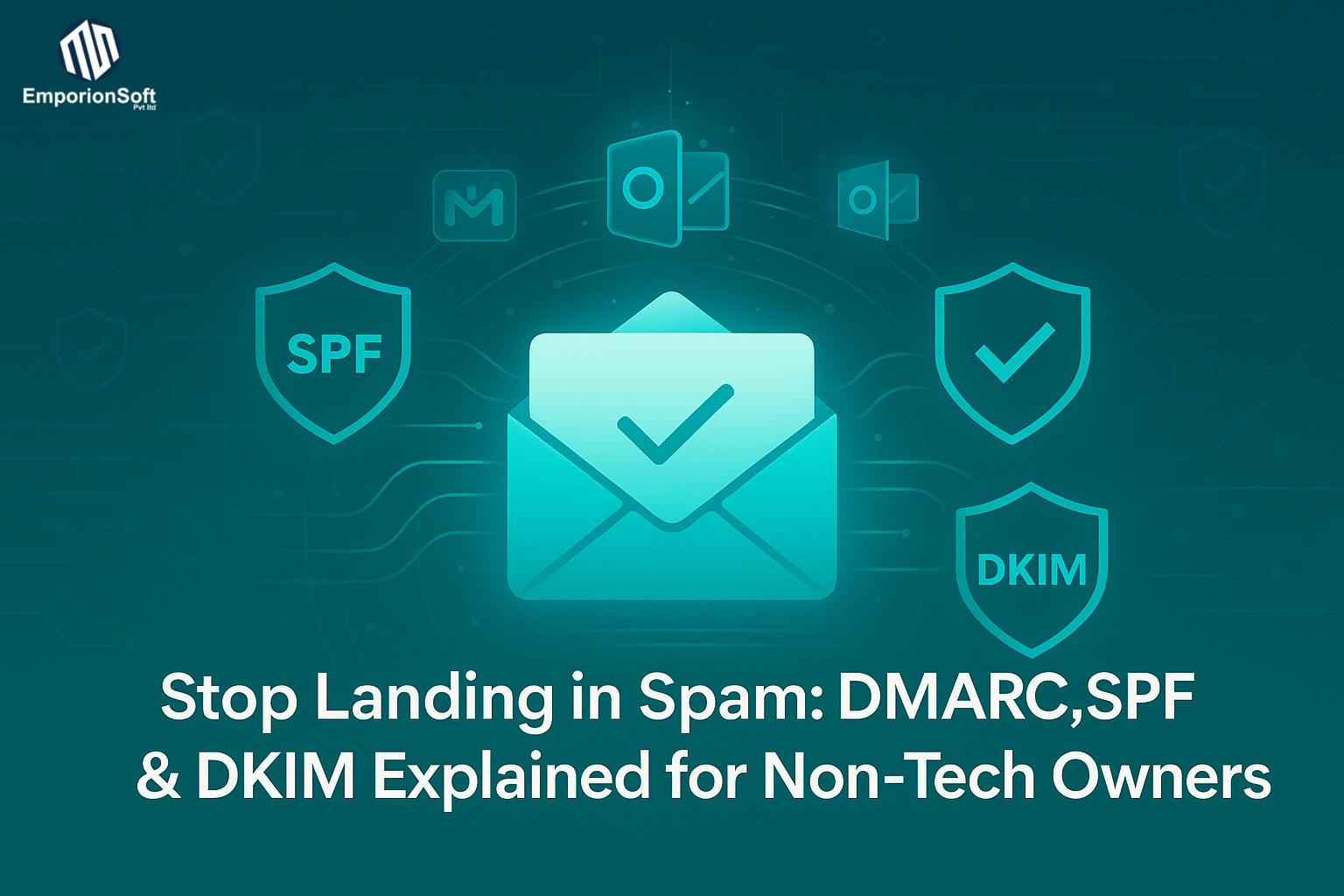
  • Stop Landing in Spam: DMARC, SPF & DKIM Explained for Non-Tech Owners

    Stop Landing in Spam: DMARC, SPF & DKIM Explained for Non-Tech Owners

    Stop Landing in Spam: DMARC, SPF & DKIM Explained for Non-Tech Owners

    Why Do Your Legitimate Business Emails Keep Landing in Spam?

    If you’ve ever sent an important business email — a proposal, invoice, or client update — only to find it buried in your recipient’s spam or junk folder, you’re not alone. It’s a frustrating, invisible problem affecting thousands of business owners every day. You hit “Send” confidently, but your email never reaches its destination. The result? Lost leads, missed opportunities, and a damaged professional image.

    The truth is, spam filters have become extremely sophisticated. They don’t just scan for suspicious words anymore — they evaluate who you are, how your email is sent, and whether your domain can be trusted. Unfortunately, even genuine businesses often get caught in the crossfire of these automated checks.


    The Hidden Forces Behind the Spam Folder

    Email service providers like Gmail, Outlook, and Office 365 use complex filtering algorithms that assess millions of signals to decide whether to deliver or block an email. These include:

    • Sender Reputation: If your domain or IP address has a history of sending bulk or unsolicited emails — even unknowingly — your messages can be flagged as spam.

    • Authentication Gaps: When an email isn’t properly verified through technical protocols, spam filters assume it’s suspicious or forged.

    • Content Triggers: Overly promotional or poorly formatted messages can look like spam, even if they’re legitimate.

    Without proper authentication, your email could look identical to a phishing attempt — the kind used by scammers pretending to be banks, retailers, or even your own brand.

    According to Google Workspace Help, modern mail systems rely on domain authentication to confirm that a message truly comes from the sender it claims to represent (source). Without it, your email might be silently rejected or diverted into spam — with no warning to you.


    Why DMARC SPF DKIM Setup Matters for Every Business

    Here’s where DMARC, SPF, and DKIM come in — the trio of protocols that protect your emails from being misidentified as spam.

    Think of them as digital “passports” for your messages:

    • SPF (Sender Policy Framework) tells the receiving server which mail servers are authorised to send emails on behalf of your domain.

    • DKIM (DomainKeys Identified Mail) adds a cryptographic signature that proves the email wasn’t tampered with in transit.

    • DMARC (Domain-based Message Authentication, Reporting & Conformance) ties both SPF and DKIM together, instructing mail servers how to handle unauthenticated messages — whether to deliver, quarantine, or reject them.

    When properly configured, these protocols tell Gmail, Outlook, and other providers, “Yes, this email is genuinely from us — not a hacker.”

    That’s why a correct DMARC SPF DKIM setup is vital for any business, regardless of size or industry. Whether you’re sending newsletters, invoices, or automated system alerts, authenticated emails ensure they actually reach your customers’ inboxes.


    The Real-World Impact: Deliverability, Trust, and Brand Protection

    A single misconfiguration can mean thousands of your legitimate messages vanish into spam filters daily. Beyond deliverability, there’s also brand protection at stake. If your domain isn’t protected with DMARC, scammers can impersonate your business — sending fake messages that damage your credibility and put customers at risk.

    For example, without a DMARC setup, a fraudster could easily spoof your address — something your customers would never suspect until it’s too late. With proper authentication, however, their attempts would be automatically flagged and blocked.

    Tools like a SPF DKIM DMARC analyzer can help identify weaknesses in your current configuration. But achieving full compliance often requires careful setup and testing, especially for businesses using Gmail, Outlook, or Salesforce email systems. That’s why many turn to professional services like EmporionSoft’s technical team to handle secure implementation and monitoring.


    Taking Control of Your Inbox Future

    If your business relies on digital communication — and almost every business does — ignoring email authentication is no longer an option. Implementing a proper DMARC SPF DKIM setup (Gmail, Outlook, or Office) doesn’t just improve deliverability; it strengthens your cybersecurity posture and protects your brand from impersonation.

    You don’t need to be a tech expert to understand it — but you do need to prioritise it. At EmporionSoft, we help businesses take control of their email identity and ensure that every legitimate message lands exactly where it belongs — in the inbox, not the spam folder.

    Demystifying Email Authentication: What Are DMARC, DKIM, and SPF?

    If email were a physical letter, the journey from sender to recipient would be simple — stamp it, post it, and wait for delivery. But in the digital world, email delivery isn’t quite that straightforward. Messages pass through multiple checkpoints where mail servers verify whether they’re genuine or forged. To make that possible, three key technologies — SPF, DKIM, and DMARC — act as your email’s passport, signature, and law of the land.

    Understanding these tools doesn’t require a degree in IT. Let’s break them down in plain English so every business owner can protect their email identity and stop legitimate messages from landing in spam.


    What is SPF? — Your Email’s Passport

    SPF (Sender Policy Framework) is like an international passport for your email. It tells receiving servers, “This message is officially travelling from a trusted location.”

    When you set up SPF, you’re essentially creating a list of mail servers authorised to send emails on behalf of your domain. Think of it as a guest list at an event — only registered guests (servers) are allowed in.

    Here’s how it works:

    1. You publish an SPF record in your domain’s DNS (Domain Name System).

    2. When your email is sent, the recipient’s mail server checks this record.

    3. If your sending server is listed, the message passes authentication; if not, it’s treated with suspicion or marked as spam.

    This simple verification step helps prevent scammers from sending fake messages that appear to come from your domain. You can learn more about the mechanics of SPF in Microsoft’s official documentation on how Office 365 uses SPF for email validation.


    What is DKIM? — The Digital Signature of Trust

    If SPF is the passport, DKIM (DomainKeys Identified Mail) is your email’s digital signature. It assures the recipient that your message hasn’t been altered during its journey across the internet.

    Here’s a simple analogy: imagine you send a signed contract to a client. DKIM ensures that when they receive it, your signature is still there — untouched, authentic, and verifiable.

    When you enable DKIM, your outgoing emails are “signed” with a private cryptographic key. The receiving mail server then uses a public key (stored in your DNS) to verify that the email hasn’t been tampered with and truly originates from your domain.

    Setting up DKIM adds credibility to your brand communications. It shows email providers like Gmail, Outlook, and Yahoo that your domain can be trusted — which means your emails are far more likely to land in the inbox rather than the spam folder.


    What is DMARC? — The Law That Enforces Email Trust

    DMARC (Domain-based Message Authentication, Reporting, and Conformance) is like the law that governs SPF and DKIM. It’s the policy that says, “If an email fails these checks, here’s what to do.”

    DMARC doesn’t just authenticate — it gives you control. Once you set up a DMARC record, you can tell mail providers how to handle suspicious messages claiming to be from your domain. You can choose to:

    • Monitor (just receive reports),

    • Quarantine (send to spam), or

    • Reject (block unauthorised emails entirely).

    DMARC also provides detailed reports showing which servers are sending mail on your behalf. These insights can help detect unauthorised use of your domain and improve your overall deliverability.

    A Free SPF/DKIM/DMARC analyzer can be used to check whether your setup is correct and to identify gaps. These tools are invaluable for small businesses wanting to stay compliant without hiring a full-time IT team.


    How They Work Together

    When SPF, DKIM, and DMARC are correctly configured, they create a powerful trio of protection:

    • SPF verifies who can send emails from your domain.

    • DKIM verifies what was sent (ensuring message integrity).

    • DMARC decides how to treat emails that fail those checks.

    Together, they prevent hackers from impersonating your brand, ensure your messages reach customers safely, and build a foundation of trust between your domain and global email networks.

    At EmporionSoft, we believe understanding these essentials shouldn’t be intimidating. Our experts make the process seamless — from DNS configuration to ongoing monitoring. If you’re unsure where to begin, you can schedule a consultation with our team to assess your current setup and guide you through professional implementation.

    How SPF, DKIM & DMARC Work Together to Safeguard Your Business Email

    Imagine you run a company that sends dozens of emails every day — invoices, newsletters, proposals, and client updates. Now imagine a cybercriminal impersonates your domain, sending fake messages to your clients asking for payments or login credentials. That’s not a distant possibility — it happens every day through email spoofing and phishing.

    This is where SPF, DKIM, and DMARC come together as a united defence system. Each plays a different role, but together they form a complete authentication framework that prevents unauthorised senders from using your domain for malicious purposes.


    The Email Authentication Chain — A Step-by-Step Flow

    Think of email delivery like a security checkpoint system at an airport. Every message your company sends must pass through three layers of verification before it reaches your recipient’s inbox.

    1. SPF: The Gatekeeper

      • When your email leaves your mail server, SPF checks the “boarding pass.”

      • The recipient’s mail server compares the sending IP address to your authorised list (your SPF record).

      • If it matches, your email is allowed to move forward.

      • If not, the system flags it as suspicious.

      • That’s why it’s essential to set up SPF correctly in your domain’s DNS records.

    2. DKIM: The Signature Checkpoint

      • Once your message passes SPF, the next stop is DKIM — which acts like a signature verification booth.

      • Every email signed with a DKIM signature carries a hidden cryptographic key.

      • The receiving server uses your public key (stored in your DNS) to verify that the message wasn’t altered during transit.

      • If the signature is missing or invalid, the message may be marked as spam or fail authentication.

    3. DMARC: The Final Judge

      • After SPF and DKIM checks, DMARC evaluates the overall results.

      • It ensures alignment — confirming that the “From” domain matches the domains used in SPF and DKIM.

      • If an email fails these checks, your DMARC record instructs what to do: allow, quarantine, or reject it entirely.

      • This step is crucial for stopping spoofed or fraudulent messages.

    Visually, you can picture this process as a chain of verification:

    Email Sent → SPF Validation → DKIM Signature Verification → DMARC Policy Enforcement → Inbox or Spam Decision.

    Each layer strengthens the next, ensuring that only legitimate messages survive the journey.


    A Real-World Example — How Outlook and Gmail Use These Checks

    When you send a message via Microsoft Outlook or Office 365, the receiving platform (say Gmail) performs the same sequence of checks.

    • First, Gmail looks at your SPF record to confirm your server is allowed to send for your domain.

    • Then, it validates your DKIM signature to ensure your message hasn’t been tampered with.

    • Finally, it applies your DMARC policy — for example, if your record says “reject,” any unauthorised sender pretending to be you is blocked automatically.

    This process happens within milliseconds, completely invisible to users — but it determines whether your message lands in the inbox or disappears into spam. That’s why a professional DMARC setup in Outlook or Gmail is not just technical hygiene — it’s brand protection.

    According to DMARC.org, domains that correctly configure DMARC see a dramatic reduction in spoofing and phishing attempts. It’s now considered a global best practice for businesses that rely on email communication.


    Building a Secure Email Ecosystem

    Without authentication, your brand reputation is always at risk. Attackers can impersonate your domain, mislead your customers, and erode trust in minutes. By ensuring your SPF, DKIM, and DMARC are correctly configured and aligned, you create a security-first communication ecosystem.

    Each element plays its part:

    • SPF confirms who can send emails for your domain.

    • DKIM guarantees message integrity.

    • DMARC ensures both rules are followed and enforces your policy.

    The result? A reliable and trustworthy email system that prevents impersonation and keeps your communications professional.

    At EmporionSoft, we’ve implemented these authentication protocols for organisations worldwide, dramatically improving deliverability and protecting sensitive communications. Our expertise in Building Resilient Software ensures that your business doesn’t just send emails — it sends trust.

    Top Mistakes That Ruin Your DMARC SPF DKIM Setup

    Setting up DMARC, SPF, and DKIM is one of the most effective ways to keep your business emails secure and out of spam. However, while the intention is right, the implementation often goes wrong. Many organisations — even large enterprises — unknowingly misconfigure their DNS records or authentication settings, resulting in email deliverability issues, domain reputation damage, and frustrated teams wondering why their messages never arrive.

    The good news? Most of these issues are easy to fix once you know where to look. Let’s explore the most common mistakes businesses make during DMARC SPF DKIM setup, whether you’re using Gmail, Outlook, Office 365, or Salesforce.


    1. Incorrect or Incomplete DNS Entries

    One of the biggest culprits behind failed authentication is a simple typo or formatting error in DNS records. For example:

    • Missing quotation marks or extra spaces in the SPF record.

    • DKIM records published under the wrong selector name.

    • DMARC records missing policy parameters (like p=quarantine or p=reject).

    Each of these can break the validation process instantly. When setting up your DMARC SPF DKIM setup in Outlook or Office, remember that even one misplaced character can render your configuration useless.

    Tip: Use a Free SPF/DKIM/DMARC analyzer to validate your DNS entries. These tools instantly identify syntax issues, incorrect domain alignment, or expired keys — helping you catch errors before they affect your email reputation.


    2. Multiple SPF Records

    A surprisingly common error is publishing more than one SPF record for the same domain. The SPF standard only allows one record per domain, and having multiple entries confuses mail servers. Instead of authenticating, the server may reject your message altogether.

    For example:
    v=spf1 include:_spf.google.com ~all
    v=spf1 include:_spf.salesforce.com -all

    ✅ The correct approach is to merge them into a single record:
    v=spf1 include:_spf.google.com include:_spf.salesforce.com ~all

    This ensures that both Gmail and Salesforce servers are authorised to send emails on your behalf.


    3. Misaligned Domains

    DMARC depends on domain alignment — meaning the domain in the “From” header must match (or be closely related to) the domains used by SPF and DKIM. Many businesses fail this alignment check by using different sending domains or third-party services without configuring them correctly.

    For instance, if your emails are sent through Salesforce or Office 365, you must ensure that those platforms are listed in your SPF and DKIM records. If not, DMARC will flag those messages as suspicious and may reject them.

    Tip: When setting up your DMARC setup in Salesforce, always include their sending servers in your SPF record and enable DKIM within the Salesforce admin panel.


    4. Not Testing or Monitoring After Setup

    Implementing DMARC isn’t a “set it and forget it” process. Many companies publish records but never check whether they’re working correctly. Without ongoing monitoring, you might miss critical issues like expired DKIM keys, unauthorised senders, or misconfigured services.

    Solution: Use tools like Google Postmaster Tools, MXToolbox, or your chosen Free SPF/DKIM/DMARC analyzer to receive regular reports. These insights show who’s sending mail from your domain and whether your emails pass or fail authentication checks.

    Regular testing prevents costly errors — and ensures your domain remains trusted by major mail providers like Gmail, Outlook, and Yahoo.


    5. Overly Strict Policies Too Soon

    It’s tempting to jump straight to a p=reject DMARC policy, but doing so prematurely can block legitimate messages before you’ve verified full compliance. A better approach is to start with p=none (monitoring mode) and gradually move to stricter enforcement once you’ve confirmed that SPF and DKIM align correctly.

    This staged rollout ensures that no valid communication gets lost while you refine your setup.


    Avoiding These Pitfalls — and Getting Professional Help

    Each of these errors might seem small, but together they can cripple your email deliverability. Worse, they can create what developers call technical debt — hidden problems that accumulate over time until they disrupt your operations entirely. If you’re curious about how small misconfigurations can lead to larger issues, explore EmporionSoft’s article on Technical Debt Explained.

    When your business relies on platforms like Outlook, Office 365, or Salesforce, expert configuration and validation become even more critical. At EmporionSoft, we help companies implement robust, compliant authentication systems that scale securely across every email channel.

    If you’re unsure where your configuration stands or suspect a setup issue, get in touch with our team via the Contact Us page. We’ll perform a comprehensive analysis, fix your DNS entries, and optimise your authentication setup for maximum deliverability.

    For more best practices, you can also review the Mailchimp Email Deliverability Guide — an excellent external resource that complements professional consultation.

    How to Set Up SPF, DKIM, and DMARC — The Right Way

    Setting up SPF, DKIM, and DMARC might sound intimidating, but in reality, it’s a straightforward process — especially when broken down into simple, step-by-step instructions. Whether your business uses Gmail (Google Workspace), Outlook (Office 365), or Salesforce, you can complete the setup in under an hour with the right guidance.

    In this section, we’ll walk you through each step in plain English, helping you configure authentication correctly and avoid the common pitfalls that lead to spam issues.


    Step 1: Set Up SPF (Sender Policy Framework)

    SPF is the foundation of your email authentication setup. It tells mail servers which hosts or services are authorised to send emails on behalf of your domain.

    Here’s how to set it up:

    1. Access your DNS settings.

      • This is typically done through your domain registrar (like GoDaddy, Namecheap, or Cloudflare).

    2. Create a new TXT record.

      • In the DNS panel, add a TXT record with the name “@” (or your domain name).

    3. Add your SPF value.

      • For Gmail/Google Workspace:
        v=spf1 include:_spf.google.com ~all

      • For Office 365/Outlook:
        v=spf1 include:spf.protection.outlook.com -all

      • For Salesforce:
        v=spf1 include:_spf.salesforce.com ~all

    4. Save and test.

      • Use a Free SPF/DKIM/DMARC analyzer or Google Postmaster Tools to verify that your SPF record is valid and not duplicated.

    💡 Tip: Always keep just one SPF record per domain and merge multiple services into a single line if necessary.


    Step 2: Enable DKIM (DomainKeys Identified Mail)

    DKIM adds a digital signature to your outgoing emails, ensuring they haven’t been tampered with.

    How to set it up:

    For Gmail (Google Workspace):

    1. Go to the Google Admin Console → Apps → Google Workspace → Gmail → Authenticate email.

    2. Click Generate new record.

    3. Copy the DKIM TXT record that Google provides.

    4. Paste this record into your DNS host (like Cloudflare) as a new TXT record.

    5. Return to the Admin Console and click Start Authentication to activate it.

    For Office 365 (Outlook):

    1. Sign in to the Microsoft 365 Defender portal.

    2. Go to Email & Collaboration → Policies & Rules → Threat Policies.

    3. Under DKIM settings, click Add Domain and copy the two CNAME records Microsoft provides.

    4. Add these to your DNS provider and then enable DKIM signing.

    For Salesforce:

    1. Log in to Salesforce Setup → Email Administration → DKIM Keys.

    2. Generate a new DKIM key (usually 1024 or 2048 bits).

    3. Publish the public key in your domain’s DNS as instructed.

    4. Click Activate to start signing outgoing emails.

    💡 Tip: Use your email provider’s DKIM verification tool or Postmaster Tools to confirm that DKIM is signing messages properly.


    Step 3: Configure DMARC (Domain-Based Message Authentication, Reporting & Conformance)

    DMARC is your policy layer. It tells receiving mail servers how to handle emails that fail SPF or DKIM checks.

    Steps to set up DMARC:

    1. Create a new TXT record in your DNS.

    2. Add the following value:
      v=DMARC1; p=none; rua=mailto:dmarc-reports@yourdomain.com; fo=1

    3. Save your record.

    4. Monitor your reports.

      • DMARC will send daily reports to the email address you specify.

    5. Gradually tighten your policy:

      • Start with p=none (monitoring mode).

      • Move to p=quarantine after verifying your setup.

      • Finally, enforce p=reject to fully block spoofed emails.

    💡 Tip: You can use tools like Dmarcian or MXToolbox to visualise and interpret DMARC reports for easier monitoring.


    ✅ Quick Setup Checklist

    Step Task Status
    1 Add and validate SPF TXT record for all platforms (Gmail, Outlook, Salesforce)
    2 Generate and publish DKIM keys, then enable authentication
    3 Create and monitor DMARC record
    4 Test with Google Postmaster Tools or MXToolbox
    5 Move from monitoring (p=none) to protection (p=reject)

    Why Correct Setup Matters

    A misconfigured record can block genuine messages, damage your sender reputation, and make your brand vulnerable to spoofing. By taking time to implement authentication correctly, you’ll protect both your clients and your domain.

    At EmporionSoft, our specialists assist businesses worldwide in achieving full DMARC compliance, ensuring optimal deliverability across all major platforms — from Gmail to Salesforce. Our expertise in Real-Time AI in Production also enables us to integrate intelligent monitoring tools that proactively detect and resolve authentication issues before they affect your operations.

    The Best Free SPF/DKIM/DMARC Analyzers and Monitoring Tools

    Once you’ve configured your SPF, DKIM, and DMARC records, the real work begins — monitoring. Setting them up correctly is only half the battle; keeping them running effectively requires continuous oversight. Email authentication is not a “set it and forget it” process. Even small DNS changes, third-party integrations, or new mail servers can break authentication silently, causing your legitimate emails to land in spam without you realising it.

    Thankfully, several free and reliable tools make it easy to test, analyse, and monitor your setup. Whether you’re a small business owner or managing enterprise-level systems, these tools provide visibility into your domain’s health, helping you identify issues before they harm your email deliverability or brand reputation.


    MXToolbox – The All-in-One Free SPF/DKIM/DMARC Analyzer

    MXToolbox is one of the most popular and trusted platforms for checking email authentication. It acts like a “health scanner” for your domain, verifying SPF, DKIM, and DMARC records in seconds.

    How it helps:

    • Instantly checks for syntax errors in SPF, DKIM, and DMARC records.

    • Highlights missing fields, misalignments, or multiple SPF entries.

    • Provides real-time DNS propagation status.

    • Offers continuous monitoring alerts when something changes in your configuration.

    How to interpret results:
    When you run a domain check, MXToolbox will show a simple report with “Pass,” “Fail,” or “Warning” status indicators.

    • Pass: Your authentication setup is correct.

    • ⚠️ Warning: You might have alignment or policy configuration issues (for example, your SPF and DKIM don’t match).

    • Fail: There’s a missing or incorrect DNS record, and your messages may not be authenticating properly.

    Consistent DMARC setup monitoring with MXToolbox ensures you maintain high deliverability rates, especially if you’re sending large volumes through Gmail or Office 365.


    Dmarcian – Visualising DMARC Reports

    Dmarcian provides an intuitive dashboard for understanding DMARC reports — perfect for non-technical users. Instead of raw XML files, you get visual charts showing where your emails come from, which servers pass or fail authentication, and what threats to watch out for.

    Key features:

    • Converts DMARC XML data into human-readable dashboards.

    • Identifies unauthorised senders using your domain.

    • Helps fine-tune your policy from p=none (monitoring) to p=reject (enforcement).

    • Offers alerts and trend tracking for ongoing compliance.

    If you’re just starting with DMARC setup, Dmarcian can be an invaluable educational tool, showing you exactly how your domain is performing and where to improve.


    Agari – Enterprise-Grade Email Intelligence

    Agari offers a more advanced, enterprise-level email authentication solution that integrates AI-driven threat detection and domain intelligence. It’s ideal for businesses that want automated monitoring and proactive threat alerts.

    Why it matters:
    Agari uses machine learning to detect anomalies — such as sudden spikes in unauthorised sending sources or suspicious domain activity. It can help prevent targeted phishing and brand impersonation campaigns before they escalate.

    Although Agari’s full suite is paid, it provides limited free tools to test your SPF, DKIM, and DMARC setup, giving you an initial health overview before upgrading to a complete monitoring platform.


    Google’s Postmaster Tools – Trusted Insights for Gmail Deliverability

    Google Postmaster Tools is a must-have if your customers primarily use Gmail. It provides data straight from Google’s mail servers, showing how Gmail interprets your emails.

    You’ll get insights into:

    • Domain reputation scores.

    • Spam complaint rates.

    • Authentication pass/fail ratios.

    • Delivery errors and IP reputation trends.

    How to use it:

    1. Log in with your Google Workspace account.

    2. Verify your domain ownership by adding a TXT record to your DNS.

    3. Access detailed performance and authentication reports.

    By combining Gmail data with reports from tools like MXToolbox and Dmarcian, you get a full 360° view of your email health and sender trust level.


    ✅ Why Continuous Monitoring Matters

    Even a perfectly configured DMARC SPF DKIM setup can fail if left unchecked. DNS changes, expired DKIM keys, or newly added third-party mail services can easily cause authentication errors overnight. Regular monitoring ensures your records stay valid and aligned — preventing damage to your domain reputation and avoiding costly downtime in communication.

    At EmporionSoft, we understand the importance of data-driven email performance. Our team leverages analytical dashboards and AI-backed tools to automate deliverability monitoring. By combining secure infrastructure with intelligent systems, we help clients maintain robust, compliant, and high-performing communication channels.

    If you’re ready to take your automation even further, explore how our AI Chatbots Guide can enhance customer interaction while maintaining secure, authenticated communication.

    Case Studies: How DMARC SPF DKIM Setup Improved Deliverability

    Email remains the backbone of business communication — from sales proposals and invoices to newsletters and password resets. Yet, for many companies, the silent problem of deliverability failure undermines customer trust and engagement. Real-world data consistently shows that businesses that invest in proper DMARC, SPF, and DKIM setup experience not just improved inbox placement but stronger brand reputation and lower phishing risks.

    Let’s explore three real-world examples across SaaS, finance, and marketing sectors where authentication transformed communication reliability and customer trust.


    1. SaaS Platform: Restoring Customer Confidence through SPF Validation

    A mid-sized SaaS provider offering project management software began noticing that critical onboarding emails and password reset messages were not reaching customers. Complaints were mounting — especially from users using Gmail, where messages often went directly to the spam folder.

    Upon investigation, the company discovered multiple issues: they were using several third-party email providers (SendGrid for transactional messages and HubSpot for marketing) but hadn’t correctly configured their SPF validation. Both services were sending on behalf of their domain, yet their DNS only included Google’s servers.

    The Fix:

    • They consolidated all authorised senders into one SPF record:
      v=spf1 include:_spf.google.com include:sendgrid.net include:hubspotemail.net ~all

    • Implemented DKIM signing for both transactional and marketing messages.

    • Set up a DMARC record in monitoring mode (p=none) to collect reports and confirm that SPF and DKIM were working correctly.

    Within just two weeks, their Gmail inbox placement increased by over 95%, bounce rates dropped by half, and customers reported a smoother onboarding experience. Their support team saw a measurable reduction in “email not received” tickets.

    This case highlights the importance of proper DMARC setup in Gmail environments, especially when using multiple email vendors.


    2. Financial Institution: Stopping Spoofing and Strengthening Brand Integrity

    A regional financial institution faced a more severe issue — phishing. Fraudsters were spoofing their domain to send fake investment offers and password reset requests. This not only harmed customer trust but also risked legal and reputational fallout.

    Their IT team collaborated with external consultants to implement SPF, DKIM, and DMARC from the ground up.

    The Fix:

    • Created strict SPF validation rules allowing only their internal mail servers and customer relationship systems to send email.

    • Generated 2048-bit DKIM records for all outbound messages.

    • Deployed a DMARC policy with p=reject, ensuring that unauthenticated emails were blocked before reaching customers.

    • Used DMARC reports to monitor unauthorised sources and quickly identify spoofing attempts.

    According to internal data, phishing incidents impersonating the bank’s domain dropped by 98% within a month of implementation. Customer feedback surveys reflected a significant boost in trust, as clients began to see verified communication indicators (such as “mailed by” authentication in Gmail).

    As Cisco’s Talos Intelligence Blog notes, most targeted phishing campaigns exploit domains without proper DMARC enforcement — proving how vital authentication is in finance, where trust and credibility are everything.


    3. Marketing Agency: Boosting Campaign Performance with DKIM Authentication

    A digital marketing agency specialising in email campaigns struggled with inconsistent deliverability. Despite engaging content and verified opt-in lists, their open rates were below industry averages. Many clients used Outlook and Office 365, where authentication failures can heavily influence spam filtering.

    The Fix:

    • Enabled DKIM signing for all outbound campaigns to prove message integrity.

    • Added a valid DMARC record with p=quarantine, later upgraded to p=reject after full alignment.

    • Conducted ongoing DMARC setup monitoring using MXToolbox and Dmarcian to track authentication success rates.

    The result was immediate: open rates improved by 30%, and click-throughs increased by 18% within the first campaign cycle. By demonstrating verified sender authenticity, their messages consistently reached client inboxes — not the spam folder.

    This transformation not only improved campaign ROI but also elevated the agency’s reputation as a trusted email marketing partner.


    Building Trust Across Every Industry

    From SaaS to finance and marketing, these examples show one clear truth: authentication builds trust. Proper SPF validation, accurate DKIM records, and a well-enforced DMARC setup don’t just improve deliverability — they safeguard brand identity.

    At EmporionSoft, we’ve seen similar success stories among our global clients. By combining technical precision with intelligent automation, we help businesses strengthen their communication pipelines and reinforce brand credibility. Our expertise in Decentralized Identity and Authentication further enhances this approach, ensuring security and compliance across all digital channels.

    Stop Landing in Spam — Partner with Experts Who Understand Email Deliverability

    Email deliverability isn’t just a technical checkbox — it’s the lifeblood of digital communication and business trust. Whether you’re running a SaaS platform, a finance firm, or an eCommerce brand, every message you send represents your company’s credibility. Yet, without proper authentication through DMARC, SPF, and DKIM, even legitimate messages risk being filtered, quarantined, or rejected by mail providers like Gmail, Outlook, and Office 365.

    Throughout this guide, we’ve explored what these protocols do, how they work together, and the tangible benefits of setting them up correctly. Now, let’s bring it all together — and show why a professionally managed implementation can transform the way your business communicates.


    The Business Case for Email Authentication

    In today’s digital landscape, spam filters have evolved to be far more intelligent — and far less forgiving. They don’t just scan your message content; they scrutinise your identity as a sender. That’s where the DMARC SPF DKIM setup becomes your digital proof of legitimacy.

    A correctly configured authentication framework ensures that:

    • Your messages reach the inbox, not the spam folder.

    • 🧠 Your brand identity is protected, preventing phishing or spoofing.

    • 🔒 Your data and customers stay secure, strengthening compliance with data protection standards.

    • 📈 Your marketing and transactional emails perform better, improving engagement and ROI.

    For businesses sending emails through multiple channels — such as Gmail, Office 365, Salesforce, or automated CRMs — a robust authentication setup is no longer optional. It’s the backbone of modern communication security and brand trust.


    Why Professional Implementation Matters

    While free tools and analyzers can help detect issues, they rarely provide the full picture. Real-world configurations often involve multiple domains, subdomains, and third-party services. That’s where expert guidance becomes invaluable.

    At EmporionSoft Pvt Ltd, our specialists combine data-driven monitoring with hands-on technical expertise to deliver secure and scalable email authentication systems. We don’t just create DNS records — we design sustainable frameworks that evolve with your business growth.

    Our Services include:

    • Full DMARC, SPF, and DKIM setup across Gmail, Outlook, and Salesforce environments.

    • Continuous DMARC setup monitoring and deliverability reporting.

    • Integration with CRM and marketing systems to ensure alignment.

    • Ongoing analysis through AI-powered security insights.

    If you’re unsure whether your domain is properly protected or want to verify your setup, book a Consultation with our technical team. We’ll conduct a comprehensive audit, identify weak points, and help you optimise deliverability using best practices.


    Beyond Email: Building a Culture of Digital Trust

    At EmporionSoft, we believe authentication isn’t just about emails — it’s about building digital trust across all business communications. Our engineers and analysts design systems that ensure every message, app, and digital interaction your company delivers is secure, compliant, and authentic.

    We also collaborate with industry innovators like The CodeV, whose cutting-edge insights into cloud, AI, and software development inspire many of our technology-driven practices. By combining our expertise with such global knowledge resources, we help organisations modernise securely and intelligently.


    Ready to Secure Your Email Future?

    If your important business emails still get lost in spam folders or your domain remains unprotected, now is the time to act. A professional DMARC SPF DKIM setup will protect your brand, improve deliverability, and enhance every customer touchpoint.

    📩 Let’s make sure your next message lands where it should — in the inbox.
    Get started today by visiting our Contact Us page or scheduling a tailored Consultation. The EmporionSoft team is ready to help you implement a secure, compliant, and deliverability-optimised email system designed for long-term success.

  • Passwordless for SMEs: How Passkeys Reduce Hacks & Password Fatigue

    Passwordless for SMEs: How Passkeys Reduce Hacks & Password Fatigue

    Passwordless for SMEs: How Passkeys Reduce Hacks & Password Fatigue

    In today’s digital-first world, passwordless authentication for small business has evolved from a luxury to a necessity. Every year, thousands of cyberattacks exploit one simple weakness — human behaviour. According to a Google Security Blog report, over 50% of breaches stem from weak, stolen, or reused passwords. For small and medium-sized enterprises (SMEs), which often operate with limited IT resources, a single breach can lead to devastating losses — not just financially, but in customer trust and operational stability.

    The average employee juggles dozens of logins across cloud platforms, CRMs, and collaboration tools. Password reuse becomes inevitable, and attackers know it. This relentless password cycle — creation, reset, reuse — doesn’t just expose vulnerabilities; it drains productivity. As businesses expand digitally, passwords have become both a liability and a bottleneck.

    The Rising Cost of Passwords for Small Businesses

    Passwords are no longer protecting businesses — they’re undermining them. Traditional password systems demand frequent resets, complex combinations, and multi-step recovery processes. For small businesses without dedicated cybersecurity teams, maintaining password hygiene across the workforce can feel impossible.

    According to NIST, the human element remains the weakest link in digital security. Employees reuse credentials across accounts or fall victim to phishing schemes that mimic trusted services. Each forgotten password triggers a cascade of support tickets, costing SMEs valuable time and IT resources.

    Data breaches are not just a technical problem — they’re a business crisis. Lost credentials can lead to ransomware attacks, stolen customer data, and compliance violations. A single compromised password in an unmonitored system can open the door to full network infiltration. The fallout can cost far more than any password reset policy ever saves.

    Yet, amid these rising risks, there’s a turning point: the shift toward passwordless systems — digital solutions that eliminate traditional passwords altogether in favour of biometrics, security keys, and passkeys. Instead of remembering dozens of strings, employees authenticate with something they are (fingerprint or face) or have (trusted device).

    Forward-thinking companies such as EmporionSoft recognise this shift as the next frontier of digital trust. Through innovative authentication integrations and secure application design, passwordless technology is helping small businesses reclaim both safety and simplicity. To explore how these systems can be embedded seamlessly into your digital ecosystem, visit the EmporionSoft Services page.

    How Password Fatigue Impacts Productivity and Security

    Password fatigue — the exhaustion from managing endless login credentials — has quietly become a major business cost. Employees waste hours each month resetting passwords or waiting for IT assistance. Beyond the lost time, password fatigue erodes morale and leads to shortcuts, such as writing credentials on sticky notes or using the same password across multiple platforms.

    From a security perspective, these shortcuts are catastrophic. Reused passwords can be harvested from public breaches and reused in credential-stuffing attacks, a growing threat vector targeting SMEs globally. According to a TechCrunch cybersecurity analysis, small businesses are now the primary targets of over 40% of phishing attempts — simply because they lack the defences of larger enterprises.

    Password fatigue also affects customer experience. When clients or partners struggle to log in or face frequent reset requests, trust diminishes. A frustrated user is less likely to engage or transact again, particularly in sectors where convenience equals loyalty.

    This is why SMEs are rapidly exploring passwordless authentication — a model that simplifies login workflows while closing the door on the most common attack vectors. Passkeys use cryptographic keys that never leave the user’s device, while biometric identifiers such as fingerprints or facial scans ensure each login is secure and unique.

    In 2025, this transition is not just about better security — it’s about efficiency, trust, and digital maturity. Passwordless systems eliminate friction for users and drastically reduce the attack surface for organisations. For small businesses seeking growth in a security-conscious world, the move to passwordless authentication represents the single most effective upgrade to their digital infrastructure.


    What Is Passwordless Authentication for Small Business?

    For many small business owners, digital security often feels like a complex, technical maze. But in reality, passwordless authentication for small business is a simple, practical evolution of how users log in — one that replaces the old, vulnerable password system with faster, safer alternatives like passkeys, biometrics, and device-based authentication.

    Imagine unlocking your office every morning: you don’t type in a code; you use a key or a fingerprint scanner. Passwordless authentication works in much the same way — except the “key” is digital. It lets your employees or customers access accounts securely using something they are (biometric data such as fingerprints or facial recognition), or something they have (a trusted device like a phone or security token).

    Traditional passwords depend on what users know — a code, phrase, or combination of letters and symbols. Unfortunately, those codes can be guessed, stolen, or forgotten. In contrast, passwordless authentication is built on cryptographic proof and unique identity verification, making it far more secure and convenient.

    This modern approach to login technology forms the foundation of zero-trust authentication, where access is granted only after verifying identity through multiple secure factors rather than relying on static credentials. For SMEs, this means no more worrying about employees using weak passwords or hackers stealing credentials from data leaks.

    At EmporionSoft, we help businesses transition to passwordless systems that align with their workflow and security needs. It’s not just a new technology — it’s a new way of building digital trust.

    How Passkeys Work Behind the Scenes

    To understand passkeys, think of them as digital padlocks that open only when both sides — the user and the service — confirm their identity. When an employee or customer sets up a passkey, the system creates two cryptographic keys: a public key stored on the server, and a private key kept securely on the user’s device.

    When it’s time to log in, instead of typing a password, the user simply confirms their identity with a fingerprint, PIN, or face scan. The device then proves ownership of the private key without ever sharing it online. The server checks the corresponding public key, and access is granted instantly. This method ensures that even if hackers breach a system, the stolen data is useless — no password to steal, no secret to guess.

    This process is made possible by open standards like FIDO2 and WebAuthn — technologies developed by the FIDO Alliance and supported by major tech leaders like Microsoft, Apple, and Google. These standards enable secure, passwordless logins across browsers, apps, and devices, meaning your employees can use the same passkey to access multiple systems safely.

    Biometric logins further enhance this ecosystem by integrating identity verification directly into devices. Features like Apple’s Face ID or Windows Hello use physical characteristics unique to each user. For SMEs, this translates into easier logins for staff, fewer IT support requests, and significantly reduced exposure to phishing attacks.

    Moreover, passwordless systems support MFA (Multi-Factor Authentication) for SMEs without adding friction. By combining something users have (device) and something they are (biometric), passwordless methods inherently satisfy multi-factor security standards — but without the need for cumbersome one-time codes or SMS verification.

    At EmporionSoft, we believe this technology is key to building a decentralised digital identity — where small businesses can protect user access without maintaining massive databases of passwords. This approach not only improves cybersecurity but also reduces compliance risks associated with storing sensitive login data.

    A Future That’s Already Here

    Contrary to popular belief, passwordless authentication isn’t futuristic — it’s already reshaping how businesses operate. From cloud software providers to e-commerce platforms, companies are rapidly adopting passkeys as part of their security transformation. Even small businesses can now integrate these systems using tools available through modern web frameworks and APIs.

    Tech giants like Microsoft have been leading the movement, noting on their Security Blog that passwordless adoption has already reduced phishing incidents and password resets by over 80% among enterprise users. For SMEs, these same benefits are now within reach — affordable, scalable, and easier than ever to implement.

    In essence, passwordless authentication replaces anxiety with assurance. It lets your team log in faster, keeps customer data safer, and eliminates the endless loop of forgotten passwords. It’s not a trend — it’s the natural next step in digital evolution.

    Why Hackers Target Small Businesses — and How Passwordless Stops Them

    Cybercriminals are no longer just chasing global corporations — they’re increasingly turning their attention to small and medium-sized enterprises (SMEs). Why? Because smaller businesses often have valuable data, financial assets, and client records, but lack the advanced security defences of larger organisations. According to the Verizon Data Breach Investigations Report, nearly half of all cyberattacks now target small businesses. The rise of remote work, cloud adoption, and digital payments has only widened the attack surface, leaving SMEs exposed to phishing, credential theft, and ransomware.

    In 2025, the need for passwordless authentication for small business is no longer about convenience — it’s about survival. Traditional password-based security models are crumbling under the pressure of increasingly sophisticated attacks. Every reused password, every shared credential, and every outdated login process is a potential entry point for hackers.

    From Phishing to Credential Theft: Understanding SME Vulnerabilities

    Let’s start with phishing — the most common and devastating cyberattack faced by SMEs. In phishing schemes, attackers disguise themselves as trusted sources, tricking employees into revealing login credentials. These attacks often look like legitimate invoices, password reset emails, or even fake collaboration requests. Once hackers gain a foothold, they can access entire business networks, steal customer data, or lock systems for ransom.

    Credential stuffing is another silent killer. Cybercriminals take usernames and passwords leaked from previous breaches and try them across multiple platforms, knowing that employees often reuse the same credentials. Even if one system is breached, attackers can chain those stolen logins across cloud storage, CRMs, and accounting platforms.

    Then there’s social engineering, where hackers manipulate employees through psychological tactics rather than technical exploits. They might impersonate a manager requesting urgent access to files or pose as a trusted vendor needing system credentials. For small businesses — where teams are closely knit and communication is less formal — these tricks often succeed.

    These vulnerabilities expose a clear truth: passwords are no longer protecting businesses; they’re exposing them. Each new password represents a risk — a weak link waiting to be exploited. Without proper authentication safeguards, even one compromised employee account can lead to catastrophic data loss.

    This is where passwordless authentication becomes a transformative shield.

    How Passwordless Authentication Closes the Security Gaps

    Passwordless authentication for small business addresses these vulnerabilities at their root. Since there are no passwords to steal, guess, or phish, most of the attack vectors used against SMEs become instantly obsolete. Instead of relying on something users know, passwordless systems rely on what they have (a device or passkey) and what they are (biometric identifiers).

    For example, passkeys use asymmetric cryptography to verify users without ever transmitting a secret. Even if attackers manage to intercept communication, they get nothing of value — no password to crack, no credential to reuse. This core mechanism forms the foundation of passkey security, which provides a significant advantage over traditional MFA (multi-factor authentication) systems that still depend on passwords as one layer of protection.

    With biometric authentication (such as fingerprints or facial recognition), phishing attacks become irrelevant. An attacker cannot replicate a fingerprint or facial scan remotely. This eliminates one of the most persistent cybersecurity threats — phishing prevention is built directly into the system.

    Furthermore, passwordless technologies integrate seamlessly into zero-trust and MFA frameworks, ensuring continuous verification without friction. Employees gain secure access, while attackers face cryptographic walls that cannot be socially engineered or easily bypassed.

    Implementing these solutions also improves cybersecurity for small business by reducing operational overhead. IT teams spend less time resetting passwords and more time focusing on proactive defence measures, like endpoint monitoring and threat response.

    At EmporionSoft, we’ve seen firsthand how passwordless authentication enhances digital resilience. One of our featured Case Studies highlights a logistics SME that reduced its phishing incidents by 70% within months of adopting biometric login systems. This transformation didn’t just secure their network — it boosted employee productivity and client confidence.

    A 2024 review by Cyber Essentials UK confirms that SMEs with strong authentication frameworks face significantly fewer successful attacks than those relying solely on passwords. This underscores the growing consensus: passwordless is not just a security upgrade — it’s a business imperative.

    As the threat landscape evolves, so must the tools SMEs use to defend themselves. Passwordless authentication represents a proactive stance — one that stops attacks before they begin, reduces human error, and strengthens the trust that small businesses depend on.

    Fighting Password Fatigue: Why Passkeys Improve Employee Experience

    For small and medium-sized businesses (SMEs), managing digital access has become a daily struggle. Employees use dozens of applications — from email and CRMs to cloud drives and accounting systems — each demanding its own password. The result? An endless cycle of forgotten passwords, reset requests, and security compromises. This modern condition, known as password fatigue, is silently draining productivity and morale across workplaces.

    Recent studies by Gartner highlight that nearly 40% of IT support tickets in SMEs are password-related. Every minute an employee spends resetting credentials is a minute lost from productive work. Beyond wasted time, password fatigue introduces a much larger risk — complacency. Overwhelmed users often resort to reusing passwords or storing them insecurely, inadvertently opening the door to cyber threats.

    This is where passwordless authentication for small business becomes a game changer. Instead of depending on what employees know (passwords that can be stolen or forgotten), it relies on what they have (a trusted device or passkey) or what they are (biometric data like fingerprints or facial scans). The result is a seamless, secure, and loginless experience that saves time and reduces mental friction.

    Imagine an employee unlocking their work system the same way they unlock their smartphone — with a fingerprint or face scan. No password resets, no sticky notes, and no phishing traps. This effortless interaction doesn’t just simplify authentication; it transforms the relationship between people and technology.

    At EmporionSoft, we’re helping SMEs adopt digital identity management systems that eliminate traditional logins while maintaining enterprise-level security. These solutions allow businesses to manage who accesses what — across devices, teams, and locations — without burdening employees with endless credentials.

    The Productivity and Security Gains of Going Passwordless

    Password fatigue isn’t just inconvenient; it’s expensive. A small business with 50 employees can lose hundreds of hours annually dealing with forgotten passwords and IT support tickets. According to Forrester, each password reset costs organisations an average of $70 in lost productivity and IT overhead. Multiply that across an entire workforce, and the numbers become staggering.

    By moving to passkeys and biometric authentication, small businesses reclaim that lost time. Employees can access systems instantly using secure, device-bound credentials. These credentials are cryptographically generated and unique to each service, meaning they can’t be reused or stolen — a huge step forward in both convenience and safety.

    Passkeys simplify onboarding too. New employees can authenticate themselves on day one without waiting for credentials to be issued or reset links to be verified. Managers gain peace of mind knowing their teams are working securely, while IT departments spend less time on maintenance and more time on innovation.

    From a usability standpoint, passwordless systems foster trust. Employees feel empowered when technology “just works.” Instead of being a source of frustration, authentication becomes invisible — allowing staff to focus on their actual roles. This human-centred approach aligns perfectly with modern adaptive software development practices, which prioritise agility and user experience. You can explore how EmporionSoft applies these principles in its Adaptive Software Development Blog.

    The security benefits are equally significant. With passkeys, even if attackers compromise a server, they gain no usable credentials. Biometric data never leaves the user’s device, and cryptographic communication ensures identity verification without exposing secrets. This dual advantage — simplicity for users and strength for systems — makes passwordless authentication one of the few upgrades that benefits both sides of the business equation.

    As TheCodeV.co.uk notes in its research on digital transformation, reducing user friction is directly tied to higher adoption rates of security protocols. The less effort employees must invest in security, the more consistently they follow best practices. Passwordless solutions embody this philosophy, making secure behaviour the default rather than the exception.

    In essence, passkeys are not just a security innovation; they’re a usability revolution. They bridge the gap between cybersecurity and employee experience, giving SMEs the power to operate like large enterprises — efficiently, securely, and confidently. For businesses looking to build both trust and productivity into their digital workflows, going passwordless is the logical next step.

    Implementing Passwordless Authentication for Small Business

    Transitioning to passwordless authentication for small business may sound complex, but with the right strategy, it can be smooth, cost-effective, and transformative. For many SMEs, the challenge isn’t awareness — it’s execution. Implementing new login systems without disrupting workflows or overwhelming teams requires a phased, thoughtful approach.

    At its core, passwordless technology is designed to simplify security, not complicate it. Whether you’re a retail startup, a logistics company, or a digital agency, adopting passkeys, biometrics, or device-based authentication can drastically reduce cyber risk and operational overhead. With professional guidance from EmporionSoft’s development and cybersecurity teams, small businesses can seamlessly integrate passwordless access into their systems — protecting users while keeping everyday operations intuitive and efficient.

    Practical Steps: From Pilot Testing to Full Rollout

    1. Assessment and Readiness Check

    Every successful implementation begins with a clear understanding of your current landscape. Before adopting passwordless solutions, SMEs should evaluate their existing authentication systems, devices, and applications. Determine which tools support modern standards such as FIDO2, WebAuthn, and OAuth 2.0.

    SMEs should also identify which departments or user groups face the most frequent login issues or password resets. These are ideal candidates for pilot testing. An initial readiness audit, often guided by an external partner like EmporionSoft, helps align technology choices with business priorities and compliance requirements.

    2. Vendor Selection and Technology Choice

    The next step is selecting a vendor that fits your scale and infrastructure. Leading providers such as Okta and Google Workspace Security Blog offer detailed frameworks and integration support for SMEs exploring passkey adoption.

    EmporionSoft helps clients evaluate vendors based on three key factors:

    • Compatibility – Does the solution work with existing identity systems, devices, and cloud applications?

    • Scalability – Can it grow with the business without costly overhauls?

    • Security Alignment – Does it integrate well with your MFA for SMEs and zero-trust frameworks?

    For example, a hybrid approach may include hardware keys for administrators, mobile-based passkeys for employees, and biometric logins for client portals.

    3. Pilot Implementation

    Once a vendor is selected, the pilot phase allows real-world testing. Start small — perhaps one department or a group of 20–50 users. Gather feedback on usability, onboarding, and accessibility.

    EmporionSoft’s engineering teams work closely with SMEs during this stage to ensure seamless API integration and smooth user transitions. This includes enabling fallback mechanisms (e.g., temporary PINs or device recovery) while still maintaining strong cryptographic standards.

    The goal here is to test loginless experiences in controlled environments and adjust configurations before expanding to the entire organisation.

    4. Integration and System Optimisation

    After a successful pilot, it’s time for a company-wide rollout. Passwordless systems must integrate with core business tools — from CRMs and HR software to internal dashboards. This stage often involves mapping digital identities across systems to unify authentication flows and eliminate redundant login prompts.

    EmporionSoft ensures that these integrations are modular, secure, and scalable, preventing the accumulation of unnecessary complexity or what’s known as technical debt. Businesses can learn more about avoiding these pitfalls in our Technical Debt Explained guide.

    As part of a broader zero-trust security framework, passwordless solutions continuously verify user identity and device integrity. This means even if one endpoint is compromised, the attacker cannot move laterally across systems — a crucial advantage for growing SMEs.

    5. Training and Change Management

    Technology adoption is only as effective as its users. EmporionSoft provides training sessions and documentation to help teams understand passwordless workflows. By highlighting the reduced login time, stronger security, and simplified user experience, employees quickly embrace the change.

    Additionally, IT departments benefit from reduced password reset requests, freeing them to focus on higher-value security initiatives. Over time, this shift fosters a more proactive, cyber-aware culture.

    6. Ongoing Monitoring and Compliance

    Even after full rollout, continuous improvement is key. Monitoring login analytics helps detect unusual access attempts, while periodic audits ensure regulatory compliance. Partnering with EmporionSoft gives SMEs long-term access to technical expertise, ensuring that authentication systems evolve alongside emerging cybersecurity standards.

    The ROI of Passwordless Authentication for Small Businesses

    For many small and medium-sized enterprises (SMEs), security investments often feel like cost centres rather than growth drivers. However, passwordless authentication for small business flips that perception. It doesn’t just enhance cybersecurity — it delivers tangible, measurable returns on investment (ROI) through reduced IT costs, improved productivity, stronger compliance, and a more trusted digital reputation.

    The shift from traditional passwords to passkeys, biometrics, and device-based authentication is more than a technical upgrade — it’s an operational advantage. In a business landscape where efficiency, customer experience, and data protection are inseparable, passwordless solutions create a compound effect: lower risks, faster workflows, and happier teams.

    From Reduced IT Costs to Stronger Brand Trust

    One of the most immediate and visible benefits of passwordless adoption lies in cost reduction. According to the IBM Cost of a Data Breach Report, the average cost of a single data breach in 2024 reached $4.88 million. While large corporations may absorb such losses, for SMEs, even a fraction of that figure can be fatal. By removing the weakest link — passwords — businesses significantly reduce the likelihood and cost of breaches.

    Beyond direct breach prevention, passwordless systems cut operational expenses tied to password management. Industry research from Forrester suggests that each password reset costs an organisation between $50 and $70 in IT labour and downtime. When multiplied across dozens of employees, these “minor” inefficiencies quickly add up. Passwordless authentication eliminates these recurring costs by removing the very concept of passwords — freeing IT teams to focus on innovation rather than maintenance.

    Faster employee onboarding is another overlooked ROI factor. With passwordless systems, new hires no longer need to memorise credentials or wait for account setup emails. Instead, they authenticate through registered devices or biometrics, accessing business systems instantly and securely. This streamlined process accelerates integration, boosts early productivity, and reduces administrative workloads for HR and IT.

    At EmporionSoft, our experience helping SMEs transition to passwordless ecosystems shows that organisations typically see a 40–60% reduction in authentication-related support tickets within months of deployment. The ripple effect is substantial — less friction for employees, fewer interruptions for managers, and smoother collaboration across teams.

    Productivity and Employee Satisfaction

    Passwordless authentication enhances employee satisfaction by removing one of the most common daily frustrations — logging in. Workers can now move between tools, platforms, and apps seamlessly, often using single sign-on (SSO) integrated with zero-trust frameworks. This not only saves time but also nurtures a culture of trust and digital fluency.

    As employees spend less time dealing with technical barriers, productivity increases. Cybersecurity Ventures predicts that global password management costs businesses over $1 trillion annually in lost productivity. For SMEs, reducing even a small percentage of that inefficiency translates directly into greater output and profitability.

    Security compliance also improves dramatically. Passwordless systems align naturally with modern regulatory standards like GDPR, NIST 800-63B, and ISO 27001, ensuring businesses meet data protection requirements without manual interventions. These built-in safeguards make audits easier and reduce the risk of penalties from data mismanagement.

    Most importantly, this shift fosters brand trust. Customers today associate strong security with credibility. When clients experience smooth, secure logins without constant resets or verifications, they perceive the company as modern, reliable, and responsible. This perception strengthens customer retention and gives SMEs a competitive edge in sectors where trust equals loyalty — such as finance, healthcare, and digital services.

    For insights on how security investments drive real-world outcomes, you can explore the EmporionSoft Our Insights section, where our team regularly publishes thought leadership on emerging tech ROI and digital resilience.

    Turning Security into Strategy

    The financial returns of passwordless adoption aren’t limited to savings — they extend to long-term growth. SMEs with modern authentication systems report fewer cyber incidents, reduced downtime, and faster adoption of remote work tools. Each of these outcomes contributes to a more resilient business model — one that adapts quickly to evolving threats without compromising usability.

    When viewed holistically, passwordless authentication becomes a cornerstone of strategic investment, not just IT expenditure. It helps SMEs operate with the confidence of enterprise-level security while maintaining agility and affordability.

    The Future of Passwordless Authentication for Small Business

    The digital landscape is undergoing a quiet revolution — one that’s redefining how we prove who we are online. For small and medium-sized enterprises (SMEs), passwordless authentication is no longer just a cybersecurity upgrade; it’s a foundational pillar of the future of digital identity management. As cyber threats grow smarter and users demand faster, frictionless access, the combination of AI, biometrics, and decentralised identity frameworks is setting the stage for a safer, more efficient business ecosystem.

    In the coming years, SMEs that adopt passwordless systems early will not only protect themselves but also position their brands as forward-thinking and trustworthy. This evolution is about more than convenience — it’s about enabling a secure, scalable, and user-centric internet where passwords are finally obsolete.

    AI, Decentralised Identity, and the End of Passwords

    One of the most transformative trends shaping this future is AI-driven authentication. Artificial intelligence is now capable of learning behavioural patterns — how a user types, moves a mouse, or even holds their device. These subtle identifiers can be used to continuously verify identity in real time, creating adaptive authentication systems that go beyond static credentials.

    For small businesses, this means a new level of protection without additional complexity. Instead of relying on manual logins or one-time passwords, AI can evaluate risk dynamically. If a login attempt looks unusual — for example, from a new device or at an odd hour — the system can trigger secondary verification or deny access entirely. This approach blends zero-trust authentication principles with intelligent context awareness, ensuring that trust is never assumed but continuously validated.

    Meanwhile, biometric login technology continues to evolve at an impressive pace. Fingerprint and facial recognition are now standard on most devices, but upcoming advancements include voice biometrics, vein mapping, and behavioural signatures that further strengthen identity assurance. According to the World Economic Forum, the global biometric security market is expected to surpass $80 billion by 2030, driven by both enterprise adoption and consumer demand for safer digital experiences. For SMEs, these technologies promise enterprise-grade security without enterprise-level costs.

    Another major milestone in the passwordless journey is the rise of decentralised identity — a system where individuals own and control their digital credentials instead of depending on centralised databases. Using blockchain-based verification methods, decentralised identity ensures that authentication data cannot be tampered with or misused. It also gives users privacy and portability, allowing them to verify themselves across multiple services without re-entering personal information.

    At EmporionSoft, we’ve explored how decentralised identity frameworks empower SMEs to implement passwordless logins that are both privacy-focused and regulation-compliant. This shift aligns perfectly with modern data governance standards and helps businesses move beyond outdated models of username-password storage.

    Security experts, including OWASP, emphasise that as systems grow interconnected, decentralisation becomes vital to prevent single points of failure. Passwordless authentication powered by decentralised identity helps businesses achieve resilient trust — even in distributed or hybrid environments.

    The role of AI doesn’t end at authentication; it extends to continuous monitoring and threat detection. Advanced algorithms can analyse network behaviour, detect anomalies, and automatically adjust access permissions — all without human intervention. This is where passwordless technology intersects with LLMOps (Large Language Model Operations) — the operational management of AI systems in production. Integrating intelligent authentication workflows into larger AI-driven infrastructure is a topic we’ve explored in the EmporionSoft LLMOps Blog.

    For SMEs, these innovations unlock new business opportunities. Imagine a future where your employees, clients, and suppliers interact securely through a shared ecosystem of trusted digital identities — with no passwords to forget, reset, or steal. This seamless experience enhances customer confidence, accelerates transactions, and strengthens regulatory compliance.

    The Google Security Blog notes that widespread passkey adoption is already well underway, with billions of Android and Chrome users now able to log in without traditional passwords. This mass adoption signals a shift from “optional innovation” to “standard practice.” Over the next few years, passwordless technology will become as expected as SSL encryption — a default feature of every credible digital business.

    For small businesses, the message is clear: the future of authentication is not coming — it’s already here. By embracing passwordless systems powered by AI, biometrics, and decentralised identity, SMEs can stay ahead of the curve, reduce risk, and deliver digital experiences that feel effortless yet secure.

    Building a Safer Digital Future with Passwordless Authentication

    As businesses continue to navigate the digital era, passwordless authentication for small business has emerged as a cornerstone of cybersecurity and operational efficiency. From the increasing risk of phishing and credential theft to the growing burden of password fatigue, SMEs have long struggled to balance convenience with security. This blog has explored how passkeys, biometrics, and decentralised identity provide a modern solution — one that not only strengthens protection but also enhances productivity, trust, and overall user experience.

    The journey toward passwordless security begins with recognising a simple truth: passwords are no longer fit for purpose. They’ve become the weakest link in the digital chain, responsible for most data breaches worldwide. In contrast, passwordless systems replace outdated credentials with cryptographic keys and biometric identifiers that cannot be stolen, guessed, or reused. The result is a frictionless login experience that protects users while streamlining everyday operations.

    For small businesses, the benefits are both practical and strategic. Passwordless solutions reduce IT overhead by cutting down password reset requests, simplify onboarding for new employees, and build confidence among customers who demand secure yet seamless access. Beyond convenience, these systems integrate with zero-trust frameworks, ensuring that every login, device, and action is continuously verified and protected.

    The business case for passwordless technology is undeniable. As discussed earlier, SMEs adopting passwordless systems see measurable ROI in the form of reduced breach incidents, lower support costs, and improved staff satisfaction. By leveraging AI-driven authentication, biometric verification, and decentralised identity, small businesses can achieve enterprise-grade security without enterprise-level complexity or cost. It’s not just about protecting systems — it’s about empowering people and future-proofing organisations for the connected economy ahead.

    At EmporionSoft, we understand that digital transformation isn’t just about adopting new technology — it’s about building systems that scale securely, adapt intelligently, and foster trust at every level.

    EmporionSoft: Your Partner for Secure Digital Transformation

    With years of expertise in secure software development and authentication integration, EmporionSoft has helped businesses around the world transition from outdated password systems to modern, passwordless frameworks. Our teams specialise in implementing FIDO2, WebAuthn, and biometric login standards that align with your company’s infrastructure and compliance requirements.

    We don’t just deploy authentication — we design it as part of a holistic strategy for scalability, resilience, and growth. Whether you need to integrate passkey adoption into your existing platform or build a new system from the ground up, our engineers ensure smooth deployment across all devices and environments. Through careful vendor selection, system design, and user training, we help SMEs eliminate complexity while maintaining the highest levels of data protection.

    EmporionSoft’s multidisciplinary teams — from developers to cybersecurity specialists — work collaboratively to implement zero-trust principles that make passwordless access the new normal. Visit our Services page to explore how we can customise a solution for your business, or connect directly through our Consultation portal for a one-on-one strategy session tailored to your company’s needs.

    If you’re ready to take the next step toward a safer, smarter, and more efficient authentication system, our Contact Us page is the perfect place to start. Our experts will assess your current infrastructure, identify potential vulnerabilities, and recommend a clear roadmap for secure, scalable implementation.

    As TheCodeV.co.uk highlights in its latest tech insights, the companies that invest in secure, user-friendly systems today will lead tomorrow’s digital economy. Passwordless technology is not a passing trend — it’s the inevitable evolution of trust in a hyperconnected world.

    At EmporionSoft, we’re proud to stand at the forefront of that transformation, helping businesses turn cybersecurity from a challenge into a competitive advantage.

  • Quantum Computing for Startups: Preparing for the Next Tech Leap

    Quantum Computing for Startups: Preparing for the Next Tech Leap

    Quantum Computing for Startups: Preparing for the Next Tech Leap

    The race to outpace computational limits is on — and quantum computing for startups is becoming the next frontier of innovation. For decades, classical computing has powered business intelligence, data analytics, and artificial intelligence. Yet, even the most advanced supercomputers are reaching their natural limits. In contrast, quantum computing promises to solve complex problems exponentially faster, unlocking capabilities once thought impossible. For startups striving to innovate in 2025 and beyond, understanding this leap isn’t optional — it’s essential.


    What Is Quantum Computing and How Does It Differ from Classical Computing?

    At its core, quantum computing redefines how information is processed. While classical computers use bits that exist as either 0 or 1, quantum computers use qubits, which can exist as both simultaneously — a phenomenon known as superposition. This means a quantum computer can explore countless possibilities at once, allowing it to perform certain calculations much faster than any conventional system.

    The difference between classical and quantum computing lies in this parallelism. Where a traditional computer might take centuries to simulate molecular interactions or financial risk scenarios, a quantum processor could potentially solve them in minutes. This fundamental distinction positions quantum technology as a game-changer for industries dependent on data complexity — from cryptography and logistics to pharmaceuticals and financial modelling.

    For entrepreneurs seeking quantum computing basics, think of it this way: while classical systems read data line by line, quantum systems read an entire library at once. The implications for startup innovation, speed, and efficiency are profound.


    Why Quantum Computing Matters for Startups in 2025

    Startups thrive on agility — the ability to move faster, think bigger, and disrupt industries. Quantum computing aligns perfectly with this mindset. As cloud-based access to quantum systems grows, early-stage companies can now experiment without owning costly hardware, thanks to services like IBM Quantum Experience and Microsoft Azure Quantum.

    For tech-driven founders, this opens doors to:

    • Quantum-safe encryption, protecting digital assets from next-generation cyber threats.

    • Predictive modelling for investment portfolios and logistics optimisation.

    • Accelerated drug discovery, enabling biotech startups to run complex simulations in record time.

    Quantum technology isn’t just for global corporations. Its democratisation through cloud platforms means smaller players can access computational power once reserved for governments and research institutions. Startups integrating quantum thinking today will have a massive competitive edge as the technology matures.


    Emerging Markets Are Catching Up — Including Pakistan

    Interestingly, quantum computing in Pakistan is gaining traction. Leading universities and research centres are beginning to introduce quantum computing courses and partnerships with international institutions. Initiatives like the National Centre for Physics and collaborations with IBM Quantum Network highlight how emerging markets are positioning themselves for this technological shift. For Pakistani startups exploring fintech, logistics, or cybersecurity, this marks a chance to lead regional innovation rather than follow global trends.


    The Bigger Picture: Preparing for a Quantum Future

    While we’re still in the early stages, the pace of development is accelerating. IBM Research predicts that by the late 2020s, quantum systems will start outperforming classical computers for specific real-world tasks — a milestone known as quantum advantage (IBM Research, 2025). This turning point could redefine how startups approach data, computation, and security altogether.

    For entrepreneurs and innovators, this isn’t about becoming quantum physicists — it’s about strategic readiness. Startups that understand the potential today will be the ones shaping tomorrow’s quantum economy.

    To explore more insights into cutting-edge technologies transforming the business world, visit EmporionSoft’s Homepage or dive into Our Insights for expert perspectives on innovation, AI, and emerging tech trends.

    How Does Quantum Computing Work? Understanding Qubits, Superposition, and Entanglement

    To truly grasp the potential of quantum computing for startups, it’s important to understand how it actually works. Unlike classical computers that rely on binary bits (either 0 or 1), quantum systems use qubits — units that can represent both 0 and 1 simultaneously. This unique property, called superposition, allows quantum computers to explore vast solution spaces at once, solving problems exponentially faster than traditional machines.


    From Bits to Qubits: The Quantum Advantage

    In classical computing, each bit represents a fixed value. A system with two bits can process four combinations sequentially: 00, 01, 10, and 11. A quantum computer, using two qubits, can evaluate all four combinations simultaneously because of superposition. This creates a massive computational advantage for startups dealing with complex optimisation, data modelling, or AI workloads.

    But superposition is only part of the story. Qubits also interact through entanglement — a phenomenon where two or more qubits become interlinked, meaning the state of one directly affects the other, no matter the distance. This interconnected behaviour enables quantum systems to perform coordinated calculations with remarkable precision, far beyond the limits of classical architectures.

    When combined, superposition and entanglement create what many researchers describe as quantum parallelism — the secret behind the staggering processing potential of these machines.


    Quantum Computing vs Classical Computing for Business

    For business leaders, the key distinction between quantum computing vs classical computing lies in how each system handles data complexity. Classical systems process instructions step-by-step, making them ideal for general applications like accounting, web hosting, or customer management. Quantum computers, however, excel at solving nonlinear, multidimensional problems that involve numerous variables and uncertainties.

    Imagine a logistics startup optimising delivery routes for thousands of variables — distance, traffic, fuel, and weather. A classical system must test routes one by one; a quantum system can process millions simultaneously, providing near-instant insights. Similarly, fintech startups can use quantum algorithms for risk modelling or fraud detection, running scenarios that would otherwise take years to compute.

    This makes quantum computing not a replacement for classical technology but a complementary evolution. Forward-thinking entrepreneurs are now adopting hybrid models, combining classical efficiency with quantum intelligence to achieve unprecedented performance levels.


    Quantum Computing Tools for Startups

    Fortunately, startups don’t need their own quantum hardware to begin exploring this field. Platforms like IBM Q Experience and Google Quantum AI offer cloud-based access to real quantum processors and simulators (IBM Quantum Experience, Google Quantum AI). These environments allow developers and researchers to experiment with quantum algorithms, test simulations, and prototype solutions using accessible interfaces.

    Many of these quantum computing tools for startups include SDKs such as IBM’s Qiskit or Google’s Cirq, enabling developers to write and test quantum code using familiar programming logic. These resources help small teams gain hands-on experience, fostering innovation without major infrastructure investment.

    As the technology matures, we’ll likely see quantum-as-a-service (QaaS) models integrated into modern business ecosystems — a trend aligned with the evolution of Adaptive Software Development and Future of Cloud Computing frameworks.


    The Entrepreneur’s Takeaway

    Quantum computing may sound abstract, but for visionary founders, it represents opportunity. By understanding how qubits, superposition, and entanglement work, startups can begin to imagine new solutions to long-standing problems. This technology isn’t just theoretical — it’s becoming commercially viable. The businesses that embrace it early will lead the next era of intelligent, data-driven innovation.

    Real-World Quantum Computing Use Cases: Transforming Startups Across Industries

    The promise of quantum computing for startups extends far beyond theoretical research — it’s already reshaping industries from finance and healthcare to logistics and cybersecurity. While traditional systems remain vital, quantum-powered innovation is enabling startups to solve previously impossible problems. As access to quantum cloud services grows, early adopters are gaining a major strategic edge.

    Below, we explore the most transformative quantum computing use cases redefining startup innovation in 2025 and beyond.


    1. Finance: Redefining Risk and Portfolio Optimisation

    In fintech, speed and precision can determine success. Quantum computing in fintech startups enables real-time analysis of complex financial datasets, empowering better risk management, fraud detection, and portfolio optimisation.

    Startups such as Multiverse Computing and Zapata AI (both featured in 15 Quantum Computing Companies & Startups 2025) are pioneering tools that simulate millions of financial scenarios instantaneously. By leveraging quantum algorithms, fintech innovators can evaluate investment risks, optimise portfolios, and detect anomalies faster than classical systems ever could.

    McKinsey’s Tech Trends 2025 report highlights that quantum finance could potentially cut risk-analysis time by 80% in the next decade — a revolutionary leap for emerging fintech firms. This capability is especially valuable for AI-driven decision-making platforms and aligns with EmporionSoft’s philosophy on Real-Time AI in Production, where intelligent automation drives measurable business value.


    2. Healthcare: Accelerating Drug Discovery and Medical Insights

    The pharmaceutical and healthcare industries are prime candidates for quantum computing applications in healthcare startups. By simulating molecular interactions at the quantum level, startups can identify new drug compounds in a fraction of the time it currently takes.

    Companies like ProteinQure and Qubit Pharmaceuticals are leading this revolution, using quantum algorithms to model biological systems and predict how new drugs interact with the human body. This drastically reduces the cost and timeline of clinical trials, allowing even smaller startups to compete with large pharmaceutical corporations.

    In 2025, healthcare innovators are also exploring quantum-enhanced genomic data analysis, where vast amounts of DNA data can be processed in seconds rather than weeks. The results — faster diagnosis, personalised medicine, and improved treatment planning — will reshape modern medicine.

    This shift aligns with EmporionSoft’s data-first approach, showcased in Harnessing the Power of Data Lakes — where scalable data ecosystems meet next-generation computation to drive smarter decisions.


    3. Logistics: Solving Complex Optimisation Problems

    For logistics startups, the challenge lies in managing vast networks of deliveries, supply chains, and routes. Quantum computing enables optimisation problems to be solved in near real-time, saving millions in operational costs.

    Startups can use quantum annealing (a specific type of quantum algorithm) to optimise routes dynamically based on live data such as traffic, fuel costs, and weather. For instance, D-Wave Systems, one of the pioneers in quantum hardware, offers cloud-based access that allows logistics firms to test quantum-powered routing and resource allocation algorithms.

    This level of optimisation was previously impossible with classical computers, positioning quantum technology as the next logical step for scaling logistics startups seeking operational efficiency and sustainability.


    4. Cybersecurity: Quantum-Safe Encryption for a Post-Classical World

    While quantum computing offers immense benefits, it also introduces new threats — especially to encryption. Startups focusing on cybersecurity are now investing in quantum-safe encryption algorithms to future-proof their data infrastructure.

    Quantum-resistant cryptography, using mathematical techniques immune to quantum attacks, is becoming a core innovation area for security-focused startups. For example, Quantinuum and Post-Quantum are working on developing encryption models designed to withstand quantum decryption attempts.

    This shift is critical for all industries handling sensitive information — from healthcare records to fintech transactions. For founders, preparing for quantum-safe systems today ensures long-term data security and compliance in tomorrow’s quantum economy.


    The Emerging Quantum Startup Landscape

    The quantum computing business applications landscape is expanding rapidly. According to McKinsey Tech Trends 2025, more than 40% of early-stage investors are eyeing quantum computing startups as the next growth wave. Global leaders such as IonQ, Rigetti Computing, and PsiQuantum are already setting benchmarks for innovation, offering APIs and toolkits startups can build upon.

    Startups exploring hybrid quantum-classical approaches are finding new revenue streams through cloud-based access and enterprise-grade integrations. This trend will only accelerate as infrastructure becomes more affordable and scalable.

    As explored by TheCodeV, the integration of quantum intelligence and AI workflows will drive a new generation of software systems capable of reasoning, predicting, and optimising with extraordinary precision — a revolution startups cannot afford to ignore.


    Takeaway: Quantum Is No Longer a Future Vision

    Quantum technology has transitioned from lab curiosity to business reality. The startups that adopt early — leveraging its applications in finance, healthcare, logistics, and cybersecurity — will be best positioned to dominate their respective markets. By merging classical efficiency with quantum innovation, forward-looking founders can unlock business models once deemed impossible, setting a new standard for what’s achievable in the digital economy.

    The Quantum Computing Ecosystem: From Global Leaders to Pakistan’s Emerging Innovators

    As quantum innovation accelerates worldwide, both established tech giants and agile startups are shaping the next computing revolution. The quantum computing ecosystem is no longer limited to elite research labs — it’s expanding into global business hubs, academia, and even emerging markets like Pakistan. Startups and universities are now working together to make quantum technology accessible, scalable, and commercially viable for diverse industries.

    Below, we explore the leading quantum technology startups driving global progress and the growing quantum computing ecosystem in Pakistan that’s beginning to make its mark on the regional tech landscape.


    Global Quantum Leaders Defining the Industry

    The world’s top quantum computing companies of 2025 are pushing boundaries in hardware, cloud services, and quantum software ecosystems. Among them are IBM Quantum, Rigetti Computing, IonQ, PsiQuantum, and D-Wave Systems — each pioneering unique architectures that advance the race toward quantum advantage.

    • Rigetti Computing has made major strides in developing superconducting quantum chips and providing Quantum Cloud Services (QCS), making quantum access available to developers worldwide.

    • D-Wave Systems, known for commercialising quantum annealing, is helping businesses solve optimisation problems in logistics and materials science.

    • Meanwhile, IonQ continues to lead in trapped-ion technology, offering high-fidelity quantum processors available via major cloud providers like AWS and Azure.

    These organisations don’t just build machines — they nurture ecosystems by collaborating with startups, researchers, and enterprise partners globally. According to Crunchbase and CB Insights reports, funding in quantum ventures surpassed $3 billion globally in 2025, with growing investment from venture capitalists, governments, and corporate R&D divisions.


    Academic Foundations: The Institute for Quantum Computing (Canada) and Global Collaboration

    The Institute for Quantum Computing (IQC) at the University of Waterloo, Canada, remains one of the most influential centres for quantum research and education. It continues to pioneer breakthroughs in quantum information science, mentoring startups and partnering with companies like IBM, Google, and Microsoft to commercialise research outcomes.

    Globally, academic-industry partnerships are driving much of the innovation pipeline. These initiatives foster open collaboration — an approach that’s inspiring research communities in Asia-Pacific and Pakistan to follow suit.


    The Quantum Computing Future in Pakistan

    In Pakistan, the journey toward quantum innovation is gaining momentum. Although still in its infancy, the quantum computing future in Pakistan looks promising, supported by growing academic interest and government-backed science initiatives.

    Leading universities such as LUMS (Lahore University of Management Sciences), NUST (National University of Sciences and Technology), and the National Centre for Physics (NCP) in Islamabad have begun integrating quantum computing research programmes and partnerships with international institutions. These initiatives aim to train the next generation of quantum engineers and software developers, aligning Pakistan’s academic capabilities with global standards.

    Moreover, discussions around establishing a Quantum Computing Startup Accelerator in Pakistan are underway — focused on nurturing local talent, building collaboration channels with global quantum providers, and promoting industrial adoption in fields like fintech, telecommunications, and national security.

    The Pakistan Quantum Initiative (conceptually modelled after the EU’s Quantum Flagship) is encouraging open research collaboration with entities such as the Institute for Quantum Computing (Canada) and D-Wave Systems. This could help Pakistani researchers access advanced infrastructure and cloud-based quantum systems to accelerate local development.


    Emerging Quantum Startups in Pakistan and Asia-Pacific

    Across Asia-Pacific, quantum technology startups are growing at a remarkable pace. Countries such as Singapore, Japan, and India have already launched multi-million-dollar initiatives to lead in the region’s quantum computing ecosystem.

    For instance:

    • QunaSys (Japan) focuses on quantum chemistry simulations for industrial applications.

    • Entropica Labs (Singapore) develops quantum algorithms and software frameworks for hybrid systems.

    • BosonQ Psi (India) builds quantum-powered simulation tools for aerospace and automotive engineering.

    In Pakistan, a few academic spin-offs and early-stage research groups are exploring quantum-safe encryption, quantum cloud access, and algorithmic simulation frameworks, signalling the early stages of a homegrown ecosystem. While these ventures are nascent, they reflect a strong appetite for innovation and international collaboration.


    Building a Secure and Resilient Quantum Future

    As Pakistan’s ecosystem matures, startups and developers will face new challenges — from quantum-safe cybersecurity to system interoperability. Here, principles from EmporionSoft’s Decentralized Identity and Authentication can play a vital role in safeguarding data integrity across hybrid classical-quantum environments. Similarly, adopting robust digital resilience strategies, as outlined in Building Resilient Software, will be key to ensuring long-term stability as new technologies are integrated.

    Pakistan’s emerging developers and entrepreneurs have a unique opportunity: to learn from global pioneers while tailoring quantum innovations to regional challenges — from financial inclusion and energy management to national cybersecurity. With continued academic support, strategic investment, and collaboration, the quantum computing ecosystem in Pakistan could evolve into one of South Asia’s most dynamic technology frontiers within the next decade.

    Preparing for the Quantum Leap: How Startups Can Embrace Quantum Computing Today

    While the quantum revolution is still emerging, startups that take proactive steps today will gain a crucial advantage tomorrow. The technology’s potential extends beyond theory — it’s transforming how businesses process data, secure information, and build intelligent products. For founders wondering how startups can use quantum computing effectively, preparation begins with understanding the tools, talent, and hybrid infrastructure needed to harness this next-generation power.

    Below are four key strategies that can help startups get quantum-ready — from encryption to education.


    1. Adopt Quantum-Safe Encryption Early

    As quantum processors evolve, they’ll soon be capable of breaking traditional encryption algorithms that protect sensitive business data today. Forward-thinking founders should begin transitioning toward quantum-safe encryption, also known as post-quantum cryptography (PQC).

    Quantum-safe algorithms, such as lattice-based cryptography, are being developed to secure digital transactions, customer data, and intellectual property against future threats. This approach ensures that even when quantum systems reach commercial maturity, your business remains resilient.

    For startups operating in finance, healthcare, or AI sectors, this is a critical step. Integrating quantum-safe solutions early also aligns with EmporionSoft’s principles of robust, privacy-first digital architecture — a foundation that supports sustainable innovation.


    2. Leverage Cloud-Based Hybrid Computing

    Not every startup can afford dedicated quantum hardware — but that’s where cloud-based hybrid computing steps in. Major tech companies now offer Quantum Computing as a Service (QCaaS) platforms, allowing developers to access real quantum machines through the cloud.

    Services such as IBM Quantum Network and Microsoft Azure Quantum provide startups with practical access to quantum processors, simulators, and development toolkits (IBM Quantum Network, Microsoft Azure Quantum). These platforms allow teams to experiment with algorithms, integrate hybrid workflows, and combine classical and quantum capabilities.

    For example, a startup could use classical machine learning for predictive analysis while offloading complex optimisation or encryption tasks to quantum simulators. This hybrid model mirrors trends in LLMOps: Scaling Large Language Models — where classical infrastructure integrates with advanced AI frameworks for enhanced performance and scalability.


    3. Learn Quantum Programming for Entrepreneurs

    Understanding the fundamentals of quantum programming is becoming an essential skill for modern tech founders. Tools like Qiskit (from IBM), Cirq (by Google), and Q# (from Microsoft) simplify quantum development, offering Python-like syntax for algorithm design and testing.

    Entrepreneurs don’t need a PhD in physics to explore these tools. They can start by learning the logic of quantum gates, entanglement, and qubit manipulation — enough to conceptualise how quantum can complement their existing technology stack.

    For startups in AI, data science, or product innovation, gaining even a basic grasp of quantum principles can inspire entirely new business models. Combining quantum logic with artificial intelligence — such as in AI Chatbots into Your Mobile App — can enable future systems that think, respond, and optimise beyond the limits of traditional computation.

    The benefits of quantum computing for business aren’t limited to performance gains — they extend to creativity, experimentation, and competitive positioning.


    4. Invest in Quantum Computing Skills and Partnerships

    The greatest barrier to quantum adoption isn’t technology — it’s talent. The demand for quantum computing specialists is growing faster than supply, making education and collaboration crucial for startups entering the field.

    Startups can begin by:

    • Partnering with academic institutions offering quantum computing courses and certifications.

    • Encouraging internal upskilling programmes in quantum algorithms and cryptography.

    • Joining innovation ecosystems like the IBM Quantum Network or Q-CTRL Startups Program to gain mentorship and collaborative opportunities.

    For those learning quantum computing for business, platforms like Coursera, edX, and Qiskit Learn provide structured learning paths designed for entrepreneurs and engineers.

    By cultivating this expertise, startups can make informed decisions about when and how to integrate quantum systems — rather than playing catch-up when the technology becomes mainstream.


    The Practical Path Forward

    Preparing for quantum adoption isn’t about overhauling your infrastructure overnight. It’s about strategic experimentation — testing QCaaS tools, securing your data with quantum-safe encryption, and training your team to think beyond classical limits.

    Just as artificial intelligence evolved from concept to necessity, quantum computing will soon redefine how data-driven businesses operate. Startups that act now will not only future-proof their systems but also lead in creating innovative solutions that merge quantum and classical intelligence — shaping the digital economy of the next decade.

    Funding the Future: Investment Opportunities in Quantum Computing Startups

    As the global tech ecosystem accelerates toward the next wave of deep technology innovation, investing in quantum computing has become one of the most strategic moves for venture capitalists and forward-thinking founders. Once considered a niche scientific pursuit, quantum technology is now recognised as a foundational pillar for the digital economy of the 2030s. From venture capital investments to government-backed quantum accelerators, funding for quantum innovation is expanding rapidly — and startups stand at the forefront of this revolution.


    Global Funding Trends: The Rise of Quantum Investment

    According to Deloitte Tech Radar and Quantum Daily, global investments in quantum technology surpassed $4 billion in 2025, with funding flowing into hardware development, quantum software platforms, and hybrid cloud integrations. Major investors like Andreessen Horowitz, Sequoia Capital, and DCVC are now actively supporting quantum-focused ventures, signalling a shift in how deep tech innovation is valued.

    This surge in capital reflects a growing belief that quantum breakthroughs will redefine sectors such as finance, cybersecurity, logistics, and pharmaceuticals. Startups working on quantum-safe encryption, algorithm design, or cloud-based QCaaS platforms are particularly attractive to investors seeking long-term technological defensibility.

    Venture funds and corporate investors are increasingly looking for startups that demonstrate quantum readiness strategies — actionable plans outlining how quantum technologies will enhance data security, scalability, or operational performance. By showcasing how quantum tools can solve high-value business challenges, entrepreneurs can attract substantial interest from innovation-driven funds and accelerator programmes.


    How Tech Entrepreneurs Can Attract Quantum Investment

    For startup founders, securing funding in this fast-evolving sector requires more than a great pitch deck. It’s about building credibility and showcasing tangible steps toward quantum adoption. Here’s how early-stage innovators can stand out:

    1. Demonstrate Practical Application
      Investors prioritise startups that go beyond theory. Whether it’s integrating quantum-safe encryption or using quantum simulation tools, demonstrating clear market relevance helps validate your roadmap.

    2. Develop Strategic Partnerships
      Joining networks such as the IBM Quantum Network or Microsoft Azure Quantum Partners provides access to infrastructure, expertise, and visibility among investors.

    3. Highlight Hybrid Readiness
      Show how your startup’s architecture can integrate with Quantum Computing as a Service (QCaaS) or hybrid AI-quantum workflows. This signals scalability and future resilience.

    4. Leverage Case Studies and Proof-of-Concepts
      Share tangible outcomes or pilot results that illustrate quantum-enhanced performance. EmporionSoft’s Case Studies section demonstrates how data-driven innovation stories can strengthen investor confidence.

    By aligning your strategy with these principles, you not only attract capital — you position your startup as a future-ready leader in the quantum ecosystem.


    Government Support and the Role of National Initiatives

    Beyond private funding, government support for quantum startups is becoming a cornerstone of national innovation agendas. The United States, United Kingdom, China, and Canada have collectively pledged billions in R&D funding to accelerate quantum innovation in startups.

    For instance:

    • The UK National Quantum Technologies Programme invests over £1 billion in quantum R&D.

    • The European Quantum Flagship supports collaborative projects across academia and industry.

    • The U.S. National Quantum Initiative Act provides federal grants and partnerships through agencies like DARPA and NSF.

    In emerging markets, particularly Pakistan, the momentum is building. The government is exploring early frameworks for a Quantum Computing Startup Accelerator Pakistan, focusing on collaboration between academia, public research institutions, and private investors. Through initiatives led by the National Centre for Physics and HEC Pakistan, funding for quantum research grants and STEM-focused incubation programmes is expanding.

    Such initiatives are crucial for empowering the next generation of quantum engineers, data scientists, and entrepreneurs — turning Pakistan into an emerging contributor within the Asia-Pacific quantum economy.


    A Quantum Investment Ecosystem Built on Collaboration

    For both investors and founders, the next decade will be defined by collaboration over competition. Strategic partnerships between startups, research institutions, and corporations will drive innovation and ensure shared success in building a quantum-ready world.

    Entrepreneurs seeking guidance on shaping their investment pitch or identifying partnership opportunities can explore EmporionSoft’s Consultation Page for tailored advisory services in emerging tech and innovation strategy.

    As Forbes Innovation aptly notes, “The quantum economy won’t be built overnight — but those who invest early will define its architecture.”

    The opportunity is clear: whether through venture capital, hybrid cloud partnerships, or government-backed programmes, investing in quantum computing today is not just about funding technology — it’s about shaping the future of intelligence, security, and innovation itself.

    The Quantum-AI Nexus: Where Intelligence Meets Innovation

    In 2025, the boundary between quantum computing and artificial intelligence (AI) is beginning to blur — and the fusion of these two transformative technologies is unlocking possibilities beyond conventional computation. For startups, this intersection represents not only an innovation opportunity but a strategic advantage in building next-generation, intelligent, and adaptive solutions.

    By combining quantum’s unparalleled computational power with AI’s capacity for pattern recognition and prediction, founders can accelerate innovation, automate complex decision-making, and open doors to previously unreachable datasets.


    Quantum Computing and Artificial Intelligence: A Powerful Synergy

    AI thrives on data, and the more data it processes, the more intelligent it becomes. However, as datasets grow exponentially, classical computing systems struggle to keep up with the demands of training and inference. This is where quantum computing and artificial intelligence intersect — quantum processors can process vast, multidimensional data in parallel, enhancing the learning capacity of neural networks.

    Quantum algorithms like Quantum Support Vector Machines (QSVM) and Quantum Approximate Optimization Algorithms (QAOA) are revolutionising data classification, predictive analytics, and pattern discovery. For example, Google Quantum AI has demonstrated how hybrid systems can drastically reduce training time for large-scale models, paving the way for Quantum Machine Learning (QML) frameworks that outperform traditional AI systems.

    For startups working in areas such as logistics optimisation, fraud detection, or drug discovery, this means faster insights, lower energy costs, and a competitive edge that scales with innovation.


    Quantum Machine Learning: The Next Evolution of Intelligent Software

    Quantum Machine Learning (QML) is not about replacing existing AI models — it’s about enhancing them. By leveraging qubits and superposition, QML algorithms can explore complex data landscapes that classical models cannot efficiently navigate.

    Startups can use this approach to:

    • Optimise AI models by training them on quantum-simulated data.

    • Accelerate inference by using quantum-inspired optimisation algorithms.

    • Enhance cybersecurity through AI-driven quantum threat prediction systems.

    This fusion is particularly relevant for AI-first startups already experimenting with automation, predictive modelling, or advanced analytics. As explored in How AI is Revolutionising Software Development, the integration of advanced intelligence into software ecosystems allows for self-improving, data-driven solutions — a foundation that quantum computing amplifies exponentially.


    Emerging Trends in Quantum-AI Systems

    The next decade will see an explosion of hybrid AI-quantum systems, where classical computing, machine learning, and quantum processing coexist. Companies such as IBM, Google, and Rigetti are already offering frameworks that integrate quantum circuits directly into existing AI pipelines.

    Startups can expect to see the following trends shape the future of quantum tech in Pakistan and beyond:

    • Quantum-accelerated neural networks that can train on smaller datasets yet achieve higher accuracy.

    • Quantum-inspired reinforcement learning, enabling machines to make smarter decisions in dynamic environments.

    • AI-assisted quantum algorithm design, where AI models help optimise quantum workflows themselves.

    These innovations will not only transform industries but also redefine AI ethics and governance. As quantum intelligence evolves, ensuring fairness, transparency, and accountability will be vital — aligning with the principles discussed in Ethics in AI.


    Quantum Computing in Emerging Markets: Pakistan’s Growing Role

    The quantum computing ecosystem in emerging markets, including Pakistan, is beginning to align with global AI research initiatives. As universities, startups, and incubators collaborate, Pakistan has a unique opportunity to combine its growing AI talent base with the strategic development of quantum technologies.

    Institutions like NUST and LUMS are exploring quantum-based machine learning frameworks, laying the groundwork for hybrid systems tailored to regional challenges — from agriculture optimisation to predictive healthcare analytics. This synergy could place Pakistan among the early adopters of AI-quantum convergence in the developing world.

    As Nature AI Journal notes, “The convergence of AI and quantum technologies will redefine computational boundaries, moving from problem-solving to problem-understanding — a leap that will reshape every intelligent system built today.”


    The Takeaway for Founders

    For forward-thinking founders, integrating quantum computing and artificial intelligence isn’t just about adopting new technologies — it’s about future-proofing their businesses. Startups that embrace this convergence early will lead innovation in predictive intelligence, automation, and data security.

    As quantum and AI continue to evolve together, the next generation of software will not only think — it will reason, adapt, and anticipate. The businesses ready to harness that intelligence today will define the technological landscape of tomorrow.

    The Road Ahead: Building Quantum-Ready Startups for the Future

    As we move deeper into the age of intelligent computing, the impact of quantum computing on startups is becoming impossible to ignore. What was once a distant scientific experiment is now evolving into a practical tool for solving real-world challenges. From AI acceleration to predictive analytics and next-gen cybersecurity, quantum technology is poised to redefine how modern startups innovate, scale, and compete.

    Startups that recognise this shift early — and begin investing in quantum-safe security, hybrid architectures, and data-driven innovation — will be the ones leading the next technological revolution.


    Preparing for the Quantum Future: A Strategic Blueprint

    The quantum revolution won’t arrive all at once; it will unfold gradually through hybridisation and collaboration. Startups can prepare practically by focusing on these key steps:

    1. Adopt Quantum-Safe Security:
      Protect your digital infrastructure with post-quantum encryption. Building secure systems today ensures resilience when classical algorithms become obsolete.

    2. Experiment with Quantum Cloud and Hybrid Systems:
      Use accessible Quantum Computing as a Service (QCaaS) platforms from IBM, Google, and Microsoft to integrate quantum workflows into classical operations.

    3. Invest in Learning and Collaboration:
      Upskill teams through partnerships, certifications, and university-led quantum programmes. For entrepreneurs building a quantum startup in Pakistan, collaboration with research institutions like LUMS and NUST can unlock a new era of innovation.

    4. Leverage Data-Driven Innovation:
      Combine quantum insights with AI-driven decision-making and real-time analytics to create software that’s faster, smarter, and more adaptable.

    These strategies not only unlock opportunities in quantum computing but also future-proof business operations in a world moving towards automation, simulation, and intelligent optimisation.


    Pakistan’s Quantum Leap: A New Horizon for Startups

    The future of quantum tech in Pakistan is brimming with potential. With academic institutions, incubators, and research hubs investing in early-stage quantum initiatives, Pakistan has the chance to become South Asia’s emerging hub for quantum innovation.

    Government programmes promoting STEM education, coupled with startup accelerators focused on quantum computing innovation, are already setting the stage for growth. As global ecosystems connect, Pakistani entrepreneurs who embrace these developments will find themselves contributing not just locally — but globally — to the next generation of deep technology solutions.


    Partnering for Quantum Success

    Transitioning into the quantum era requires more than just curiosity — it demands technical strategy, innovation leadership, and the right partners. That’s where EmporionSoft Pvt Ltd comes in.

    At EmporionSoft, we help startups and enterprises embrace future technologies with confidence. Whether it’s AI-driven software, hybrid quantum integrations, or secure digital transformation, our experts guide you from concept to deployment with clarity and precision.

    To explore how your business can lead in the quantum age, visit:

    According to the World Economic Forum Future of Quantum Report 2025, nations and businesses that adopt quantum technologies in the next decade will define the global innovation landscape for generations.


    In Closing

    The quantum age is not coming — it’s already here. The startups that dare to experiment today will become the innovators of tomorrow. As the world transitions into this new era of computing, collaboration, vision, and strategic readiness will determine who leads and who lags behind.

    Together, let’s shape the next chapter of intelligent innovation — one where EmporionSoft and visionary founders redefine what’s possible in the quantum age of collaboration and creativity.

  • AR and VR in Business: The Next Frontier for Startup Engagement | EmporionSoft

    AR and VR in Business: The Next Frontier for Startup Engagement | EmporionSoft

    AR and VR in Business: The Next Frontier for Startup Engagement

    The Rise of AR and VR in Modern Business

    In 2025, startups stand on the edge of a new technological revolution — one powered by Augmented Reality (AR) and Virtual Reality (VR). Once confined to gaming and entertainment, these technologies have evolved into essential business tools, transforming how companies market, train, and collaborate. Across the UK and beyond, innovative startups are now using AR VR business applications to design immersive customer experiences, improve remote workflows, and reimagine how products and services are delivered.

    According to PwC’s Global Economic Impact of VR and AR Report, immersive technologies are projected to contribute over $1.5 trillion to the global economy by 2030, with the most significant growth coming from enterprise AR VR solutions that enable smarter business operations and real-time collaboration. For agile startups and fast-scaling enterprises, this signals not just opportunity — but a necessity to adapt and lead.

    At EmporionSoft Pvt Ltd, we help businesses harness the full power of these technologies through tailored software development and immersive digital experiences. From custom AR visualisations to VR-based training simulations, our team designs solutions that unlock innovation and long-term engagement for businesses worldwide. Explore our services to see how we help startups adopt the tools of the future — today.


    How Immersive Tech is Reshaping the Startup Landscape

    Startups thrive on agility — the ability to test, iterate, and scale faster than traditional enterprises. This is where AR and VR technologies shine. By merging physical and digital worlds, they enable startups to prototype faster, market smarter, and collaborate without boundaries.

    In marketing, immersive marketing solutions have redefined consumer engagement. Instead of static ads or two-dimensional websites, businesses can now build interactive 3D environments where customers can explore products in real time. From virtual showrooms to augmented reality product visualisation apps, these experiences create emotional connections that increase both conversion rates and brand loyalty.

    In education and workforce training, AR and VR are closing the gap between theory and practice. A growing number of startups are deploying VR-based training platforms that allow employees to practise real-world tasks in safe, controlled virtual environments — reducing costs and improving skill retention. Similarly, AR overlays help field technicians visualise complex systems during maintenance, guided by digital cues that boost accuracy and efficiency.

    Collaboration, too, has entered a new dimension. With remote and hybrid work now the global norm, VR collaboration tools are allowing teams to co-create in shared 3D spaces, conduct immersive meetings, and visualise data spatially. For startups, this not only fosters creativity but also bridges geographic barriers, offering a new level of inclusivity and productivity.

    Industry analysts such as Gartner predict that by 2027, more than 40% of large enterprises will integrate AR or VR into their employee training and customer experience strategies — a trend already visible in forward-thinking startups. These immersive ecosystems are setting the benchmark for modern business innovation, giving startups the same tools once reserved for global enterprises.

    At EmporionSoft, we recognise that the future of business engagement is immersive, data-driven, and human-centred. Our expertise in enterprise AR VR solutions empowers startups to deploy scalable, high-performance systems that transform ideas into experiences. Whether developing an AR-powered retail app or designing a VR training platform, we ensure technology amplifies creativity, not replaces it.


    Looking Ahead: A New Era of Business Innovation

    The evolution of AR VR business applications marks a defining moment for startups entering 2025. As these tools become more accessible and cost-efficient, barriers to innovation continue to fall. What was once experimental is now practical — and what’s practical today will soon become the standard for how businesses operate and engage with customers.

    Immersive technologies are no longer futuristic concepts; they are the new foundation of competitive strategy. From immersive marketing solutions that captivate audiences to enterprise AR VR platforms that reshape workflows, startups that embrace these innovations early will be the ones leading tomorrow’s digital economy.

    EmporionSoft stands at the intersection of creativity and technology, helping startups worldwide turn vision into virtual reality. As we step into this new era, one truth is clear — the future of business isn’t just digital; it’s immersive.

    Immersive Marketing: A New Era for Startups

    In today’s digital-first economy, attention is the new currency — and startups are learning that immersive experiences are the best way to earn it. As consumers become desensitised to traditional ads and flat online content, Augmented Reality (AR) and Virtual Reality (VR) are stepping in to redefine engagement. By blending storytelling with interactivity, startups are creating experiences that customers can feel, not just see.

    The rise of AR VR for digital marketing is more than a trend; it’s a shift in how businesses communicate value. According to Forbes, brands using AR in their campaigns report average engagement rates 200% higher than those relying on standard digital content. This surge in engagement stems from the emotional impact immersive experiences deliver — users don’t just view a product; they experience it first-hand.

    For innovative startups, the implications are immense. Instead of competing for clicks, they’re now competing for presence — building memorable, emotionally resonant experiences that drive loyalty and long-term growth. At EmporionSoft Pvt Ltd, we help startups design such experiences through custom AR and VR marketing solutions that bring products to life and transform the way audiences interact with brands.

    Discover how immersive marketing is reshaping industries in our case studies and explore strategic insights on the future of innovation through our insights page.


    From Virtual Showrooms to AR Product Visualisation

    Imagine walking into a showroom from your living room — no travel, no appointments, just a headset or a smartphone. That’s the power of virtual showrooms, one of the fastest-growing AR VR business applications for startups. By replicating physical spaces in high-fidelity 3D, brands allow customers to explore, customise, and interact with products in real time.

    TheCodeV (https://thecodev.co.uk/) notes that companies embracing virtual tours for business see up to 40% higher customer retention, particularly in industries like retail, automotive, and real estate. For instance, furniture brands use AR VR for product visualization to let customers preview items in their homes before purchase — significantly reducing return rates. Similarly, automotive startups showcase vehicle interiors using VR environments, giving buyers a tactile sense of space and comfort without a physical test drive.

    In the real estate sector, virtual tours for business have become a cornerstone of remote engagement. A startup showcasing luxury apartments can now invite global buyers to walk through photorealistic spaces, examine details, and even toggle between day and night lighting — all from a browser or VR headset. These experiences shorten the sales cycle, eliminate geographic barriers, and enhance decision-making confidence.

    What makes these tools so powerful is the sense of control they give the user. Customers are not passive viewers; they become participants in their own buying journey. That interactivity fosters trust — and trust, in turn, drives conversions.


    Building Emotional Connections Through Immersive Media

    The most effective marketing doesn’t just inform — it makes people feel. AR and VR are helping brands tap into that emotional layer by turning digital content into lived experiences. Startups can now guide users through interactive AR experiences that tell a story while showcasing a product’s value in context.

    Consider how fashion brands use AR filters on social media to let users virtually “try on” clothing or accessories. Or how travel startups use VR to transport potential customers to destinations, letting them experience before they buy. These immersive touchpoints trigger emotions, making brand interactions memorable and personal.

    HubSpot reports that immersive experiences increase brand recall by up to 70%, as users are far more likely to remember interactive encounters than static ads. This means startups investing in AR VR for digital marketing gain more than visibility — they gain memorability, the foundation of modern brand equity.

    EmporionSoft’s approach to immersive marketing goes beyond visuals. We focus on crafting interactive ecosystems where emotion meets technology — whether through VR storytelling, AR-enhanced product journeys, or 3D brand experiences that live across web, mobile, and headset platforms.


    The Future of Engagement is Immersive

    As technology continues to evolve, immersive marketing solutions are becoming the new baseline for digital competitiveness. The combination of virtual product demos, AR-enhanced visuals, and virtual showrooms enables startups to scale customer engagement without scaling costs.

    Looking ahead, AI integration will make these experiences even smarter — adapting in real time to user behaviour and preferences. The startups that embrace AR and VR early will not only capture attention but redefine what customer experience means in the next decade.

    At EmporionSoft, we believe this evolution is already underway. We work with visionary founders who understand that immersive technology is not a luxury — it’s the new language of business growth. By blending creativity, analytics, and engineering excellence, we help startups build marketing ecosystems that don’t just tell stories — they let customers step inside them.

    Revolutionising Corporate Training Through Immersive Technologies

    The global shift toward digital transformation has brought learning and professional development into a new dimension — quite literally. Traditional training methods, once dominated by lectures, manuals, and static e-learning modules, are being replaced by immersive learning platforms powered by Augmented Reality (AR) and Virtual Reality (VR). These tools enable employees to learn by doing, offering safe, realistic environments that simulate real-world conditions without real-world risks.

    Startups, in particular, are leading this charge. With limited resources and a strong need for innovation, they’re finding that AR VR for training and simulation offers a high return on investment — not just in cost savings, but in productivity, retention, and engagement. According to Deloitte Insights, organisations using immersive learning technologies experience up to 60% improvement in training efficiency and a 40% reduction in training time, as employees retain knowledge faster through experiential learning.

    At EmporionSoft Pvt Ltd, we help companies implement these innovations through customised software solutions and scalable AR/VR training ecosystems. Our services empower startups and enterprises alike to transform onboarding, upskilling, and compliance training into interactive experiences that drive measurable results.


    The Power of AR and VR in Skill Development and Simulation

    Imagine a new employee learning to operate complex machinery — not through a textbook or static video, but within a fully immersive VR simulation that replicates every control, sound, and motion of the real equipment. This is the reality of modern corporate VR training, where mistakes no longer lead to damage or injury, but to deeper understanding.

    AR VR for training and simulation enables learners to interact with digital environments that mimic their work conditions. In sectors like healthcare, aviation, or construction, trainees can practise intricate procedures repeatedly, gaining mastery before stepping into live scenarios. Harvard Business Review highlights that immersive learning “enhances muscle memory, decision-making, and emotional engagement,” making it far more effective than conventional classroom methods.

    These platforms are not limited to high-risk industries. Startups across marketing, retail, and customer service now use immersive learning platforms to enhance soft skills, such as leadership, negotiation, and communication. Employees engage with virtual avatars, handle simulated customer interactions, and receive AI-driven feedback on tone, response speed, and empathy. The result? Teams that are more confident, more prepared, and better aligned with company values.

    At EmporionSoft, our development process integrates simulation realism with data analytics, enabling businesses to measure skill progress and adapt training modules dynamically. Through agile and adaptive software development, we design learning ecosystems that evolve with each employee’s journey — offering personalised, on-demand experiences that maximise retention and impact.


    Making Training Accessible and Scalable for Startups

    One of the biggest challenges for startups is scaling their workforce without sacrificing quality or consistency in training. Immersive technologies offer an elegant solution. Corporate VR training can be deployed remotely, enabling new hires anywhere in the world to experience the same high-quality onboarding as in-office employees. This is especially valuable for distributed teams and hybrid organisations, where standardisation often becomes a logistical hurdle.

    Moreover, the affordability of AR/VR tools has improved dramatically. With standalone headsets and browser-based AR now accessible to most users, immersive learning platforms no longer require large enterprise budgets. Startups can deploy lightweight, scalable solutions that grow with their teams — a key advantage in fast-paced industries like software development, logistics, and manufacturing.

    These technologies also reduce downtime and minimise safety risks. For instance, maintenance teams can rehearse procedures using AR overlays that guide them step-by-step in real-time, while customer-facing employees can practise dealing with complex situations in a controlled VR space. Such experiential learning not only improves performance but also builds confidence — a critical ingredient for long-term employee satisfaction and retention.


    A Future of Smarter, Safer, and More Engaging Learning

    As technology continues to evolve, AR VR for training and simulation is set to become a cornerstone of corporate learning strategies. With AI-driven adaptation, biometric feedback, and cloud scalability, the next generation of immersive learning platforms will deliver hyper-personalised training experiences that mirror real-world performance in real time.

    For startups aiming to compete with larger organisations, the ability to onboard, educate, and retain talent efficiently can be a defining advantage. By integrating corporate VR training into their digital ecosystems, they not only future-proof their workforce but also establish a culture of continuous learning and innovation.

    EmporionSoft believes that learning should never feel like a chore — it should be an experience. Our team is committed to helping businesses design immersive educational environments that combine technology, creativity, and data to shape the professionals of tomorrow. In a world where skills evolve as fast as software, AR and VR are not just training tools; they are the architects of a smarter, safer, and more empowered workforce.

    The Future of Collaboration: Virtual Spaces & Real Results

    The modern workplace is no longer defined by walls, offices, or even time zones. As hybrid and remote work models become the global standard, startups and enterprises alike are turning to Augmented Reality (AR) and Virtual Reality (VR) to bridge geographical gaps and foster real-time collaboration. What was once a futuristic concept — teams working together in shared virtual environments — has now become an operational necessity.

    Through AR VR for remote collaboration, businesses are reimagining meetings, project management, and even hands-on work in industries like construction, engineering, and healthcare. Gartner’s Digital Workplace Trends Report predicts that by 2027, over 50% of enterprise collaboration platforms will integrate immersive or XR (Extended Reality) technologies, enabling employees to interact more intuitively across virtual spaces.

    At EmporionSoft Pvt Ltd, we help organisations embrace this evolution by building scalable, enterprise-grade VR software and AR-based collaboration tools that bring distributed teams closer — no matter where they are. From virtual meeting rooms to real-time design reviews, we empower companies to communicate, visualise, and innovate more effectively in the digital age.

    Discover how these collaborative technologies are reshaping the workplace in our article on cloud computing, and if you’re ready to explore immersive collaboration tools for your business, reach out through our contact page.


    How Startups are Building Global Teams in Virtual Environments

    For startups, agility and speed are everything — but maintaining both in a remote setting is a challenge. That’s where VR meeting platforms and AR collaboration tools come in. These technologies are redefining the way distributed teams brainstorm, design, and make decisions.

    With enterprise-grade VR software, teams can enter fully interactive virtual workspaces that simulate real-world meeting dynamics. Instead of video calls with limited engagement, VR meetings allow participants to share ideas spatially — sketching on virtual whiteboards, manipulating 3D models, or analysing data visualisations in real-time. This immersive environment creates a sense of presence and focus that traditional collaboration tools can’t replicate.

    AR, on the other hand, adds digital layers to the physical world. Engineers, designers, and field workers can share their perspectives using AR-enabled devices, overlaying digital information directly onto real-world objects. For instance, AR for field service operations allows technicians to visualise internal components, follow guided repair instructions, and even receive expert support from remote supervisors who see the same view in real-time. This not only improves accuracy but dramatically reduces the time and cost of on-site visits.

    In architecture and design, teams use XR business applications to collaborate on 3D building models that everyone can explore virtually — walking through proposed spaces, identifying structural concerns, and applying design changes instantly. Similarly, in engineering, remote teams can perform industrial inspections using AR overlays, enhancing safety and efficiency while eliminating unnecessary travel.


    Breaking Barriers and Reducing Costs

    The financial and environmental implications of AR and VR collaboration are profound. Remote coordination powered by AR VR for remote collaboration significantly reduces the need for business travel, cutting carbon emissions and expenses simultaneously. According to Gartner, companies adopting immersive collaboration tools can reduce travel-related operational costs by up to 30% annually while maintaining — or even improving — productivity levels.

    These technologies also foster inclusivity. By removing the physical constraints of office locations, startups can hire talent from across the globe without worrying about relocation or commuting. This democratisation of opportunity creates more diverse, innovative teams while maintaining a unified company culture through shared digital spaces.

    Moreover, XR business applications are becoming more accessible than ever. Cloud-based rendering and AI-driven automation mean that startups can implement immersive tools without massive hardware investments. Employees can access VR workspaces using standalone headsets or even standard laptops and mobile devices, making the shift to immersive collaboration both affordable and scalable.


    The Human Element of Digital Connection

    While AR and VR are driven by advanced engineering, their ultimate success lies in their ability to strengthen human connection. VR meeting platforms create empathy by replicating non-verbal communication cues — eye contact, gestures, and spatial awareness — which are often lost in traditional video conferencing. Meanwhile, AR enables real-time feedback and problem-solving, keeping teams synchronised even when separated by thousands of miles.

    At EmporionSoft, we understand that technology is only as powerful as the people who use it. That’s why our solutions combine usability, security, and innovation — ensuring that immersive collaboration becomes a seamless part of everyday operations. Whether you’re managing a global design project or conducting AR for field service operations, our systems are built to enhance efficiency without sacrificing human interaction.

    The rise of AR VR for remote collaboration marks a turning point in how businesses operate. No longer confined by geography or device, teams can now innovate freely within digital environments that feel as real as physical ones. For startups looking to scale globally without losing cohesion, these immersive tools aren’t just the future of collaboration — they’re the foundation of a smarter, more connected world.

    Transforming Industry with AR and VR Innovation

    The industrial landscape is undergoing a radical shift, powered by the rise of industrial AR VR solutions that are redefining how factories, logistics networks, and commercial enterprises operate. As businesses continue to embrace digital transformation, immersive technologies such as Augmented Reality (AR) and Virtual Reality (VR) are no longer experimental — they are becoming integral components of modern operations.

    According to PwC’s “Seeing Is Believing” report, immersive technologies could add $1.5 trillion to the global economy by 2030, with the largest impact projected in manufacturing, healthcare, and retail. Startups that once struggled to compete with industrial giants are now leveraging AR VR for business innovation to streamline workflows, reduce downtime, and enhance decision-making through real-time 3D visualisation and simulation.

    At EmporionSoft Pvt Ltd, we’re helping businesses across the globe harness these technologies through tailored, enterprise-grade software development. Our expertise spans from industrial inspection systems to immersive design visualisations and digital factory training modules. Explore real-world transformations in our case studies or learn how decentralised systems complement this evolution in our article on Blockchain Beyond Crypto.


    From Smart Factories to Real Estate Immersion

    The industrial sector has long been defined by precision, efficiency, and safety — all of which are being reimagined through industrial AR VR solutions. In manufacturing, VR for manufacturing operations allows engineers and operators to simulate complex assembly lines before physical implementation. By testing processes in virtual environments, companies can identify bottlenecks, optimise layouts, and train workers — all without halting production.

    Accenture’s Technology Vision report highlights that 68% of industrial executives believe AR and VR will be crucial for creating more resilient, adaptive, and efficient factories. Virtual twins of production systems — often integrated with IoT data — allow teams to monitor machine performance, predict maintenance needs, and plan upgrades with minimal disruption. Startups adopting these tools are gaining a competitive edge through lower costs, safer environments, and faster time-to-market.

    In logistics and field services, AR for industrial inspection is transforming the way maintenance and quality assurance are conducted. Technicians can use AR headsets to overlay diagnostic information, assembly guides, or remote expert support directly onto machinery. This minimises human error and ensures accuracy even in high-pressure conditions. Moreover, companies in oil, energy, and utilities are deploying AR for field service operations to monitor pipelines and infrastructure remotely — reducing on-site visits and enhancing worker safety.


    Designing the Future: Architecture, Real Estate & Beyond

    Beyond manufacturing, immersive technologies are revolutionising architecture and design. Architects and urban planners are using AR VR for architecture and design to visualise buildings before they exist — walking through scaled environments, testing lighting conditions, and adjusting materials interactively. These visualisations accelerate decision-making, improve client communication, and reduce costly revisions later in the construction cycle.

    The impact extends to real estate marketing, where AR VR in real estate marketing has become a defining trend. Virtual tours and 3D walkthroughs allow potential buyers or investors to explore properties remotely, experiencing scale, atmosphere, and detail in a way static images cannot deliver. MIT Technology Review notes that immersive property marketing increases buyer confidence and decreases decision times by up to 35%, especially for international clients.

    Similarly, AR VR in e-commerce is creating new dimensions of product engagement. Customers can visualise furniture in their living rooms, test-fit machinery in industrial spaces, or explore architectural components before purchase. Startups are adopting this approach to deliver interactive, customer-centric shopping experiences that rival in-person engagement — blending practicality with innovation.


    Driving Business Innovation Through Immersion

    The convergence of AR, VR, and data analytics is pushing industrial innovation into a new era — one where efficiency and creativity coexist. From smart factories and digital twins to virtual showrooms, immersive technologies are no longer isolated solutions but interconnected elements of a larger Industry 4.0 ecosystem.

    For startups, this presents a unique opportunity to lead rather than follow. By adopting AR VR for business innovation, they can transform traditional workflows into intelligent, data-driven systems. For example, a logistics startup can implement AR-assisted navigation to optimise warehouse routes, while an architectural firm can build a VR-driven client engagement platform that doubles as a design review tool.

    At EmporionSoft, we view AR and VR as strategic enablers of industrial growth — not just tools for visualisation. Our developers and solution architects design applications that integrate seamlessly with enterprise systems, enabling real-time collaboration, predictive analytics, and immersive operations. Whether it’s AR for industrial inspection or VR for manufacturing simulations, our mission is to empower organisations with cutting-edge solutions that enhance precision, efficiency, and innovation.

    Immersive technology is no longer a futuristic concept — it’s a practical asset for industries ready to evolve. As the line between digital and physical continues to blur, industrial AR VR solutions are shaping a smarter, safer, and more connected business world — one where imagination meets engineering to redefine what’s possible.

    How AR VR Development Companies Power Startup Innovation

    The global surge in immersive technology has given rise to an entire ecosystem of AR VR development companies, startups, and B2B service providers committed to redefining digital engagement. As AR and VR move beyond gaming into business, healthcare, education, and enterprise collaboration, the demand for expert development partners has never been higher. For startups, partnering with the right AR/VR specialist can mean the difference between a one-time novelty and a transformative, scalable solution that drives long-term value.

    In this evolving landscape, EmporionSoft Pvt Ltd stands as a strategic innovation partner, helping startups and enterprises design cost-effective AR VR solutions tailored to their business needs. By combining technical expertise with creative vision, we enable organisations to integrate immersive technology into their digital ecosystems — whether for customer engagement, industrial training, or data-driven simulation.

    The global AR and VR market is expected to exceed $200 billion by 2030, according to VentureBeat, with startups contributing significantly to this momentum through niche innovations and rapid prototyping. However, building a sustainable immersive product requires more than just creativity — it demands engineering precision, platform integration, and a deep understanding of user experience. That’s where professional AR VR consultancy and development firms come into play.

    At EmporionSoft, our services cover the full project lifecycle — from concept design to deployment and maintenance. We work with clients to assess technical feasibility, design high-performance architectures, and deliver immersive applications that run seamlessly across devices and operating systems.


    Partnering with Experts for Custom AR and VR Experiences

    Every startup has a vision, but turning that vision into an immersive experience requires collaboration with professionals who understand both technology and business strategy. Top AR VR development companies serve as innovation accelerators — providing technical expertise, creative direction, and scalability options that help startups bring ideas to market faster.

    At EmporionSoft, our development approach centres on flexibility and value. We believe that cost-effective AR VR solutions don’t mean compromising quality. Instead, our teams use agile methodologies and modular architecture to build solutions that scale with business growth. This adaptability ensures that startups can start small — validating concepts quickly — and then expand into full-scale deployments once product-market fit is achieved.

    A strong example of how strategic partnerships enable success can be seen across the global tech community. TechCrunch reports that B2B collaborations in the AR/VR sector have accelerated innovation across industries — from virtual design reviews in construction to immersive product visualisation in retail. These partnerships empower businesses to experiment and innovate without the heavy upfront investment of building in-house immersive teams.

    Furthermore, TheCodeV (https://thecodev.co.uk/) notes that companies integrating immersive technologies into their workflows are seeing tangible ROI — from increased employee efficiency to higher customer retention. This demonstrates that the future of digital engagement lies in collaborative ecosystems, where developers, designers, and business strategists co-create solutions that are both technically sound and commercially viable.

    For startups, partnering with an experienced AR VR consultancy offers access to resources and expertise that might otherwise be out of reach. From choosing the right 3D engine to integrating backend systems and cloud infrastructure, these firms act as end-to-end enablers of innovation.


    Scalability, Integration, and Long-Term Value

    Beyond development, sustainability and scalability are the hallmarks of successful AR/VR projects. A well-designed immersive platform must integrate with existing enterprise systems — CRMs, ERPs, and analytics platforms — to generate actionable insights and measurable outcomes. This seamless integration ensures that immersive solutions become a core part of an organisation’s digital transformation journey rather than an isolated experiment.

    EmporionSoft specialises in this kind of AR VR integration, ensuring that immersive experiences connect smoothly with data pipelines, APIs, and user management systems. Our team focuses on delivering long-term value — building systems that can evolve with market trends and technological advancements.

    Our consultation page provides startups and enterprises with the opportunity to explore how immersive technologies can align with their specific business goals. Whether it’s virtual prototyping for manufacturing, training simulations for enterprise learning, or interactive AR applications for retail, EmporionSoft provides expert guidance from initial strategy through final implementation.

    The ecosystem of AR VR development companies represents a powerful shift in how businesses innovate. No longer reserved for large corporations, immersive technologies are now accessible, scalable, and deeply transformative for startups seeking to compete in a global marketplace.

    By partnering with experienced AR VR consultancy firms like EmporionSoft, businesses gain access to the tools, talent, and technology required to unlock this potential. Together, these collaborations are shaping the next generation of digital experiences — where interaction becomes immersion, and innovation becomes reality.

    Immersive technology is not just about seeing the future; it’s about building it — one virtual experience at a time.

    The Metaverse and Beyond: Expanding the AR VR Frontier

    As the lines between the physical and digital worlds continue to blur, Augmented Reality (AR) and Virtual Reality (VR) are becoming the foundational layers of a new business frontier — the metaverse. Far from being a buzzword, the metaverse represents a convergence of immersive technologies, real-time data, and decentralised digital ecosystems, enabling companies to operate in virtual spaces that are just as impactful as physical ones.

    For startups and enterprises alike, this shift is creating opportunities to redefine customer engagement, workforce collaboration, and operational efficiency. According to McKinsey’s Metaverse Report (2023), the metaverse could generate up to $5 trillion in global value by 2030, with the largest impact expected in e-commerce, professional training, and remote collaboration. This transformation will be driven not only by immersive hardware but also by AR VR innovation in business, where digital twins, 3D visualisation services, and virtual workspaces become mainstream tools for growth.

    At EmporionSoft Pvt Ltd, we view this evolution as more than a technological shift — it’s a strategic reimagination of how businesses create value. Through our expertise in AI, software engineering, and immersive systems, we help companies transition from traditional digital platforms to immersive business ecosystems that connect people, products, and data seamlessly. Explore more on this transformation in our articles on AI and software development and thought leadership pieces on our insights page.


    How Startups are Preparing for the Next Immersive Economy

    Startups, by nature, thrive on innovation — and nowhere is this more evident than in the growing ecosystem of AR VR startups shaping the metaverse economy. These companies are pioneering virtual reality solutions for business, ranging from 3D product design and immersive analytics dashboards to digital offices and training environments that redefine the workplace experience.

    The World Economic Forum highlights that the metaverse will be a “persistent, decentralised environment where business transactions, learning, and collaboration can occur in real-time.” For startups, this means an opportunity to build business models that are borderless, sustainable, and experiential. Imagine an architecture firm that operates entirely in a 3D virtual environment, allowing clients to tour digital blueprints; or a logistics company that uses AR overlays to track shipments and optimise delivery routes in real time. These aren’t hypothetical ideas — they’re the emerging reality of AR VR innovation in business.

    EmporionSoft helps startups integrate these innovations into scalable, high-performance systems. Our teams develop metaverse-ready platforms that support 3D visualisation services, interactive data visualisation, and digital commerce experiences — bridging the gap between Web 2.0 and Web 3.0. We believe that accessibility and interoperability will define success in this new economy. That’s why our immersive software solutions are designed for cross-platform compatibility, ensuring that businesses can operate seamlessly across VR headsets, mobile devices, and desktop environments.


    Redefining the Future Workplace through Immersive Collaboration

    The future of work will not be confined to physical offices or static digital tools. Instead, employees will engage in immersive collaboration tools that allow them to meet, design, and innovate in shared 3D spaces. These virtual environments will function as dynamic offices where ideas can be visualised, prototypes can be built collaboratively, and teams can co-create in real-time — regardless of geography.

    Startups experimenting with metaverse business applications are already seeing early success. McKinsey reports that organisations using immersive collaboration platforms experience a 35% boost in creativity and engagement, alongside significant reductions in meeting fatigue and communication barriers. By replacing passive online meetings with interactive, spatially aware collaboration, AR and VR technologies bring the human element back to remote work — empathy, body language, and connection.

    Beyond internal collaboration, the metaverse opens new frontiers for customer interaction. Imagine hosting global trade fairs, training sessions, or product demos entirely within virtual reality solutions for business — no travel, no physical setup, just pure interaction. These experiences not only reduce operational costs but also allow businesses to measure engagement in ways traditional channels never could.

    At EmporionSoft, we’re already helping clients build the foundations for this future. Our development of enterprise AR and VR ecosystems focuses on real-world scalability — integrating AI-driven analytics, blockchain-based identity verification, and cloud synchronisation to create truly immersive and secure virtual workplaces.


    A Vision of 2030: Connected, Immersive, Intelligent

    By 2030, immersive technologies will no longer be optional — they will be essential for competitive advantage. Businesses will move beyond screens into persistent digital environments where every interaction, product, and decision can be visualised in 3D. Metaverse business applications will underpin everything from marketing and education to manufacturing and healthcare.

    Startups that embrace this shift now will lead the next wave of digital transformation. The combination of AR VR innovation in business, AI intelligence, and blockchain infrastructure will give rise to an economy that is immersive, data-driven, and human-centred.

    EmporionSoft is committed to guiding companies through this evolution — helping them envision, design, and implement immersive strategies that prepare them for the decade ahead. By blending advanced engineering with creative design, we turn visionary concepts into functional, future-proof solutions that empower businesses to thrive in the immersive age.

    The future of digital business isn’t just about transformation — it’s about transcendence. And with the metaverse expanding at unprecedented speed, those who innovate today will define the reality of tomorrow.

    AR and VR: Powering the Next Era of Startup Engagement

    The digital world is evolving at a speed never seen before — and startups that embrace immersive innovation are the ones defining its future. Over the past decade, Augmented Reality (AR) and Virtual Reality (VR) have evolved from experimental tools into core drivers of business transformation. From redefining marketing to revolutionising training, collaboration, and industrial operations, AR VR business applications are now the foundation of a more interactive, efficient, and intelligent startup ecosystem.

    As explored in this series, immersive technology is far more than visual novelty — it’s a strategic enabler. In marketing, immersive marketing solutions and virtual product demos have empowered brands to build emotional connections with their audiences, turning engagement into loyalty. In education and professional development, AR VR for training and simulation has replaced outdated models with interactive learning environments that improve performance, confidence, and retention. Meanwhile, AR VR for remote collaboration has reshaped how teams communicate and create, enabling global startups to operate as seamlessly as if they were in the same room.

    In industrial contexts, AR VR innovation in business has opened new frontiers in manufacturing, logistics, and real estate — from AR for industrial inspection to VR for manufacturing operations and immersive architectural design. As industries digitalise, immersive tools are bridging physical and virtual worlds, optimising production and visualisation in ways unimaginable just a few years ago.

    This technological convergence is not limited to enterprise giants. Startups — agile, creative, and adaptive — are using these same tools to gain competitive advantage. The rise of cost-effective AR VR solutions has democratised access, allowing smaller teams to harness technologies once reserved for global corporations. According to Harvard Business Review, immersive technologies are now one of the top three areas of investment for innovation-led startups worldwide, driving measurable growth through enhanced customer experience and data-driven insights.

    EmporionSoft Pvt Ltd understands this shift better than most. As a forward-thinking software company with a global footprint, we’ve seen first-hand how startups can achieve exponential growth by integrating AR and VR into their digital ecosystems. These tools are not just reshaping industries — they’re redefining what it means to engage, collaborate, and compete in a connected world.


    Partner with EmporionSoft to Build Immersive, Future-Ready Solutions

    The next decade will belong to those who master immersion — startups that don’t just adapt to change but create it. As metaverse business applications, immersive learning environments, and virtual reality solutions for business continue to expand, forward-thinking companies need partners who understand both technology and vision.

    At EmporionSoft, we empower startups and enterprises to unlock the full potential of AR and VR. From interactive AR experiences to enterprise-grade VR training systems, we design and deploy custom-built immersive platforms tailored to your industry, objectives, and scale. Our approach combines strategic consultancy, cutting-edge development, and end-to-end integration — ensuring that every immersive solution we deliver is scalable, measurable, and future-proof.

    Whether your goal is to transform customer engagement, optimise training, or build immersive collaboration environments, our team can guide you every step of the way. Explore our wide range of services, or begin your transformation journey by booking a personalised consultation with our experts. If you’re ready to take the next leap toward digital innovation, you can reach out directly via our contact page.

    Startups are no longer competing on product or price alone — they’re competing on experience. And in this new reality, immersive technology is the key to lasting differentiation. AR and VR give startups the power to build worlds around their ideas — worlds where customers interact, learn, and collaborate in ways that feel authentic and unforgettable.

    Forbes Future Tech predicts that immersive ecosystems will become the foundation of business operations by 2030, integrating with AI, blockchain, and cloud computing to create fully connected digital enterprises. At EmporionSoft, we’re already helping clients prepare for that future — turning abstract visions into tangible, profitable realities.

    The time to act is now. Every innovation wave rewards early adopters — those who see possibilities before they become norms. By embracing AR VR business applications today, your startup can position itself at the forefront of tomorrow’s immersive economy.

    EmporionSoft stands ready to be your partner in that journey — combining creative design, technical mastery, and strategic foresight to help your business build, grow, and lead in the immersive era. Together, we can turn imagination into innovation — and innovation into impact.

  • Decentralised Organisations: How DAOs and Web3 Will Reshape Startups

    Decentralised Organisations: How DAOs and Web3 Will Reshape Startups

    Understanding DAOs and Web3: The Next Evolution in Startup Governance

    In today’s rapidly changing digital economy, the traditional idea of a centralised corporation led by executives and shareholders is being challenged. Across the globe, a new model of organisational governance is emerging — one that prioritises community ownership, transparency, and automation. This model, powered by blockchain, is known as the Decentralised Autonomous Organisation (DAO). Together with Web3 technologies, DAOs represent a profound shift in how startups are built, managed, and scaled in a trustless, borderless ecosystem.

    What Are DAOs and How Do They Work?

    A DAO (Decentralised Autonomous Organisation) is a blockchain-based entity governed by code rather than people. It operates through smart contracts — self-executing agreements that automatically enforce decisions based on predefined rules. Unlike traditional organisations that rely on hierarchical management structures, DAOs use transparent protocols where every transaction, vote, or funding proposal is recorded on the blockchain.

    Each member of a DAO typically holds governance tokens, representing their voting power. Instead of a CEO or board making top-down decisions, every member can propose, discuss, and vote on initiatives. This creates a democratic, community-led ecosystem where power is distributed equally among participants — not concentrated in a few hands.

    As explained by Ethereum.org, DAOs eliminate the need for central authorities by embedding decision-making logic into code. This allows communities to collaborate, invest, and innovate collectively while ensuring all actions remain transparent and verifiable on-chain.

    DAOs and Web3: Redefining Organisational Governance

    To understand DAOs and Web3, it’s essential to recognise how Web3 builds upon earlier internet generations. While Web 1.0 was read-only and Web 2.0 introduced social interactivity, Web3 integrates blockchain, smart contracts, and decentralised identity. It gives individuals digital ownership of assets, identities, and even communities — creating the foundation for DAOs to thrive.

    Web3 enables trustless collaboration, meaning individuals and startups can work together without relying on intermediaries. Startups can raise funds, share profits, and make governance decisions automatically through smart contracts — all while maintaining complete transparency. This model has proven transformative in sectors like decentralised finance (DeFi), supply chain, and creative economies, where coordination and trust are critical.

    In Pakistan, the growing interest in blockchain development and Web3 communities is paving the way for DAO innovation. Many emerging entrepreneurs are asking, “what is DAO in Web3 Pakistan?” The answer lies in this synergy: DAOs offer a blueprint for collective startup ownership, while Web3 provides the technological backbone enabling this model to scale securely across industries.

    Why DAOs Matter for Startups

    For startups, DAOs represent a revolution in organisational design. Instead of being tied to a legal jurisdiction or physical office, DAOs can operate globally from day one. Smart contracts ensure fair participation, automate funding rounds, and maintain integrity without manual intervention. This not only reduces operational costs but also builds stronger community engagement — turning early supporters into active stakeholders.

    Moreover, DAOs foster innovation through open-source collaboration. Developers and entrepreneurs can build new features, suggest improvements, or even fork existing DAO frameworks to suit their business needs. This flexibility and transparency are driving a surge of interest among Web3 startups and blockchain enthusiasts worldwide.

    Industry experts, including analysts at CoinDesk, argue that DAOs are not merely a trend but a long-term shift in how organisations will function in a decentralised future. As blockchain adoption accelerates in emerging markets such as Pakistan, DAOs will likely play a central role in shaping next-generation tech ventures.

    Laying the Groundwork for the Next Frontier

    The combination of DAOs and Web3 is fundamentally redefining what it means to build and lead a startup. Instead of relying on institutional investors or rigid corporate frameworks, founders can now establish community-owned ecosystems that reward participation and innovation.

    As organisations evolve toward autonomy and inclusivity, the focus will increasingly shift toward tokenised governance — a model where decision-making and ownership are encoded directly into the blockchain.

    Tokenised Governance: How Blockchain Empowers DAOs

    In 2023, the global blockchain community witnessed a remarkable example of decentralised decision-making when MakerDAO, one of the world’s largest decentralised finance (DeFi) projects, allowed token holders to vote on key monetary policies worth billions of dollars. Every proposal — from adjusting lending rates to modifying collateral types — was decided not by executives, but by the DAO’s global community through token-based governance. This transparent and inclusive model is now inspiring startups worldwide, including those in Pakistan, to explore tokenised governance as a foundation for community-led innovation.

    What Is Tokenised Governance and How Does It Work?

    To understand DAO governance explained, we first need to unpack the concept of tokenised governance. In simple terms, tokenised governance refers to a decentralised voting and decision-making system where stakeholders use blockchain-based governance tokens to influence the direction of a project or organisation.

    Each token represents voting power. The more tokens a user holds (often earned through contributions, investment, or participation), the greater their ability to influence strategic decisions such as project funding, partnerships, or product development. Unlike traditional corporate structures, where board members and investors make exclusive decisions, tokenised governance distributes authority among the community.

    This system operates through smart contracts — self-executing codes that automatically tally votes and enforce outcomes without human bias or interference. The result is a model that is transparent, tamper-proof, and fully auditable, empowering members to collectively steer the DAO’s mission in real time.

    The Power of Tokenised Governance in Pakistan’s Web3 Landscape

    The rise of tokenised governance in Pakistan signifies more than just technological progress — it symbolises a cultural shift in how organisations operate. Pakistan’s tech ecosystem, already home to a growing number of blockchain enthusiasts and developers, is gradually adopting DAO-based frameworks to promote community ownership and decentralised decision-making.

    In particular, blockchain DAO startups in Pakistan are experimenting with token voting for various use cases — from crowdfunding and open-source development to cooperative business models. For example, local blockchain incubators and DeFi-focused groups have begun to design DAO structures that allow contributors to propose new features or allocate shared resources transparently.

    This innovation holds significant appeal for startups seeking to attract Web3 investors. Tokenised systems create measurable accountability by linking decision-making directly to token ownership, ensuring that those who are most invested in the project’s success have a proportional voice in its governance.

    Legal and Operational Benefits for Startups

    While tokenised governance offers immense flexibility, its benefits extend far beyond innovation and inclusivity. Legally, DAOs enable startups to function as borderless digital cooperatives, removing the need for physical headquarters or traditional registration structures. Operationally, they streamline governance processes by automating decisions through smart contracts, minimising administrative overhead and reducing the risk of corruption or unilateral control.

    For founders and investors in Pakistan, this decentralised framework represents a promising new way to build trust with international partners. Transparent voting and verifiable decision logs can serve as strong compliance tools for emerging Web3 startups in Pakistan, helping them attract both local and global venture capital.

    Moreover, DAO frameworks allow adaptive governance — a concept central to modern agile methodologies. By continuously updating governance logic through blockchain-based protocols, organisations can remain responsive to evolving market conditions without relying on traditional bureaucratic hierarchies. This approach mirrors principles discussed in Adaptive Software Development, where flexibility and iteration lead to sustainable growth.

    Building a Future of Fair, Transparent, and Scalable Governance

    The promise of tokenised governance lies in its ability to democratise decision-making, reduce agency costs, and ensure that every contributor — from developers to investors — has a voice. It’s an emerging governance model particularly well-suited for Pakistan’s vibrant tech startup community, where trust, transparency, and innovation are becoming core differentiators.

    As more Pakistani projects explore DAO-based decision-making, the line between technology and community will continue to blur. This shift not only aligns with global blockchain trends but also positions Pakistan as a potential leader in Web3 organisational innovation.

    Smart Contracts: The Backbone of DAOs and Web3 Innovation

    Imagine signing a business agreement where both parties rely on trust — a promise written on paper, notarised by a third party, and enforced by a legal system that can take weeks or months to resolve disputes. Now imagine the same agreement written in code, automatically executed when predefined conditions are met, without lawyers, intermediaries, or delays. This is the fundamental difference between traditional contracts and smart contracts, the digital backbone of DAOs and Web3 innovation.

    Smart contracts are self-executing programs stored on the blockchain. They automatically perform actions — such as releasing payments, allocating votes, or issuing tokens — once the specified rules are met. This automation not only reduces friction and costs but also eliminates the risk of human bias or manipulation. In a world of decentralised systems, smart contracts are the invisible yet powerful enforcers of trust.


    How Smart Contracts Power DAOs

    In the context of Decentralised Autonomous Organisations (DAOs), smart contracts form the foundation of governance and decision-making. Every action within a DAO — from member onboarding and proposal submission to voting and fund allocation — is encoded into these digital agreements. Once deployed, they run autonomously on the blockchain, ensuring that no single individual or institution can alter outcomes for personal gain.

    This architecture has made decentralized organizations more secure, transparent, and scalable. Instead of relying on manual operations or central authorities, DAOs use smart contracts to execute governance logic automatically. When a member submits a proposal, the voting process is handled entirely by the contract, and if approved, the contract instantly releases funds from the DAO’s treasury.

    In Pakistan, this model is beginning to gain traction among blockchain innovators and entrepreneurs exploring smart contracts for DAOs Pakistan. As local tech hubs and fintech startups begin experimenting with decentralised governance frameworks, they are turning to blockchain developers in Pakistan to create transparent, tamper-proof systems that automate community operations and startup funding cycles.


    Smart Contracts Driving Transparency and Efficiency

    One of the greatest strengths of smart contracts is their transparency. Every transaction and action is recorded immutably on the blockchain, allowing participants and external auditors to verify the integrity of DAO operations in real time. This is particularly vital in regions where organisational trust is often undermined by bureaucracy or corruption.

    For instance, in DAO-based crowdfunding platforms, smart contracts can hold raised funds in escrow until the community votes to approve a milestone. If the project fails to meet the requirements, funds are automatically refunded — no disputes, no delays. This ensures fairness for contributors and accountability for creators.

    Moreover, smart contracts for DAOs are not limited to financial transactions. They’re also being used to automate governance, employee compensation, and open-source collaboration. By embedding business logic into transparent code, startups in Pakistan and beyond can ensure decisions are executed consistently without human interference.


    Real-World Examples and Technological Synergy

    Projects like Aragon, MolochDAO, and Compound have already demonstrated how smart contracts can redefine organisational management, community voting, and resource allocation. Each of these DAOs relies on blockchain automation to reduce administrative overhead and enable global participation.

    For Pakistani developers, the opportunity lies in building similar systems tailored to local industries such as logistics, fintech, and digital services. Collaborating with blockchain developers in Pakistan, startups can deploy tokenised governance models that handle operations at scale while maintaining complete transparency.

    EmporionSoft’s ongoing focus on AI-powered automation and decentralised software architectures aligns with this evolution. For example, principles from LLMOps: Scaling, Monitoring, and Optimising Large Language Models and Real-Time AI in Production — such as automation, reliability, and scalability — mirror the goals of smart contract-driven DAOs. Both paradigms aim to create systems that adapt, self-govern, and scale intelligently without human oversight.


    The Next Step: Towards Community-Driven Web3 Ecosystems

    Smart contracts are more than technical components — they are digital trust engines that make decentralisation viable. By embedding fairness, security, and automation into every transaction, they lay the groundwork for truly community-driven organisations.

    In Pakistan’s emerging Web3 ecosystem, these tools will be central to scaling transparent DAOs, democratising access to funding, and redefining how startups operate in the digital economy.

    As the next step, we’ll explore how these systems are evolving into dynamic community-driven Web3 ecosystems, where collaboration replaces hierarchy — discussed further in Section 4: “DAO Communities and Web3 Ecosystems: Building Trust Through Participation.”


    DAO Communities and Web3 Ecosystems: Building Trust Through Participation

    In 2025, a group of young developers in Karachi launched an experimental DAO community in Pakistan aimed at empowering freelancers, designers, and entrepreneurs through shared governance. Instead of relying on a central organisation or external investors, members contributed skills and funds into a collective pool managed by smart contracts. Every decision — from allocating budgets to selecting projects — was made through token-based voting. Within months, the community became a hub for collaborative innovation, showcasing how Web3 ecosystems are redefining entrepreneurship in Pakistan.

    This story reflects a broader movement taking shape across the country — one where decentralised collaboration, transparency, and shared ownership are replacing traditional hierarchies. These DAO-led communities are not just changing how startups operate; they are transforming how trust itself is built in the digital economy.


    The Rise of DAO and Web3 Communities in Pakistan

    The emergence of a vibrant Web3 community in Pakistan marks a turning point for the nation’s digital transformation. From Islamabad’s blockchain meetups to Lahore’s developer hackathons, entrepreneurs are uniting around a shared belief: innovation should be open, community-driven, and borderless.

    A DAO (Decentralised Autonomous Organisation) offers precisely this — a governance model that empowers members equally, ensuring all decisions are transparent and verifiable on-chain. For Pakistani startups, this model solves a persistent problem: how to build trust in a system traditionally dominated by opaque management structures.

    As developers and blockchain enthusiasts collaborate on open source Web3 communities in Pakistan, they are creating ecosystems that reward contribution rather than position. Each member has a voice, and every line of code or token of support can directly influence the community’s future direction.


    Transparency and Collaboration: The Core of DAO Culture

    DAOs thrive because they embed transparency and collaboration into their DNA. All proposals, transactions, and votes are publicly visible, enabling full accountability. This model resonates deeply with Pakistan’s growing pool of digital talent — professionals who are increasingly seeking Web3 jobs in Pakistan that value merit, participation, and decentralised ownership.

    One of the most remarkable benefits of DAOs is their funding mechanism. Through transparent, blockchain-based treasuries, communities can collectively manage and distribute resources without the need for central administrators. For entrepreneurs, this means fairer access to capital. For contributors, it ensures that their work and ideas are rewarded proportionally to their impact.

    Platforms such as Gitcoin have demonstrated how open collaboration and transparent funding can revolutionise innovation. By aligning incentives between creators and contributors, Gitcoin enables DAOs to sustain themselves through continuous community engagement — a model increasingly being replicated by Pakistani developers building localised ecosystems.


    Peer-to-Peer Ownership and Innovation

    The spirit of Web3 lies in its ability to democratise innovation. Instead of centralised platforms profiting from user data and creativity, Web3 tools empower individuals to own their digital identities, creations, and contributions.

    Projects focused on decentralised identity are helping establish this trust layer within Pakistan’s tech space. By verifying digital credentials securely on the blockchain, startups can ensure authenticity while maintaining privacy. This aligns with the principles discussed in Decentralized Identity and Authentication, where digital sovereignty plays a key role in Web3 adoption.

    Moreover, as highlighted in The Software Developer’s Roadmap 2025, learning blockchain development and DAO participation is rapidly becoming a must-have skill for modern developers. The intersection of software engineering and community-driven governance is creating new career paths, from smart contract engineers to DAO governance analysts, contributing to a surge in Web3 jobs in Pakistan.


    A New Era of Community-Driven Entrepreneurship

    The growth of DAO communities is more than a technological shift — it’s a cultural transformation. These decentralised ecosystems foster collaboration over competition, trust over hierarchy, and participation over control. In a society where traditional business structures often struggle with transparency, DAOs offer a refreshing alternative: organisations that are both efficient and democratic.

    By combining open-source development, token-based incentives, and borderless participation, DAOs are enabling the next generation of entrepreneurs to build scalable, community-owned enterprises. As Pakistan’s Web3 ecosystem matures, these communities will become the backbone of its digital economy.

    DAO vs Web3: Understanding the Relationship Between Decentralisation and Innovation

    The terms DAO and Web3 are often used interchangeably in modern tech discussions, yet they represent two distinct — though deeply interconnected — components of the decentralised digital revolution. Understanding their differences and synergies is essential for startups, developers, and investors who aim to leverage blockchain technologies effectively.

    Before diving deeper, here’s a clear comparison of DAO vs Web3 explained:

    Aspect DAO (Decentralised Autonomous Organisation) Web3 (Decentralised Web)
    Definition A blockchain-based organisation governed by smart contracts and community voting. The next generation of the internet powered by blockchain, enabling ownership, decentralisation, and token economies.
    Primary Function Facilitates decentralised governance and decision-making. Provides the infrastructure and tools (blockchains, smart contracts, dApps) that power decentralised ecosystems.
    Control Structure Community-driven, token-based governance. Decentralised ownership through blockchain protocols and user-controlled data.
    Core Technology Smart contracts, governance tokens, on-chain voting. Blockchain networks, decentralised storage, and identity systems.
    Key Benefit Transparency and collective ownership. Security, interoperability, and open innovation.
    Example Use Case A DAO funding local blockchain projects in Pakistan through tokenised voting. A decentralised application (dApp) that connects users to those DAO projects.

    How DAOs Support Web3 Startups

    While Web3 serves as the infrastructure layer — the framework upon which decentralised systems operate — DAOs function as the organisational model that governs them. In essence, DAOs are the “how” while Web3 is the “where.”

    For example, a Web3 startup might use blockchain to host a decentralised marketplace, but its governance — decisions about platform updates, treasury management, or community rewards — can be managed by a DAO. This symbiotic relationship allows businesses to operate without central authorities, instead relying on transparent rules encoded in smart contracts.

    In Pakistan, an increasing number of entrepreneurs are exploring this model as part of the future of Web3 in Pakistan. These innovators recognise that DAOs provide a scalable way to maintain trust, while Web3 infrastructure offers the security and interoperability needed for cross-border growth.

    Emerging blockchain hubs in cities like Lahore and Karachi are becoming focal points for Web3 development services in Pakistan, where developers and consultants collaborate to create DAO-integrated dApps. This collaboration not only strengthens community-driven innovation but also enhances Pakistan’s global presence in the decentralised tech economy.


    Scalability, Transparency, and Economic Inclusion

    One of the primary reasons startups are combining DAOs and Web3 is their ability to foster scalable and transparent ecosystems. Traditional startup governance often faces challenges related to centralisation — limited participation, lack of accountability, and restricted funding access.

    By contrast, a DAO operating within the Web3 framework enables open participation where investors, developers, and users can contribute directly to decision-making and funding. Smart contracts ensure every transaction and vote is recorded transparently, building trust among stakeholders without the need for intermediaries.

    Moreover, this model encourages economic inclusion, allowing even small contributors to play meaningful roles in shaping projects. In Pakistan’s growing digital landscape, this inclusivity has the potential to attract new talent, drive innovation, and support sustainable startup ecosystems aligned with global blockchain standards.

    These developments also align with principles discussed in Future of Cloud Computing and Cloud Providers Comparison 2025, where scalable infrastructures enable businesses to operate efficiently without centralised bottlenecks — much like DAOs do in governance.


    The Path Forward: Bridging Governance and Infrastructure

    While DAOs provide the governance framework, Web3 delivers the technical foundation that supports it. Together, they are shaping a decentralised economy where ownership, accountability, and innovation coexist seamlessly.

    In Pakistan, the increasing collaboration between developers, investors, and policymakers highlights the growing recognition that DAOs and Web3 are more than technologies — they are instruments for building digital independence.

    As startups continue to explore decentralised governance models and blockchain-powered platforms, understanding how to align both DAO structures and Web3 technologies will be vital for long-term sustainability and regulatory compliance.

    The Future of DAOs and Web3 for Startups: Building the Next Digital Economy

    As we move closer to 2030, the line between human collaboration and digital governance is blurring faster than ever before. The convergence of DAOs and Web3 is not just an incremental shift in technology — it represents a complete reimagining of how startups, communities, and even nations will function in the digital age. Startups that once relied on hierarchical structures and centralised funding models are now being replaced by self-governing ecosystems driven by smart contracts, tokenised incentives, and transparent decision-making.

    In this rapidly evolving landscape, DAOs and Web3 in Pakistan are emerging as powerful forces capable of democratising entrepreneurship, attracting global investment, and building digital trust across borders. As these technologies mature, Pakistan’s growing developer base and innovative startup culture position the nation to become a leading participant in the decentralised global economy.


    A Glimpse Into the Next Decade of Innovation

    By 2030, DAOs (Decentralised Autonomous Organisations) will redefine how businesses are built and operated. Instead of traditional hierarchies, teams will form around shared missions, with every stakeholder holding a tokenised vote in key decisions. Smart contracts will handle everything from payroll and project funding to legal agreements, minimising bureaucracy and empowering startups to scale with unmatched efficiency.

    In Pakistan, blockchain DAO startups are already experimenting with these models to create transparent funding ecosystems, decentralised marketplaces, and open-source innovation hubs. These communities embody the principles of trustless collaboration and peer-to-peer ownership, ensuring that innovation is driven by merit, not privilege.

    For entrepreneurs eager to learn how to create DAO in Pakistan, the opportunity has never been greater. The country’s growing pool of blockchain developers, combined with evolving regulatory awareness and government-led digital transformation initiatives, provides a strong foundation for future decentralised enterprises.


    The Four Pillars of a DAO-Driven Economy

    Reflecting on the journey through the previous sections of this article, four core pillars emerge as the foundation of the DAO and Web3 revolution:

    1. Governance: Tokenised decision-making ensures that communities lead the direction of innovation. DAOs replace traditional management with transparent, consensus-driven structures that strengthen accountability.

    2. Automation: Smart contracts eliminate inefficiencies, enabling startups to scale operations automatically and securely.

    3. Community: Open collaboration empowers local and global contributors to co-create and share value without intermediaries.

    4. Regulation: As policymakers begin to understand blockchain’s transformative potential, frameworks for legal compliance and innovation are steadily forming, ensuring responsible growth for decentralised startups in Pakistan.

    Together, these elements lay the groundwork for a resilient, transparent, and participatory digital economy — one where every contributor plays an integral role in shaping progress.


    EmporionSoft: Your Partner in Building the Decentralised Future

    At EmporionSoft Pvt Ltd, we believe that the future of innovation lies in decentralisation. Our team specialises in helping startups and enterprises design, develop, and deploy Web3 and DAO-based applications that combine the power of blockchain with intuitive user experiences. Whether you’re a visionary founder exploring blockchain DAO startups in Pakistan or an established enterprise seeking to modernise your governance models, EmporionSoft provides the technical expertise and strategic guidance needed to make it happen.

    From tokenised voting systems and smart contract development to decentralised identity solutions, our engineers and strategists work closely with clients to bring their Web3 visions to life. With every project, our mission is simple — to help organisations unlock the full potential of decentralisation while ensuring compliance, scalability, and real-world value.

    Ready to take the next step toward your decentralised future? Learn more about our expertise through:


    Building the Next Digital Economy — Together

    As we enter an era defined by DAOs and Web3, startups have the chance to move beyond boundaries, unlocking global collaboration and transparent innovation. With the right combination of governance, automation, community participation, and regulatory insight, Pakistan has the potential to become a Web3 innovation hub — a model for how emerging economies can thrive in a decentralised world.

    EmporionSoft Pvt Ltd invites founders, investors, and innovators to join this movement and co-create the future of decentralised business. Let’s build smarter, fairer, and more open digital ecosystems — one DAO at a time.

  • Climate Tech Startups: Software Solutions for a Sustainable Future

    Climate Tech Startups: Software Solutions for a Sustainable Future

    The Rise of Climate Tech Startups in the UK

    In an era where the consequences of climate change are no longer distant forecasts but present realities, the global startup ecosystem is responding with unprecedented innovation. From carbon accounting platforms to AI-powered energy management systems, climate tech startups are shaping a new generation of sustainable businesses. Across the UK, this movement has gained powerful momentum — combining cutting-edge software solutions with a collective drive towards net-zero emissions and long-term environmental resilience.

    Recent data from PwC’s State of Climate Tech 2024 report reveals that global investment in climate technology surpassed $70 billion, with the UK securing a growing share of this capital. This surge highlights how the nation’s green technology startups are emerging as key players in tackling carbon-intensive industries and redefining sustainability through digital transformation.


    Why Climate Tech Matters

    The urgency to combat climate change has never been greater. Global temperatures are rising faster than expected, and industries face increasing pressure to decarbonise. This is where climate tech startups UK are stepping in — developing software platforms that help businesses monitor, measure, and reduce their environmental impact.

    These startups are no longer niche players; they represent the front line of climate innovation. From carbon tracking software that enables companies to quantify their emissions, to energy optimisation platforms powered by machine learning, software now sits at the core of every climate tech solution.

    Moreover, sustainable tech startups UK are not just creating tools; they are building ecosystems. Cloud-based systems integrate IoT sensors, AI models, and big data analytics to streamline environmental reporting and ESG compliance. This convergence of software and sustainability is accelerating the UK’s path to a low-carbon economy — aligning perfectly with national and international climate objectives.


    The UK’s Net-Zero Vision

    The UK climate tech ecosystem stands among the most dynamic in the world. Bolstered by government initiatives such as the Net Zero Innovation Portfolio and Clean Growth Strategy, the nation is investing heavily in technologies that reduce emissions across transport, energy, and construction sectors. According to GOV.UK, the UK aims to cut greenhouse gas emissions by 68% by 2030, making innovation-led entrepreneurship essential to achieving this goal.

    Cities like London, Manchester, and Oxford have evolved into hotbeds for net zero startups UK, hosting accelerators, incubators, and research partnerships dedicated to clean growth. Companies like Octopus Energy, Carbon Clean, and Oxwash exemplify how British startups are leveraging software engineering to scale sustainable solutions that have global impact.

    As the climate emergency intensifies, the fusion of environmental science and digital innovation is proving indispensable. And at the forefront of this movement are green technology startups UK, whose digital ingenuity is shaping the roadmap for a sustainable and profitable future.


    At EmporionSoft, we recognise the transformative role of software in building a greener world. Our team helps startups and enterprises alike develop scalable digital products that support sustainability goals and operational efficiency. Explore more insights on how emerging technologies are shaping global innovation on our Insights page.

    Authoritative Source: GOV.UK – Net Zero Strategy

    Software-Driven Climate Innovation

    In the rapidly evolving landscape of climate tech startups, software has become the driving force behind measurable, scalable climate solutions. The integration of artificial intelligence, cloud computing, and data analytics is accelerating climate innovation in the UK, enabling both startups and enterprises to track emissions, optimise renewable systems, and forecast environmental outcomes with remarkable precision.

    As industries strive to decarbonise and governments tighten sustainability regulations, green innovation companies UK are responding by deploying powerful digital tools that turn complex environmental data into actionable insights. This software-led transformation is not just supporting policy compliance — it’s redefining how sustainability is engineered, measured, and scaled.


    Carbon Management Platforms & AI Optimisation

    At the heart of clean growth innovation UK lies the rise of intelligent carbon management platforms — advanced software systems that quantify, analyse, and report on corporate carbon footprints in real time. Using machine learning and cloud-based data pipelines, these tools help organisations automate the tracking of Scope 1, 2, and 3 emissions, ensuring transparency across the supply chain.

    AI-driven optimisation systems are particularly transformative for renewable energy startups UK. By leveraging predictive analytics, artificial intelligence can anticipate fluctuations in solar, wind, or hydro energy output and adjust distribution to reduce waste. For instance, AI-based grid management systems are helping cities dynamically balance renewable inputs, minimising reliance on fossil fuels while stabilising energy delivery.

    Companies such as EmporionSoft are leading this shift by developing custom digital tools that empower sustainable business transformation — from automated ESG dashboards to carbon accounting applications that integrate directly with enterprise systems. These solutions not only enhance compliance but also support smarter, data-backed decision-making for climate-conscious organisations.
    Learn more about how EmporionSoft builds bespoke climate software through their Services page.

    External research supports this growing trend: According to a 2025 analysis by Tech Nation and PwC, over 60% of UK climate startups now incorporate AI or data science components into their sustainability solutions. This technological sophistication is what differentiates today’s climate tech sector from its predecessors — precision, automation, and scalability.


    Predictive Tools for Net-Zero Roadmaps

    Beyond immediate emission tracking, predictive analytics has become indispensable in shaping net-zero strategies. Modern data-driven systems use historical patterns, environmental modelling, and sensor data to simulate carbon reduction outcomes before they are implemented. This approach allows organisations to test the impact of policy, technology, and operational changes virtually — dramatically reducing risk and improving cost-efficiency.

    For example, software-led scenario modelling helps renewable energy startups UK determine optimal infrastructure placement for solar arrays or wind farms by combining geographic data, weather forecasting, and machine learning predictions. Similarly, urban planners are using AI simulations to identify the most effective pathways to achieve localised net-zero goals, from energy-efficient buildings to electrified transport networks.

    These predictive tools are not isolated innovations but part of a broader clean growth ecosystem — one where data platforms, APIs, and interoperable software layers collaborate to create real-time environmental intelligence.

    For startups and businesses seeking strategic technology partners in this domain, agencies like TheCodeV demonstrate how integrated digital partnerships can turn visionary sustainability ideas into practical, software-powered solutions that scale globally.

    By combining software engineering excellence with sustainability intelligence, climate tech startups are proving that digital innovation is not merely an enabler — it is the cornerstone of the UK’s transition toward a cleaner, smarter, and more resilient future.

    The UK Cleantech Ecosystem: Startups Leading the Charge

    The United Kingdom has emerged as one of the most dynamic ecosystems for cleantech startups UK, blending policy support, venture capital, and world-class talent to fuel sustainable innovation. With a strong national commitment to achieving net-zero emissions by 2050, the country has become a thriving hub for climate tech startups London, Manchester, and Oxford — cities that are now synonymous with clean growth and green entrepreneurship.

    These UK cleantech clusters are home to hundreds of pioneering companies redefining how energy, waste, transport, and manufacturing systems operate. What sets the UK apart is its ability to connect cutting-edge software innovation with real-world sustainability challenges — from carbon capture and renewable integration to recycling and supply chain transparency.


    Government-Backed Clusters and Innovation Hubs

    The UK government has actively supported the rise of green startup hub UK initiatives through organisations like Innovate UK, Tech Nation, and the Department for Energy Security and Net Zero. These programmes channel millions of pounds into research, pilot projects, and startup acceleration to ensure that innovation thrives across every region.

    In London, several high-impact accelerators, such as the Carbon13 Climate Venture Builder and Tech Nation’s Net Zero Programme, are nurturing early-stage ventures focused on sustainability-driven technologies. Meanwhile, Manchester — through its Greater Manchester Combined Authority’s Green Growth programme — is becoming a regional centre for smart energy and low-carbon mobility innovation.

    Further south, Oxford’s Science and Innovation Campus continues to play a pivotal role in supporting climate innovators, offering incubation support to deep-tech ventures tackling emissions and resource management challenges. These climate tech venture hub UK initiatives collectively contribute to a vibrant ecosystem that connects entrepreneurs, investors, and researchers for collaborative growth.

    For a deeper understanding of how innovation ecosystems can withstand disruption while remaining sustainable, see EmporionSoft’s insight on Building Resilient Software: Strategies for Disaster Recovery and Business Continuity.


    Top UK Climate Tech Success Stories

    The UK’s climate tech movement is defined by its success stories — startups that began with bold ideas and are now global leaders in sustainability technology.

    1. Octopus Energy (London)

    Perhaps the most recognisable name among climate tech startups London, Octopus Energy is revolutionising the renewable energy market with its AI-powered Kraken platform. This system enables real-time optimisation of energy supply and demand, integrating millions of data points to manage green energy distribution efficiently. The company’s valuation surpassed £4 billion, proving that cleantech can be both profitable and transformative.

    2. Carbon Clean (London & India)

    Another standout, Carbon Clean, focuses on carbon capture technology for industrial facilities. Its modular systems reduce emissions from cement and steel plants, with global clients in over 40 countries. Recognised by Tech Nation and the Financial Times, Carbon Clean has become a benchmark for UK cleantech clusters scaling internationally.

    3. Oxwash (Oxford)

    From Oxford’s innovation ecosystem, Oxwash exemplifies circular economy principles through its software-integrated laundry logistics platform. By using electric cargo bikes and advanced water recycling, Oxwash delivers carbon-neutral services to major clients, including hotels and universities. It demonstrates how even traditional industries can be transformed by digital-first, eco-friendly operations.

    Beyond these pioneers, hundreds of cleantech startups UK are pushing boundaries in areas like smart grids, sustainable construction, and waste-to-energy innovation — many of which are supported by incubators such as GreenTech South, Energy Systems Catapult, and Cambridge Cleantech.


    The Collaborative Power of Cleantech Clusters

    The success of the UK cleantech ecosystem lies not only in individual breakthroughs but in the collaborative networks that unite academia, enterprise, and government. These clusters foster shared learning, access to green financing, and the cross-pollination of ideas across disciplines.

    By bridging the gap between research and commercial deployment, the UK is transforming sustainability into a data-driven, software-powered sector that attracts investors worldwide.

    To see how digital innovation underpins climate resilience and clean growth, explore EmporionSoft’s Case Studies showcasing scalable software solutions built for environmental and business sustainability.

    Authoritative Source: Innovate UK – Clean Growth and Infrastructure

    Emerging Climate Tech Software Trends

    The next wave of sustainable innovation is being shaped by intelligent, data-driven systems that are redefining what’s possible in climate technology. Across the UK, sustainable tech startups UK are merging environmental science with advanced software engineering to accelerate the global transition to net-zero. From connected sensors to predictive AI models and blockchain-based traceability tools, the landscape of clean growth innovation UK is evolving faster than ever.

    As industries demand greater transparency, efficiency, and accountability, emerging climate tech companies UK are seizing the opportunity to build platforms that not only measure sustainability impact but actively optimise it. These innovations are positioning the UK as a leader in digital sustainability — where software becomes the engine of green transformation.


    AI for Environmental Efficiency

    Artificial intelligence has become one of the most powerful enablers for green innovation companies UK. AI algorithms can process vast environmental datasets to reveal insights that were once impossible to identify. From optimising renewable energy grids to predicting air quality fluctuations, machine learning is empowering businesses to act with precision and foresight.

    For example, predictive AI models are being used to fine-tune wind turbine operations, improving energy yield and reducing mechanical stress. Meanwhile, data-driven forecasting tools help cities optimise heating, cooling, and traffic systems to cut emissions in real time.

    Many sustainable tech startups UK are building custom AI-driven sustainability dashboards that track performance against ESG and carbon reduction goals — allowing companies to make decisions rooted in evidence, not estimation. These tools bridge the gap between environmental ambition and measurable results.

    For organisations exploring intelligent automation, AI in Software Development by EmporionSoft provides insights into how machine learning architectures are reshaping industries far beyond traditional tech.


    IoT for Energy Optimisation

    The Internet of Things (IoT) is playing an equally vital role in enabling clean growth innovation UK. Through a network of smart sensors and connected devices, IoT solutions collect granular data on energy use, waste management, and environmental performance.

    Industrial facilities, for instance, deploy IoT-based monitoring systems to detect inefficiencies in energy consumption, helping reduce both operational costs and carbon footprints. In residential and urban contexts, IoT platforms integrate with smart grids to manage electricity flow dynamically, ensuring renewable energy sources are used to their fullest potential.

    By merging IoT data streams with AI analytics, emerging climate tech companies UK are developing integrated sustainability ecosystems — capable of self-correcting inefficiencies and predicting energy demands before they occur. The result is a smarter, more adaptive infrastructure supporting the UK’s journey to net zero.


    Blockchain for Green Transparency

    Transparency is at the core of sustainable progress — and blockchain technology is redefining how trust and accountability are maintained across global supply chains. For green innovation companies UK, distributed ledger systems offer a secure, tamper-proof method to track every stage of a product’s lifecycle, from raw material extraction to final delivery.

    This approach is particularly impactful for sectors like manufacturing, food production, and renewable energy, where stakeholders require proof of sustainable sourcing and ethical operations. Blockchain’s immutability ensures that sustainability claims are verifiable — reducing “greenwashing” and strengthening consumer trust.

    Additionally, blockchain-powered carbon credit systems are emerging as scalable solutions for emission tracking and trading. These digital ledgers allow businesses to offset emissions transparently while ensuring regulatory compliance.

    EmporionSoft explores this transformative technology in Blockchain Beyond Crypto, illustrating how decentralised systems are revolutionising more than finance — they’re redefining environmental accountability.

    Building Scalable Climate Tech Software Platforms

    As the climate technology sector matures, scalability has become a defining factor separating promising prototypes from globally impactful solutions. Today’s climate tech startups UK are not just developing environmental software—they’re engineering cloud-native platforms capable of processing vast datasets, deploying AI-driven insights, and integrating seamlessly with IoT and ESG systems.

    To achieve this, startups are adopting modern development methodologies and architectures rooted in agility, cloud computing, and data intelligence. From data lakes to LLMOps, these software practices are empowering low carbon startups UK to innovate rapidly while maintaining flexibility, reliability, and sustainability at scale.


    Scaling with Data-Driven Infrastructure

    At the heart of every scalable climate solution lies data—from satellite imagery and weather forecasts to emissions tracking and predictive energy analytics. To handle this complexity, sustainable entrepreneurship UK increasingly depends on data lake architectures, which store and organise massive volumes of structured and unstructured information from diverse sources.

    Unlike traditional databases, data lakes enable near real-time analytics, supporting predictive models for carbon reduction, energy demand forecasting, and climate risk assessment. They also serve as the foundation for advanced AI and machine learning models that drive intelligent decision-making within climate intelligence systems.

    For example, a renewable energy platform might use a data lake to aggregate IoT sensor data from solar panels and wind turbines, allowing AI algorithms to predict optimal production schedules. This level of insight is essential for both scalability and measurable environmental impact.

    EmporionSoft’s insight, Harnessing the Power of Data Lakes for Scalable Data-Driven Software Development, explores how data lake ecosystems empower climate startups to build smarter, faster, and greener.

    By leveraging the elasticity of cloud infrastructure (AWS, Azure, Google Cloud), startups can dynamically scale their operations to meet global sustainability demands without heavy upfront costs or carbon-intensive hardware.


    Software Architecture for Sustainability

    Scalable climate tech platforms require software architectures designed around resilience, modularity, and continuous delivery. Agile development methodologies allow teams to adapt quickly to evolving environmental data, regulation updates, and market dynamics. This iterative approach ensures that sustainability solutions remain relevant and responsive to real-world needs.

    Cloud-native frameworks such as Kubernetes, Docker, and microservices architecture are redefining how climate tech startups UK build and deploy their systems. These tools enable distributed computing, fault tolerance, and flexible scaling—critical capabilities for startups managing volatile energy data and global sustainability metrics.

    Moreover, LLMOps (Large Language Model Operations) is now being integrated into climate software pipelines to automate analysis and decision support. LLMOps allows startups to train and deploy AI models that interpret sustainability reports, generate compliance summaries, and even recommend data-driven emission strategies.

    EmporionSoft explores this innovation in LLMOps: Scaling, Monitoring, and Optimising Large Language Models in Real-World Apps, showcasing how operationalising AI enhances environmental intelligence systems.

    By combining agile practices, modular architectures, and AI-driven automation, climate tech startup accelerator UK programmes are enabling founders to bring scalable, low-carbon digital products to market faster than ever.


    The Future of Scalable Green Platforms

    The convergence of cloud infrastructure, AI, and sustainability analytics has made scalability synonymous with impact. Low carbon startups UK that prioritise flexible, data-centric architectures can evolve quickly, adapt globally, and deliver measurable contributions to decarbonisation goals.

    In this new era of sustainable entrepreneurship UK, scalability is more than a technical capability—it’s a sustainability strategy in itself, allowing startups to amplify positive change through intelligent, software-driven ecosystems.

    Challenges in Building a Green Startup

    While the UK has become a global leader in climate innovation, the road to success for green technology startups UK is far from straightforward. Founders in this fast-evolving sector face a complex mix of policy, funding, and technical challenges — each shaping how sustainable innovation takes root and scales. Yet, amid these constraints, the UK’s position as a thriving green startup hub UK offers immense opportunity for those who can adapt, innovate, and leverage software-driven efficiency to overcome systemic barriers.

    As net zero startups UK pursue climate-positive transformation, their ability to navigate regulation, secure funding, and design resilient software architectures will determine their long-term sustainability — both environmentally and commercially.


    Regulatory, Technical, and Funding Barriers

    For many early-stage ventures, navigating the regulatory environment is one of the most significant hurdles. The UK government’s evolving sustainability frameworks — including the Net Zero Strategy and Clean Growth Plan — introduce compliance complexities around data reporting, carbon accounting, and ESG transparency. While these policies are designed to encourage cleaner practices, they can create administrative overhead for startups lacking resources or technical infrastructure.

    Funding remains another substantial obstacle. Despite record-breaking investment in climate innovation, a PwC Net Zero Future50 report notes that over 70% of green startups still struggle to secure consistent early-stage capital. Investors often require proof of scalability and revenue models, which can be difficult for companies developing research-intensive or regulatory-dependent technologies.

    On the technical side, software scalability and interoperability pose growing challenges. Many climate solutions rely on integrating multiple systems — from IoT sensors and data lakes to carbon analytics and energy management platforms. Without agile architecture, these integrations can become costly, fragmented, and inefficient.

    To mitigate these issues, startups are increasingly turning to adaptive and modular development frameworks. EmporionSoft discusses this in detail in Adaptive Software Development, explaining how flexibility and iteration can help climate-focused ventures evolve alongside policy and market shifts.


    Unlocking Opportunities with Scalable Software

    Despite these challenges, the opportunities for sustainable business incubators UK and entrepreneurs in the green tech space are growing rapidly. Government-backed programmes such as Innovate UK’s Net Zero Innovation Portfolio and London’s Green Finance Institute are providing financial and technical support for scaling sustainable solutions.

    At the same time, software innovation continues to unlock new efficiencies. Cloud-native systems, AI analytics, and digital twins allow startups to model, test, and optimise environmental outcomes before deployment. These tools reduce the cost of experimentation and improve scalability, giving smaller companies a competitive edge in a data-driven economy.

    Furthermore, the collaborative environment of the green startup hub UK — connecting universities, corporate partners, and tech consultancies — fosters cross-sector partnerships essential for growth. Organisations like Tech Nation and Cambridge Cleantech are building ecosystems where climate innovation thrives through shared data, open APIs, and co-development models.

    For climate entrepreneurs seeking expert guidance on software design, innovation strategy, or digital sustainability transformation, EmporionSoft offers tailored Consultation services designed to help startups align their technology with both business and environmental goals.

    The lesson is clear: while barriers exist, they are not insurmountable. With strategic partnerships, adaptable architectures, and a commitment to continuous improvement, net zero startups UK can transform today’s obstacles into tomorrow’s competitive advantages.

    Investment and Policy Landscape Powering UK Climate Innovation

    The United Kingdom’s transformation into a global climate tech venture hub UK has been driven by a powerful combination of private capital, progressive policy, and corporate sustainability initiatives. As global investors prioritise environmental, social, and governance (ESG) alignment, the UK has emerged as a frontrunner in attracting funding for clean growth innovation UK and climate-positive technology.

    In 2024 alone, Climate Tech VC reported that over £6.5 billion was invested in UK-based cleantech and sustainability startups — a 28% increase from the previous year. This surge reflects the growing confidence of venture capitalists and policymakers in the potential of green innovation companies UK to generate both environmental and economic returns.


    Venture Capital and Private Investment Momentum

    Private capital has played a crucial role in accelerating climate innovation. Funds such as Energy Impact Partners, Octopus Ventures, and Clean Growth Fund have become major backers of UK cleantech clusters, investing in technologies ranging from carbon capture and energy storage to AI-based resource optimisation.

    These funds are increasingly focusing on software-first climate startups — companies that build digital tools for carbon management, energy forecasting, and ESG analytics. Investors recognise that software-driven solutions can scale globally with minimal environmental footprint, amplifying climate impact per investment pound.

    The concentration of climate venture capital around London, Cambridge, and Oxford has also reinforced the UK’s leadership in green entrepreneurship. These regions now host some of Europe’s most active startup accelerators and research partnerships, including Carbon13, Tech Nation’s Net Zero Programme, and Green Angel Syndicate.

    EmporionSoft’s insight on Project Management Tools for Tech Companies highlights how structured planning and agile execution are critical in managing such large-scale innovation projects — especially those involving complex, multi-stakeholder climate technologies.


    Government Incentives and Policy Support

    The UK government has created a robust policy framework that nurtures clean growth innovation UK through both financial incentives and regulatory clarity. Key programmes such as the Net Zero Innovation Portfolio, Clean Growth Fund, and Industrial Energy Transformation Fund have collectively allocated billions to climate technology research, commercialisation, and deployment.

    Tax relief initiatives like the Enterprise Investment Scheme (EIS) and R&D Tax Credits have further encouraged private investors and startups to engage in sustainable innovation. Meanwhile, policies under the UK Net Zero Strategy ensure that innovation funding aligns with long-term emission reduction goals.

    These coordinated efforts have positioned the UK not only as an early adopter but as a policy-driven incubator for green technologies. They also create a stable environment for green innovation companies UK to scale their digital platforms and infrastructure without excessive policy risk.


    Corporate Sustainability Investments

    Alongside startups and VCs, large enterprises are increasingly contributing to the UK cleantech clusters through direct investment and strategic partnerships. Major corporations — from BP Ventures to National Grid — are funding early-stage pilots that blend software, renewable energy, and data science to meet corporate sustainability targets.

    This cross-sector collaboration has led to a surge in demand for enterprise-grade software solutions that facilitate carbon auditing, energy optimisation, and supply chain transparency. Many of these projects rely on cloud infrastructure and big data analytics — technologies central to sustainable scaling.

    EmporionSoft’s resource on the Future of Cloud Computing illustrates how cloud-native platforms are accelerating innovation across cleantech industries, offering scalable performance with reduced energy consumption.


    The Financial Future of Climate Innovation

    As the UK cements its reputation as Europe’s premier climate tech venture hub, financial institutions and policymakers are working hand-in-hand to sustain momentum. Initiatives from London & Partners and the UK Infrastructure Bank are bridging capital gaps by connecting impact investors with promising green innovation companies UK.

    This synergy between public policy and private finance ensures that sustainability is no longer treated as a moral imperative alone — but as a viable, high-return investment class. The combination of strategic funding, supportive governance, and a thriving innovation culture continues to propel clean growth innovation UK, setting the standard for how digital transformation can enable a truly sustainable economy.

    The Future of Climate Tech Software

    The rise of climate tech startups marks a defining moment in how technology is being used to tackle the planet’s most urgent challenge. Across the globe—and particularly within the United Kingdom—innovation in software, artificial intelligence, and cloud computing is accelerating the world’s shift toward net zero. These digital breakthroughs are helping organisations monitor emissions, predict environmental impact, and optimise renewable systems with unprecedented accuracy.

    Through a combination of AI-driven analytics, scalable cloud infrastructure, and data intelligence, the UK has positioned itself at the forefront of climate innovation UK. The country’s strong research base, forward-thinking policies, and growing community of renewable energy startups UK have collectively built a foundation for a greener, more resilient digital economy.

    From smart grid optimisation to carbon tracking platforms and ESG dashboards, climate tech startups are redefining what sustainable business means in the 21st century. Software no longer merely supports operations — it drives measurable change. Every line of code, every algorithm, and every connected device contributes to a vision where innovation serves the environment rather than depletes it.

    This shift represents more than just technological evolution; it is the emergence of sustainable entrepreneurship UK — a new paradigm in which businesses, investors, and developers unite to deliver profitability with purpose. By leveraging scalable, data-driven platforms, these innovators are transforming sustainability into both a moral responsibility and a competitive advantage.

    As the International Energy Agency (IEA) notes, digital technologies will be central to achieving global decarbonisation, enabling smarter energy management and sustainable economic growth. Similarly, the UN Climate Reports emphasise the role of software and AI in accelerating sustainable transformation at scale. Together, these perspectives highlight how the digital revolution can align seamlessly with the environmental one.


    Partnering for a Greener Digital World

    At the heart of this transformation are technology partners who understand the intersection of innovation and sustainability. EmporionSoft Pvt Ltd stands at the forefront of this change — crafting intelligent, cloud-based software that empowers climate-focused organisations to scale their impact globally.

    From building AI-driven carbon analytics platforms to designing sustainable digital infrastructures, our team combines expertise in modern software engineering with a commitment to climate responsibility. Whether you are an early-stage startup or an established green enterprise, EmporionSoft offers the technological foundation to help you achieve your environmental and business goals.

    At EmporionSoft, we empower green innovators with intelligent, scalable software solutions that drive measurable sustainability impact. Ready to lead the change? Contact our team today or explore our Services to start building your next climate innovation.

    With the UK leading the charge in climate innovation UK, the future of sustainability is being written in code — and the world is ready to follow.

  • Data-Driven Growth: Startup Growth Metrics Every Founder Must Track

    Data-Driven Growth: Startup Growth Metrics Every Founder Must Track

    Data-Driven Growth: Why Startup Founders Can’t Afford to Ignore Their Metrics

    In today’s hyper-competitive ecosystem, intuition is no longer enough to steer a startup toward success. While creativity and vision ignite an idea, data-driven startup growth keeps it alive. The startups that thrive in 2025 and beyond are those that understand — and act upon — their numbers. From tracking monthly recurring revenue to measuring churn and acquisition cost, startup growth metrics have become the lifeblood of informed decision-making and sustainable scaling.

    In fact, according to Harvard Business Review, startups that consistently leverage data outperform their competitors by over 20% in growth rate and operational efficiency. Data isn’t just an advantage — it’s a survival tool.


    The Data-Driven Mindset for Modern Founders

    Modern founders are not just visionaries; they are scientists of their own growth. Every successful growth stage startup is built upon a foundation of measurable insight — a system of feedback loops that tell founders what’s working and what’s not. Gone are the days when progress was gauged by investor interest or social buzz. In the era of digital transparency, it’s the metrics that tell the truth.

    For example, a high-growth startup might rely on dashboards that visualise customer acquisition cost (CAC), conversion funnels, or lifetime value (LTV). These dashboards give real-time clarity on how the business performs and where to adjust strategies. By contrast, early-stage founders who ignore these indicators often waste valuable capital on untested ideas or inefficient campaigns.

    This data-driven culture allows founders to scale lean, iterating quickly based on hard evidence rather than assumption — scaling lean mastering the key metrics for startup growth isn’t just a catchphrase, it’s a proven methodology. It enables teams to prioritise initiatives with the highest ROI, eliminate waste, and focus efforts where real traction exists.

    At EmporionSoft Pvt Ltd, this principle underpins the way digital transformation projects are built. From software development services to intelligent analytics dashboards, the company empowers founders to visualise their key metrics in actionable ways, ensuring decisions are backed by insight rather than instinct.


    From Gut Feelings to Growth Metrics: A Shift in Strategy

    The most defining shift in the startup ecosystem has been the move from intuition-led to data-driven startup growth. A decade ago, “gut feeling” guided product pivots, hiring decisions, and marketing spend. Today, data has become the central nervous system of every successful business strategy.

    Consider the difference between two startups at the same funding stage. One uses real-time dashboards that track retention and CAC:LTV ratios; the other relies on qualitative impressions from sales calls. Over time, the first startup learns exactly when to adjust pricing or refine its acquisition channels, while the second keeps guessing — often reacting too late. The result? The data-informed company experiences exponential growth, while the other stagnates or collapses.

    This evolution mirrors the Lean Startup methodology, where experimentation replaces assumption. When applied effectively, it enables founders to identify “north star metrics” — the single measure that best captures their company’s long-term success. For SaaS startups, this could be active subscribers per month; for marketplaces, gross transaction volume; for mobile apps, user retention rate.

    But true innovation happens when metrics are connected — when founders integrate product analytics, customer feedback, and financial KPIs into one coherent picture. That’s where modern platforms and analytics engineering come in. By implementing tailored growth dashboards through providers like EmporionSoft, founders can centralise their operational insights and make faster, more strategic moves.


    Why Metrics Matter More Than Ever

    In the current climate, every decision must prove its worth. Startups can no longer afford to rely on optimism or market buzz — they must operate with measurable precision. Understanding startup growth metrics not only helps founders validate their startup growth strategy but also aligns their teams around common objectives. Engineers, marketers, and product managers can all read the same data and work towards the same goals, eliminating silos and miscommunication.

    Moreover, investors increasingly demand clarity in numbers. A founder who can confidently discuss churn reduction, CAC optimisation, or MRR growth signals maturity and control — traits that attract funding. This is where data becomes storytelling: a transparent narrative of progress and potential.

    Startups that master their metrics don’t just survive; they scale smarter, faster, and stronger. They learn that growth isn’t about doing more — it’s about doing better. And with the right analytics foundation in place, doing better becomes a matter of clarity, not chance.

    Understanding the Four Stages of Startup Growth: From Idea to Maturity

    Every successful startup follows a recognisable path — from its fragile beginnings to becoming a scalable, mature business. Yet, the secret to surviving this journey lies not in ambition alone but in understanding the stages of startup growth and the metrics that guide each phase. Founders who align their goals with measurable outcomes at every stage build stronger, leaner, and more adaptable companies that can navigate uncertainty with confidence.

    A Startup Genome study found that nearly 70% of startups fail due to premature scaling, often because they focus on the wrong indicators too early. Recognising where your startup truly stands in its business cycle — from startup growth, establishment, expansion to maturity — is therefore crucial to achieving long-term sustainability.


    The Four Stages of Startup Growth Explained

    Every company begins as an idea — but how it transforms into a revenue-generating entity depends on how effectively it moves through four fundamental stages of growth. Each stage demands distinct key performance indicators (KPIs) to measure progress, guide decision-making, and prevent costly missteps.

    1. Pre-Startup Stage: Ideation and Validation

    This is where the vision forms. Founders focus on identifying market needs, building prototypes, and testing their assumptions. The key here is validation, not profit.
    Metrics at this stage include:

    • Problem–solution fit (Are you solving a real problem?)

    • Customer discovery metrics (survey participation, sign-ups, pilot engagement)

    • Prototype engagement rate

    The goal is to avoid building something nobody wants. For early innovators, focusing on early stage startup growth means prioritising feedback over revenue.

    2. Establishment Stage: Product-Market Fit and Early Traction

    Once a viable product exists, the next challenge is proving people will pay for it. This phase is where many founders face their first scaling temptation. Instead, focus shifts toward traction.
    Essential KPIs include:

    • Customer acquisition cost (CAC)

    • Monthly recurring revenue (MRR)

    • Activation and retention rates

    Here, sustainable progress depends on validating repeatable growth channels. A startup that understands its startup company growth rate at this stage can make data-driven investments in marketing and operations rather than relying on guesswork.

    3. Expansion Stage: Scaling Operations and Markets

    After achieving consistent product-market fit, startups enter expansion mode — often characterised by rising customer demand and funding inflows. However, expansion must be strategic. Over-hiring or over-spending can sink momentum.
    Metrics include:

    • Revenue growth rate (month-over-month or year-over-year)

    • Customer lifetime value (LTV)

    • Market share increase

    • Churn rate

    Founders should benchmark themselves against industry standards and competitors, maintaining efficiency while increasing output. Strategic agility, as explored in Adaptive Software Development, becomes essential here — helping teams evolve their technology and processes to meet scaling demands.

    4. Maturity Stage: Optimisation and Diversification

    At maturity, the startup stabilises into a full-fledged business. Focus shifts from aggressive expansion to optimisation, profitability, and innovation.
    Metrics include:

    • Net promoter score (NPS)

    • Profit margins and EBITDA

    • Operational efficiency ratio

    A mature company now aims for startup sustainable growth — continuous innovation without destabilising its core. Mature startups may also explore diversification into new products or verticals while maintaining consistent customer satisfaction.


    Aligning Metrics with Your Growth Stage

    One of the most common traps in entrepreneurship is tracking the wrong KPIs for your stage of growth. A pre-seed founder obsessing over revenue, or a scaling company ignoring churn, can easily derail progress. For example, during the establishment stage, CAC and retention are far more critical than profit margin; meanwhile, a mature business must focus on efficiency and long-term value.

    Understanding this alignment ensures that decision-making stays relevant and data-driven. It also strengthens communication with investors, who value transparency and stage-appropriate benchmarks.

    At EmporionSoft Pvt Ltd, we apply this principle when helping startups design bespoke data ecosystems and performance dashboards. Our case studies showcase how founders across industries leveraged accurate stage-based metrics to identify bottlenecks, improve scalability, and achieve predictable revenue growth.


    From Early-Stage Startup Growth to Hyper Growth Startup

    Moving from early-stage validation to hyper-growth scaling isn’t a linear process — it’s a series of informed transitions. The fastest-growing startups are those that respect each stage’s metrics before advancing to the next. They evolve from testing hypotheses to building repeatable systems and, finally, to automating processes for efficiency.

    Hyper-growth startups, particularly in SaaS and tech sectors, often demonstrate “hockey-stick” expansion — exponential gains following a long plateau of experimentation. But this trajectory is never random. It’s the byproduct of consistent tracking, agile adaptation, and continuous refinement of KPIs at every level.

    Founders who master this discipline create resilient organisations capable of navigating shifts in technology, customer behaviour, and market competition. They understand that startup growth is not about speed but precision — knowing when to scale and what to measure.

    Financial Foundations: The KPIs Every Founder Must Master for Sustainable Startup Growth

    Behind every successful pitch deck, funding round, and scaling decision lies a deep understanding of numbers that matter. While vision attracts investors, financial KPIs define credibility. Founders who can clearly explain their Monthly Recurring Revenue (MRR), Customer Acquisition Cost (CAC), Lifetime Value (LTV), Gross Margin, and Runway stand apart as data-literate leaders ready for scalable success.

    These metrics aren’t mere accounting figures — they’re strategic growth signals. They show how efficiently your business converts resources into revenue, how sustainable your model is, and whether you’re ready to enter a new growth phase. As Investopedia notes, mastering these indicators helps startups “transform uncertainty into measurable opportunity.”


    Decoding MRR, CAC, and LTV

    At the heart of modern startup finance are three interlinked KPIs: MRR, CAC, and LTV. They form the backbone of any credible growth analysis.

    Monthly Recurring Revenue (MRR)

    MRR measures the predictable income your business generates each month — particularly vital for SaaS and subscription-based models.
    Formula:

    MRR = Total Number of Paying Customers × Average Revenue per Customer

    For instance, if you have 500 active users paying £20 per month, your MRR is £10,000. Tracking this consistently helps determine whether your growth model for startup is moving towards stability or volatility. A steadily rising MRR signals solid retention and market traction.

    Customer Acquisition Cost (CAC)

    CAC tells you how much you spend to acquire one paying customer.
    Formula:

    CAC = Total Sales and Marketing Spend ÷ Number of New Customers Acquired

    A high CAC relative to revenue means your marketing strategy is inefficient or unsustainable. Reducing CAC through optimised funnels or automation increases profitability and investor appeal.

    Lifetime Value (LTV)

    LTV estimates the total revenue you can expect from a customer throughout their relationship with your business.
    Formula:

    LTV = Average Purchase Value × Purchase Frequency × Customer Lifespan

    When comparing LTV vs CAC, investors look for at least a 3:1 ratio — meaning each customer generates three times the value of their acquisition cost. This balance indicates your startup is on the right path to profitability and scalability.

    By integrating these KPIs into real-time dashboards — such as those built using EmporionSoft’s data-driven software solutions — founders gain clarity on growth velocity, campaign ROI, and unit economics without drowning in spreadsheets.


    Profitability Metrics That Predict Growth

    Beyond acquisition and retention, profitability metrics reveal the health and sustainability of your business. These determine how efficiently your startup converts sales into actual profit.

    Gross Margin

    This metric shows how much revenue remains after subtracting the direct costs of producing goods or services.
    Formula:

    Gross Margin (%) = [(Revenue – Cost of Goods Sold) ÷ Revenue] × 100

    A high gross margin indicates a scalable model with room for reinvestment. For software startups, margins typically exceed 70–80%, while hardware or logistics startups may operate between 30–50%, depending on startup growth rate by industry.

    Cash Burn and Runway

    Runway represents how long your startup can operate before running out of cash.
    Formula:

    Runway = Current Cash ÷ Monthly Net Burn Rate

    If your company burns £20,000 per month and has £120,000 in reserve, your runway is six months. Founders who know their runway can plan fundraising and expansion more strategically — avoiding the trap of scaling without safety.

    Break-Even Point

    The break-even point defines when total revenue equals total costs. Startups reaching this point early demonstrate operational maturity and attract investors seeking stability.

    These profitability metrics connect directly with investor confidence. Venture capital firms such as Sequoia Capital often use them as benchmarks when assessing startup scalability and future funding potential.


    The Startup Growth Rate Calculator: Turning Data into Decisions

    Growth isn’t guesswork — it’s measurable. Understanding how to calculate growth rate for startup performance allows founders to see whether their trajectory aligns with expectations.

    Formula:

    Growth Rate (%) = [(Current Period Revenue – Previous Period Revenue) ÷ Previous Period Revenue] × 100

    For example, if your revenue increased from £50,000 to £65,000 month-over-month, your growth rate is 30%. Monitoring this trend over time provides insight into momentum, seasonality, and overall market fit.

    Average Growth Rate of Startups

    Industry data suggests that early-stage SaaS startups typically experience 15–25% month-over-month growth during the first two years, while hardware and retail startups may grow slower, around 5–10% depending on capital intensity. Comparing your numbers against these benchmarks helps assess whether your startup growth plan examples are realistic or overly ambitious.

    At EmporionSoft Pvt Ltd, growth analytics are embedded into scalable data ecosystems. By leveraging advanced insights through solutions like Harnessing the Power of Data Lakes, founders can centralise and visualise these metrics across departments — from finance to marketing — ensuring that each decision contributes directly to measurable progress.

    From Numbers to Narrative

    Ultimately, these KPIs transform your startup’s financial data into a growth story investors understand. A founder who can articulate how MRR trends, CAC efficiency, and runway projections work together doesn’t just demonstrate business literacy — they build credibility and trust.

    Beyond the Numbers: Operational and Customer Metrics That Drive Sustainable Startup Growth

    While financial indicators reveal how efficiently a startup earns money, operational and customer metrics show how long it can keep earning it. Many founders obsess over vanity figures such as downloads or followers, but true growth comes from how effectively users engage, stay, and advocate for your product.

    By analysing churn rate, retention, Net Promoter Score (NPS), activation rate, and product engagement, startups gain insight into customer satisfaction, experience quality, and long-term viability. These are the real pillars behind every hockey stick growth startup — the kind of exponential curve every founder dreams of achieving.

    According to Bain & Company, a 5% increase in retention can boost profits by 25–95%. That’s not a marketing tactic — it’s a strategy for survival.


    The Role of Churn Rate in Sustainable Growth

    If revenue is the oxygen of a startup, churn is the leak in the tank. Churn rate measures the percentage of customers who stop using a product or service over a given time. It’s one of the most revealing yet underappreciated metrics in early scaling.

    Formula:

    Churn Rate = (Customers Lost During Period ÷ Total Customers at Start of Period) × 100

    A low churn rate signals strong product-market fit, while a high churn rate indicates friction — poor onboarding, weak value proposition, or lack of product evolution.

    For example, a SaaS startup with 1,000 active users that loses 50 in a month has a churn rate of 5%, which might be acceptable in early stages but devastating during expansion. Founders should view churn not as a failure metric but as an opportunity for refinement. Analysing why users leave helps uncover weak points in customer experience or pricing structure.

    Forward-thinking teams often deploy growth hacking tools for startups to automate churn analysis. Machine learning models can predict at-risk customers based on usage frequency or declining engagement. By integrating such real-time analytics — similar to the methods showcased in Real-Time AI in Production — startups can intervene before churn occurs, turning potential losses into recoveries.

    Sustainable growth isn’t about endlessly acquiring new customers; it’s about retaining the ones you already have.


    Customer Retention and Lifetime Value Connection

    Customer retention is the heartbeat of a growth-oriented startup business. It reflects your ability to maintain long-term relationships and continuously deliver value. A retained customer costs less to serve and often spends more over time, directly influencing Lifetime Value (LTV).

    Formula:

    Retention Rate = [(Total Customers at End – New Customers During Period) ÷ Total Customers at Start] × 100

    When retention strengthens, LTV naturally increases, reducing dependence on constant acquisition and stabilising revenue. This creates a virtuous cycle where customer satisfaction fuels profitability — the hallmark of sustainable startup growth.

    Beyond numbers, retention reflects emotional loyalty. This is where Net Promoter Score (NPS) becomes indispensable. NPS gauges how likely customers are to recommend your product to others — a strong indicator of organic growth potential.

    Formula:

    NPS = % Promoters – % Detractors

    As HubSpot notes, companies with higher NPS scores grow at more than twice the rate of competitors. Tracking this regularly allows founders to see if their value proposition truly resonates or if product promises fall short.

    High retention and strong NPS combined create a compounding growth effect — where each satisfied customer attracts more, accelerating network-driven expansion. This foundation supports the kind of compounding curve seen in growth startups bootcamp agenda sessions: small, consistent wins that turn into exponential scale.


    User Experience as a Growth Engine

    A great product isn’t just one that works — it’s one that users love to engage with. Activation rate and product engagement metrics reveal how intuitively customers adopt and interact with a product after signup or first use.

    Activation Rate

    Activation marks the point when users experience the product’s “aha moment.” For a project management tool, it might be when a user creates their first task; for a streaming app, when they watch their first video.
    Formula:

    Activation Rate = (Number of Activated Users ÷ Total Sign-Ups) × 100

    Higher activation rates indicate a smooth onboarding flow and clear value delivery. A drop here suggests complexity or poor UX, areas ripe for improvement through growth hacking strategies for startup success.

    Product Engagement

    This measures how frequently and deeply users interact with the product — through daily usage, feature adoption, or time spent. Consistent engagement leads to retention, advocacy, and upselling potential.

    Companies achieving hockey stick growth startup curves typically have one thing in common: continuous user engagement improvements based on behaviour-driven data. Startups can leverage A/B testing, feedback loops, and behavioural analytics to uncover what drives satisfaction.

    At EmporionSoft Pvt Ltd, these insights inform digital innovation across industries. Through advanced analytics and adaptive software development principles explored in The Software Developer’s Roadmap 2025, EmporionSoft helps founders build user-centric systems that turn engagement into enduring loyalty.


    Beyond Vanity Metrics

    Metrics like social media followers or app installs may look impressive but rarely correlate with actual business growth. Operational and customer metrics — churn, retention, activation, NPS — reveal whether users find lasting value. These indicators transform a product from being “downloaded” to being lived with.

    In essence, growth hacking isn’t about shortcuts; it’s about understanding what truly drives user success and sustainable revenue. Founders who focus on these deeper metrics don’t just achieve growth — they achieve longevity.

    Building a Data Infrastructure: Turning Startup Growth Metrics into Actionable Intelligence

    In the modern digital ecosystem, data is the new fuel, but without the right infrastructure, it’s just untapped potential. Startups that succeed in today’s competitive markets don’t merely collect information — they transform it into insight. A reliable data infrastructure enables founders to visualise their startup growth metrics in real time, spot inefficiencies, and make faster, smarter decisions.

    This is where business intelligence (BI) tools, AI-driven analytics, and data pipelines come together to form the growth engine of a modern startup. Platforms like EmporionSoft Pvt Ltd design such systems to automate growth reporting, track performance KPIs, and deliver visibility across every business function — from sales and marketing to product and customer success.

    According to Gartner, companies using data-driven decision frameworks are three times more likely to outperform competitors in operational efficiency and revenue growth. For founders, this means data infrastructure isn’t a luxury — it’s a foundation for survival.


    From Spreadsheets to AI-Driven Dashboards

    Every startup begins with spreadsheets. They’re familiar, flexible, and quick to set up. But as the company scales, spreadsheets become a bottleneck — fragmented data sources, human errors, and manual reporting slow decision-making. This is where AI-driven dashboards redefine efficiency.

    AI-powered analytics platforms transform static data into dynamic growth intelligence. Rather than waiting for monthly reports, founders can view live metrics such as MRR, CAC, churn rate, and retention trends — updated in real time. For growth hacking for tech startups, this shift is revolutionary: founders can test campaigns, measure ROI instantly, and adjust strategy based on accurate insights rather than gut instinct.

    EmporionSoft’s approach moves beyond basic visualisation. Their advanced dashboards incorporate machine learning algorithms that predict churn risk, forecast revenue, and identify bottlenecks automatically. This proactive model transforms reactive founders into strategic operators — aligning perfectly with a startup growth hacking business strategy that thrives on agility, automation, and precision.

    For instance, one EmporionSoft client integrated predictive analytics into their SaaS dashboard to identify declining engagement before churn occurred. Within three months, retention rose by 18%, proving that AI dashboards aren’t just analytical tools — they’re decision accelerators.


    Tools for Tracking Startup Growth Metrics in Real Time

    Modern data ecosystems rely on a powerful combination of BI tools, data warehouses, and API-driven pipelines to deliver reliable, up-to-date insights. These systems serve as the backbone of any growth engine startup, ensuring that every department operates from a single source of truth.

    1. Business Intelligence (BI) Tools

    Platforms like Tableau, Power BI, and Google Looker help visualise complex datasets in intuitive ways. They enable non-technical founders to interpret numbers through interactive dashboards rather than raw reports.
    When integrated with cloud analytics tools and APIs, these systems enable real-time visibility into performance — a critical component of growth hacking strategies for startup success.

    2. Data Pipelines and Warehouses

    Behind every dashboard lies an automated data pipeline. These pipelines collect information from CRM systems, marketing platforms, and product analytics tools, then consolidate it into a central warehouse (e.g. BigQuery or Snowflake). This reduces manual reporting and ensures accuracy across metrics like conversion rate, engagement, and customer lifecycle value.

    EmporionSoft’s engineering team specialises in building these scalable data pipelines, connecting diverse data sources through custom integrations. These pipelines feed into AI models that generate automated performance summaries — a feature particularly valuable for early-stage startups that lack dedicated data analysts.

    3. AI and Predictive Analytics

    AI enhances BI by identifying patterns humans might miss. Predictive models can anticipate revenue dips, spot rising acquisition costs, and suggest corrective actions. When coupled with intelligent automation, AI transforms analytics from reporting what happened to predicting what will happen.

    EmporionSoft extends this intelligence through its AI Chatbots Integration Guide, which demonstrates how conversational AI can interpret dashboards and answer real-time data queries. This allows founders to ask, “What’s my CAC trend this quarter?” and receive instant insights — no manual lookup required.


    Centralising Data for Smarter Decisions

    As startups grow, they often accumulate fragmented systems — marketing analytics in one tool, sales data in another, and customer support tickets somewhere else. Without centralisation, data becomes siloed, creating blind spots that can derail strategy. The solution lies in building a unified data ecosystem, where every department draws from one trusted repository.

    EmporionSoft’s data infrastructure projects focus on centralising data pipelines and visualising metrics across the organisation through AI-powered dashboards. This enables leadership teams to collaborate effectively, aligning engineering, product, and marketing efforts around measurable outcomes.

    By adopting this approach, startups evolve into data-literate organisations — where every decision is backed by evidence, every experiment tracked in real time, and every opportunity quantified. This level of transparency helps attract investors, improve scalability, and ensure sustainable profitability.

    Notably, TheCodeV.co.uk highlights how data centralisation supports “strategic agility” — the ability to pivot fast without losing operational consistency. Founders who harness this agility develop resilience against market fluctuations and gain a long-term competitive edge.


    EmporionSoft’s Role in Data-Driven Transformation

    At EmporionSoft, data-driven systems are at the heart of software innovation. The company’s expertise in automation, BI engineering, and AI architecture enables startups to implement growth-ready dashboards that go beyond traditional reporting. These systems empower founders to visualise startup growth hacking business strategies at scale — from marketing automation to investor-grade analytics.

    EmporionSoft’s solutions align with accelerator programs such as the Oracle Startup Growth Accelerator, focusing on measurable growth frameworks and data transparency. By leveraging automation and AI, the firm helps startups create sustainable systems that don’t just display numbers — they tell the story of success.

    Ultimately, building reliable data infrastructure is not about having more dashboards; it’s about creating a living intelligence network — one that connects strategy, performance, and innovation. For founders, this represents the evolution from tracking data to commanding growth itself.

    Avoiding Vanity Metrics: Building a Culture of Meaningful Measurement in Startups

    In the world of modern entrepreneurship, data has become both a blessing and a burden. Startups collect more metrics than ever — from website visits and app downloads to social followers and impressions. Yet, not all data tells the truth. When founders misinterpret these numbers or focus on the wrong ones, they risk creating an illusion of progress that masks real problems.

    This is the danger of vanity metrics — figures that look impressive but lack actionable value. Understanding the difference between appearance and impact is what separates scalable startups from those that fade after early hype. As Harvard Business Review warns, “Metrics that flatter often distract from metrics that matter.”

    In this section, we’ll explore how to spot vanity traps, prioritise actionable metrics, and cultivate a lean, data-centric culture that drives true startup growth and strategic clarity.


    The Trap of Vanity Metrics

    Vanity metrics are data points that appear positive but fail to reflect real customer value or business health. They offer emotional satisfaction but no practical guidance. Common examples include:

    • App downloads without active usage

    • Website traffic without conversions

    • Email open rates without clicks or sign-ups

    • Follower counts without engagement

    Imagine a founder boasting 100,000 app installs. On the surface, that looks like traction. But if only 5% of those users log in weekly, the startup’s growth isn’t real — it’s superficial. Downloads ≠ engagement. Vanity metrics often fuel misleading optimism, encouraging premature scaling or misguided marketing spend.

    This issue is especially critical in growth hacking a SaaS startup, where engagement and retention define survival. A SaaS product with a high signup rate but low activation or renewal rate is losing money with every “win.”

    Founders must ask: does this metric drive behaviour or merely describe popularity? If it doesn’t inform a decision or predict future performance, it’s likely a vanity metric.

    Vanity also affects team morale and investor perception. Inflated dashboards may look impressive during a pitch, but seasoned investors can see through them. They look for metrics tied to value creation — revenue per user, retention rate, LTV:CAC ratio, and churn reduction — not social proof without substance.


    How to Identify Actionable Insights

    Actionable metrics are data points that influence decisions and correlate directly with business outcomes. They measure progress in ways that allow teams to adapt, test hypotheses, and learn.

    For example, in a lean startup growth hypothesis example, a founder might test:

    “If we improve onboarding, user activation will increase by 20% within 30 days.”

    To validate this hypothesis, actionable metrics such as activation rate, feature adoption, and retention rate become crucial. These numbers drive specific product or marketing actions.

    By contrast, tracking “total downloads” during this test tells you nothing about whether onboarding improvements worked. It’s data, but it’s not direction.

    Startups can improve their measurement discipline by following three key principles:

    1. Link every metric to a business goal.
      Ask: What decision will this data influence? If none, discard it.

    2. Segment and contextualise.
      Rather than total traffic, measure qualified leads by source or conversion rate by campaign. Context turns raw data into insight.

    3. Automate and visualise correctly.
      Use data dashboards that highlight cause-and-effect relationships rather than vanity-driven totals.

    For instance, startups using analytics pipelines developed by EmporionSoft Pvt Ltd can easily distinguish engagement from exposure — turning reporting into decision science rather than data decoration.

    Actionable metrics empower growth hacking for tech startups to evolve continuously. They show what works, what doesn’t, and what needs iteration. In contrast, vanity metrics fuel ego and inertia — two deadly forces in a fast-moving digital market.


    Building a Lean, Data-Centric Culture

    A lean, data-centric culture is not about tracking everything — it’s about tracking the right things. This approach stems from the Lean Startup methodology, where experimentation and learning take precedence over assumption and scale.

    Founders should prioritise evidence over excitement, fostering a mindset where every initiative is measurable and every metric tied to a hypothesis. Whether testing new features, marketing strategies, or pricing models, teams must constantly ask: What behaviour does this metric reflect, and how can we influence it?

    This disciplined culture also helps prevent technical debt — the accumulation of unvalidated assumptions and unused tools that slow down progress. To understand how such inefficiencies compound over time, explore Technical Debt Explained, which breaks down how poor system design and unmanaged data complexity hinder growth.

    Ethics also plays a crucial role. In the pursuit of growth, some startups manipulate metrics — inflating engagement figures or selectively reporting KPIs. But genuine sustainability requires transparency. As discussed in Ethics in AI, responsible data practices build trust among customers, teams, and investors.

    Actionable Example

    Consider a mobile app startup that tracks “total screen time” as a success metric. On paper, rising screen time may suggest engagement — but what if users spend that time searching for a feature they can’t find? A shift to task completion rate and time-to-success metrics paints a clearer picture. The company can now take tangible steps — improving navigation or redesigning the UI — to boost satisfaction and retention.

    This is how startups transition from data accumulation to data application — the defining trait of scalable, intelligent companies.


    Beyond Numbers: Measuring What Matters

    Founders often join growth hacking online courses for tech startups hoping for quick wins or secret formulas. But the truth is simpler and harder: growth comes from disciplined learning. Vanity metrics may impress in the short term, but actionable insights sustain the long term.

    Startups must embrace evidence-based evolution — test hypotheses, analyse cause and effect, and pivot intelligently. This mindset distinguishes genuine innovators from noise-makers in the ever-crowded startup landscape.

    By grounding decisions in validated data, teams transform growth from chance into a repeatable process. And that’s the true power behind startups and growth strategies examples seen in global success stories — clarity, honesty, and relentless learning.

    Lessons from the Field: How Data-Driven Startups Achieved (and Lost) Growth Momentum

    Behind every successful startup lies a pattern — a disciplined focus on measurable outcomes and actionable metrics. While creativity may spark innovation, data-driven execution fuels scale. Across industries — SaaS, hardware, and tech — founders who tracked key indicators such as CAC:LTV ratio, activation rate, and churn rate built resilient, scalable companies. Conversely, those who ignored these metrics often found themselves overwhelmed by unsustainable growth or operational chaos.

    The following case studies illustrate both sides of the story — from high-growth startup success stories to sobering lessons of failure — and highlight how mastering metrics can make or break a venture.


    Case Study 1: SaaS Startup’s Journey from Seed to Series A

    In 2021, a SaaS-based project management startup in Europe — inspired by the likes of Asana and Notion — began its journey with a small seed round of £400,000. Like many early ventures, its initial challenge was achieving product-market fit. Rather than chasing vanity metrics like downloads or social mentions, the founders focused exclusively on activation rate, customer acquisition cost (CAC), and lifetime value (LTV).

    Their growth engine centred on a clear CAC:LTV ratio target of 1:3, a benchmark often cited by Y Combinator for sustainable SaaS scaling. Every marketing campaign, feature update, and pricing change was measured against this ratio.

    • Initial Phase (Seed Round): The team used A/B testing to determine which onboarding flow improved activation. Data revealed that simplifying signup steps increased activation rate from 42% to 68%.

    • Growth Phase (Pre-Series A): Using automated dashboards built with business intelligence tools, the founders monitored churn and customer lifetime revenue in real-time. When churn rose to 6%, they implemented personalised email nudges and feature tutorials, reducing it to 3.8% within two months.

    By the time they approached Series A investors, the company showcased consistent 20% month-over-month revenue growth, strong retention, and a transparent data model — securing £6.2 million in new funding.

    Their story epitomises how applying the three horizons of growth for startups — short-term traction, medium-term optimisation, and long-term innovation — builds credibility and investor trust.

    EmporionSoft’s own case studies reflect a similar philosophy: measurable metrics over assumptions. By helping clients visualise their performance data through smart analytics platforms, the company empowers startups to scale with clarity, not chaos.


    Case Study 2: Hyper Growth Startup in Tech Industry

    In 2019, a hyper growth tech startup in the logistics automation space experienced what every founder dreams of — explosive adoption. Its AI-driven tracking software gained rapid traction across the Middle East and South Asia, with customers praising its predictive route optimisation. However, unlike many companies caught off-guard by scale, this team built their operations around data-first discipline.

    Their growth strategy mirrored frameworks discussed in TheCodeV.co.uk — particularly around balancing rapid scale with data sustainability. By integrating machine learning dashboards, they tracked customer retention, server uptime, and operational efficiency metrics in real time.

    The leadership’s obsession with data led to several measurable results:

    • CAC dropped by 27% after automating sales qualification through AI.

    • LTV increased by 32% after implementing proactive customer support automation.

    • Retention grew consistently, fuelling compounding revenue growth.

    They also embraced principles from traction how any startup can achieve explosive customer growth, focusing on small experiments that scaled fast once validated — such as pricing tier adjustments and feature gating.

    What distinguished this company from others in the same space was its adaptive governance. Rather than chasing unverified metrics, they built cross-departmental dashboards, connecting finance, engineering, and marketing in one data ecosystem.

    EmporionSoft’s approach to intelligent infrastructure — similar to that seen in Blockchain Beyond Crypto — reflects this strategy: use automation and analytics to ensure growth doesn’t outpace operational readiness. Today, that logistics startup operates across 18 countries and serves as a high growth startup synonym for disciplined scalability.


    Learning from Failure: When Data Was Ignored

    Not all stories end in success. In 2020, a Pakistani e-commerce startup — once hailed as a rising star among startups and their growth in Pakistan — collapsed within 18 months of its Series A round.

    The company expanded aggressively across multiple cities, prioritising rapid GMV (gross merchandise volume) growth and flashy customer acquisition campaigns. They celebrated vanity metrics — downloads, website visitors, and social impressions — without examining whether those users translated into repeat customers or sustainable margins.

    When acquisition costs skyrocketed, the lack of actionable KPIs became fatal. Churn rates rose above 15%, cash flow turned negative, and by the time the leadership realised the problem, it was too late. The business model had scaled faster than it could stabilise.

    Post-analysis by TechCrunch revealed a recurring pattern among failed high-growth startups: a lack of metric literacy. Teams often celebrate temporary traction without validating true customer behaviour or profitability.

    Had this company applied a lean startup hypothesis — testing, validating, and iterating with clear performance indicators — its story could have mirrored the sustainable scale seen in its regional peers.

    This cautionary tale reinforces a simple truth: data ignored is opportunity lost. Founders must combine ambition with analysis, creativity with control.


    Data-Driven Takeaways

    Across these examples, a consistent theme emerges — data maturity defines growth maturity. Whether in SaaS or logistics, the most successful startups leverage structured analytics, unified dashboards, and hypothesis-driven experimentation to fuel long-term success.

    EmporionSoft’s own journey in enabling these transformations demonstrates how data engineering and business intelligence empower founders to balance innovation with accountability. The future belongs not just to the bold, but to the measured


    Conclusion: Turning Metrics into Momentum for Startup Success

    Throughout this guide, we’ve seen how the most successful founders are not just visionaries — they are data strategists. They recognise that startup growth is not a product of luck or viral buzz, but of measurable insight and deliberate optimisation. By mastering key performance indicators (MRR, CAC, LTV, churn, retention, activation), they transform uncertainty into clarity and decisions into predictable progress.

    When viewed through a structured analytics framework, the growth of a startup business chart becomes more than a set of lines and percentages — it becomes a story of learning, iteration, and resilience. Startups that harness data early gain a decisive advantage: they evolve faster, attract smarter funding, and build scalable systems designed to last.

    According to McKinsey & Company, organisations that rely on data-driven decision-making are 23 times more likely to acquire customers and six times more likely to retain them. Similarly, Forbes reports that investor confidence rises dramatically when founders can demonstrate metric-based transparency and operational control. In other words, mastering metrics is not just about performance — it’s about perception, credibility, and long-term trust.


    From Insight to Impact: The Founder’s Advantage

    True growth happens when founders use insights not merely to observe but to act. Every data point — whether an uptick in retention or a dip in conversion — tells a story that can shape product evolution, pricing strategy, or marketing focus.

    This is where an effective startup growth strategy transitions from numbers to narrative. Instead of reacting to market noise, founders can proactively design their company’s trajectory. They understand which levers drive engagement, what customer behaviours forecast churn, and how operational efficiency translates into profitability.

    When visualised through advanced analytics and business intelligence systems, this data becomes a compass — guiding teams across departments towards a unified goal. It helps founders articulate a compelling vision to investors, align internal stakeholders, and maintain agility in rapidly changing markets.

    Startups that embrace such precision-thinking stand out in every phase of development, embodying the principles behind modern startups and growth strategies: test, learn, adapt, and scale with purpose. The future belongs to those who not only collect data but interpret it wisely and act upon it decisively.


    Partner with Experts to Build Your Growth Engine

    Achieving data maturity requires more than dashboards — it requires a robust ecosystem that integrates automation, analytics, and intelligence. That’s where EmporionSoft Pvt Ltd becomes a partner in your growth journey.

    With expertise in data analytics dashboards, BI systems, and custom growth-tracking software, EmporionSoft empowers startups to transform raw numbers into strategic advantage. Their tailored solutions centralise KPIs, automate reporting, and deliver the real-time insights you need to grow confidently.

    Whether you’re an early-stage founder defining your metrics or a scaling business refining your strategy, EmporionSoft helps you turn complexity into clarity.

    Explore their Consultation Page to discuss your data vision, or reach out directly via Contact Us to begin building your startup’s intelligence framework. You can also visit Our Insights to read more about the technologies shaping data-driven business innovation worldwide.


    EmporionSoft: Where Data Becomes Direction

    The age of instinct-driven entrepreneurship is over. The future belongs to those who see patterns in numbers and purpose in performance. By aligning your startup’s growth model with measurable intelligence, you’re not just keeping pace with change — you’re defining it.

    Now is the time to evolve your vision into a data-powered reality. Partner with EmporionSoft Pvt Ltd, and together, let’s build the systems, dashboards, and strategies that turn your insights into impact — and your startup into a story of sustainable success.

  • GitOps and DevSecOps: The Future of Startup Development Pipelines

    GitOps and DevSecOps: The Future of Startup Development Pipelines

    GitOps and DevSecOps: The Future of Startup Development Pipelines

    The Shift from Traditional DevOps to GitOps and DevSecOps

    In today’s hyper-competitive software landscape, startups live or die by their ability to deliver innovation faster than ever before. Release cycles that once spanned weeks are now compressed into days—or even hours. Yet, with this speed comes a heightened demand for reliability, compliance, and robust security. This is where GitOps and DevSecOps are transforming the rules of the game for modern software development pipelines.

    Over the past decade, DevOps has revolutionised how teams collaborate, bridging the gap between development and operations. However, as software ecosystems expand, traditional DevOps approaches are struggling to keep up with the escalating complexity of cloud-native environments. The question is no longer just about efficiency, but about trust, traceability, and security at every commit. This is precisely where GitOps and DevSecOps enter the conversation — blending automation with governance to redefine the software delivery lifecycle for startups.

    To understand the transition, it’s essential to revisit the distinction between DevOps vs DevSecOps and GitOps vs DevOps. DevOps focuses primarily on integrating development and operations for faster deployments. DevSecOps extends this model by embedding security practices throughout the pipeline, making “security as code” a default rather than an afterthought. GitOps, on the other hand, builds upon the DevOps foundation by using Git as the single source of truth for both infrastructure and application configurations. This paradigm ensures that any change — from a code update to a Kubernetes configuration — is versioned, auditable, and automatically deployed through declarative automation.

    When combined, GitOps and DevSecOps establish a pipeline where every change is secure, compliant, and reproducible, allowing startups to scale with confidence. According to the Cloud Native Computing Foundation (CNCF), GitOps enables consistency across environments by leveraging the same version-controlled approach that developers already use for software, now applied to infrastructure and policy. Meanwhile, Red Hat’s DevSecOps documentation reinforces that this security-driven evolution ensures code integrity without sacrificing deployment velocity — a critical balance for emerging tech ventures.

    At EmporionSoft, we’ve observed this shift first-hand across projects involving AI, blockchain, and data-driven platforms. Startups are rapidly realising that conventional CI/CD models lack the built-in resilience and transparency required for scaling securely in cloud-native environments. Integrating GitOps and DevSecOps practices into their pipelines offers not only better automation and rollback capabilities but also ensures that every action—every deployment—is governed by code, reducing human error and improving compliance across the board.

    Why Startups Need Security and Speed in Equal Measure

    For startups, time-to-market is often the decisive factor between success and failure. However, the relentless pressure to release faster can lead to vulnerabilities slipping through the cracks. Traditional DevOps pipelines, while effective in continuous delivery, often treat security as a final checkpoint rather than a continuous process. This reactive stance leaves critical gaps in an era when cyber threats are more advanced and regulations are more stringent.

    By adopting DevSecOps, startups embed automated testing, vulnerability scanning, and policy enforcement throughout the development process — shifting security “left” to catch issues before they reach production. Similarly, GitOps ensures that infrastructure changes are traceable, peer-reviewed, and automatically validated, making it far easier to identify and roll back problematic updates. Together, these methodologies create an ecosystem of speed, security, and stability — the three pillars of modern software success.

    The shift towards automation and compliance is not just a technical upgrade but a strategic imperative. Startups embracing GitOps and DevSecOps report higher deployment frequencies, lower change failure rates, and faster recovery times — outcomes supported by research from Google’s DORA State of DevOps reports. This blend of agility and governance empowers startups to innovate without compromising trust or operational efficiency.

    For organisations looking to evolve their software pipelines, EmporionSoft’s team of experts provides tailored solutions that integrate AI-driven automation and secure-by-design principles. To learn how artificial intelligence can further enhance your pipeline security and performance, explore our detailed insights in How AI is Revolutionizing Software Development.

    Defining GitOps and DevSecOps for Modern Startups

    In the fast-moving world of software innovation, startups cannot afford to rely on outdated delivery models. They need pipelines that are not only automated but also auditable, secure, and self-healing. This is where GitOps and DevSecOps have emerged as the new gold standards in modern software engineering. Both build upon the foundations of DevOps but extend its philosophy to cover governance, compliance, and end-to-end security.

    To begin with, the DevSecOps definition can be described as an evolution of DevOps that embeds security practices throughout the continuous integration and continuous deployment (CI/CD) process. Instead of treating security as a separate post-development task, DevSecOps ensures that every phase — from planning and coding to building, testing, and deployment — incorporates proactive security checks. This “shift-left” approach means potential vulnerabilities are identified early, drastically reducing risk and remediation costs.

    GitOps, on the other hand, introduces a paradigm in which Git serves as the single source of truth for both code and infrastructure. All system configurations and application states are stored and managed in Git repositories, ensuring that deployments are reproducible, trackable, and easily reversible. For startups working with GitOps Kubernetes environments, this means that every change in the repository is automatically synchronised with the live system, creating a self-operating deployment mechanism.

    A practical example illustrates this alignment. Imagine a startup deploying a microservices-based application on Kubernetes. Instead of manually pushing changes, the development team commits configuration updates to a Git repository. Tools like Flux GitOps or ArgoCD then detect the change, validate it, and automatically apply it to the cluster — ensuring consistency and eliminating human error. This declarative model not only simplifies complex operations but also enhances transparency and auditability, making it ideal for small teams scaling rapidly in a cloud-native world.

    Both methodologies are guided by clear philosophical frameworks. The DevSecOps manifesto, published by industry practitioners, advocates principles like “security as code,” “compliance as code,” and “automation everywhere.” Similarly, the Cloud Native Computing Foundation (CNCF) defines GitOps standards as a set of best practices that rely on declarative systems and version control to manage infrastructure and application deployment (CNCF GitOps Standards). Together, these movements represent a shift from manual processes to fully automated, code-driven governance — a transformation that enables startups to scale without sacrificing control or security.

    At EmporionSoft, we often see early-stage ventures adopting these practices to streamline disaster recovery and improve resilience. By defining infrastructure and security policies as code, teams can replicate entire environments instantly, ensure compliance under regulatory frameworks, and recover from incidents with minimal downtime. These advantages are not theoretical; they are measurable gains that directly impact uptime, agility, and trust.

    Key Principles: Infrastructure as Code, Security as Code, and Automation

    The unifying thread between GitOps and DevSecOps lies in their shared commitment to automation and codification. Three foundational principles drive their effectiveness:

    1. Infrastructure as Code (IaC):
    GitOps operationalises IaC by storing infrastructure configurations in version control. For startups deploying applications through GitOps Kubernetes, this ensures that any infrastructure drift can be detected and corrected automatically. The entire operational state of the system is visible, auditable, and recoverable.

    2. Security as Code:
    In DevSecOps, security policies, vulnerability scans, and compliance rules are codified and integrated directly into CI/CD pipelines. By embedding tools such as static analysis, dependency scanning, and container vulnerability checks, startups can maintain continuous assurance rather than periodic audits. AWS’s DevSecOps Pipeline Reference Architecture outlines how security automation can become a seamless part of every build and release.

    3. Continuous Automation and Feedback:
    Automation forms the backbone of both methodologies. GitOps automates deployments, while DevSecOps automates security verification. The result is a closed feedback loop — developers receive instant alerts when code introduces risks or fails compliance checks. This constant feedback reinforces accountability and accelerates innovation cycles.

    Ultimately, both GitOps and DevSecOps share the goal of making software delivery faster, safer, and more reliable. They replace manual approvals and ad-hoc deployments with policy-driven, reproducible systems that can scale with a startup’s ambitions.

    The Synergy Between GitOps and DevSecOps

    As startups move deeper into cloud-native development, achieving both velocity and security has become a delicate balancing act. This is where the synergy between GitOps and DevSecOps emerges as a transformative force — creating a streamlined, auditable, and secure software delivery pipeline. By combining GitOps’ declarative infrastructure management with DevSecOps’ continuous security automation, startups can achieve unprecedented levels of consistency, traceability, and resilience within their CI/CD systems.

    Both methodologies share a core philosophy: automation through code. While GitOps focuses on using Git as the single source of truth for all operational configurations, DevSecOps ensures that every step in the development process — from build to deployment — includes automated security validation. When united, they give rise to a self-regulating DevSecOps pipeline, one that not only deploys software continuously but also verifies compliance and security policies in real time.

    For example, in a GitOps Kubernetes environment, configuration files for clusters and workloads are stored in Git repositories. When a developer commits a change, automation tools like ArgoCD or Jenkins X GitOps detect the modification and synchronise it with the target environment. This ensures that deployments are declarative and reversible — a concept that drastically reduces risk. If an issue arises, teams can simply revert the Git commit to roll back to a previous, stable state instantly.

    Meanwhile, DevSecOps ensures that this process is never blind to security concerns. Static Application Security Testing (SAST) and Dynamic Application Security Testing (DAST) tools are integrated directly into the pipeline to scan for vulnerabilities, configuration drift, or mismanaged secrets before the code reaches production. The combination of DevSecOps tools — such as SonarQube, OWASP ZAP, or Snyk — with GitOps automation results in an adaptive, self-healing system that prevents misconfigurations and ensures compliance with security policies automatically.

    Startups adopting this fusion gain a significant edge. GitOps enables rapid iteration and consistent environment management, while DevSecOps introduces guardrails that maintain security integrity. Together, they eliminate manual approvals and ad-hoc checks, replacing them with continuous validation pipelines that operate at the speed of innovation.

    At EmporionSoft, we have witnessed this harmony firsthand in projects where real-time AI-driven deployments depend on constant iteration and reliability. For instance, when deploying AI models that require frequent updates, GitOps and DevSecOps ensure that model versions are traceable, securely tested, and deployed seamlessly — without the risk of unverified changes or compliance violations. This approach is not limited to AI; it extends to any startup operating on distributed cloud infrastructures, where downtime or data exposure can be fatal to business credibility.

    Google Cloud’s GitOps best practices guide reinforces this by highlighting the value of combining declarative infrastructure management with automated policy enforcement. According to their framework, the integration of GitOps with DevSecOps principles ensures that “every deployment is verified, logged, and reversible,” establishing a foundation of operational confidence that’s vital for scaling technology-driven startups.

    Automated Compliance, Faster Deployments, and Fewer Vulnerabilities

    The most profound benefit of merging GitOps and DevSecOps lies in automation with accountability. By aligning automation with version control, every configuration, security rule, and deployment event is versioned and auditable. This auditability ensures not only operational transparency but also regulatory compliance — a growing necessity for startups managing sensitive user data.

    The use of Jenkins X GitOps allows development teams to define entire CI/CD workflows as code. Each build is verified, tested, and deployed using automated scripts, drastically reducing manual intervention. Meanwhile, integrated DevSecOps tools continuously monitor for vulnerabilities or misconfigurations, offering instant remediation suggestions. The result is a software pipeline that evolves continuously without sacrificing control or security posture.

    Compliance, often a bottleneck in traditional CI/CD systems, becomes a seamless part of the workflow under this integrated approach. Policies are coded and stored alongside infrastructure definitions, meaning compliance checks are executed automatically during deployments. Rollbacks — once a manual and time-consuming process — are handled instantly through Git-based reversions.

    For startups running distributed systems across multiple clouds, such as AWS, Azure, or GCP, this model aligns perfectly with the need for multi-cloud consistency. Teams can use GitOps to manage their deployments declaratively while DevSecOps ensures uniform policy enforcement across every environment — a concept detailed further in EmporionSoft’s Cloud Providers Comparison 2025.

    Implementing GitOps and DevSecOps in Startup Pipelines

    For startups striving to innovate at speed without compromising on security, integrating GitOps and DevSecOps into their software delivery pipelines has become a critical success factor. These modern methodologies enable lean teams to automate deployments, enforce compliance, and reduce operational risks — all through version-controlled, auditable systems. However, adopting them requires a structured and well-planned approach. By understanding the DevSecOps process flow and the core principles behind GitOps-driven automation, startups can gradually build a secure, scalable, and fully automated CI/CD ecosystem.

    The implementation journey begins with defining who owns what. Startups must ensure that developers, operations, and security teams share a common understanding of how code moves from development to production. This cultural shift — from siloed teams to integrated collaboration — forms the foundation for successful adoption.

    Unlike traditional DevOps, where automation often ends with deployment, implementing DevSecOps extends automation into continuous security validation and monitoring. Similarly, GitOps uses Git repositories as the single source of truth for both infrastructure and application states, ensuring reproducibility and transparency across all environments. When implemented correctly, this duo eliminates guesswork and manual interventions, replacing them with a consistent, codified workflow that guarantees both speed and safety.

    At EmporionSoft, we advocate an incremental approach — adopting these practices step by step to minimise disruption while maximising long-term value.


    From Planning to Production: Step-by-Step Integration

    1. Establish Version-Controlled Infrastructure and Application Repositories
    The first step is to define infrastructure as code (IaC) and store all configurations in Git. This means Kubernetes manifests, Terraform scripts, Helm charts, and deployment policies are all versioned within repositories. Git becomes the “command centre” — every modification, approval, and rollback happens through pull requests, ensuring complete visibility and traceability.

    Open-source tools like ArgoCD or GitLab CI can automate deployment processes by monitoring these repositories. Whenever a change is committed, these tools synchronise the live environment with the declared state in Git. This automation ensures that environments remain consistent, reducing configuration drift and human error.

    2. Integrate Security from the Start (Shift-Left Security)
    In a true DevSecOps process flow, security must be integrated into every development phase — not added later as a patch. This includes automated vulnerability scanning, dependency checks, and static analysis. Startups can incorporate open source DevSecOps tools such as OWASP ZAP (for web application security) and SonarQube (for static code analysis) into their pipelines.

    By embedding these tools directly into CI/CD workflows, teams can automatically detect vulnerabilities with every build and pull request. For example, GitLab CI natively supports DevSecOps automation via integrated scanning templates and job runners — a process clearly outlined in the GitLab Docs. Similarly, OWASP ZAP provides automated security testing for staging environments, ensuring that vulnerabilities are caught long before production releases (OWASP Official Site).

    3. Implement Continuous Compliance and Policy as Code
    Compliance requirements such as GDPR, ISO 27001, or SOC 2 can become complex as startups scale. Using DevSecOps best practices, teams can codify compliance rules and embed them into pipelines. Policy-as-code tools like Open Policy Agent (OPA) or Conftest help enforce organisational rules at runtime, preventing non-compliant deployments automatically.

    4. Create Feedback Loops for Continuous Improvement
    GitOps ensures that deployment changes are instantly visible, while DevSecOps enables real-time security feedback. This closed-loop feedback allows developers to learn from failures, refine policies, and continuously improve the pipeline. Moreover, monitoring and logging tools (e.g., Prometheus, Grafana, or ELK stack) can be integrated to enhance observability — essential for proactive incident management.

    5. Test, Audit, and Evolve Regularly
    Once pipelines are automated, it’s vital to conduct frequent audits and retrospectives. Automated audit trails within Git provide a historical record of every deployment and policy change, supporting regulatory compliance. As your startup matures, scale your automation horizontally — expanding into multi-cloud or hybrid environments while maintaining the same governance model.


    By following this structured roadmap, startups not only gain agility but also reinforce trust with investors, partners, and users. At EmporionSoft, our experts help clients design and deploy these architectures with tailored automation and compliance strategies. If your startup is exploring secure CI/CD adoption, consider booking a consultation to map your technology needs with a proven GitOps–DevSecOps framework.

    Essential Tools for GitOps and DevSecOps Integration

    When it comes to building modern, scalable, and secure CI/CD systems, startups rely heavily on the right combination of GitOps and DevSecOps tools. These tools form the foundation of automation, policy enforcement, and compliance — the key pillars of a resilient software delivery pipeline. The true power of GitOps and DevSecOps lies not only in their principles but in how effectively they are implemented using frameworks such as Kubernetes, ArgoCD, Jenkins X, Flux, and SonarQube.

    For fast-growing startups, these technologies provide a competitive edge by delivering software faster while maintaining enterprise-grade security. Selecting and integrating the right mix of open-source and cloud-native solutions can make or break your CI/CD success.

    At the heart of this evolution is Kubernetes, the orchestrator that powers most modern GitOps workflows. By automating container deployment, scaling, and management, Kubernetes provides the perfect foundation for GitOps-driven infrastructure. Startups can declaratively define their application environments, making deployment and rollback processes repeatable and auditable. This is where tools like Flux GitOps and ArgoCD shine — continuously syncing the desired state stored in Git repositories with the actual state of the cluster, ensuring consistency at all times.

    ArgoCD, a popular open-source GitOps tool under the CNCF ecosystem, automates the deployment of applications to Kubernetes clusters. It ensures that configuration drifts are detected instantly and corrected through reconciliation loops. For example, if a developer changes a setting manually within a Kubernetes cluster, ArgoCD detects the discrepancy and reverts it to match the version stored in Git — maintaining both integrity and auditability. Similarly, Flux GitOps offers lightweight yet powerful continuous delivery capabilities for multi-environment deployments, making it ideal for startups managing multiple clusters or microservices across hybrid cloud platforms.

    Another key player in the GitOps ecosystem is Jenkins X, which extends the capabilities of Jenkins by integrating GitOps principles directly into the CI/CD process. It enables teams to define pipelines as code, manage them via Git, and automate every phase — from build and test to deployment. Jenkins X’s native Kubernetes support ensures that infrastructure provisioning and application delivery are handled seamlessly through declarative configurations.

    When comparing Spinnaker vs GitOps, the main distinction lies in methodology and scalability. Spinnaker, originally developed by Netflix, is a multi-cloud continuous delivery platform that focuses on deployment strategies such as canary releases and blue-green deployments. GitOps, by contrast, focuses on declarative configuration and version control. Startups looking for simplicity, visibility, and automation at scale often prefer GitOps-driven frameworks like ArgoCD and Flux due to their lightweight nature and stronger integration with Kubernetes-native workflows.

    From a security standpoint, DevSecOps tools add the crucial “Sec” into the automation chain. Tools such as SonarQube, OWASP ZAP, and Aqua Trivy represent some of the best open source DevSecOps tools available for startups. SonarQube, for example, performs SAST DevSecOps tools analysis by scanning source code for bugs, vulnerabilities, and code smells before the software is even built. OWASP ZAP complements this with dynamic security testing (DAST), allowing developers to simulate attacks and detect weaknesses during runtime.

    Integrating these tools into CI/CD workflows not only increases reliability but also embeds compliance checks at every phase of software delivery. This approach ensures that no insecure or unverified code reaches production, aligning with the DevSecOps tools list recommended by industry leaders such as AWS, Google, and the Cloud Native Computing Foundation (CNCF).

    For startups navigating the complexities of tool selection, EmporionSoft recommends aligning each tool with business priorities, scalability goals, and security needs. A great starting point is to follow the structured progression outlined in The Software Developer’s Roadmap 2025, which highlights the essential technologies and frameworks driving software innovation. Once teams are equipped with the right toolset, project orchestration can be further refined using platforms featured in Project Management Tools for Tech Companies, ensuring coordination across all stages of delivery.

    How to Choose the Right Stack for Your Startup

    Selecting the right GitOps and DevSecOps stack depends on your startup’s growth stage, team expertise, and deployment environment. For early-stage teams, starting with open-source tools like Flux and OWASP ZAP ensures affordability and adaptability. As the company scales, adding enterprise integrations such as GitHub Actions, Jenkins X, or ArgoCD can improve automation depth and policy management.

    The best approach is to combine simplicity with scalability — build your foundation using lightweight GitOps automation, and progressively integrate DevSecOps tools that enhance governance and observability. This ensures that your software remains secure and compliant as your startup evolves into larger, multi-team operations.

    By thoughtfully curating this technology stack, startups can transform their CI/CD pipelines into fully autonomous, self-healing systems — where every commit triggers a secure, automated deployment backed by constant validation and monitoring.

    Building a Strong DevSecOps Culture

    The success of GitOps and DevSecOps adoption in startups isn’t defined solely by tools or frameworks — it’s determined by people. A strong DevSecOps culture bridges the gap between development, operations, and security teams, creating a unified approach to building and maintaining secure software systems. For startups, where agility and innovation often take precedence, embedding a culture of shared responsibility is the key to sustaining growth without compromising compliance or trust.

    The cultural foundation of DevSecOps rests on collaboration and transparency. Unlike traditional silos, where developers focus on shipping features and security teams intervene only after deployment, a DevSecOps-oriented startup integrates these disciplines from the very beginning. Every team member, from engineers to product managers, becomes accountable for the application’s security posture. This approach transforms security from being a checkpoint into a continuous, shared process.

    A crucial aspect of fostering this culture lies in redefining roles. The modern DevSecOps engineer isn’t just a security specialist — they are a bridge between innovation and governance. Their role combines development, automation, and security monitoring, ensuring that the CI/CD pipeline is both fast and resilient. A well-rounded DevSecOps engineer job description typically includes expertise in infrastructure as code (IaC), cloud security, vulnerability scanning, and continuous monitoring. They must also have a deep understanding of automation tools like Jenkins, ArgoCD, or GitLab CI, as well as open-source security solutions such as SonarQube or OWASP ZAP.

    However, fostering a DevSecOps culture is not just about assigning titles — it’s about mindset transformation. Leaders must create an environment where team members feel empowered to raise security concerns, suggest improvements, and experiment with automation safely. At EmporionSoft, we’ve seen how empowering cross-functional collaboration helps startups accelerate innovation cycles while maintaining compliance and security standards.

    Another vital component of cultural growth is communication. Regular syncs between development and security teams ensure that both sides understand the context behind every code change or infrastructure update. Startups can also establish “security champions” — developers trained to embed best practices within their squads — to strengthen grassroots adoption. This bottom-up reinforcement creates a ripple effect, promoting secure coding habits and reducing dependency on reactive auditing.

    Microsoft’s DevSecOps Learning Path emphasises this integration of culture and process, describing it as “a journey toward collective accountability and automation-driven assurance.” This philosophy encourages startups to invest in education and training as continuous, long-term strategies rather than one-time interventions.


    Training Teams and Measuring Maturity

    A strong DevSecOps culture thrives on continuous learning and measurable improvement. Building skills and maturity within the team requires structured training, self-assessment, and incremental growth. Startups can begin this journey by enrolling their engineers in DevSecOps training programmes that focus on secure coding, automation pipelines, and cloud-native security principles. These courses not only upskill individuals but also align the entire organisation toward a shared security-first mindset.

    The DevSecOps maturity model provides a valuable framework for assessing how well security is integrated into the development lifecycle. It evaluates an organisation across key dimensions such as collaboration, automation, metrics, and governance. Startups in the early stages typically focus on integrating static analysis tools (SAST), automating basic testing, and centralising secrets management. As they mature, they evolve toward continuous compliance, policy as code, and AI-assisted threat detection.

    Internally, startups can build capability through mentorship and practical exposure. EmporionSoft supports early-career engineers through its Internship Opportunities, where participants gain hands-on experience with secure development practices, GitOps pipelines, and automation frameworks. Such initiatives not only nurture technical talent but also reinforce the collaborative culture that defines a mature DevSecOps environment.

    Beyond training, leaders must also measure progress objectively. Metrics such as mean time to detect (MTTD), mean time to remediate (MTTR), and the percentage of automated security tests provide tangible indicators of improvement. By tracking these metrics, startups can pinpoint weaknesses, refine processes, and celebrate milestones, keeping teams motivated throughout their maturity journey.

    Finally, culture and technology must evolve hand in hand. The integration of AI, machine learning, and real-time analytics will continue to reshape the future of DevSecOps, making adaptive learning and continuous feedback loops essential. Startups that embed these cultural principles early will not only scale faster but also build software that users can truly trust.

    Startup Success Stories with GitOps and DevSecOps

    Across industries, startups are rapidly realising that the combination of GitOps and DevSecOps is not just a technical upgrade — it’s a business advantage. These methodologies empower lean teams to automate delivery, enforce security, and innovate with confidence. Real-world DevSecOps examples demonstrate how even small startups can achieve enterprise-level resilience and scalability by adopting the right processes and tools early on.

    The journey to automation and compliance may seem daunting, but success stories from forward-thinking startups reveal a consistent pattern: begin with culture, codify everything, and iterate continuously. The following examples showcase how emerging businesses in diverse sectors have embraced DevSecOps solutions to accelerate growth while strengthening their security posture.


    How Modern Teams Achieve Speed and Security at Scale

    Case Study 1: Fintech Startup Secures Continuous Deployment with GitOps and DevSecOps
    A London-based fintech startup managing a real-time payments platform faced a critical challenge: balancing rapid release cycles with the strict compliance standards of financial data management. Manual reviews and fragmented deployment processes were slowing innovation.

    The company transitioned to a GitOps-driven CI/CD pipeline using ArgoCD and Flux to automate Kubernetes deployments. Every infrastructure change was now tracked through Git commits, ensuring transparency and rollback capability. Simultaneously, the security team integrated DevSecOps tools such as SonarQube, OWASP ZAP, and Snyk to automate vulnerability scanning in the CI/CD pipeline.

    By partnering with a leading DevSecOps vendor, the startup achieved a 60% reduction in deployment time and eliminated human error in production changes. Security testing shifted from quarterly reviews to continuous verification, ensuring that every release was both compliant and stable.

    EmporionSoft’s experience with blockchain-enabled systems has shown similar outcomes in secure financial environments — as explored in Practical Blockchain Applications for Startups — where transparency and immutability align perfectly with the principles of GitOps automation.


    Case Study 2: HealthTech Innovator Embeds Compliance Through Automation
    A HealthTech startup developing a patient data management app struggled with meeting regulatory compliance, particularly GDPR and HIPAA requirements. The founders implemented DevSecOps solutions that embedded automated compliance checks into their build pipeline. Using Jenkins X and GitLab CI, the team built a policy-as-code system, ensuring that deployments could only occur if security and data encryption rules were met.

    GitOps played a crucial role in enforcing traceability. Each deployment was logged as a Git commit, and any configuration drift automatically triggered alerts. By integrating Kubernetes secrets management and static code analysis, the startup created an auditable, zero-trust deployment model — an essential step for handling sensitive medical data.

    After implementation, release frequency increased from monthly to weekly, and compliance reporting time dropped by nearly 70%. This success story illustrates that DevSecOps examples are not limited to technology companies — even regulated sectors can scale securely through code-driven governance.


    Case Study 3: SaaS Startup Achieves Scalability Through Automated Infrastructure
    A cloud-based SaaS provider offering analytics dashboards for retail clients faced growing pains as it onboarded new users. Manual infrastructure provisioning led to inconsistent environments and unpredictable downtimes.

    By embracing GitOps Kubernetes architecture with Flux and ArgoCD, the startup automated infrastructure replication and application delivery. Meanwhile, integrating security automation through DevSecOps tools like Aqua Security and Trivy ensured that vulnerabilities were detected before production.

    The results were transformative: environment setup time decreased from several hours to minutes, uptime reached 99.98%, and customer onboarding became nearly instantaneous. The founders credited their success to combining declarative GitOps workflows with open-source DevSecOps tools, which gave them both scalability and security without vendor lock-in.

    External research from Atlassian’s DevOps case studies supports these outcomes, showing that organisations that fully embrace DevSecOps achieve 208 times faster deployment frequencies and 50% fewer security incidents compared to traditional setups.


    The Bigger Picture: Culture Meets Technology

    These stories illustrate that the real power of GitOps and DevSecOps lies not only in technology but in the mindset of continuous improvement. By treating infrastructure and security policies as code, startups create repeatable, transparent systems that foster both agility and accountability.

    At EmporionSoft, similar transformations have been witnessed across multiple projects — from AI-driven platforms to blockchain-based data solutions. The combination of automation and security-first design consistently yields better ROI, reduced downtime, and faster recovery from failures.

    The Future of GitOps and DevSecOps for Startups

    As the digital economy accelerates, startups stand at the crossroads of innovation and accountability. The ability to deliver software rapidly is no longer optional — it’s a survival factor. Yet, velocity without visibility or governance can lead to costly failures. This is where the integration of GitOps and DevSecOps becomes the cornerstone of modern software engineering — enabling agility, scalability, and security in perfect balance.

    Over the course of this article, we’ve explored how these methodologies redefine CI/CD pipelines, blending automation with resilience and compliance with creativity. But beyond immediate efficiency, they signal a much broader shift — one that is shaping the DevSecOps future across industries. For startups building their first products or scaling their infrastructure globally, embracing GitOps automation and DevSecOps best practices today means laying a foundation that will sustain tomorrow’s growth.

    At its heart, GitOps transforms how infrastructure is managed. By using Git as the single source of truth, startups can make changes predictably, recover rapidly, and deploy confidently across distributed systems. DevSecOps, in turn, ensures that these changes are continuously validated against security, compliance, and quality benchmarks. The result is a self-regulating, self-healing delivery ecosystem — one that mirrors the agility of modern startups while maintaining enterprise-grade control.

    Startups adopting these methodologies are already reaping measurable benefits: faster release cycles, reduced security incidents, and lower operational overheads. What once required large DevOps teams can now be achieved by small, highly skilled teams using automated pipelines and open-source frameworks. This democratisation of automation has made GitOps and DevSecOps not only scalable but also accessible to early-stage businesses that prioritise innovation over infrastructure maintenance.

    Looking ahead, three major trends are set to define the next evolution of startup pipelines.


    A Unified Vision for Secure, Scalable Development

    1. AI-Powered CI/CD and Predictive Automation
    Artificial intelligence is already transforming DevOps through anomaly detection, smart alerts, and automated performance tuning. In the next phase, AI will become an integral part of GitOps automation, predicting deployment failures, recommending optimisations, and dynamically enforcing best practices. Imagine a pipeline that learns from every deployment and proactively suggests safer or faster alternatives — this is the future of intelligent DevSecOps.

    EmporionSoft anticipates a shift towards AI-assisted DevSecOps pipelines, where tools analyse historical build data, detect code vulnerabilities early, and even auto-remediate configuration errors. This evolution aligns perfectly with the company’s vision of data-driven development, as outlined in its earlier research on AI integration in software systems.

    2. Policy as Code and Autonomous Compliance
    As data regulations become more complex, startups can no longer rely on manual compliance audits. The future lies in policy as code, where compliance rules, security policies, and access controls are codified, versioned, and enforced automatically. This ensures that every commit, build, and deployment adheres to regulatory frameworks without human intervention.

    Integrating GitOps with policy-as-code tools like Open Policy Agent (OPA) or Kyverno enables startups to achieve continuous compliance. Combined with DevSecOps best practices, these policies become living blueprints — always aligned with organisational objectives and regulatory needs.

    3. Zero-Trust Automation and Security by Design
    The traditional perimeter-based approach to security is no longer sufficient. As cloud-native applications span hybrid and multi-cloud infrastructures, zero-trust automation will become a defining pillar of DevSecOps pipelines. In this model, every user, device, and process is continuously verified before gaining access.

    GitOps workflows will play a central role in this transformation. With declarative configurations stored in Git, zero-trust environments can automatically validate infrastructure and application states, ensuring that no unauthorised changes bypass security controls. This approach not only prevents breaches but also provides instant traceability — critical for startups working with financial, healthcare, or government clients.

    External innovators are also paving the way for this future. TheCodeV UK highlights how modern DevOps and AI-driven automation are reshaping software pipelines, emphasising the need for continuous adaptability in both people and process. The synergy between AI and automation will define the next generation of DevSecOps tools — enabling teams to predict, prevent, and perfect every deployment.


    EmporionSoft’s Vision for the DevSecOps Future

    At EmporionSoft Pvt Ltd, we believe the future belongs to startups that can innovate securely. Our engineers, architects, and security specialists collaborate to build pipelines that are not only fast but intelligent — blending GitOps automation with adaptive security practices. Through continuous improvement, custom toolchain integration, and deep expertise in cloud-native ecosystems, EmporionSoft helps organisations transition from traditional DevOps to full-scale DevSecOps maturity.

    Whether you’re an early-stage founder or a scaling tech enterprise, now is the time to invest in sustainable automation. EmporionSoft’s team can guide you through every stage of your transformation — from assessing your current maturity level to implementing AI-enhanced workflows and secure delivery models. Learn more about our approach to innovation by visiting our Consultation page or reaching out directly through our Contact Us portal.

    By embracing the combined power of GitOps and DevSecOps, startups can move beyond reactive development into an era of predictive, intelligent, and compliant software delivery. It’s not just about faster releases — it’s about building trust, resilience, and scalability from day one.

  • SaaS Business Models 2025: From Usage-Based Pricing to Vertical SaaS

    SaaS Business Models 2025: From Usage-Based Pricing to Vertical SaaS

    Next-Gen SaaS Models: From Usage-Based Pricing to Vertical SaaS

    Why SaaS Business Models Are Changing in 2025

    SaaS business models 2025 are undergoing a dramatic transformation, driven by shifting customer expectations, market saturation, and the need for sustainable growth. Founders and investors alike recognise that the traditional “one-size-fits-all” subscription is no longer enough to keep customers loyal. Instead, the conversation in 2025 is about fairness, flexibility, and value — qualities that modern users expect from their software providers.

    Over the last decade, SaaS has travelled an exciting journey. We started with traditional flat subscriptions — simple monthly or annual payments that prioritised predictability for providers. The next stage was freemium models, which enabled companies to grow fast by lowering barriers to entry, though they often struggled with conversion. By 2020, forward-thinking SaaS companies began experimenting with usage-based pricing, tying revenue directly to customer value. Fast-forward to 2025, and these approaches have evolved into a diverse set of strategies including hybrid and vertical SaaS models, each designed to maximise retention and reduce churn.

    For founders, startups, and scaling businesses, understanding these shifts is essential. The companies that adopt innovative SaaS strategies are the ones that will lead their industries in customer satisfaction, profitability, and resilience.


    The Evolution of SaaS Pricing Models

    From Subscriptions to Freemium

    Traditional subscriptions worked well in SaaS’s early days, offering stability for providers and straightforward billing for customers. However, in highly competitive markets, rigid pricing quickly became a limitation. Freemium models appeared as a clever alternative — providing entry-level access at no cost and creating large user bases ripe for upselling. Yet, the weakness was clear: high infrastructure costs with uncertain returns.

    Rise of Usage-Based Pricing

    Usage-based pricing, also known as the “pay-as-you-go” model, solved a key pain point. Customers only pay for what they use, aligning cost with value. For example, a small startup might pay pennies to access essential analytics, while a multinational scales their bill based on volume. This model, now mainstream in 2025, has been particularly powerful in reducing churn, as customers no longer feel locked into plans that don’t reflect their needs.

    Looking Ahead to Hybrid and Vertical SaaS

    By 2025, the SaaS world has become more nuanced. Hybrid models combine predictable subscriptions with variable usage tiers, while vertical SaaS companies specialise in tailored solutions for industries like healthcare, finance, or logistics. These models demonstrate that pricing is no longer just a financial decision — it is a strategic lever for growth.


    Why This Matters for Founders and Scaling Businesses

    For startups and growing organisations, pricing isn’t simply about revenue collection. It is about customer experience, retention, and differentiation. In crowded markets, adopting the wrong model can increase churn and slow down growth. Conversely, the right pricing approach can unlock competitive advantages and secure long-term loyalty.

    This is why a growing number of businesses are seeking expert partners to help them navigate the complexity of SaaS strategy and implementation. At EmporionSoft, for example, we support ambitious founders with services that bridge technical execution and business alignment, ensuring SaaS models evolve in step with user demands (see our Services).

    For developers and product leaders, aligning with trends is also crucial. Resources like The Software Developer’s Roadmap 2025 show how modern development must integrate with new pricing and delivery models to ensure scalability and profitability.


    The Bigger Picture

    The SaaS market continues to expand at pace. According to a recent Gartner report, global SaaS revenue is forecast to surpass $232 billion in 2025, up from $197 billion in 2023, highlighting not just growth but also the fierce competition within the sector. This scale of opportunity means the decisions founders make today about their pricing and delivery models will shape the sustainability of their businesses for years to come.

    The Rise of Usage-Based SaaS Pricing

    “Only pay for what you use” is not just a consumer slogan anymore — it has become a defining expectation of modern software buyers. In 2025, pay-as-you-go SaaS has emerged as one of the most powerful SaaS business models 2025, offering flexibility and fairness in a way traditional subscriptions cannot match. Customers today want pricing that reflects their actual consumption, not a flat monthly bill that often feels detached from value. This shift reflects a deeper trend: software must now adapt to customer behaviour, not the other way around.

    Across industries, from data analytics platforms to cloud services, usage-based pricing is enabling companies to attract broader audiences and foster loyalty. When customers feel they are paying in proportion to the benefits they receive, they are more likely to stay engaged and renew. This alignment between price and value is central to why usage-based models are dominating SaaS conversations in 2025.


    Why Pay-As-You-Go Resonates With Customers

    Customer Retention Through Flexibility

    One of the biggest challenges SaaS companies face is retention. High churn rates can quickly erode revenue, especially for startups with limited margins. Pay-as-you-go SaaS models address this by lowering the barrier to entry and keeping costs variable. Small customers don’t feel overcharged, while larger enterprises scale their payments seamlessly as usage grows.

    This dynamic creates an environment where customers don’t resent monthly invoices. Instead, they see them as fair reflections of their usage. As a result, SaaS retention strategies increasingly prioritise consumption-based billing as a lever for reducing cancellations.

    Fair Value Exchange Builds Trust

    A core reason why SaaS churn reduction is stronger under usage-based models is the sense of transparency. Customers aren’t paying for unused features or locked into tiers that don’t fit their needs. Instead, they pay only when they generate value. This strengthens the customer-provider relationship, turning pricing into a trust-building mechanism rather than a source of frustration.


    Pros & Cons for SaaS Startups

    Advantages of Usage-Based SaaS Pricing

    • Scalability: Revenue grows alongside customer usage, making it easier to expand with high-value clients.

    • Market Accessibility: Startups can attract smaller users unwilling to commit to subscriptions.

    • Lower Churn: Flexible pricing reduces the pressure to cancel when customers’ needs fluctuate.

    • Customer Insights: Usage data provides deep insights into how customers engage with features, guiding product development.

    These advantages explain why many SaaS firms now integrate usage-based options into their pricing experiments. By aligning customer outcomes with business revenue, providers strengthen their long-term sustainability.

    Challenges and Trade-Offs

    Despite the benefits, usage-based pricing also brings complexity. Startups must weigh several risks:

    • Revenue Forecasting: Predictable revenue streams are harder to achieve when bills fluctuate by customer usage. This can complicate fundraising and investor confidence.

    • Billing Complexity: Usage-based systems require robust infrastructure to track consumption, issue transparent invoices, and manage disputes.

    • Cash Flow Risks: Customers with inconsistent usage patterns may contribute to irregular revenue cycles.

    For early-stage businesses, the decision often lies in striking a balance — offering usage-based tiers while keeping some fixed plans for predictability.


    Practical Applications in 2025

    SaaS companies adopting usage-based pricing are finding innovative ways to differentiate. For instance, cloud platforms charge by processing time or storage, while API-driven companies bill by the number of calls. These models not only serve customers better but also encourage providers to innovate continuously, optimising features around what delivers the most value.

    EmporionSoft’s expertise in implementing cutting-edge solutions, such as Real-Time AI in Production, shows how businesses can adapt their SaaS models in line with evolving demand. Founders exploring usage-based strategies can also explore tailored guidance through EmporionSoft’s Consultation services.


    The Broader Shift in the Subscription Economy

    Usage-based pricing isn’t an isolated trend — it reflects broader changes across the digital economy. A Harvard Business Review analysis of the subscription economy highlights that customer-centric pricing is now the most important differentiator in competitive markets. Companies that innovate in pricing are not only winning more customers but also fostering deeper loyalty.

    For SaaS founders in 2025, this shift means that pricing decisions are no longer just financial levers; they are central to customer strategy. Those who embrace usage-based models stand to reduce churn, increase retention, and future-proof their revenue streams.

    Hybrid SaaS Pricing: The Best of Both Worlds

    In the landscape of SaaS business models 2025, hybrid pricing has emerged as the natural bridge between the simplicity of subscriptions and the fairness of usage-based models. For enterprises, it offers the best of both worlds: predictable costs that satisfy finance teams and flexible consumption that appeals to operational leaders. This balance is particularly important at a time when customers expect adaptability without losing the stability they once valued in traditional models.

    Why Hybrid Pricing Fits Enterprise SaaS Models

    Enterprises often operate under two conflicting pressures: the need for reliable budgeting and the demand for agility. A flat subscription can provide cost certainty but fails to account for fluctuating usage across teams, projects, and business cycles. Conversely, a fully usage-based model can make long-term financial planning difficult.

    SaaS hybrid pricing solves this tension by combining fixed subscriptions with variable consumption charges. For instance, a customer might pay a baseline fee for access to a platform, with additional charges based on storage, user activity, or data volume. This layered approach ensures that clients are never overpaying for unused capacity while vendors still secure recurring revenue.


    Real-World Examples: AWS, Snowflake, and B2B Platforms

    AWS (Amazon Web Services)

    AWS is the classic example of consumption-based SaaS blended with hybrid principles. Customers typically commit to a baseline subscription tier for support and platform access, but variable charges are applied to usage categories such as storage, compute, or networking. This hybrid model has allowed AWS to scale globally, serving startups and Fortune 500 enterprises with equal relevance.

    Snowflake

    Snowflake’s approach has redefined cloud data warehousing. Clients pay for storage at predictable rates but face usage-based fees when computing resources are consumed. The duality of stable baseline charges and flexible consumption allows customers to scale efficiently while maintaining transparency in billing.

    B2B SaaS Platforms

    Beyond tech giants, smaller enterprise SaaS models are embracing hybrid pricing to differentiate. Platforms for project management, analytics, and customer engagement often include baseline tiers for core features with premium add-ons (e.g., extra dashboards or advanced AI insights). This approach helps companies serve both SMBs with limited budgets and enterprises with high consumption needs.


    How Hybrid SaaS Pricing Works

    A visual-friendly breakdown of hybrid models can be understood in three layers:

    1. Base Tier Subscription – fixed monthly or annual cost guaranteeing access to the platform’s core features.

    2. Add-Ons – optional upgrades for specialised needs such as security modules, advanced reporting, or integrations.

    3. Consumption Fees – variable charges tied directly to customer usage (e.g., per gigabyte stored, per user added, per transaction processed).

    This structure gives enterprises predictability at the core, while ensuring flexibility at the edges. Vendors benefit from recurring revenue while retaining the opportunity to monetise heavy users more effectively.


    Benefits for SaaS Startups and Enterprises

    For Customers

    • Budget Certainty: Finance teams can forecast recurring costs with confidence.

    • Scalability: Clients only pay extra as their usage grows, aligning spend with business outcomes.

    • Customisation: Add-ons allow enterprises to tailor solutions without paying for unnecessary features.

    For Vendors

    • Revenue Diversification: Mix of subscription and consumption ensures steady cash flow with growth upside.

    • Customer Retention: Hybrid models discourage churn by offering choice, flexibility, and fairness.

    • Market Expansion: Vendors can attract both small clients (with low subscription entry points) and large enterprises (with high consumption tiers).


    Strategic Importance in 2025

    According to a McKinsey report, SaaS companies that adopt flexible pricing models such as hybrid or consumption-based approaches grow revenue 20–30% faster than those relying on static subscriptions. Similarly, BCG highlights that hybrid pricing enables providers to better capture value across diverse customer segments, especially in competitive enterprise markets.

    For SaaS founders in 2025, hybrid pricing is no longer just an experiment — it is becoming a competitive necessity. The ability to strike a balance between stability and flexibility will define who scales sustainably and who risks stagnation.


    Linking Pricing Models to Broader Cloud Growth

    Hybrid SaaS pricing also ties closely to the broader evolution of cloud infrastructure. As highlighted in EmporionSoft’s insights on the Future of Cloud Computing, enterprises are increasingly adopting multi-cloud strategies that demand pricing models flexible enough to reflect varied usage patterns.

    At EmporionSoft, we’ve seen through client engagements that successful pricing strategies often become as important as product features themselves. Businesses looking for real-world applications of hybrid pricing can explore detailed Case Studies that demonstrate its impact on scaling, retention, and customer satisfaction.


    Final Thought

    In 2025, SaaS hybrid pricing is not just a bridge between two models — it is the blueprint for balancing enterprise needs with modern customer expectations. By blending subscription predictability with consumption-based SaaS flexibility, companies can future-proof their offerings while unlocking sustainable growth.

    Vertical SaaS: Industry-Specific Solutions for 2025

    “In 2025, SaaS no longer aims to serve everyone—it aims to serve you.” This powerful shift captures the essence of vertical SaaS, one of the most dominant SaaS business models 2025. Unlike horizontal SaaS platforms that target broad business functions across industries, vertical SaaS solutions are designed with laser focus, catering to the unique workflows, compliance needs, and customer expectations of specific sectors such as healthcare, finance, logistics, and legal technology.

    This transformation is redefining how companies perceive software value. Instead of one-size-fits-all platforms, businesses are increasingly choosing solutions that feel tailor-made for their challenges.


    What Is Vertical SaaS?

    Vertical SaaS refers to industry-specific SaaS products built to address the unique operational requirements of a single sector. Examples include:

    • Healthcare SaaS platforms offering electronic health records with built-in compliance for HIPAA or GDPR.

    • Finance SaaS tools tailored for risk management, fraud detection, and regulatory reporting.

    • Logistics SaaS solutions optimising fleet management, route planning, and supply chain visibility.

    • Legal tech SaaS platforms automating case documentation, e-discovery, and client management.

    Unlike broad productivity tools that span multiple industries, vertical SaaS thrives by going deep into specialised functionality, offering superior domain expertise and higher relevance to target users.


    Benefits of Vertical SaaS

    Deep Domain Expertise

    Vertical SaaS providers build solutions that mirror industry-specific workflows, creating seamless integration with daily operations. This level of alignment means customers spend less time customising software and more time using it effectively.

    Lower Churn and Higher Retention

    Customers using industry-focused solutions rarely find equal alternatives in generic platforms. This translates into significantly lower churn. The perceived value of vertical SaaS leads to stronger adoption and consistent renewals, a core advantage in a competitive subscription economy.

    Higher Lifetime Value (LTV)

    Because vertical SaaS is so closely tied to business-critical functions, clients are more willing to commit long term. As a result, SaaS LTV increases dramatically compared to horizontal providers. Long-term contracts, add-ons, and integrations amplify the revenue potential of each customer.


    Risks and Limitations of Vertical SaaS

    While the benefits are clear, vertical SaaS does face challenges:

    • Smaller Total Addressable Market (TAM): By focusing on a single industry, providers naturally reduce the size of their potential customer base. Growth requires careful scaling across geographies rather than across industries.

    • Higher Compliance Requirements: Industries such as healthcare and finance demand strict adherence to regulatory frameworks. Building secure, compliant solutions requires significant investment in governance and auditing.

    • Barrier to Diversification: Unlike horizontal SaaS providers, vertical players may find it harder to pivot into new sectors without fundamentally re-engineering their platform.

    Despite these risks, the stability of long-term contracts and industry reliance on specialised tools often outweighs the limitations.


    Vertical SaaS in 2025: Growth and Adoption

    According to a Forbes report, the global vertical SaaS market is expected to grow at double-digit rates throughout 2025, driven by demand for tailored solutions in highly regulated and complex industries. Similarly, TechCrunch notes that investor interest in industry-focused SaaS startups has surged, particularly in healthcare and fintech, where innovation meets necessity.

    The rise of vertical SaaS examples highlights how software is no longer about being broad but about being indispensable. Startups entering this space are securing higher valuations due to predictable recurring revenue streams and long-term retention potential.


    Vertical SaaS and Broader Tech Trends

    Vertical SaaS does not exist in isolation; it is part of the broader evolution of adaptive, resilient software development. EmporionSoft’s insights on Adaptive Software Development demonstrate how customisation and agility are key to meeting industry-specific needs. Similarly, innovations in areas such as blockchain are opening opportunities for compliance and security in niche SaaS markets, as discussed in Blockchain Beyond Crypto.

    This convergence of industry-specific SaaS with emerging technologies underscores why vertical SaaS is one of the most promising business models of 2025.


    Final Thought

    Vertical SaaS represents a strategic pivot away from generic platforms toward precision-fit, domain-driven solutions. By focusing on deep expertise, lowering churn, and driving higher SaaS LTV, these providers secure stronger customer relationships and long-term growth. While the TAM may be smaller, the depth of engagement ensures that vertical SaaS will remain a powerful force in 2025 and beyond.

    AI-Driven SaaS: From Smart Features to Smart Monetisation

    “AI isn’t an add-on for SaaS anymore—it’s the backbone.” In 2025, the most competitive SaaS business models 2025 are not those that simply offer automation or analytics as optional extras. Instead, the winners are platforms where artificial intelligence, automation, and data lakes form the very foundation of how value is delivered and monetised.

    AI-enabled SaaS solutions are moving beyond operational efficiency into the realms of predictive intelligence, hyper-personalisation, and adaptive pricing. The result? SaaS companies are achieving lower churn, higher customer lifetime value, and entirely new revenue streams.


    AI SaaS 2025: Predictive Analytics at the Core

    Modern SaaS platforms are leveraging AI to predict user needs before they become problems. Predictive analytics enables businesses to anticipate customer churn, forecast resource demand, and even identify cross-sell opportunities. For example, a project management SaaS might suggest additional integrations when it predicts that a customer’s workload will spike, turning AI SaaS 2025 into a proactive business partner rather than a passive tool.

    This predictive capability is transforming how startups and enterprises make decisions. It moves software from being reactive to anticipatory, fundamentally changing customer expectations and satisfaction.


    Personalisation as a Growth Driver

    Customers are no longer content with generic experiences. AI-driven SaaS tools excel at creating personalised journeys by analysing usage patterns, preferences, and behavioural data. From tailored dashboards to adaptive onboarding sequences, personalisation powered by AI has become one of the most effective retention levers in modern SaaS.

    By tailoring features and communications to individual customer profiles, SaaS providers strengthen engagement and reduce churn. This reflects a wider market trend: customer-centric personalisation is now seen as a baseline expectation in SaaS business models 2025.


    AI in Customer Support and Engagement

    AI-driven chatbots and virtual assistants are no longer simple FAQ responders. In 2025, they provide context-aware guidance, support ticket triage, and even in-app coaching. Intelligent assistants enhance customer experiences by resolving queries faster, reducing human support costs, and increasing user confidence.

    For SaaS providers, these tools generate invaluable data. Every customer interaction enriches the platform’s predictive models, which in turn drives product improvements and SaaS data monetisation strategies.


    Data Lakes: The Foundation of Intelligent SaaS

    AI thrives on data. Without scalable, well-structured data storage, SaaS companies cannot unlock the full value of machine learning. This is why data lakes have become indispensable in 2025. By consolidating structured and unstructured data from multiple sources, they enable real-time analytics and actionable insights.

    For example, SaaS companies leveraging insights from Harnessing the Power of Data Lakes can design smarter pricing models, improve user segmentation, and enhance feature recommendation engines. Data lakes ensure that SaaS businesses don’t just collect data — they turn it into long-term competitive advantage.


    Smart Monetisation: AI Pricing SaaS and Intelligent Upselling

    One of the most transformative applications of AI in SaaS is intelligent pricing. Traditional tiers and discounts are giving way to AI pricing SaaS, where algorithms dynamically adjust based on user value, industry benchmarks, and even seasonality.

    Additionally, intelligent upselling strategies are now powered by machine learning. Instead of broad marketing campaigns, AI identifies micro-opportunities — suggesting premium features only when customers are most likely to convert. This not only increases revenue per user but also strengthens satisfaction, as recommendations feel helpful rather than intrusive.


    Linking AI and Modern SaaS Development

    AI-driven SaaS is inseparable from innovation in software engineering. As EmporionSoft explains in How AI is Revolutionising Software Development, automation and machine learning are reshaping coding, deployment, and scalability itself. When combined with SaaS platforms, these shifts lead to faster releases, smarter product iterations, and more responsive user experiences.

    The convergence of AI development and SaaS monetisation strategies is setting a new benchmark for software businesses in 2025.


    The Bigger Picture: AI SaaS Market Growth

    Industry analysts consistently highlight the pace of AI adoption in SaaS. According to reports shared by TheCodeV, AI is now considered a “non-negotiable” for competitive SaaS platforms, with investors favouring startups that demonstrate clear AI integration. This underlines the reality that artificial intelligence has transitioned from a differentiator into a market expectation.


    Final Thought

    By embedding AI, automation, and data lakes into their DNA, SaaS providers in 2025 are creating smarter, more personalised, and more profitable platforms. From predictive analytics to AI pricing SaaS, these innovations are not only transforming customer experiences but also redefining how software companies scale. The shift confirms one truth: the future of SaaS lies not in generic functionality but in intelligence, adaptability, and monetisation through data.

    Retention-First SaaS Design

    “Retention, not acquisition, defines SaaS success in 2025.” This statement captures the reality facing modern SaaS providers. While acquiring new customers remains important, the real battleground lies in keeping existing users engaged, satisfied, and loyal. In an increasingly competitive market, the most successful SaaS business models 2025 are built around retention-first strategies that reduce churn and maximise customer lifetime value (LTV).

    Customer-centric design goes far beyond product functionality. It involves anticipating user needs, personalising experiences, and building long-term relationships. By focusing on personalised onboarding, engagement metrics, continuous feedback, and user experience improvements, SaaS providers are turning retention into their strongest growth driver.


    Personalised Onboarding: Setting the Tone Early

    Onboarding is the critical moment when first impressions are made. In SaaS onboarding 2025, companies no longer deliver one-size-fits-all tutorials. Instead, they use AI and behavioural data to create personalised onboarding flows that reflect user roles, goals, and preferences.

    For example, a project manager might be shown collaborative tools first, while a developer is introduced to integration options. This customised approach reduces friction, accelerates time-to-value, and increases adoption rates.

    Personalised onboarding is one of the most effective SaaS UX best practices, ensuring that customers feel understood from day one. It lays the foundation for long-term retention and higher satisfaction levels.


    In-App Engagement Metrics: Measuring What Matters

    Once customers are onboarded, tracking engagement becomes vital. SaaS providers now rely on in-app analytics to monitor usage frequency, feature adoption, and drop-off points. These insights allow companies to intervene early if a customer appears disengaged.

    For instance, if analytics reveal that a team has stopped using collaboration features, providers can trigger in-app prompts offering guidance, tutorials, or even discounts on advanced tools. This proactive approach not only increases engagement but also prevents churn.

    As EmporionSoft highlights in Project Management Tools, understanding how customers interact with features helps businesses optimise products in real time. By aligning product decisions with actual customer behaviour, SaaS companies ensure relevance and stickiness.


    Customer Feedback Loops: Listening to Stay Relevant

    Engagement is not just about monitoring — it’s about dialogue. Modern SaaS companies are embedding customer feedback loops directly into their platforms, using surveys, feedback widgets, and real-time chat to capture insights.

    These loops allow providers to refine products continuously, addressing user pain points before they escalate into cancellations. More importantly, they create a sense of co-creation, making customers feel invested in the product’s evolution.

    When customers see that their feedback leads to tangible improvements, trust deepens and churn declines. This is why customer-centric SaaS strategies prioritise listening as much as building.


    Lowering Churn With UX Improvements

    Churn is often the result of poor user experience rather than poor product functionality. In 2025, SaaS UX best practices emphasise intuitive design, simplified workflows, and responsive support. Companies are investing heavily in usability testing and iterative design to ensure seamless customer journeys.

    For example, eliminating unnecessary steps in onboarding forms, improving navigation, or adding contextual tooltips can significantly reduce frustration. Even small changes in interface design can improve adoption and boost retention.

    According to a Deloitte report, SaaS companies that prioritise UX see up to 25% higher customer retention compared to those that focus solely on features. This underscores the strategic role of design in shaping the financial success of modern SaaS businesses.


    Building Lifetime Value

    The end goal of customer-centric strategies is not just retention but maximising SaaS customer lifetime value. By reducing churn, driving deeper adoption, and cultivating advocacy, SaaS providers can transform satisfied users into long-term partners.

    Effective strategies include:

    • Tiered loyalty programmes that reward long-term customers.

    • Contextual upselling based on in-app behaviour.

    • Proactive success management, ensuring customers achieve their intended outcomes.

    Together, these efforts increase revenue per customer while lowering acquisition costs.

    SaaS companies ready to refine their retention strategies can connect directly with EmporionSoft for tailored support via Contact Us.


    Final Thought

    In SaaS business models 2025, customer-centric design is no longer optional — it is the primary driver of growth. From personalised onboarding to real-time feedback loops, providers that invest in retention-first strategies are not only reducing churn but also unlocking higher customer lifetime value.

    By embedding SaaS UX best practices and aligning product development with user needs, businesses position themselves to thrive in a saturated market. Retention has become the new acquisition, and in 2025, it defines the future of SaaS.

    The Future of SaaS Business Models 2025 and Beyond

    The evolution of SaaS has always been driven by one principle: aligning business value with customer value. In SaaS business models 2025, that alignment has never been stronger. From usage-based pricing to hybrid models, from vertical SaaS to AI-powered platforms and customer-centric design, the industry is embracing strategies that prioritise retention, fairness, and adaptability.


    Usage-Based and Hybrid Pricing: Redefining Fairness

    The rise of pay-as-you-go SaaS demonstrated that customers value transparency and flexibility. By paying only for what they use, businesses perceive pricing as a fair exchange, leading to reduced churn and stronger trust.

    Meanwhile, hybrid SaaS pricing has emerged as the natural bridge between subscription predictability and usage-based flexibility. Enterprises now enjoy stable baselines for budgeting, alongside scalable options that grow with demand. Together, these models strengthen customer relationships while diversifying revenue streams.


    Vertical SaaS: Precision Over Scale

    The surge of industry-specific SaaS reflects a critical shift: software is no longer about serving everyone, but about serving industries with deep expertise. From healthcare to finance and logistics, vertical SaaS examples showcase how specialised solutions deliver lower churn and higher SaaS customer lifetime value (LTV).

    Although the total addressable market may be narrower, the payoff lies in higher retention, stronger compliance capabilities, and customers who treat SaaS platforms as indispensable.


    AI-Powered SaaS: Intelligence at the Core

    Artificial intelligence has moved from feature to foundation. AI SaaS 2025 is driving predictive analytics, hyper-personalisation, and intelligent upselling. Data lakes, automation, and AI pricing SaaS strategies ensure providers are not just delivering tools, but learning, adapting, and monetising in smarter ways.

    As Gartner’s 2025 SaaS forecast shows, global SaaS revenue is projected to surpass $230 billion, with AI-driven solutions leading much of that growth. The platforms that embed AI and data at their core are the ones positioned to scale sustainably.


    Customer-Centric SaaS: Retention as the Growth Engine

    In 2025, SaaS success is defined not by how many customers a company acquires, but by how many it retains. SaaS onboarding 2025, in-app engagement metrics, and continuous feedback loops are helping providers deliver experiences that reduce churn and maximise satisfaction.

    By embedding SaaS UX best practices, companies are improving usability, strengthening loyalty, and unlocking higher LTV. Retention-first design is no longer optional; it is the cornerstone of every competitive SaaS strategy.


    Scaling with EmporionSoft Pvt Ltd

    The future of SaaS is clear: businesses that embrace modern pricing, AI innovation, and customer-centric design will thrive, while those that cling to outdated models risk falling behind. The challenge for founders and enterprises lies in execution — choosing the right model, implementing it effectively, and ensuring scalability.

    This is where EmporionSoft Pvt Ltd can help. As a trusted technology partner, we specialise in aligning SaaS strategy, development, and scaling with modern market demands. Whether you are exploring usage-based pricing, building AI-enabled SaaS solutions, or launching an industry-specific platform, our expertise ensures your product is ready for growth.

    Discover more About us, explore our Services, or book a tailored Consultation to see how we can accelerate your SaaS journey.


    Final Thought

    The SaaS industry in 2025 is at a crossroads. With hybrid models balancing predictability and flexibility, vertical SaaS delivering deep expertise, AI transforming monetisation, and customer-centric strategies reducing churn, the future belongs to companies that adapt with speed and precision.

    According to McKinsey Digital, SaaS providers that modernise their models can achieve 20–40% higher growth compared to competitors clinging to traditional subscriptions. The evidence is clear: next-generation SaaS models are not a trend but a survival strategy.

    If you’re ready to scale smarter, build stronger retention, and future-proof your business, it’s time to act. Partner with EmporionSoft Pvt Ltd and let’s shape the next era of SaaS together.

  • Generative AI for Small Businesses: Unlocking Efficiency and Personalisation

    Generative AI for Small Businesses: Unlocking Efficiency and Personalisation

    Generative AI for Small Businesses: Unlocking Efficiency and Personalisation

    Artificial Intelligence is no longer an exclusive tool for Silicon Valley giants. Today, it is reshaping the way even the smallest enterprises operate, compete, and grow. What once required multi-million-pound budgets and vast technical resources is now available to startups, independent retailers, and service providers. Generative AI for small businesses has become a practical reality, opening new possibilities for efficiency, creativity, and customer engagement.

    What Does AI Stand for in Business?

    Before diving into applications, it helps to clarify the basics. AI, or Artificial Intelligence, in business refers to systems and software that can perform tasks traditionally requiring human intelligence. These include analysing data, predicting outcomes, generating content, and personalising customer interactions.

    When we talk specifically about generative AI, we are referring to algorithms capable of producing new, original outputs such as text, images, designs, or even product prototypes. Tools like ChatGPT or GitHub Copilot can draft marketing copy, write emails, generate code, and create design assets. This capability makes ai applications for small business both practical and powerful.

    Why Generative AI Matters for SMEs

    Small and medium-sized enterprises (SMEs) often face the challenge of limited resources. Competing with larger organisations requires them to do more with less. Generative AI for small businesses offers a unique opportunity to close that gap. By automating time-consuming processes and providing intelligent insights, these tools allow owners and teams to focus on what really drives growth—innovation and customer relationships.

    For example, generative AI can streamline email campaigns, personalise website content, or generate instant responses to customer queries. It is also transforming how data is handled. Instead of hiring a team of analysts, businesses can use ai software for small business to quickly identify patterns and predict customer needs.

    Everyday AI Applications for Small Business

    The practical uses of generative AI extend across industries:

    • Retail and e-commerce: Automating product descriptions, tailoring recommendations, and managing inventory forecasts.

    • Professional services: Drafting contracts, writing proposals, and personalising client communications.

    • Marketing and sales: Generating social media posts, analysing customer feedback, and creating campaign strategies.

    These applications show that generative AI is not a distant concept—it is already embedded in the workflows of forward-thinking SMEs.

    Levelling the Playing Field

    Historically, cutting-edge technology was expensive and difficult to implement. Many business owners still assume that ai software for small business is out of reach. In reality, modern platforms have made these tools affordable, accessible, and scalable. Cloud-based solutions, flexible pricing models, and intuitive interfaces mean that a café in Preston or a consultancy in London can harness the same tools as a multinational corporation.

    The key is understanding where generative AI can deliver the greatest return. This might be through reducing repetitive admin tasks, boosting the quality of marketing content, or personalising customer experiences at scale.

    From Curiosity to Strategic Advantage

    The shift from AI being a “nice-to-have” experiment to a strategic business driver is already underway. Surveys by leading consultancies show that companies adopting AI early are enjoying significant gains in efficiency and customer satisfaction. For small businesses, this adoption is no longer about experimentation—it is about staying competitive.

    Whether you are a startup founder or a local entrepreneur, exploring generative AI for small businesses is now less about asking if you should adopt it, and more about when.

    Where to Begin

    If you are just starting your AI journey, the first step is understanding your specific needs and objectives. Which tasks consume the most time in your business? Where do you struggle to deliver a personalised experience? Once identified, AI tools can be applied in targeted ways that deliver quick wins without overwhelming your operations.

    At EmporionSoft, we specialise in helping organisations of all sizes unlock the potential of emerging technologies. From strategy to deployment, our services are designed to ensure that businesses adopt AI in ways that are practical, cost-effective, and growth-oriented

    Practical Applications of Generative AI in Small Businesses

    Imagine a small design agency preparing dozens of tailored client proposals every month. Traditionally, this task takes hours of research, writing, and formatting. Now, with generative AI for small businesses, a simple prompt can produce a professional draft in minutes—freeing staff to focus on refining ideas rather than building documents from scratch. This is the kind of efficiency revolution transforming everyday business operations.

    AI Solutions for Business Across Industries

    Generative AI is not confined to one sector. It has evolved into a set of adaptable AI solutions for business that can be customised for diverse needs. For small enterprises, this means gaining access to tools once reserved for multinational corporations. According to Harvard Business Review, companies using AI are already reporting significant productivity gains and improved decision-making (HBR, 2023).

    From e-commerce to professional services, the applications are wide-ranging:

    • Retailers can use AI to generate engaging product descriptions or forecast demand more accurately.

    • Hospitality providers can offer personalised travel recommendations by analysing customer preferences.

    • Local consultancies can streamline routine reporting, allowing consultants to dedicate more time to client engagement.

    Automating Everyday Business Processes

    One of the strongest advantages of generative AI is its ability to streamline business processes that would otherwise consume valuable resources. For example, SMEs can use generative AI to:

    • Draft job descriptions and internal policies.

    • Automatically summarise lengthy reports.

    • Personalise email campaigns at scale.

    • Generate meeting notes or proposals.

    By handling these repetitive yet essential activities, AI helps businesses focus on strategy and growth. This positions generative AI not just as a tool for convenience but as a driver of competitive advantage.

    Crafting a Professional AI Business Proposal

    Creating a compelling proposal can make or break a deal for a startup. Generative AI enables small firms to draft detailed, persuasive proposals in minutes. Instead of struggling with formatting and wording, entrepreneurs can input their key objectives and allow AI to suggest polished copy and structured layouts. This makes AI for business proposal preparation far less daunting, particularly for early-stage companies without large marketing or sales teams.

    Enhancing E-commerce with AI Assistants

    E-commerce is one of the most dynamic spaces where generative AI has immediate impact. An AI assistant for e-commerce business can provide real-time chat support, recommend products, or even predict what a customer may need based on browsing patterns. These assistants are not only reducing customer service costs but also increasing conversion rates through more personalised experiences.

    For instance, small online retailers can integrate AI-powered chatbots to answer FAQs, track deliveries, or suggest complementary items. This leads to smoother customer journeys and stronger brand loyalty. You can learn more about practical implementations in our case studies and explore how AI chatbots in apps are reshaping digital customer engagement.

    Real-World Use Cases

    • Marketing agencies use AI to create hundreds of unique social media posts for different clients within hours.

    • Healthcare clinics apply AI to automate patient intake forms and generate personalised care summaries.

    • Law firms leverage AI to review contracts and prepare legal drafts, reducing overhead costs.

    • E-commerce platforms employ AI to design personalised offers, improving upselling and cross-selling opportunities.

    These examples show that generative AI is more than a buzzword—it is a transformative tool that small businesses can implement today.

    The Growing Case for Adoption

    As Forbes highlights, companies that adopt AI early are more likely to see efficiency gains and maintain competitive advantage in crowded markets (Forbes, 2024). For SMEs, this means the time to act is now. By identifying opportunities where AI for business processes can replace manual work, owners can unlock new levels of productivity and personalisation.

    Generative AI is no longer experimental—it is already delivering tangible results in businesses of all sizes. For small enterprises willing to embrace the technology, the benefits are clear: smarter operations, stronger customer connections, and a path to sustainable growth.

    Essential AI Tools for Small Businesses in 2025

    Choosing the right technology can feel overwhelming, especially with the rapid pace of AI innovation. Fortunately, there are several AI tools for small businesses marketing and operations that are practical, affordable, and easy to adopt. From automating content to improving customer experiences, these platforms are becoming everyday essentials for startups and SMEs.

    According to McKinsey & Company, AI adoption has accelerated significantly in recent years, with companies reporting measurable gains in productivity and customer engagement (McKinsey, 2023). Below are some of the best AI apps for business that small enterprises should consider.

    ChatGPT – Conversational Powerhouse

    OpenAI’s ChatGPT has become a household name. For small businesses, it can draft emails, answer customer queries, or generate marketing copy in seconds. It is especially valuable for customer-facing roles, acting almost like a digital assistant.

    • Automates customer service with instant replies.

    • Creates blog drafts, product descriptions, and proposals.

    • Personalises content to improve customer experience.

    This makes ChatGPT one of the most versatile ai tools for small businesses marketing.

    GitHub Copilot – AI for Developers

    Small businesses in the tech space often lack large development teams. GitHub Copilot provides real-time code suggestions, helping developers write cleaner and faster code. It boosts efficiency by reducing repetitive work and offering intelligent recommendations.

    • Accelerates software development.

    • Reduces coding errors.

    • Acts as an AI-powered “pair programmer.”

    For deeper insights on developer productivity, see how Cursor AI boosts efficiency.

    Jasper – AI-Powered Copywriting

    Jasper is an AI writing platform designed for marketers. It helps craft persuasive website copy, blogs, and ad campaigns. Jasper’s templates make it especially helpful for teams with limited writing expertise.

    • Generates SEO-optimised content.

    • Provides tone and style adjustments.

    • Reduces turnaround times for campaigns.

    Jasper demonstrates how an ai platform for business can directly improve sales and marketing results.

    Canva AI – Smarter Design for Non-Designers

    Good visuals are essential, but many SMEs lack dedicated design staff. Canva’s AI features allow anyone to generate professional-grade graphics, presentations, or social media posts.

    • AI-powered design templates.

    • Instant background removal and image editing.

    • Automated resizing for multi-channel campaigns.

    This tool empowers small business owners to keep their branding consistent without expensive design software.

    Zoho Analytics – Free AI for Forecasting

    Understanding future trends is crucial for decision-making. Zoho Analytics offers free AI software for business sales forecasting, enabling SMEs to anticipate demand and plan inventory or services effectively.

    • Predicts sales based on past data.

    • Provides interactive dashboards.

    • Helps owners make data-driven decisions.

    This is particularly useful for retail and e-commerce businesses managing fluctuating markets.

    Grammarly – Communication Made Simple

    Professional communication builds trust. Grammarly’s AI not only checks spelling but also improves clarity, tone, and style. For small businesses dealing with clients, partners, or global customers, this tool ensures messages remain polished and professional.

    • Real-time grammar and style corrections.

    • Multilingual support.

    • Suggestions to improve tone and readability.

    The Growing AI Ecosystem for SMEs

    The list above only scratches the surface of what’s possible. Other emerging tools focus on customer insights, automation, and analytics, forming part of a growing ai platform for business adoption. For a broader view of digital transformation, you can explore EmporionSoft’s insights into the latest technology trends.

    By choosing the right combination of tools, SMEs can level the playing field against larger competitors. These solutions don’t just save time—they help businesses deliver more personalised experiences, reduce costs, and unlock innovation.

    Barriers and Misconceptions in Adopting Generative AI

    While the potential of generative AI for small businesses is undeniable, many owners hesitate to adopt it. Misconceptions about cost, complexity, and suitability create unnecessary barriers. Using a problem–solution framework, we can see that these concerns often stem from outdated assumptions rather than reality.

    Misconception 1: AI Technology Is Too Expensive for Businesses

    The Problem:
    Many SMEs believe that AI requires heavy investment in infrastructure, large teams, and advanced expertise. This perception has been fuelled by years of stories about tech giants spending billions on AI research.

    The Solution:
    Cloud-based services have democratised access. Today, even micro-businesses can use affordable platforms like ChatGPT or Canva AI without buying expensive hardware. Subscription models allow SMEs to start for as little as a few pounds per month. According to PwC, AI could contribute up to $15.7 trillion to the global economy by 2030, and small businesses that adopt early stand to capture part of this value (PwC, 2018).

    This means that SMEs don’t need enterprise-level budgets. Instead, they can begin with low-cost ai ideas for business, such as automating customer service responses or generating social media content.

    Misconception 2: AI Is Only for Large Enterprises

    The Problem:
    Some owners assume AI is too complex for their scale of operations, viewing it as something only multinationals can benefit from. This often prevents SMEs from even exploring AI adoption.

    The Solution:
    In reality, ai is good for business at every scale. A small retailer can use AI to forecast stock demand, while a local café might apply AI to personalise loyalty programmes. Starting small allows SMEs to test benefits without overcommitting resources. For example, introducing a chatbot for FAQs can save staff time and improve customer satisfaction instantly.

    Exploring technical debt explained also helps SMEs understand how gradual adoption reduces risks. By building incrementally, businesses avoid overwhelming their systems or staff.

    Misconception 3: AI Adoption Is a One-Off Project

    The Problem:
    Many believe that implementing AI is a single, high-stakes investment that must be perfect from day one. This perception can stall decision-making, as small businesses wait for the “right time.”

    The Solution:
    Generative AI adoption should be treated as an iterative process. Start with one or two affordable tools, evaluate outcomes, then expand. This incremental approach aligns with broader digital transformation trends. In fact, understanding the future of cloud computing shows how flexible infrastructure can scale with business needs, ensuring AI capabilities grow alongside the enterprise.

    Predicting AI for Business for the Next 20 Years

    Looking ahead, the role of AI will only increase. Analysts forecast that within two decades, AI will be embedded in almost every business function, from decision-making to product innovation. Predicting AI for business for next 20 years suggests that early adopters—especially SMEs—will enjoy compounding advantages in efficiency and customer loyalty.

    Generative AI is not about replacing human creativity but enhancing it. For SMEs, the barrier is not cost or scale but mindset. By reframing AI as a gradual, affordable tool rather than an intimidating investment, small businesses can unlock new growth opportunities.

    How Small Businesses Can Prepare for AI Adoption

    Adopting artificial intelligence can feel daunting for smaller enterprises. The good news is that preparation doesn’t require vast budgets or large teams. Instead, it starts with thoughtful planning. This guide provides a clear roadmap on how small businesses can prepare for AI, with actionable steps designed for startups and SMEs.

    Step 1: Build Essential Skills

    AI is most effective when employees understand its potential. Business owners don’t need to become data scientists, but they should grasp the fundamentals.

    Checklist – Skills Development

    • Provide basic training for staff on AI concepts.

    • Explore resources such as an intro to AI for business leaders.

    • Encourage managers to review materials like an ai for business managers course overview.

    • Identify team members who can champion AI projects.

    Investing in education ensures your workforce is confident in using new tools. According to MIT Sloan Management Review, firms that invest in AI literacy are far more successful in implementation (MIT SMR, 2023).

    Step 2: Get Data Ready

    AI thrives on high-quality data. Small businesses often overlook this, relying on scattered spreadsheets or inconsistent customer records. Preparing your data ensures AI tools provide accurate and useful results.

    Checklist – Data Readiness

    • Audit existing data sources (CRM, sales, customer feedback).

    • Standardise formats and remove duplicates.

    • Secure sensitive data to comply with regulations.

    • Create a centralised database for easy integration with AI tools.

    Clean and structured data gives businesses a solid foundation for applying predictive analytics, chatbots, or personalisation engines.

    Step 3: Identify High-Impact Workflows

    Not every process needs AI immediately. SMEs should focus on areas where automation delivers the biggest return on investment.

    Checklist – Workflow Prioritisation

    • Pinpoint repetitive, time-consuming tasks.

    • Highlight processes with high error rates.

    • Look for customer-facing activities where personalisation adds value.

    • Start with one or two pilot projects before scaling.

    Examples include automating invoice processing, creating personalised marketing campaigns, or deploying chatbots for FAQs.

    Step 4: Develop a Change-Ready Culture

    Adopting AI means embracing change. Staff may worry about job security or struggle to adapt to new tools. Business leaders must foster a culture of experimentation and support.

    Checklist – Culture & Leadership

    • Communicate benefits clearly to employees.

    • Reassure staff that AI augments rather than replaces their roles.

    • Celebrate small wins from early AI projects.

    • Encourage feedback and adapt implementation accordingly.

    Strong leadership is vital. Resources such as ai for business managers provide valuable frameworks for guiding teams through transformation.

    Step 5: Partner with Experts

    Few SMEs have the in-house expertise to manage full-scale AI adoption. Partnering with technology specialists reduces risk and speeds up implementation.

    Checklist – External Support

    • Seek advice from consultants experienced in AI for SMEs.

    • Use pilot projects to test tools before scaling.

    • Connect with trusted providers for integration and training.

    EmporionSoft offers tailored consultation services to help businesses assess their readiness and design effective roadmaps. You can also meet our team of experts who specialise in guiding organisations through digital transformation.

    Moving from Preparation to Action

    Preparing for AI doesn’t mean committing to complex systems overnight. Instead, it’s about building skills, cleaning data, prioritising workflows, encouraging cultural readiness, and seeking expert help where needed.

    For small businesses, the question is no longer whether AI is relevant but how quickly it can be adopted to deliver value. By taking these steps, SMEs position themselves not just to compete but to thrive in an AI-driven future.

    Real-Life Case Studies of Generative AI in Small Businesses

    Generative AI is no longer just a futuristic concept. Across industries, small and medium-sized enterprises (SMEs) are already reaping its rewards. From chatbots that handle thousands of customer queries to forecasting tools that improve inventory management, AI is proving to be a powerful growth driver.

    Case Study 1: AI Chatbots Transforming E-Commerce

    A local fashion retailer integrated an AI chatbot for e-commerce business to manage customer queries about product availability, sizing, and shipping. Previously, staff spent up to 30 hours a week handling these requests. After deployment, the chatbot resolved 70% of customer questions instantly, freeing the team to focus on fulfilment and upselling.

    This solution not only saved time but also boosted customer satisfaction scores by 25%. By leveraging one of the best AI chatbots for e-commerce business, the retailer saw conversion rates improve due to faster response times and personalised recommendations.

    Case Study 2: AI in Sales Forecasting for SMEs

    A family-owned electronics store faced constant challenges with overstocking and understocking. By adopting a generative AI tool for sales forecasting, the business began predicting demand with 85% accuracy. This tool acted almost like an AI-based digital assistant for business science direct.pdf, processing past sales data, seasonal trends, and customer behaviour.

    Within six months, the company reduced inventory waste by 20% and increased revenue by 12%. For a small business, these gains were game-changing. The use of AI in forecasting shows how automation can convert historical data into actionable insights.

    Case Study 3: Streamlining Data Entry with AI

    Administrative tasks can weigh heavily on SMEs. A regional logistics firm automated data entry for business documents using AI, eliminating the need for manual input of shipping records and invoices.

    The system processed documents five times faster than humans, cutting administrative costs by nearly 30%. Errors were also reduced, improving compliance and client trust. Employees were then reallocated to customer service roles, increasing overall business value.

    Case Study 4: Personalised Marketing with AI

    A boutique travel agency introduced AI-generated personalised emails for clients. Instead of sending generic campaigns, the tool crafted customised itineraries and offers based on browsing history and past trips.

    Results were immediate: email open rates rose from 15% to 38%, while bookings increased by 18% within three months. This demonstrates how generative AI can elevate customer engagement for SMEs by tailoring experiences that once required large marketing teams.

    Broader Lessons from Case Studies

    These examples reveal recurring themes:

    • Efficiency gains: SMEs saved hundreds of hours on repetitive tasks.

    • Revenue growth: Increased sales and reduced waste improved profitability.

    • Customer satisfaction: Personalisation and faster responses built stronger loyalty.

    For businesses curious about exploring these tools further, EmporionSoft provides insights into broader innovations such as blockchain beyond crypto and adaptive software development.

    Looking Ahead

    As TheCodeV highlights in its reports (https://thecodev.co.uk/), SMEs that embrace generative AI early often outperform their competitors in agility and customer experience. The key takeaway is clear: AI adoption is not just about technology—it is about unlocking measurable business outcomes.

    By starting with practical applications like chatbots, forecasting, and personalised marketing, small businesses can build scalable, sustainable growth strategies in the AI era.

    The Future of Generative AI for Small Businesses

    Generative AI has already reshaped how small enterprises operate, but the journey is only beginning. Over the next decade, the technology will mature into a standard business tool—much like email or cloud computing did in previous decades. For startups and SMEs, the future will be defined not just by adopting AI, but by embedding it into every core function.

    Personalised Customer Experiences at Scale

    One of the strongest trends for the future is hyper-personalisation. Small businesses will no longer compete solely on price or product, but on how tailored their experiences are. With generative AI, a café can design loyalty offers for each customer, while an e-commerce store can suggest products with uncanny accuracy. These capabilities are becoming cost-effective, practical, and accessible.

    Generative AI tools will also improve customer interactions through chatbots, personalised marketing, and voice-based assistants. By creating these bespoke journeys, SMEs can build stronger loyalty and higher lifetime value, turning occasional buyers into long-term advocates.

    Smarter Automation of Workflows

    Beyond customer-facing improvements, generative AI for small businesses will increasingly automate back-office processes. From financial reporting to HR management, AI will cut through inefficiencies and errors. Over the next ten years, intelligent systems will handle routine documentation, freeing teams for strategic growth tasks.

    This is where business intelligence (BI) also plays a pivotal role. As reports from McKinsey & Company highlight, businesses that integrate AI with data-driven decision-making outperform their peers in efficiency and innovation (McKinsey, 2023). In practical terms, BI helps you to implement AI for business by ensuring accurate insights, clean data pipelines, and measurable results.

    Evolving Business Models with AI

    We will also see the emergence of new business models for AI companies, some of which will directly benefit SMEs. Subscription-based AI services, pay-as-you-use platforms, and industry-specific AI solutions will lower the barriers to entry. This flexibility allows small businesses to scale AI adoption without overcommitting resources.

    At the same time, SMEs themselves may evolve their operations using AI. For instance, a small logistics firm could reimagine its services by offering predictive delivery slots powered by AI. Similarly, local consultancies could use AI-generated insights to provide richer reports, effectively elevating their value proposition.

    AI as a Strategic Partner, Not Just a Tool

    For many SMEs, the future of generative AI is about shifting perspective. AI should not be seen as a stand-alone app, but as a strategic partner integrated into decision-making. Leaders can start by drafting a proposal for AI in business that defines objectives, timelines, and measurable benefits. Doing so ensures AI adoption is aligned with long-term goals rather than treated as a short-term experiment.

    Business leaders and managers should also consider structured learning, such as an intro to AI for business leaders, to build confidence in implementation. By pairing education with expert guidance, SMEs can avoid pitfalls and extract maximum value from AI adoption.

    How BI Helps You to Implement AI for Business

    The next decade will blur the lines between AI, BI, and digital operations. SMEs will increasingly rely on BI systems to guide AI applications—identifying where automation saves costs, where personalisation increases revenue, and where predictive analytics uncovers new opportunities. Simply put, how BI helps you to implement AI for business is by ensuring the technology is grounded in reliable data and business strategy.

    Preparing Today for Tomorrow’s AI

    The future is exciting, but preparation starts now. Generative AI is already practical for SMEs, with affordable tools available for customer engagement, forecasting, and content creation. The businesses that begin experimenting today will build a competitive moat that grows deeper over time.

    EmporionSoft provides tailored solutions designed for SMEs ready to embrace this journey. From strategy to deployment, our services focus on delivering cost-effective AI adoption that drives measurable results. If you are ready to explore your options, we encourage you to contact us for a consultation.

    Final Thoughts and Call-to-Action

    Generative AI is no longer an abstract idea—it is a practical tool that empowers small businesses to work smarter, serve customers better, and compete on a global scale. Over the next decade, those who adopt early will see compounding benefits in efficiency, profitability, and customer trust.

    The time to act is now. Don’t wait for your competitors to define the future. Partner with EmporionSoft Pvt Ltd, and together, we will design an AI-powered strategy that unlocks efficiency, personalisation, and sustainable growth for your business.